Category Archives: Government & Business

What’s brewing in Sacramento, Silicon Valley, and beyond

And Now, the Senate Show Begins

Senators Barbara Boxer (D-CA) and John Kerry (D-MA) have released their climate bill into the maw of Senate committees. Their Clean Energy Jobs and American Power Act is designed to cut greenhouse gas emissions by 20% from 2005 levels by 2020, with a long-range goal of 80% by 2050.

Sen. Boxer told me in an interview today that five committees have jurisdiction over various pieces of the legislation, which runs about 800 pages at this point (versus 1,400 for the version that narrowly passed the House). She conceded that it’s unlikely to clear the committee gantlet and get to the Senate floor in time for the next major round of U.N. climate talks, set for December 7 in Copenhagen.

Given multiple major distractions such as economic recovery, health care reform, and two ongoing wars, Boxer predicted that it would likely be late December before a version of the climate bill could come to the floor. She said “I have a hunch we’re going to be in until Christmas Eve, frankly.”

Box says she and her colleagues have “broadened the coalition” since a House version of national carbon legislation squeaked through by nine votes over the summer. “We think at the end of the day, they (skeptics) will realize that this is the most flexible way to stand up and fight this challenge called global warming.”

Boxer counterposed this “flexibility” with what some consider the likely alternative; non-legislated regulation of greenhouse gases by the Environmental Protection Agency, under the decades-old Clean Air Act. Coincidentally or not, EPA took a step in that direction today by announcing proposed new requirements for large industrial emitters of carbon dioxide.

EPA’s proposed “tailoring rule” covers six known greenhouse gases produced by power plants, oil & chemical refineries and other large-scale operations. Boxer says she doesn’t see the announcement as competing with Congress. “I think this is a very important signal to my colleagues that the EPA wants to work with us. They’re just going after the biggest polluters and that’s following our lead.”

As for “subnational” initiatives like the Governors’ Climate Summit, going on this week in L.A. (and where EPA chief Lisa Jackson chose to announce the new rules), Boxer said her bill “should encourage the Governors to keep on going. Keep on keepin’ on because the more we all do, the easier it will be in the end.”

Boxer said “We have to step up here or we’re going to see the terrible results of unchecked global warming. This is the moment,” she said. “We’re losing the window.”

Lauren Sommer is covering the L.A. summit for Climate Watch. Watch for her daily posts.
Governor: RPS Order “Stronger than Law”

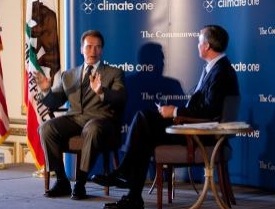
Gov. Schwarzenegger fields questions from Greg Dalton of the Commonwealth Club's Climate One initiative. Photo: Governor's Office

Governor Arnold Schwarzenegger is defending his planned veto of two renewable power bills, saying the executive order he issued instead is “stronger than the law” because it places fewer limitations on electricity imported from other states.

At the tail end of the legislative session, California’s assembly and senate passed separate bills requiring the state’s utilities to draw a third of their energy from renewable sources by 2020. But during a Q&A session at San Francisco’s Commonwealth Club Thursday, the Governor said that the recently passed bills were “for special interests” and that they “represented protectionism,” the latter a reference to limits on how much energy could be imported from neighboring states. The Governor’s own executive order has the same proportional requirement or “renewable portfolio standard” (RPS) as the bills but sets no limits on imported power. Also unlike the legislature’s bills, the order does not exclude particular sources, such as hydro-electric from the definition of “renewables.”

Critics contend that succeeding governors might simply rescind the order, which Governor Schwarzenegger does not deny. He faces an October 11 deadline to veto the bills.

Governor Schwarzenegger’s appearance was designed to mark the third anniversary of the state’s adoption of AB 32, the Global Warming Solutions Act of 2006, a law which has its own detractors.

Meg Whitman, the former CEO of eBay, who is running for governor said last week that she would issue a moratorium on most AB 32-related rules on her first day as Governor.  When asked about  Whitman’s remarks Schwarzenegger dismissed her comments as “just rhetoric.”

“I think she will probably reconsider what she has said and will see that the greatest thing that can happen for California is to move forward. I’m sure she does not want to be counted as one of those Republicans that want to move us back to the Stone Age,” he said.

Touting the state’s achievements in renewable energy innovation, emissions reductions,  and technology, the Governor painted a rosy picture of an invigorated economy, new jobs, and a cleaner environment throughout the state.

“A wave of green innovation is washing over our state right now,” he said.  “In last three years,  scientists and entrepreneurs have pumped more than $6 billion of venture capital into California.  Since 2005, green jobs in California have grown ten times faster than other jobs. California companies hold more than 40% of the nation’s new patents in solar and wind technology, and solar installations this year alone in California have gone up by 120%.”

Focusing largely on projected economic benefits, he made a case for continuing on the path California started three years ago with AB 32 and is continuing under his executive order from earlier this month, saying that the current path offers far more economic opportunity than economic risk.

“I know that it’s possible to protect the environment and the economy at the same time,” he said. “Technology will save us all. It’s all about technology, technology, technology. ”

Not all of the speech was about legislation, green technologies and the economy, however. The Governor did respond to a question from  group of fourth-graders attending the talk, asking what he says to his children about climate change.

“I’ve had major fights with my kids,” he said.

He said he has imposed a five-minute shower rule in his house and that he sometimes “spies” on his children to make sure they are obeying his order.

“If their showers are more than five minutes, there will be consequences.”

He added that other environmental steps his family has taken at home are to install solar panels nearby to provide energy for the family swimming pool and jacuzzi, and that they have converted the regular engines on their Hummers to hydrogen or bio-fuel engines.

A Sea Change in Ocean Policy Promised

Reed Galin
Photo: Reed Galin

A phalanx of high-level federal officials marched into San Francisco today to announce a major shift in the way the federal government oversees the oceans.

The top-level administrators from the White House and several agencies held a public meeting to launch efforts toward a first-ever National Ocean Policy, in which they say restoring a healthy ecosystem will be a top priority.

The newly formed Interagency Ocean Policy Task Force is led by Nancy Sutley, chair of the White House Council on Environmental Quality and one of President Obama’s top advisors on the environment. She arrived surrounded by representatives from the National Oceanic and Atmospheric Administration (NOAA), EPA, Navy, Coast Guard and Dept. of Interior (which, odd as it sounds, is responsible for vast tracts on the outer continental shelf).

Asked why we’re just getting around to a unified national ocean policy, Sutley said that “Too often the federal government sits in its stovepipes,” with each agency taking a narrow view. This effort is an attempt to break through traditional parochialism in favor of a more holistic approach to the challenges.

Task force member Jane Lubchenco, who heads NOAA, said that for the first time, policy makers are saying loudly that “healthy oceans matter.” And right now, she says, they’re not real healthy.

“At a global scale, I would say that oceans are in critical condition,” said Lubchenco. ” Most people are unaware of how much disruption and depletion has occurred within the oceans. We’re seeing the symptoms of much of that. It’s time to get on with the solutions.”

The task force will address a growing array of concerns, from shrinking fisheries to higher acid levels in the ocean—many of which are likely related to climate change.

Lubchenco, who is also an Undersecretary of Commerce, told me that “Climate change is exacerbating many of the existing challenges for ocean uses. There’s very good evidence that climate change is already having very significant impacts on oceans.” Lubchenco also cited “the related problem of ocean acidification,” and reeled off a laundry list of  climate impacts, including “loss of biological diversity, increasing transport of invasive species, nutrient pollution, habitat loss, and over-fishing.”

Lubchenco added “That sum total of stresses on ocean ecosystems means that we need to be taking new approaches.” The most sweeping of those “new approaches” will be “ecosystem-based management,” a term used repeatedly in the Interim Report issued by the task force this month.

According to the report:

“The implementation of ecosystem-based management embodies a fundamental shift in how the United States manages these resources, and provides a foundation for how the remaining objectives would be implemented…It would provide the opportunity to ensure proactive and holistic approaches to balance the use and conservation of these valuable resources. This broad-based application of ecosystem-based management would provide a framework for the management of our resources, and allow for such benefits as helping to restore fish populations, control invasive species, support healthy coastal communities and ecosystems, restore sensitive species and habitats, protect human health, and rationally allow for emerging uses of the ocean, including new energy production.”

The task force will also be taking its own stab at some long-term solutions for the troubled Sacramento River Delta. The interim report is open for public comment until October 10.

Copenhagen Sans Congress

KQED’s Los Angeles Bureau Chief and frequent Climate Watch contributor Rob Schmitz is spending six weeks in Japan, as part of  the Abe Fellowship Program. He’s filing a series of blog posts and radio reports on Japan’s extraordinary strides in energy efficiency–and what we might learn from them.

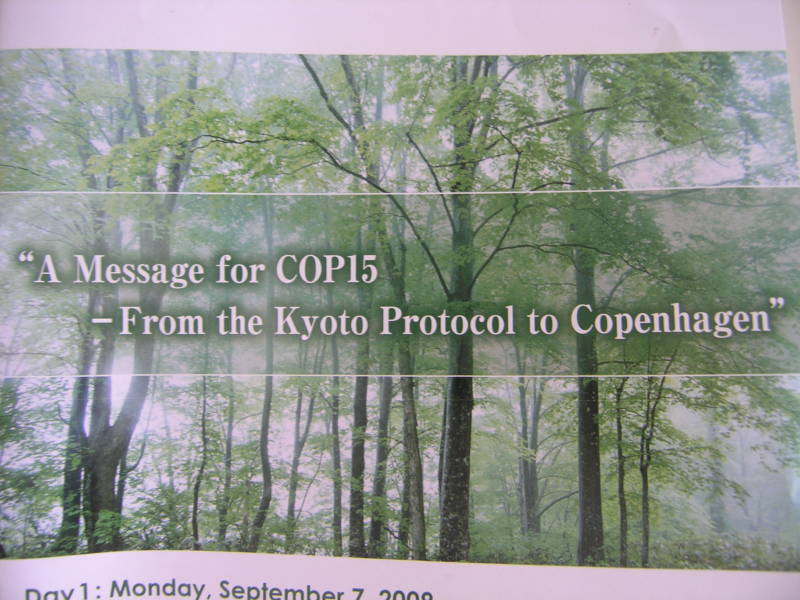
…And a message for the US from Yvo de Boer–An official program from last week’s Asahi World Environment Forum in Tokyo.

With the United Nations Climate Change Conference in Copenhagen two and a half months away, it’s becoming increasingly likely that lawmakers on Capitol Hill will not pass legislation on greenhouse gas reductions in time. A commonly accepted premise seems to be that without domestic climate legislation enacted at home, the U.S. won’t be able to sign a global deal on climate change in Copenhagen, either.

Not true, said UN Climate chief Yvo de Boer last week at the Asahi World Environment Forum here in Tokyo. de Boer told a packed house that in recent conversations he’s had with Senator John Kerry (chairman of the Senate Foreign Relations Committee) and senior advisors to President Obama, it was clear to him that the United States doesn’t need Congress to act in order to sign a deal in Copenhagen. (Listen to an audio clip of his remarks using the player below.)

[audio:http://kqed03.streamguys.us/anon.kqed/climatewatch/YvodeBoer.mp3]

This isn’t the first time de Boer has said this, nor is it the first time this notion has been floated. Last year, Marc Ambiner, political editor for The Atlantic, wrote in his blog about how the administration could bypass Congress for comprehensive energy reform by using the Clean Air Act as a platform. It seems that some of Obama’s environmental advisors believe that the act not only gives the Environmental Protection Agency the power to regulate greenhouse gases but also to institute a cap-and-trade regime on its own. Going around Congress for such an important policy shift would no doubt be a controversial step, but if such powerful and influential figures are hinting at it to de Boer, maybe we’ll see a little Copenhagen surprise on the part of the American delegation.

Scotland Rising to Carbon Challenge

This dispatch came in from Alison van Diggelen after a recent visit to her home country. Van Diggelen is a freelance writer and interviewer and founder of the Fresh Dialogues website and podcast. Originally from Glasgow, she now makes her home in Silicon Valley.

Scotland Aims to Beat California on Climate Change Action

By Alison van Diggelen

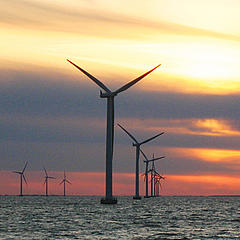
Wind turbines off Scottish coast. Photo: World Wildlife Fund

It’s not often that Scotland is ahead of the game compared to California, but on the issue of climate change, this small northern country has taken a legislative lead that has put it on the green map of the world.

As the California Legislature this week grapples with new laws* requiring utilities to get 33% of their energy from renewable sources by 2020, Scotland is sitting pretty. It is already close to its 31% target of energy from renewables by 2011 and has an even bolder target of 50% by 2020.

On a trip to Scotland this summer, I met with Lena Wilson, CEO of Scottish Enterprise, a government-funded organization that promotes Scottish interests both at home and abroad. She told me that the fight against global warming is a crucial part of the government’s strategy because ultimately a low carbon future is an economic stimulus and job creator for the country.

But how did Scotland muster the political will to set such ambitious targets? Scotland’s First Minister, Alex Salmond is passionate about renewable energy, Wilson told me; and establishing Scotland as a hub of green energy and green-tech is key to his strategy. Part of the plan is to harness its natural resources – powerful wind and wave power, estimated to account for a quarter of Europe’s potential. Salmond recently opened the largest wind farm in Europe to drive home that point. It’s on the outskirts of my home town of Glasgow and makes me rather proud.

Yet, making bold targets isn’t the end of the story. Scotland must create a whole ecosystem to make green growth attractive in Scotland. It launched the Saltire Prize last year to stimulate innovation in wave and tidal power; but still has ground to cover. As well as the financial, administrative and logistical challenges, there’s the issue of NIMBY-ism. Although Wilson insisted they’re pursing a popular green agenda, some of the locals I talked to in Scotland were less enthusiastic about the aesthetics of wind turbines.
And then there’s the “nuclear option.” Just as in California, the issue is red hot. Salmond is publically against it, but if he wants to keep shining his low carbon credentials, he may be forced to rethink his position.

One final note: When I asked Wilson, is your boss, Alex Salmond the Al Gore of Scotland? Her response was enlightening. She almost choked. Being a staunch nationalist, union man and former socialist, she doubted he’d enjoy the comparison. On my next trip, I hope to discuss this with the man himself and find out exactly how his passion for green took root. Stay tuned.

*State legislators passed two bills during their overnight session on Friday. Here’s a summary provided by the advocacy group Environment California:

AB 64 (Krekorian) & SB 14 (Simitian): AB 64 and SB 14 are companion bills that together set California on the path toward producing 33% of its electricity from renewable resources like solar and wind power. While there was much controversy over amendments to the bill that add in language for PG&E to potentially build large hydroelectric dams in British Columbia and call it renewable energy as well as amendments pushed by British Petroleum and Chevron that put 7,000 MW of fossil fuel burning combined heat and power plants ahead of renewable energy, the two bills still stand to become the biggest renewable energy mandate in the country”

Few Surprises as Climate Symposium Opens

A broad spectrum of scientists, entrepreneurs and public officials are meeting in Sacramento this week for the sixth annual Climate Change Research Symposium, sponsored by the California Energy Commission (CEC).

Today and tomorrow are packed with technical lectures on topics ranging from “Decadal Changes in the El Nino Pattern and Impact on the Hydroclimate…” to “Climate and Wine Grape Phenology in Napa Valley.” But yesterday it was up to the policy honchos to set the scene.

There was little in that preamble that hasn’t been heard before. When asked about recently expressed doubts that the state’s utilities can attain a one-third proportion of renewable energy within the next decade, air board chief Mary Nichols said “Not only can we do it, we have to do it.” Nichols, probably the state’s highest-profile point-person on climate policy,  said the the state’s broader, longer-range goal for cutting greenhouse gas emissions simply can’t be achieved without it.

Just as if they’d heard her, legislators tonight passed SB 14 out of committee. The bill requires utilities to meet the 33% renewable portfolio standard (RPS) by 2020 (in other words, to derive a third of their power from low-carbon sources). Green energy activists lamented language in the current version that allows utilities to slip that deadline, if there are delays in bringing new renewable energy sources online.

There was a clear signal from yesterday’s symposium speakers that, as we’ve previously discussed in this space, adaptation is taking center stage on the policy front. California has set targets for “mitigation” of global warming and put some of the wheels in motion. Now attention has turned to preparing for inevitable climate change effects, already in the pipeline.

The CEC’s newest Commissioner, Julia Levin, warned against the onset of “NIMBY” syndrome as measures are implemented across the state, such as the build-out of solar and wind “farms.”

And Stanford scientist Chris Field, who heads the IPCC’s Working Group II, noted that while growing interest in the “other” greenhouse gases (methane, nitrous oxides, etc.) is justified, the focus should remain on controlling carbon dioxide.  “As long as the world maintains an aggressive focus on economic growth,” said Field, “It’s the economic growth that’s the driver of future emissions and that’s why strategies to find ways to grow the economy without increasing carbon emissions are so important.” While some of the other gases are more potent greenhouse gases, Field says they’ll see little or no growth in volume in coming years.

Field previewed some of what he sees as the focal points of the next major IPCC climate report, known as AR5. Field predicted that we’ll see a shift in focus from making the case that global warming is real and human-induced, to providing more and better information that “stakeholders” can act upon. Field cited a recent study projecting that corn yields in Africa could fall 30% by 2040, due to climate forces.

Japan’s Climate Plan: Too Ambitious?

KQED’s Los Angeles Bureau Chief and frequent Climate Watch contributor Rob Schmitz is spending six weeks in Japan, as part of  the Abe Fellowship for Journalists. In the weeks to come he’ll file a series of special reports on Japan’s extraordinary strides in energy efficiency–and what we might learn from them.

Saturday night, on my way home from an interview, I witnessed one of the more interesting orchestrated movements of humanity the world has to offer. I shot this video when I was changing trains at Shibuya station, one of Tokyo’s busiest. The intersection shows how well Japan engineers pedestrian movement–but how well will it engineer its residents’ greenhouse gas emissions?

On Monday, I attended the Asahi World Environment Forum, where all the bigwigs on climate change were in attendance (including Yvo de Boer and Rajendra Pachauri, among others). The surprise visitor was Japan’s Prime Minister-elect Yukio Hatoyama.

Hatoyama makes his climate change pledge.

He told a packed house that Japan will aim to reduce its greenhouse gases by 25% from 1990 levels by 2020.

“In my personal opinion, that’s impossible,” Hidetoshi Nakagami told me last week. Nakagami is President of the Jyukankyo Research Institute and holds a coveted seat on the advisory committee to Japan’s powerful Ministry of Economy, Trade, and Industry, or METI. “Hatoyama’s pledge is pure politics,” he said. “It’s not practical, it’s not possible, and there’s not enough time.”

Nakagami is not a pessimist. He played a large role in creating Japan’s very successful Top Runner program, a 1997 policy that searches for the most efficient model of any given electrical appliance and then makes that model the industry standard, requiring other companies to adhere to it when making new models of the same appliance. The program was one of Japan’s most ambitious energy efficiency measures, and Nakagami had to fight against Japan’s largest companies in order to help craft the policy into law.

While Nakagami would like to see a one-quarter reduction in greenhouse gases from 1990 levels in the next decade, he says it’ll cost the average Japanese dearly. When former Prime Minister Taro Aso pledged to cut Japan’s greenhouse gases by 15% of 2005 levels, Nakagami’s institute estimated that the effort would cost each Japanese household, on average, 70,000 yen–a little over USD $700–a year. Even that, says Nakagami, would be a tall order in this economy.

In the end, Hatoyama may not fill this order. His historic pledge, which during his campaign, seemed to have no strings attached to it, now has an important caveat. At Monday’s forum, he told the audience that Japan will embark on this journey as long as other major countries also set similar ambitious targets.

Japan’s future hanging in the balance.

After the forum concluded, I walked outside into Tokyo’s rush hour: pedestrians everywhere, taxis speeding by me. I stopped at a Shinto shrine built among enormous glass skyscrapers. In front stood an Omikuji shrine, where believers tie a paper copy of their fortune, with hopes that it’ll come true. Hundreds of paper fortunes rattled in the hot, summer wind. I wondered if one of them was Hatoyama’s.

Mister Hatoyama’s Neighborhood

KQED’s Los Angeles Bureau Chief and frequent Climate Watch contributor Rob Schmitz is spending six weeks in Japan, as part of  the Abe Fellowship for Journalists. In the weeks to come he’ll file a series of special reports on Japan’s extraordinary strides in energy efficiency–and what we might learn from them.

Yesterday Japan held a national election. My neighbor won it. Well, technically, his party won it, but it’s assumed that my neighbor, who heads the Democratic Party of Japan, will become Prime Minister within a couple of weeks when the party formally elects him.

A peek outside my door yesterday revealed media vans and limos outside the house of my new neighbor and Japan’s new prime minister-elect, Yukio Hatoyama.

My neighbor is Yukio Hatoyama. He lives in a large house across the street from the apartment I’m renting here in the tony Tokyo suburb of Denenchofu. Yesterday morning an elderly police officer knocked on my door clutching a map, explaining to me in slow, metered Japanese that his men would be establishing a perimeter around our neighborhood to keep out protesters, non-credentialed journalists, and anyone interested in engaging in general tomfoolery near the Hatoyama residence (an English-speaking neighbor helped translate). I mustered the only Japanese response I knew (“Arigato!”), not having sufficient language skills to explain that I, in fact, was one of those “non-credentialed journalists.” He smiled, bowed, and moved on to the next residence.

As early results on the afternoon television news began to confirm that Hatoyama’s party was on the path to victory, my neighborhood, which was virtually silent for my first few days here, started buzzing with activity. Police officers on foot patrol, random passers-by who somehow got past the perimeter stopping in front of Hatoyama’s house to stand and stare before being ushered away, and members of the “credentialed” Japanese press sitting on the curb in the rain, quietly watched over by the around-the-clock security presence in front of Hatoyama’s home. My wife and I are thinking of baking our neighbor a cake as a congratulations gift–if we could just get by security.

Apart from the amazing coincidence that the apartment I rented happened to be located across the street from the incoming prime minister, my new neighbor has a lot of work ahead of him. Japan is suffering its worst unemployment ever, and many here are fed up with the Liberal Democratic Party, which, despite its name, is the conservative party that has ruled Japan for 50 years.

View of Hatoyama’s house from my living room. “May I borrow some sugar, Hatoyama-san? …and perhaps an interview?”

Hatoyama has promised the Japanese more social welfare programs and fewer incentives to big Japanese business but some experts wonder if it’s a good idea to tinker with a system that’s helped Japan become one of the world’s biggest success stories.

Hatoyama has a strong California connection: His doctorate in engineering is from Stanford University, where he met his wife. He speaks English well–well enough to have written a provocative Op-Ed in the New York Times this past weekend; a timely critique of U.S.-led globalism and unbridled capitalism, and a call for Japan to retreat from this system, to a more regional and sustainable economic framework.

More to the purpose of my reporting here, Hatoyama has pledged to make Japan a more prominent world leader in battling climate change. He’s pledged to cut the country’s greenhouse gas emissions by 25% from 1990 levels by 2020, and has promised to generate more jobs for Japanese workers by helping develop the clean-tech industry here.

He also heavily favors on a bigger reliance on nuclear power for Japan; a stance that is not as controversial as you may think in this country. In recent polls, the majority of Japanese respondents say they’re open to a larger reliance on nuclear power. In a country that imports all of its fossil fuels, nuclear power means more energy security and fewer greenhouse gas emissions. On the other hand, it heightens the thorny debate of what to do with radioactive waste–a debate that, despite poll numbers, is of big concern to many Japanese. With all these issues to tackle, it’s likely that my neighbor won’t be spending too much time at home in the coming weeks. Maybe I should offer to house-sit.

Do We Need Nuclear?

This is an updated re-post from August 24th, when my radio feature first aired on KQED’s Quest series. That report repeats on this week’s magazine edition of The California Report.

More people appear to be saying “yes” these days, even if grudgingly. The question is: Is it too late?

The Public Policy Institute of California has been tracking public support for expanded nuclear power over the past several years. Survey participants are offered a menu of four potential energy options, one at a time.

The question posed is: “Thinking about the country as a whole, to address the country’s energy needs and reduce dependence on foreign oil sources, do you favor or oppose the following proposals?” Then the four options are offered, including: “How about building more nuclear power plants at this time”

As recently as 2002, adults surveyed in California opposed the idea by a margin of 59% to 33%. But that gap has been closing steadily in the years since and by this July, Californians were split just about down the middle on the question, with 46% in favor and 48% opposed. The poll has a margin of error of about 2%, making it a virtual tie.

When you dig into the numbers a little deeper, some demographic preferences emerge. Support increases with both age and education. Californians 55 and older support more nuclear by a wide margin (58% to 36%) as do college graduates (50%-43%).

Many people use cost as an argument against nuclear but just as the PPIC was phoning around for opinions on the matter, the Palo Alto-based Electric Power Research Institute was finishing up its own report, concluding that trying to reach greenhouse gas reduction goals without baseload technologies like nuclear power, could end up costing much more.

Dan Kammen, who runs an energy lab at U.C. Berkeley, would appear to agree. He said in a recent interview for Climate Watch that “Without knowing exactly where things will come down on nuclear, I think that it absolutely has to be part of the equation in a way that it has not been in the past. Energy costs from fossil fuels are rising at almost 5% a year now, and the damage we are doing and are going to do more of, if we don’t stop our fossil fuel expansion, in terms of greenhouse warming, is so large an issue that these technologies have to be back on the table.

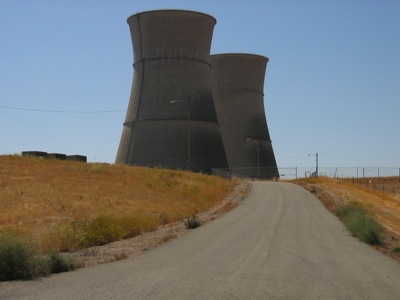
Is the road back to nuclear a dead end? Cooling towers at the decommissioned Rancho Seco nuclear power plant.

But there are serious doubts whether the nation–let alone the state–is in a position to embrace nuclear as it did in the 1960s. Kammen is also a professor of nuclear engineering, and noted with some alarm the rate at which the industry is “graying.” Now in his mid-forties, he told me that when he attends technical meetings for nuclear engineers, he’s often “the youngest guy in the room–by 20 years.” Since the U.S. more or less abandoned its nuclear hopes following the Three Mile Island debacle, the nation has ceded most of its nuclear industrial capacity to other nations, and few young people have chosen to enter the field.

Reports from new projects around the world have not been encouraging of late. Finland is struggling mightily to get its newest reactor up and running. This goes directly to doubts expressed by Kammen and others, that the industry can cowboy up fast enough for nuclear to play a meaningful role in meeting CO2 reduction targets.

The effective ban on new nuclear plants that California has had in place since 1976 could be reconsidered. But ultimately electric utilities will have to want it and I sense a certain “nuclear fatigue” in that arena.

Managers at the Sacramento Municipal Utility District (SMUD) shut down its only reactor in 1989, after a thumbs-down referendum. When I called to ask for an interview on the prospects for a nuclear revival, they declined. They didn’t even want to talk about it. Managers at PG&E, whose twin reactors at Diablo Canyon produce nearly a quarter of the utility’s output, still claim an interest in nuclear. But when I asked CEO Peter Darbee about it recently, he said he had the sense that most people in California would prefer to look elsewhere for energy solutions.

Of course, that was before the latest PPIC poll.