
Category Archives: Government & Business

What’s brewing in Sacramento, Silicon Valley, and beyond

Climate Watch in Copenhagen

Earthshine_NASAClimate Watch begins it’s coverage of the UN’s COP 15 climate talks in Copenhagen this evening, when KQED’s This Week in Northern California airs my recently taped interview with former Vice President and Nobel Laureate Al Gore. The original 20-minute interview has been “edited for TV,” down to about nine minutes. The full interview is to be posted on This Week’s website.

The interview begins with Gore’s assessment of the upcoming climate conference and then moves on to California’s role, the hype surrounding “green jobs,” controversy over climate science, his new book, and other topics. Regrettably, the interview was recorded before the eruption of the email scandal now known as “Climategate,” so I wasn’t able to get his take on that.

It’s pretty hard to spring anything on Gore. He’s heard every question there is to be asked about a thousand times and has carefully crafted, well-rehearsed answers to all of them. He did seem slightly off-balance when I asked him about FactCheck.org’s conclusions about some of the green job creation hype.

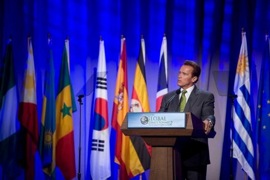
On Monday, our radio and online coverage begins in earnest when the first of Rob Schmitz’ reports from Copenhagen airs on The California Report. Schmitz, KQED’s Los Angeles Bureau Chief, arrives there on Saturday and will be there for the entire two weeks of events and negotiations. He’ll provide radio reports and frequent blog posts, covering–among other things–the appearance of California Governor Arnold Schwarzenegger on “Subnational Day.” In a climate-related media event on Treasure Island this week, Schwarzenegger said his mission in Copenhagen would be to rally governors, mayors, provincial leaders and other subnational players, to continue their own progress toward greenhouse gas emissions and not wait for national governments and international bodies to take action.

Also on Monday, Rob and I will join host Michael Krasny and NASA climatologist James Hansen on KQED’s Forum program. Hansen was the original climate whistle-blower, complaining that the Bush administration was muzzling climate scientists. Hansen has since taken a hard line against the upcoming efforts in Copenhagen, saying that cap & trade is the wrong path to climate intervention (both Gore and Hansen are promoting new books of theirs).

State Water Deliveries May Set New Low

State water officials have announced they are likely to release a record-low allocation of water to cities and farms next year– just five percent of what water contractors have requested. Though still preliminary, it’s the lowest allocation since the State Water Project began delivering water back in 1967.

The announcement may have caught some by surprise, since Department of Water Resources (DWR) data would seem to show reservoirs at higher levels than last year at this time, with major reservoirs at 69% of storage capacity, compared to 57% last year.

When I asked DWR Deputy Director Susan Simms about it, even she was stumped at first. But then she called me back to say that the data includes both federal and state reservoirs, and the state’s storage levels at both Lake Oroville and San Luis Reservoir (shared with the feds) is actually lower than last year (52% and 48% of “normal,” respectively). And, she says, the state has to contend with pumping restrictions to protect both salmon and delta smelt this time around.

DWR Director Lester Snow told reporters this morning that there’s nothing in the recently passed bundle of state water bills that can provide any immediate relief. And if you thought the prospect of increased precipitation from El Nino could save the day, don’t get out the umbrella just yet. David Rizzardo, Chief of the state’s Snow Survey section, estimates there’s only a 50-60% chance of a stronger El Nino kicking in this year. December and January will be the most telling months–but precipitation from El Nino would likely be concentrated in the southern half of the state. Officials say that would provide more “flexibility” in meeting water needs systemwide, but all of California’s biggest reservoirs are located in the northern part of the state.

December water delivery estimates almost always get a boost once it starts snowing. Last year’s initial projection was 15%, and that was later revised upward, eventually to 40 percent. Snow called today’s estimate “very conservative.”

If you think the five percent figure is supposed to scare us, it is. Water officials want to send a message that Californians need to be prepared to conserve. The state’s drought coordinator, Wendy Martin, just returned from a water tour in Australia, where she says she saw water-saving measures in place that California has yet to fully develop: storm water recapture, water recycling, and more. Martin also observed that the Australians now wish that they’d taken the epic drought of the last several years more seriously, sooner.

Scientists Respond Cautiously to Hijacked Email

I’ve spent several days dithering over whether to weigh in on the recent email heist from a server at the University of East Anglia in the UK. For those who choose to read it that way, the hacked email originally passed among climate scientists worldwide has, rightly or wrongly, provided those who reject the prevailing climate science with enough radioactive ammo to fill Yucca Mountain.

Some high-profile California researchers figure prominently in the material. In a searchable database of the messages, for example, the name of Ben Santer, a climate modeler at Lawrence Livermore National Lab came up 173 times. Stanford’s Steve Schneider came up 71 times. Both are outspoken defenders of science supporting the human contribution to global warming.

Another scientist quoted or referred to (99 times), Kevin Trenberth, is a name familiar to readers of this blog and listeners to Climate Watch radio coverage. Trenberth is a climatologist at the National Center for Atmospheric Research (NCAR) in Boulder, CO.  I’ve interviewed him mostly about the role of the Pacific oscillation known as El Nino in climate patterns. After the decade’s worth of email came to light, I wrote Trenberth for a response. His reply may not be entirely original. Some lines have also been attributed to a spokesman for the university whose servers were invaded. In any case, here’s Trenberth’s response to Climate Watch:

It is a matter of concern that data, including personal information about individuals, appears to have been illegally taken and a criminal investigation is underway. The selective publication of some stolen emails and other papers taken out of context is mischievous and cannot be considered a genuine attempt to engage with this issue in a responsible way. The volume of material published and its piecemeal nature makes it impossible to confirm what proportion is genuine.  Many elements have been published selectively on a number of websites. Generally the items are out of context, incomplete and very misleading. Some others are wildly misinterpreted and have a simple explanation.

The material published relates to the work of the Climatic Research Unit (CRU) and other scientists around the world.  Many of the scientists featured in the emails with [Phil] Jones [of East Anglia] have web sites and freely and openly make available their papers, presentations, blogs and other information. Several of the emails document the detailed procedures used in the IPCC AR4 Fourth Assessment report for Chapter 3 (for which Phil Jones and Kevin Trenberth were coordinating lead authors) and other chapters. They actually reveal the integrity of the process and the hard work that goes into such an assessment.

Trenberth then went on to cite some specific “examples of misinterpretations:”

From Kevin Trenberth, interpreted as a failure of computer models:

“The fact is that we can’t account for the lack of warming at the moment and it is a travesty that we can’t. The CERES data published in the August BAMS 09 supplement on 2008 shows there should be even more warming: but the data are surely wrong. Our observing system is inadequate.”

This refers to the inability of our current observations from satellites and in situ to account for where all the energy has gone. A paper on this is available here:

Trenberth, K. E., 2009: An imperative for climate change planning: tracking Earth’s global energy. Current Opinion in Environmental Sustainability, 1, 19-27, doi:10.1016/j.cosust.2009.06.001. [PDF]

This paper tracks the effects of the changing Sun, how much heat went into the land, ocean, melting Arctic sea ice, melting Greenland and Antarctica, and changes in clouds, along with changes in greenhouse gases. We can track this well for 1993 to 2003, but not for 2004 to 2008. It does NOT mean that global warming is not happening, on the contrary, it suggests that we simply can’t fully explain why 2008 was as cool as it was, but with an implication that warming will come back, as it has. In 2008 there was a La Nina event.  We now have an El Nino underway.

Kevin Trenberth

Meanwhile, the university’s Climate Research Unit has posted a series of rebuttals. Still, this digital hijacking is disturbing on a lot of levels. Whether you accept the prevailing climate science or consider the email damning evidence to the contrary, it is a distraction from the business at hand in Copenhagen and a public relations train wreck for the IPCC and many of its most eminent contributing scientists. You can bet that it won’t be forgotten when a major climate bill hits the floor of the U.S. Senate for debate, early next year. Oklahoma Republican James Inhofe, vocal critic of global warming science, is already calling for an investigation.

Sketchy First Look at California Cap & Trade

On Tuesday the California Air Resources Board put out a sneak preview of the carbon cap & trade system mandated by the Global Warming Solutions Act of 2006 (AB 32). Couched as a “preliminary draft,” the 132-page plan is intended as a broad outline for a final Cap-and-Trade regulation scheduled to go before the board late next year.

As such, the draft lacks a few key components, such as how many allowances the state plans to auction off to industry, versus give away. Air Board chief Mary Nichols says her agency is still waiting on recommendations from an expert committee on how to best handle allowances.

Environmentalists have been pushing for polluters to pay for allowances up front. In an email to me on Tuesday, in anticipation of the draft, Bernadette del Chiaro of Environment California wrote that her group is “slightly disappointed that ARB staff are punting on the issue of auctions. ARB in the scoping plan said they are committed to getting to 100% auctions. I hope the draft rules at least repeat this commitment.”

The draft appears to stop short of an outright commitment, reiterating that “transition to a 100 percent auction was a worthwhile goal.” In a conference call with reporters, Nichols said she anticipates at least a partial auction. Also undetermined is how to deploy the funds that emitters may pay for allowances. Nichols said a $10 per ton price for carbon could produce a two-to-four-billion-dollar pool of money, which could be used for such things as “buying down” utility costs for low-income families or creating incentives for development of renewable energy technology. Nichols declined to project what a cap & trade system would end up costing households in California.

You can download a PDF file of the complete report at the CARB website (under “What’s New). A public meeting is scheduled for December 14 in Sacramento, to get feedback on the Preliminary Draft Regulation released this week.

Also on Tuesday, the Governor’s Office announced that Quebec, one of California’s partners in the Western Climate Initiative for regional carbon trading, has set a target “to reduce its greenhouse gas emissions 20 percent below 1990 levels by 2020 and the introduction of a clean-car emissions standard equivalent to California’s Vehicle Tailpipe Emissions Standards.”

The WCI includes seven western states and four Canadian provinces. Any progress from the state’s WCI partners is welcome at this point, as most have been reluctant to set their intentions into law.

Check out our interactive map of California’s largest industrial emitters of greenhouse gases.

$11 Billion in Water Bonds: Follow the Money

Governor Schwarzenegger traveled to Fresno County Monday to sign the centerpiece of last week’s package of water bills—an $11.14 billion bond measure that would pay for new dams and reservoirs and a sweeping program of conservation, water recycling and drought relief projects.

The governor appeared at a Friant Dam press conference with state Senator Dave Cogdill, R-Modesto, author of the bond initiative. Schwarzenegger said he’s hopeful that the bond, along with other measures in last week’s comprehensive water agreement, will put an end to the “holy water wars” pitting Northern v. Southern California and among cities, agriculture, fishing communities, and environmentalists.

The the governor signed the bond bill amid criticism that last-minute negotiations added more than $1 billion in earmarks designed to win support for the measure.

See our map, prepared by KQED editor Dan Brekke, for a detailed breakdown of where the $11.14 billion in bond money is supposed to go.


View KQED: California Reservoir Watch in a larger map

Attitudes about Climate Change are Shifting. Is Yours?

app_full_proxy
One possible Facebook results "badge" from KQED's "Matter of Degree" survey

Coinciding with the release of a Climate Watch Facebook survey that explores attitudes toward climate change, a new national poll by the Pew Research Center for People and the Press shows that the percentage of people who believe that climate change is a reality has decreased significantly in the past year.  Last year, 71%  nationwide believed the Earth was warming, regardless of the cause. This year the number is 57%.

Yesterday, Andrew Kohut, who directs the Pew Research Center for People and the Press, and Dr. Anthony Leiserowitz of the Yale Project on Climate Change joined Neal Conan on Talk of the Nation to discuss changing attitudes about climate change. (You can listen to the 30-minute segment or read the transcript here.)

Kohut said that the economy most likely plays a large role in the drop.  The number of respondents who assigned a top priority to protecting the environment dropped from 56% to 41% in this year’s study, while the proportion who chose dealing with the economy rose to 85%.  That squares with another part of the survey, in which fewer people said they were willing to protect the environment if it meant slowing economic growth or higher energy prices.

“I think what happens,” said Kohut on yesterday’s program, “is if you’re giving [the environment] a low priority, people will sometimes develop a rationale for that low priority. So you have more people saying, ‘Well, maybe it’s not all that serious’…”

Kohut also pointed out that the cool summer experienced by much of the country this year could have played a role in the apparent flagging acceptance of climate change.

The Pew report, released last week, shows a dramatic partisan split in attitudes toward climate change.  Just thirty-two percent of conservative Republicans believe there is solid evidence for global warming, compared with 83% of liberal Democrats, according to Pew.

Leiserowitz discussed his research into attitudes about climate change, which was done in collaboration with the George Mason University Center for Climate Change Communication.

“This research really came from the recognition that Americans don’t speak with a single voice about climate change,” said Leiserowitz. “And what we found, in fact, is that there are six different Americas within America on this particular issue.” National surveys of attitudes toward climate change often yield very different results from polls in California, where there has been greater acceptance of the warming concept in general, as well as the role of human activity in it.

The original Yale-George Mason study, called “Global Warming’s Six Americas,” divides survey-takers into six psychographic groups: Alarmed (18%), Concerned (33%), Cautious (19%), Disengaged (12%), Doubtful (11%), and Dismissive (7%).

Climate Watch teamed up with Leiserowitz and his colleague Ed Maibach from GMU, to create an online version of this survey, called “A Matter of Degree.”  You can take the survey on KQED’s website or on Facebook.  Both versions allow you to compare your results to those of the original study as well as all online survey-takers.  With the Facebook version you can also compare your results with your Facebook “friends” who have already taken the survey and can invite new friends to take the survey.  The Facebook application also features a discussion area where respondents can share thoughts about the climate change and the survey itself, and there are links to learn more about each profile “type”.

What’s your climate profile?  Take the survey and find out.

An Hour with Amory Lovins

In case you missed it amid the flurry of climate-related news last week: On September 30, Amory Lovins, founder and chief scientist of the Rocky Mountain Institute, and an honest-to-goodness energy guru to many, spent an hour in conversation with Michael Krasny and callers to KQED’s Forum program. You can listen to the entire archived broadcast or scan some of the highlights here, compiled by Climate Watch intern David Ferry.

On China:

“We can count on China to lead the world out of the climate mess…Even though the U.S. has led the world in wind installations the past three years, this year China’s going to pass us so fast we won’t even hear them go by. China’s doubled its wind installation each of the past four years, and there’s a new paper in Science from Harvard and Tsinghua in September saying that China can meet all its electric needs–not the growth but the total–till at least 2030, cost effectively, from its wind resources.”

On Nuclear Power:

“Basically nuclear and coal plants are getting walloped in the global marketplace by efficiency and renewables and cogeneration because they’re a lot cheaper and they have less financial risk so they can attract private investment.”

Grading the Obama Administration on Renewables:

“Greatly improved and I think on the whole doing very well.”

On the Upcoming UN Climate Talks in Copenhagen:

“I’m cautiously optimistic…But remember that governments are usually the last to figure these things out. Most governments still think climate protection is costly. They haven’t figured out yet that economic theorists got the sign wrong and actually climate protection is profitable. Once you change the conversation from cost, burden and sacrifice to profit, jobs and competitive advantage it makes the politics a whole lot easier.”

On Energy Efficiency & Steve Chu’s “Low-Hanging Fruit” metaphor:

“The technologies keep improving faster than we use them, so efficiency is an ever bigger and cheaper source–it’s as if the ‘low hanging fruit’ had fallen on the ground; it’s mushing up around the ankles, it’s spilling in over the tops of our boots and the efficiency tree keeps dumping more fruit on our heads.”

On Large-Scale Solar Farms v. “Distributed” Power Generation:

“The sun is distributed for free. Why gather it in one place and then pay to spread it out again? The National Renewable Energy Lab says if we put solar cells on seven percent of the structures in this country it would run all our electric needs without using any land. And for that matter, the wind potential on available windy land in this country is several times our total electric need and the footprint is actually very small.”

On Whether Climate Change is Irreversible:

“There are a half-dozen known mechanisms of rapid climate change. Several of them show like they may be starting up, so it’s urgent to reverse that…we have plenty of technology already available to stabilize climate to the extent that irreversible changes have not already started. We don’t know what that extent is, so we ought to go full bore on best buys first and hope that we’re in time.”

You can also take a virtual tour of Lovins’ home in Colorado, which doubles as a laboratory for energy innovation.

UN Climate Chief: 2014 “Will Alarm the World”

As Governor Arnold Schwarzenegger wrapped up his three-day Global Climate Summit today, with signatures and ceremony, the U.N.’s top climate official set a sobering tone with his own parting shot.

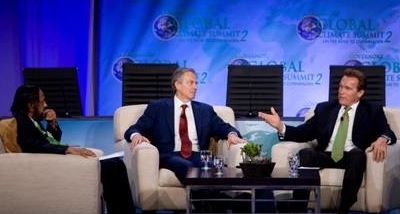
In a final panel this afternoon, the Governor was joined by former Prime Minister Tony Blair and Rajendra Pachauri, who chairs the U.N.’s Intergovernmental Panel on Climate Change (IPCC). Pachauri said the worst-case scenarios from previous climate modeling appear to be coming true, and warned that the next climate change assessment from the IPCC, due out in 2014, “will alarm the world.”

Then he went on to reiterate a prediction he made before the U.N. earlier this month; that based on the science he’s seen, 12 countries are in danger of becoming failed states due to the impacts of climate change. And while he stopped short of listing the nations, previous statements appear to imply that several of the states on his list are in Africa.

Elsewhere at the summit, 30 delegates from state and local governments around the world signed a final agreement to collaborate on climate change. If they follow through with some muscle on the partnership, they’ll be collaborating on clean transportation and on climate adaptation strategies.

Governors from Brazil, Indonesia and U.S.also called on their national governments to address deforestation at the UN climate treaty talks in Copenhagen. Forest loss accounts for 20% of climate emissions globally. California also signed its agreement with the Jiangsu Province of China.

The three-day summit’s title was “On the Road to Copenhagen” and the international talks have been front and center in the discussions here. The governors attending would like their role in combating climate change formally recognized there. They see themselves on the front lines of climate change, as evidenced by this much cited statistic: 50-80% of the emissions cuts needed to reach the UN’s goals will be implemented by states and cities.

But despite the Copenhagen-mania, Schwarzenegger stuck with his subnational message, saying: “Climate change isn’t all about this one treaty.” Even if the talks at Copenhagen fail, he says states and provinces should keep forging ahead.

Photo: Office of the Governor.

A Bottom-Up Climate Approach

Governor's Office
Photo: Governor's Office

The second Governors’ Climate Summit kicked off yesterday with a plenary on adaptation to climate change. Most of the climate policy we hear about has to do with mitigation; cutting emissions to reduce the rate of climate warming. Increasingly, though, policy makers are looking at ways to adapt to the effects that are already palpable.

Several international leaders had stories to tell:

– Premier Gordon Campbell of British Columbia said that due to warming winters, pine beetles will kill 80% of the mature pine forests in his province by 2013.

– Dr. Dessima Williams of the Alliance of Small Island States said rising sea levels make climate change “a case of life and death” for island nations.

According to a World Bank analysis cited by Michele De Nevers of the Bank’s Environment Department, adapting to climate change will cost $75-100 billion dollars a year for developing countries–and that’s with only 2 degrees (Celsius) of warming by 2050. That seems like a big number, but De Nevers reminded the crowd that it’s on par with the recent financial bailout.

I also spoke with Margret Kim, China Program Director for the California Air Resources Board and EPA, who has been working with the government of the Jiangsu Province in China.  She filled me in on the agreement that Governor Schwarzenegger is expected to sign today with leaders from the province to help them reduce greenhouse gas emissions.  Based on this framework, California would develop an action plan to share expertise and research with the province.

This partnership is built on a 2005 agreement that California signed with the province, which was focused on energy efficiency. Barbara Finamore of the Natural Resources Defense Council says real progress was made on the first agreement with Jiangsu, which set several efficiency incentives and programs in motion. But they have more to do.  Ninety-five percent of the province’s electricity comes from coal.

The announcement comes on the heels of President Hu Jintao’s declaration less than two weeks ago that China would make notable reductions in its carbon intensity by 2020.  Carbon intensity isn’t quite as simple as a straight emissions cut. It measures the amount of carbon dioxide produced for each dollar of economic output.  And fixed targets aren’t part of the expected Jiangsu agreement either. But Finamore says this is a landmark agreement since it shows an important shift in China’s willingness to tackle climate change. As she said, “I’ve been working in China on energy issues for more than 20 years, and there has been a tremendous amount of recent progress.” And a bottom-up approach–with states piloting environmental policies before national governments adopt them–is certainly something we’re familiar with in California.

Provincial Climate Summitry: Day One

Governor Schwarzenegger kicked off his second Global Climate Summit Wednesday in Los Angeles–and “global” is certainly the emphasis.  The three-day conference features panelists from more than 70 states, provinces and countries who are discussing “subnational” strategies to cut carbon emissions.  (That’s the policy wonk term for regional, state and provincial governments).

Events like these are at risk of being feel-good political meet-and-greets, but I spoke with Louis Blumberg of The Nature Conservancy, who believes that the partnerships created at the last climate summit have borne fruit in the past year. Blumberg is part of a deforestation working group made up of five Brazilian states, two provinces in Indonesia and three states in the U.S. They’re working on carbon accounting techniques for forestry projects–or in carbon parlance, REDD (Reduced Emissions from Deforestation and Degradation).

Expect more partnership announcements from the rest of the summit.  The first signed this week came from California and Mexico, who announced a partnership to protect Monarch Butterfly habitat in Mexico through reforestation.  California forests are also getting some attention.  The Governor also announced a deal with the largest private forest owner in California, Sierra Pacific Industries, to produce carbon credits from its forestry projects.

Still, for all the state-level dialogue, national climate news stole the show.  EPA Administrator Lisa Jackson appeared just after the Governor to announce  a proposed rule to use the Clean Air Act to regulate greenhouse gas emissions from large power plants and refineries. And in Washington, Senators Barbara Boxer and John Kerry released a national climate bill in the Senate (see Craig Miller’s post for more on that).

The Governor took it all in stride, reminding the audience that California piloted many of the policies the national government is now considering. “That’s how powerful states and regions are,” said Schwarzenegger. “We really are the laboratories for the national governments. That’s where the action is.”