Category Archives: Government & Business

What’s brewing in Sacramento, Silicon Valley, and beyond

The Air Quality-Carbon Connection

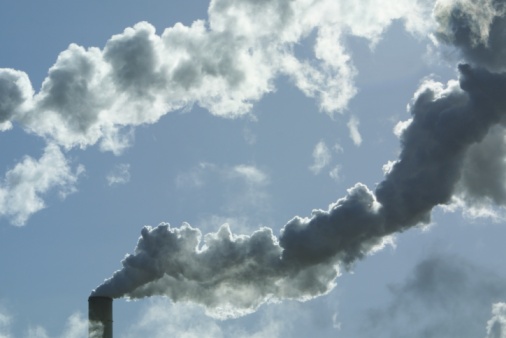
Here’s a news flash: California has an air pollution problem.  According to the American Lung Association’s 2009 State of the Air Report, 38 of California’s 52 counties get failing grades for either high ozone or particle pollution days.  (You can see your own county’s grades for ozone and air particle pollution at the State of the Air website.)

In fact, last month the federal EPA’s new director for San Francisco-based Region 9 made an astonishing claim on KQED’s Forum program. Jared Blumenfeld said that more Californians die from air pollution than from car wrecks. When a caller asked him to back up the claim, Blumenfeld provided the following statistics:

– Traffic-related fatalities: 3,949 deaths per year from 3,535 fatal collisions (average for 1999-2008)
– Deaths associated with PM2.5 exposure above 5 ug/m3 in California : 18,000 deaths per year

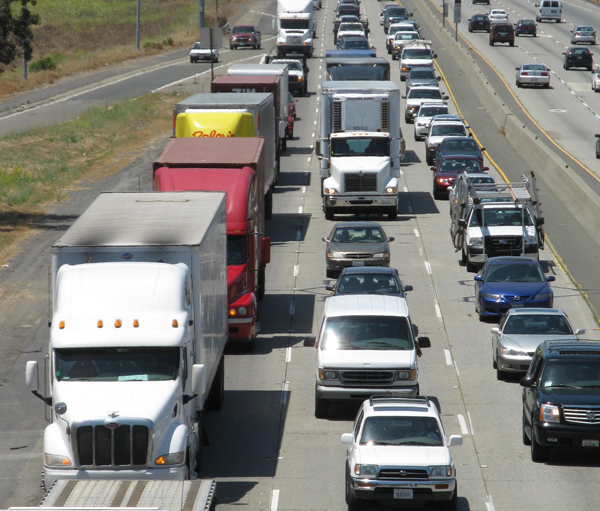
Cars are doing double duty in these statistics, since passenger vehicles are a large source of air pollution. Over the decades the state has addressed this fact with landmark efforts to regulate vehicle emissions, in efforts initially to improve local air quality and more recently, to reduce greenhouse gas emissions.

In a new study released this week by the Public Policy Institute of California (PPIC),  researchers looked at two state priorities: reducing greenhouse gas emissions that cause global warming and improving air quality to benefit public health, and evaluated the effectiveness of four potential transportation strategies to address both.

What they found is something that policymakers have known all along: there are no easy answers.  And everything involves a trade-off.

PPIC research fellow Louise Bedworth compared the cost, public health benefits, and GHG reduction potential for various alternative-fuel vehicles; battery-electrics, fuel cell, ethanol, and for reducing overall vehicle miles.  What she found is that transforming California’s vehicle fleet to battery-electric vehicles provides the greatest public health benefit, but that high costs and technological uncertainty make this option far from ideal.

On the flip side, said Bedsworth, while we have the technology for vehicles to run on corn-based ethanol, research shows that when indirect land-use costs are considered, corn-based biofuels provide no significant public health or climate change benefit.

But while the PPIC looks at local health and global warming effects separately, a new study out of Stanford has found that the two are directly linked. It’s well established that carbon dioxide contributes to global warming and that increased temperatures can exacerbate air pollution, but the new study shows that CO2 “domes” that develop over urban areas are, in fact, causing health problems for city-dwellers.  The study, conducted by civil and environmental engineering professor Mark Jacobsen, looked at models for the contiguous 48 states, for California and for the Los Angeles area. Results showed an increased death rate in all three areas compared to what the rate would be if no local carbon dioxide were being emitted.

Neither current regulations, nor the federal cap-and-trade bill passed by the House address the local effects of CO2 emissions on health.  Jacobsen says that this study provides evidence that they should.  He estimated an increase in premature mortality of 50-to-100 deaths per year from local CO2 emissions in California.

Jacobsen talks about his study in the video, below.

California Behind in Weatherizing Homes

Touted as a “shovel-ready” project that would create jobs immediately by leveraging existing infrastructure, the Department of Energy’s Weatherization Assistance Program has so far fallen far short of its goals.  The program received almost $5 billion under the American Recovery and Reinvestment Act of 2009 (ARRA) to improve the energy efficiency of nearly 590,000 residences of low-income citizens — more than a tenfold increase over the $450 million approved in FY 2009.

But a Special Report released last month from the Inspector General of the Office of Audit Services at the DOE found that as of December, just $368 million (8%) of the $4.73 billion allocation had been spent, and 5% of the nearly 600,000 units nationwide slated for weatherization with funding from the Recovery Act were actually completed.

That includes completion of just 12 of 43,400 planned units in California, which has been allotted more than $185.8 million in Recovery Act funding for its Weatherization Assistance Program.

So much for shovel-ready.

The report outlines reasons for the hold-up. Among them was a lengthy delay while the Department of Labor conducted wage surveys to determine appropriate compensation for weatherization work, so that the program would be in compliance with regulations.  Many states did not want to begin work until the wage rates were in place, the report stated, so much weatherization work throughout the country did not begin until late in 2009.

The report also found that, “Ironically, given the anticipated stimulus effect of the program, economic programs in many states adversely impacted their ability to ensure that weatherization activities were performed.”

Effects like hiring freezes, and, in California in particular, furloughs created significant staffing challenges in implementing the Weatherization Program, the report said.

In a a press release responding to the DOE report, the National Association for State Community Services Programs  (state officials implementing the DOE program), said that, “While it is accurate to assert that the ramp-up of expenditures and production has been slower than anticipated, this has been due largely to variables outside of the control of network providers.”

T. Maria Caudill, a spokesperson for the California State Department of Community Services and Development, the “network provider” in that state, said that as of December 2009, state administrators were still waiting for “specificity” from the federal government with regard to wage requirements.  In the last two months, California has aggressively worked to get contracts in place and units weatherized, she said.

According to Caudill, as of the end of February, 849 units had been completed across the state and 1,047 were in the process of being weatherized.

“We are on target to meet our first milestone,” said Caudill, referring to the goal of 12,900 units weatherized with ARRA funds by September 30.

She said that currently, eight service areas including Los Angeles, San Francisco, and El Dorado County are still without contracts for the ARRA weatherization work.

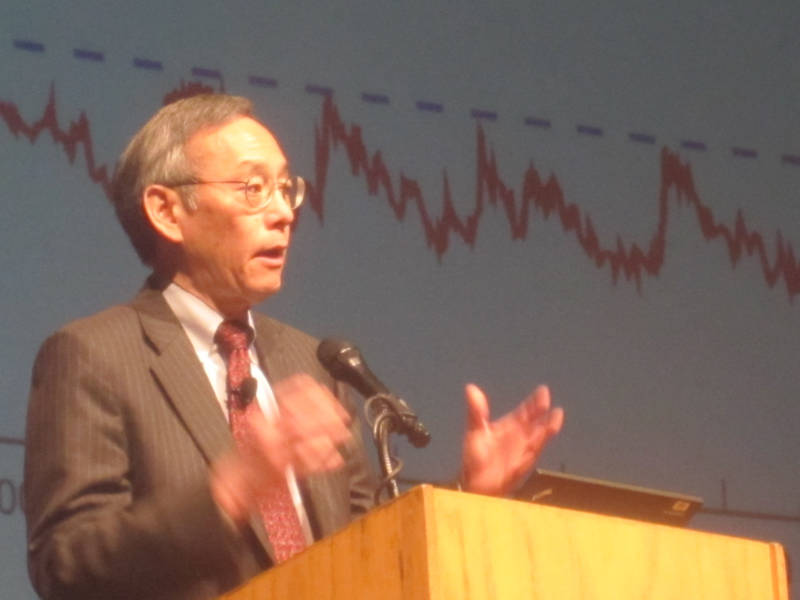
In a speech at Stanford yesterday, Energy Secretary Steven Chu told students and faculty that the number one priority of the DOE is “to get America employed using clean energy as the tool.”  Repeating a favorite metaphor of his, Chu called energy efficiency the “low-hanging fruit” for creating jobs, saving money, and reducing emissions.

As of December 2009, 520 jobs had been created or saved in California by the DOE’s use of recovery funds, according to a recent report from the Pew Center on Global Climate Change. That number will grow as California plays catch up, weatherizing more than 40,000 units between now and March 2012, which is the deadline for spending Recovery Act funds.

Governor Rejects LAO Jobs Report on AB-32

Governor Arnold Schwarzenegger said today that he’s “absolutely convinced” that California’s climate law “will create jobs more than kill jobs.”

“Unlike others that only have theoretical opinions,” he said, “I travel up and down the state and see first-hand.”  By “theoretical opinions,” the Governor appeared to be dismissing last week’s analysis by the non-partisan Legislative Analyst’s Office of the likely economic impact of the climate mitigation law, usually known by it’s legislative shorthand, AB-32.

But the report was hardly an unqualified downer. While the LAO concedes that “certain individual businesses and households…would be seriously affected,” the ten-page analysis presents a mixed bag of pluses and minuses, costing jobs in the near term but with potential long-term benefits. According to the report:

“The effects of the SP (Air Board Scoping Plan) on California jobs are difficult to accurately predict but would be mixed, with gains in some occupations and industries (including so-called” green” jobs) and losses in others (primarily involving fossil fuel-related energy production). On balance, however, we believe that the aggregate net jobs impact in the near term is likely to be negative, even after recognizing that many of the SP’s programs phase in over time.”

The report, issued in response to a request from state Senator Dave Cogdill (R-Fresno), is an assessment of California’s Global Warming Solutions Act, passed in 2006 to reduce greenhouse gas emissions, and set for full implementation in 2012. The law is under attack as a potent job killer, by a gubernatorial hopeful and a nascent ballot measure. Business groups are divided on AB-32’s overall effects.

The LAO report concludes that the law’s cap-and-trade program of carbon pricing “would almost certainly raise the near-term prices of electricity, gasoline, and certain other energy sources,” but at the same time, tighter energy efficiency standards for buildings would lower utility bills. Another measure, the low-carbon fuel standard, would raise the price of new cards but also reduce their operating costs.

Netting out the opposing effects of all these components is tricky business, involving a “complex model with hundreds of equations,” as described in the report. The LAO concludes that farther out on the time horizon, economic effects of AB-32 become fuzzier:

“In the longer term, its net effect on jobs-potentially either positive or negative-is unknown and will depend on a variety of factors. In a relative sense, however, its effect on jobs in both the near term and longer term will probably be modest in comparison to the overall size of the state’s economy.”

The Air Resources Board, California’s lead agency in implementing AB-32, initially projected the law would produce a net gain of 120,000 jobs in California by 2020. “They could be exactly correct,” LAO staff economist James Nachbauer told me, though his office isn’t putting its own number on the jobs effect. In it’s report, the LAO “questions the reliability” of the estimate in the scoping plan and concludes that the Air Board’s models “are not able to provide reliable estimates of the jobs impacts” in 2020. To meet it’s goals, AB-32 requires cutting emissions by about 15% from current levels, by 202o.

The Air Board has promised to provide a revised analysis, which LAO staffers say they expect to receive later this month. But as Nachbauer sums it up, “These weren’t created as jobs programs.”

Chu: Time to End “Paralysis”

Photo: Gretchen Weber

Energy Secretary Steven Chu returned to his old stomping grounds at Stanford University yesterday with a broad outline for jump-starting “a clean energy industrial revolution.”  Speaking to a packed auditorium of students and faculty, Chu advocated the passage of a comprehensive energy bill, saying that increased innovation and investment in “clean tech” is essential for American competitiveness, as well as for reducing dependence on foreign oil and mitigating climate change:

“We are right now in a state of paralysis. There are many businesses who say ‘No, no, we can’t do this, this country was founded on cheap energy, that’s what I want.’  That’s just holding off the inevitable.  So if we hold off the inevitable for another 5 or 10 years, I think we will lose.  Because the other countries are moving.  And then we play catch up.  And then we import their stuff.  That’s what’s at risk.  The future of the prosperity of the US is at risk.  Energy touches everything.”

Chu said the United States is “not doing so well” in terms of clean energy innovation and cited the drop in US market share in photovoltaics  from 44% in 1996 to less than 10% today.

“The US innovation machine is the best in the world,” he said, and then recited a dismal laundry list of fields in which the US is no longer leading the way, including auto fuel efficiency, hybrid car batteries, energy transmission, energy transmission equipment, and nuclear technology.

When asked by an audience member why the US doesn’t commit to a Manhattan Project-style endeavor to solve the energy issue, Chu explained that a project at that scale would have an annual cost in the tens of billions.  In comparison, the current base budget of the DOE is $3 billion per year.

“I agree.  We should do that,” he said. “Tell people in Congress how important it is.”

Key to America’s success, he said is an energy bill that sends signals to the private sector that clean energy is a profitable venture, through incentives and tax breaks.  He said that the federal government plays a role in grants and loan guarantees, but to scale technologies from the idea stage to the factory floor, private investors must play a role.

“America has an opportunity to seize the day and to lead in what has to be a new industrial revolution,” said Chu.  “It’s our choice. Do we want to be leaders or followers?”

As if on cue, it looks like Los Angeles is about to crush one plan that might have helped put southern California at the forefront of clean energy generation and transmission. The Riverside Press-Enterprise reports today that Los Angeles officials will likely announce tomorrow that they’re pulling the plug on the contentious project known as Green Path North.   The project would have installed 80 miles of high-voltage lines and towers to carry geothermal, wind and solar energy from Imperial County to Los Angeles and some Inland cities.  The plans have met with opposition from environmental groups and communities along the proposed corridors.

The project was featured last year in a radio series for Climate Watch by KQED’s Rob Schmitz, on plans to get clean energy from southern California’s deserts to its cities.

Climate Scientists Respond to IPCC Critics

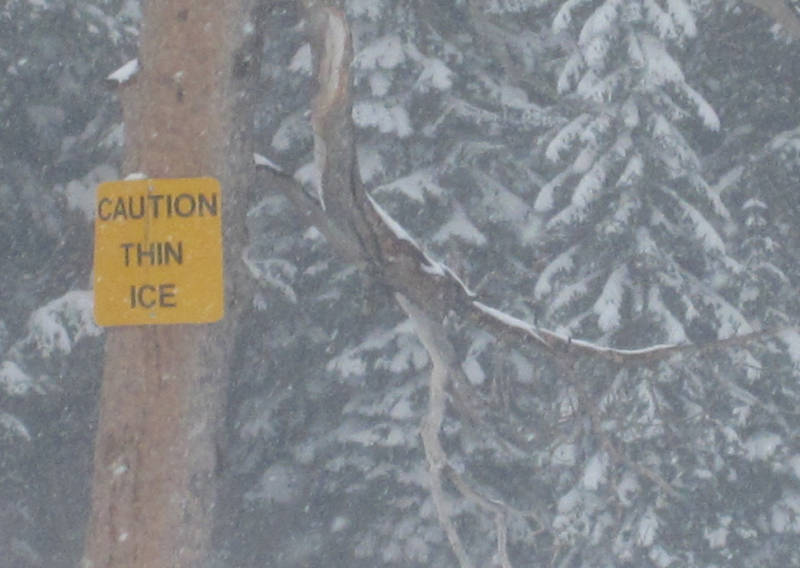
Snowstorm at Donner Pass, January 2010 (Photo: Gretchen Weber)

As we all know, climate scientists have been on the hot seat lately. Among other recent incidents, they’ve drawn fire for the leaked East Anglia emails and for the now-retracted assertion in a 2007 report from the Intergovernmental Panel on Climate Change that Himalayan glaciers might be gone by 2035.  In both cases, researchers admitted missteps and expressed regret. But they say neither incident invalidates the mass of evidence that the Earth is warming and that human activity is a likely cause.

On a call with journalists this week, three leading scientists defended the IPCC, its processes, and climate science in general.  Fielding questions were Penn State glaciologist Richard Alley, Scripps Institute climate scientist Richard Somerville, and Chris Field, director of the Carnegie Institute Department of Global Ecology at Stanford.

“There are errors, and you can find errors on both sides,” said Alley, referring to the fact that previous IPCC reports had underestimated sea-level rise.  “It’s done by humans. It’s not perfect.  But these errors in no way impact our fundamental understanding that we’re adding CO2 to the air, that this is turning up the Earth’s thermostat,” he said.

Somerville made a similar point about the false Himalayan prediction in the 2007 report.

“I liken what’s happened here to the occasional error that happens a bank statement or a phone book,” he said, noting that the 2007 report was 3,000 pages long.

Just because a bank makes a mistake on your statement, he argued, “That’s not a reason to distrust banks.”

The scientists defended the IPCC standards and review process, but supported the IPCC’s recent announcement that it will seek an outside review for future studies in efforts to avoid mistakes in the future.  It’s not clear yet what the independent review process will look like.

“The best thing we can do to push errors to the minimum is to have more eyes looking and to have more expertise and more transparency,” said Field.

There’s no question that errors such as the one about the Himalayan glaciers have provided fodder for critics of climate science and may have contributed to a recent decline in public concern about (and belief in) global warming. During their call this week, the climate researchers bemoaned the fact the urgency of their findings isn’t getting through.

“The fact is that we don’t have forever to decide to reduce emissions of greenhouse gases,” Somerville said. “That’s not something you can procrastinate for ever. Mother Nature imposes a time scale and it’s measured in a few years, not a century.”

Scientists are being forced to defend their work against attacks that are based on policy, not science, Somerville said. The IPCC has a mandate to be policy-neutral, and its goal is to provide information that is policy-relevant but not policy-prescriptive, he said.

“And yet, when you take apart the criticisms that have been made of IPCC and climate science in general, you’ll find, I believe, that in many cases they are motivated by policy concerns rather than scientific concerns,” he said.  “And so I think you’ll find individuals and organizations who have strong views on carbon taxes or government participation in free markets or ceding sovereignty of one country by signing international agreements – all kinds of things like that that are disguised as concerns about the science.”

There’s an interesting conversation happening at Yale Environment 360 about the future of the IPCC.  Robert T. Watson, chair of the IPCC from 1997 to 2002, argues in an essay that while there’s room for improvement in terms of implementation, the IPCC’s procedures are sound.   On the other side, University of Colorado Environmental Studies Professor Roger A. Pielke argues for sweeping reform, citing, among other criteria, a need for a mechanism for resolving allegations of error and a policy pertaining to real and perceived conflicts of interest.

DOI Setting Up Regional Climate Centers

Rachel Cohen is serving an internship at Climate Watch. She has written for the Oakland Tribune and San Mateo County Times.

AK_87676111_blogBy Rachel Cohen

The federal Deptartment of the Interior has selected the University of Alaska to host the first in a network of eight “regional climate centers” around the country.

In making the selection, Interior secretary Ken Salazar called Alaska “ground zero for climate change,” citing “rapidly melting Arctic-sea ice and permafrost, and threats to the survival of Native Alaskan coastal communities.” The center will be located in Anchorage.

Salazar said that in the weeks to come, DOI will be screening proposals for the next four centers, targeted for the Northwest, Southeast, Southwest and North Central regions.

The first center follows quickly the announcement in February that NOAA is establishing a National Climate Service. Modeled on its century-old National Weather Service, the NCS will also have a regional emphasis.

“The new service will give more structure and visibility to NOAA, changing the way money moves around, and resources can be brought to bear,” said Kelly Redmond, a climatologist with NOAA’s Western Regional Climate Center in Reno.

Redmond, who has been involved with the creation of the Climate Service for the past couple years, said the new service aims to provide decision makers, including state and local planners and policymakers, with the kinds of information they’ve been asking for.

That ranges from answers to “backyard questions,” such as looking up the climate of a new home’s location or whether to fodder for major business investment decisions.

Officials say the new federal service will work within the existing budget and appoint a director to each of six regions.  The Western Regional Climate Center, in Reno, where Redmond is based, is affiliated with the University of Nevada’s Desert Research Institute.

Roughly half of the total land area in the western US is federally managed. Much of it is arid and mountainous, with its own set of climate issues.  NOAA works with a matrix of state and federal agencies, some with overlapping jurisdictions.  The Climate Service will pull research from diverse sources under one umbrella.

Redmond says coordination of climate information is evolving along a path similar to that which led to the  creation of NOAA in the 1970s.  While national and local weather systems are well connected, climate programs remain fragmented. By creating a single conduit for climate information, Redmond says NOAA may be better able to prioritize research efforts.

Likewise, Salazar says his department’s Regional Climate Science Centers “will provide science about climate change impacts, help land managers adapt to the impacts, and engage the public through education initiatives.”

“In short,” said Salazar in his statement, “Climate Science Centers will better connect our scientists with land managers and the public.”

More Water Likely for Farms and Cities–With a Catch

Craig Miller
What is now looking like a "normal" wet winter may mean bigger water allocations for crops. Photo: Craig Miller

We’d like to think that weather and water supply is a straightforward proposition. If rain falls in the lowlands and snow blankets the Sierra Nevada the way we expect it to, then we ought to have enough water to get us through the dry months ahead. But of course, California water is never that simple. The latest example: today’s state and federal announcements of projected  deliveries from two massive Central Valley water systems.

From the state: The Department of Water Resources said it’s increasing promised State Water Project deliveries from five percent–the amount projected last December 1–to 15%.

In a conference call with reporters, newly-appointed DWR Director Mark Cowin called the 15% figure “very conservative.” He said that if the wet season continues on its current “average” path, the department could deliver between 35-and-45% of the contracted amount.  Cowin said where final allocations would land in that range depends on pumping restrictions currently in place to protect endangered salmon and smelt.  “That spread between 35 and 45 percent is based on how the fisheries agencies ultimately apply the existing rules to protect fish–and how much resulting flexibility we have to pump water from the Delta,” Cowin said.

The bottom line from the DWR announcement: Three years of drought have taken a toll on water supplies that will take more than one good year of rain and snow to reverse. Cowin says runoff from the healthy Sierra snowpack will be lower than normal, as more water is absorbed by relatively dry soil.

At the same time, the State Water Project’s biggest reservoir, Lake Oroville, stands at 54% of its normal level for this time of year. The other linchpin for SWP supply, San Luis Reservoir, is at 80 percent of normal overall. But most of that water is already spoken for and is unavailable for meeting this year’s state water contract commitments.

As the state was adjusting its projections, officials also weighed in on 2010 deliveries from the federal Central Valley Project.

Secretary of the Interior Ken Salazar announced that the initial allocation from the CVP to San Joaquin Valley farmers and other users is 5%. That’s better than nothing–which was the early allocation last year. But it was only part of the news.

Salazar disclosed that negotiations involving Senator Dianne Feinstein, other members of the California congressional delegation, water contractors, and environmental groups have hammered out a plan that could deliver nearly 40% of contracted supplies to CVP customers. But there’s a big “if” in the picture: Those expanded deliveries only happen if the wet season continues to be wet.

Weeks of controversy preceded Salazar’s announcement. Areas of the San Joaquin Valley that have gone thirsty during the three-year drought–notably the Westlands Water District–have been agitating for more federal water even if it means overriding Endangered Species Act protections for fish.

Feinstein went to bat for Westlands and other federal water customers, proposing an amendment to a jobs bill that would set aside Delta pumping limits in order to guarantee deliveries to Valley water users. That sparked outrage from those working to save the Delta fisheries and a sharply critical letter from a dozen House members. But it also apparently prompted the talks that led to Salazar’s announcement. In a statement, Feinstein said she was pleased with the projected allocations announced today and praised the “creative thinking” that went into it. But she added that she’s watching how water shipments play out. Although she has shelved her water amendment for now, she said, “I reserve the right to bring it back should it become necessary.”

Here’s our updated KQED California Reservoir Watch, which gives a pretty good picture of the state’s water storage:

<
View KQED: California Reservoir Watch in a larger map

Mapping California’s Shifting Climate

By Gretchen Weber & Molly Samuel

A companion radio piece to this post aired on The California Report.

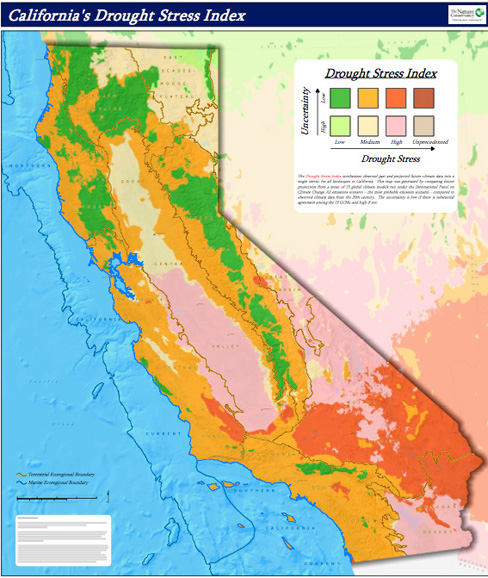
Map from The Nature Conservancy showing projected drought conditions for 2070-2100
Projected drought conditions for 2070-2100 (Map: The Nature Conservancy)

Climate change is causing conservationists to rethink traditional methods of protecting lands and ecosystems. The conventional strategy of setting aside a specific parcel of land (and increasingly, ocean) to protect a particular community of organisms may no longer be sufficient in a rapidly changing climate. While greenhouse gas reduction and climate change mitigation remains a top priority for most conservationists, land managers have begun developing adaptation strategies that take the effects of a warming planet into account.

“We have a fantastic conservation success story in having conserved a huge network of protected areas,” says Healy Hamilton, director of the Center for Applied Biodiversity Informatics at the California Academy of Sciences. “The issue with those protected areas is that they all have static boundaries around them and they work to protect what lies within them,  So the plants and animals that are there are well-protected, as long as they stay there.” Trouble is, the habitat isn’t staying put.

Climate has “Velocity”

The world’s ecosystems will need to move about a quarter of a mile each year to keep up with climate change, according to a recent study published in Nature (link is to the first paragraph of the paper; the full article is only available to subscribers, but you can read a press release about the about the study).

Researchers from the Carnegie Institution, Stanford, the California Academy of Sciences, and UC Berkeley collaborated on the paper, which describes climate belts sweeping north and south from the equator–and also moving uphill–as the world warms.

Hamilton, who co-authored the study, told a packed house at the Center for Biological Diversity in January, that “Climates are on the move. It’s not just a slow unfolding, it’s a radical, abnormal process. Everywhere we look, shifts are already occurring.”

And under these changing conditions, she said, plants and animals have three choices: “They can stay and adapt, they can shift with their climate, or they can go locally extinct if they can’t move fast enough.”

The study’s lead author, Scott Loarie, a fellow at the Carnegie Institution, explains that climate change forecasts are commonly measured in degrees per year, but the authors of this study wanted to know how those temperature changes would affect what can live where. So they used temperature “velocity” (in kilometers per year) to measure how fast regional climate conditions are moving as the planet heats up.

It turns out that the belts move at different rates, depending on the landscape. In the Amazon Basin, velocity is relatively high. It’s a large and homogeneous ecosystem, so as the temperature changes there, plants and animals will have to travel a long way to keep up with the climate in which they’ve evolved to thrive. In a place like California, with its microclimates and variable topography, the velocity is lower. Some species may need merely to migrate to a nearby north-facing–and therefore cooler–slope. Others will have to head north and toward the coast. Climate models forecast that eventually the Bay Area will look more like Southern California, and the Bay Area’s current climate will be located somewhere north of us.

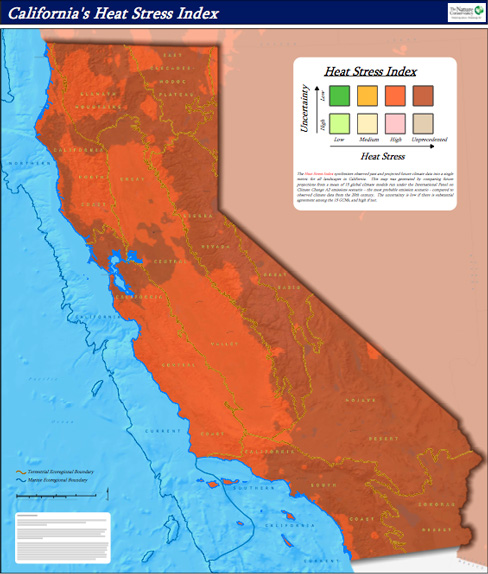
Projected Heat Stress in California for 2070-2100 (Map: The Nature Conservancy)

Mapping a Moving Climate

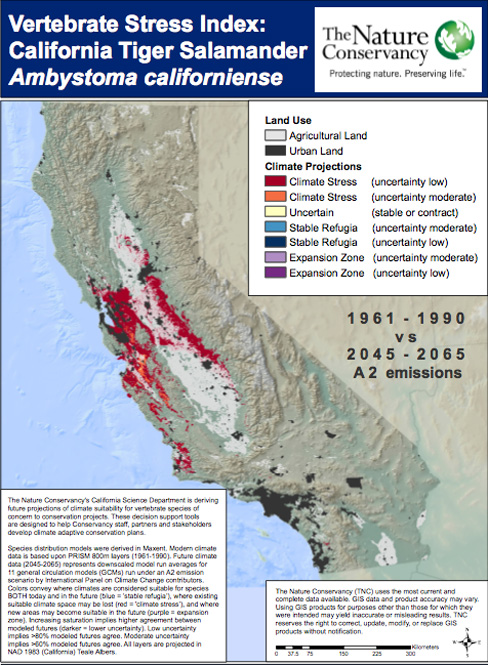
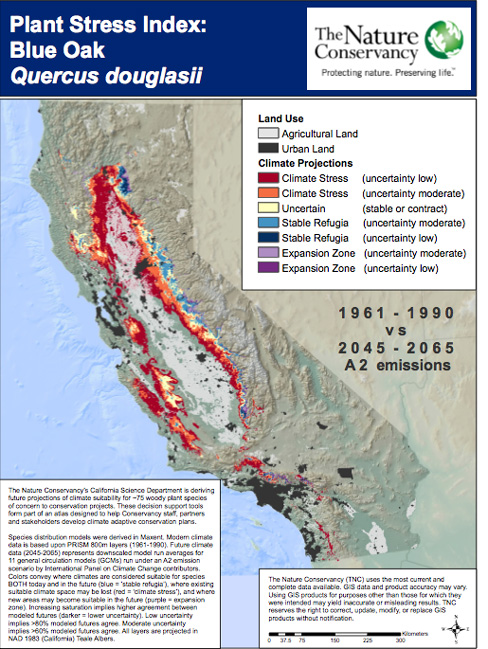
The Nature Conservancy of California has attempted to map some of these trends (see above and below). Scientists averaged together several different climate models to create a picture of California’s future in terms of temperature and precipitation. They then applied that projection to habitats for specific species, to make predictions about how ranges may shift. The maps show both how much areas are likely to change, as well as how certain the predictions are.

“What we’re trying to understand is how does the way we protect species in the future need to change with a changing climate,” says Rebecca Shaw, Director of Conservation for the Nature Conservancy of California. “The kind of strategies you employ and how much you spend is really going to be dependent on how certain you are about change in the future.”

For example, she says some parts of the Sierra are not likely to change very much over the next century, but some places like the Mojave Desert are expected to change a great deal. That kind of information could be useful for land managers trying to plan for the future. For example, in areas that are expected to undergo great change, it might be more important to preserve corridors, or connecting stretches of protected lands, so that populations can move as the climate changes, if they are unable to adapt where they are.

Loarie says “assisted migration”–helping specific species move to new locations–is expensive, unpredictable, and unrealistic. Instead, he, too, corridors for plants and animals to safely follow their climate–if they can keep up. Species like the American pika, already living on mountaintops, can’t go any farther uphill. Their habitats could disappear completely, or, as Loarie says, “they’ll pop off the top.”

There are limitations to the predictions one can make with temperature velocity measurements. What temperature changes will do to fog, for instance, is still unknown, so it’s not clear yet where the redwoods will need to move in the next 100 or so years.

To enable the second option, Hamilton agrees with Loarie. she says the conservation community needs to rethink its traditional strategy of protecting lands. Instead of protecting specific parcels of land and expecting them the stay the same over time, conservationists need to expect change, and to create connectivity in the landscape so that species can move when and if they need to.

Projected changes in California Salamander habitat (Map: The Nature Conservancy)
Projected changes in California Blue Oak habitat (Map: The Nature Conservancy)

On the Road to a National GHG Auto Standard

Photo: Craig Miller

The California Air Resources Board (CARB) announced Thursday that the state has fulfilled its part of the May 2009 agreement set between auto manufacturers and two federal agencies that will establish the nation’s first greenhouse gas emissions standard for cars.

The new regulation adopted Thursday contains what CARB spokesman Stanley Young called “largely technical fixes,” including a change that will allow cars that meet the federal standard in the years 2012 to 2016 to be counted as compliant with the stricter California standard.  (The federal standard goes into effect in 2012.  It differs from the California standard until the two reach the same levels in 2016.)

The California law mandating rules to cut greenhouse gas emissions from cars, AB 1493, was passed in 2002.  Between 2005 and 2009, the state fought for an EPA waiver that would allow it to implement a standard tougher than existing federal rules. Last May, President Obama announced a national standard for tailpipe emissions of greenhouse gases  modeled on California’s rules.  In June, the U.S. EPA  granted the waiver the state had long sought.  See the CARB website for a history of the struggles over the regulations.

CARB says that national implementation of the standard will cut 941 million tons of CO2 by 2020, compared to 793 million tons had the standard been limited to California and the thirteen states that had adopted California’s rules.

AB 1493 would not be affected by a suspension of AB 32, an issue Californians may be voting on soon.

Accounting for Corporate Carbon

Five years ago, the notion of measuring your company’s carbon footprint might have seemed quaint, or foolish, or just plain impossible.  And not too many large companies were interested.  But a recent report from the consulting firm Groom Energy Solutions finds that corporate emissions reporting is fast becoming big business (Groom describes itself as a “provider of renewable and energy efficiency systems to commercial and industrial companies.”)

The Groom analysis focuses on “enterprise carbon accounting” software, or, in plain language, technology that helps companies track their emissions.  According to the report, venture capitalists invested $46 million in enterprise carbon accounting (ECA) software in 2009, and it predicts that purchases of the technology will increase 600% by next year.

According to Paul Baier, VP of consulting services for Groom, 60% of Fortune 500 companies currently report their carbon emissions, and that number is growing rapidly.

“By the end of 2010, if a company is not reporting, it will be seen as a laggard in the industry,” said Baier.  “It’s increasingly mainstream for corporations to be doing this now.

Ninety percent of reporting companies are using “spreadsheets and consultants” to determine their footprints, said Baier, and the rest are using ECA software.  Three years from now he expects that 80% will be using the software, which helps companies track hundreds of different data points related to operational emissions.

“They don’t keep track of their financial information with spreadsheets anymore, and they won’t be using them for carbon reporting much longer,” he said.

In general, corporate carbon accounting is limited to what the Greenhouse Gas Protocol Initiative (which sets the widely accepted standards) refers to as Scope 1 and Scope 2.  These include the direct emissions of company operations such as on-site fuel combustion and electricity use.  Significantly, Scopes 1 and 2 leave out the potentially enormous, yet elusive footprint of a company’s suppliers and the myriad of other associated carbon sources.  In the works are standards for measuring Scope 3, which Baier calls “everything else,” but for now, there is no generally agreed-upon template for measuring this wider footprint.

Which leaves room for debate, such as when The Wall Street Journal raised questions about the 2008 pronouncement by Dell Inc. that it had achieved carbon neutrality. The Journal article reported that Dell was measuring only a small fraction of total emissions associated with the company.  Dell had taken into account employee air travel and building electricity use, but not emissions produced from transporting products or the footprints of the factories around that world that supply it with computer parts.

Given the inconsistencies and uncertainties of corporate carbon accounting, not to mention the cost in employee time and technology investments, why are companies flocking to do it?

According to the Groom Energy report, the three main drivers, in order, are:

  1. Increased pressure from customers and investors for companies to create a “greener” public image
  2. Cost and energy savings
  3. Mandates from buyers, like the Walmart Supplier Sustainability Assessment Program, intended to measure the environmental impact of its 100,000 suppliers.

Reducing CO2 emissions to help mitigate the effects of climate change did not make the list.