Category Archives: Government & Business

What’s brewing in Sacramento, Silicon Valley, and beyond

Hot Topics in San Diego

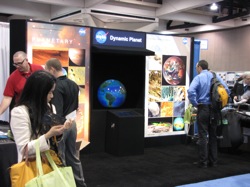
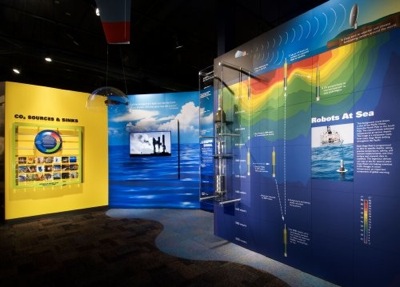
NASA's "Dynamic Planet" exhibit at the San Diego Convention Center. Photo: Craig Miller

SAN DIEGO –The annual meeting of the American Association for the Advancement of Science (AAAS) draws “thousands” of scientists in virtually every endeavor, from astrophysics to zoology. In climate science circles there was no lack of topics to choose from this year. Among them:

Geo-Engineering

Several sessions were devoted to the notion of fending off climate change by tinkering with earth systems. In technical sessions and news briefings, there was a range of opinion on display, from “Let’s try it” to “Let’s look at it,” to “Don’t even think about it.” There seems to be general agreement that techniques like seeding the atmosphere with particulates could yield rapid results–but the idea is fraught with political controversy and legal pitfalls. Stanford’s Ken Caldeira likened the idea to a cancer patient who accepts the risks of chemotherapy, in order to avoid worse consequences. Philosophy professor (and Caldeira’s former teacher) Martin Bunzl, firmly rejected that analogy, saying that unlike cancer therapy, the risks are not well known and “You can’t just turn it off.” Bunzl directs the Climate and Social Policy Initiative at Rutgers University.

At Climate Watch, we’re preparing an explanatory radio feature on geo-engineering, for broadcast in the coming weeks.

Oceans

The plight of the planet’s oceans was a focus of the conference, with numerous discussions of acidification, marine reserves and the newly implemented concept of “marine spatial planning,” an effort to map the oceans’ topography, biota and habitat, then translate that into a kind of zoning plan for human use (an approach specifically mandated by the Obama administration last year).

In October, researchers will formally conclude the Census of Marine Life, a 10-year collaboration among scientists in 80 countries, to “assess and explain the diversity, distribution and abundance of life in the ocean.” During a media briefing at AAAS, census Co-Chief Scientist Ron O’Dor estimated that the final tally would include 5,000 newly discovered species (“not counting the microbials”), from flying sea cucumbers to the “Rasta sponge,” which, according to O’Dor’s colleague, Shirley Pomponi, appears to sport dreadlocks and also “produces an anti-cancer compound.” O’Dor said one general conclusion from the census would be that while it is “large and resilient, we can’t keep insulting the ocean forever.”

Science & Policy

In keeping with the meeting’s theme of “Bridging Science and Society,” and reflecting the current angst over credibility in science, there were overflow sessions with titles such as “A Wobbly Three-Legged Stool: Science, Politics and the Public.” While people spilled out the door of that room, hard-science lectures in adjacent rooms drew just a smattering of people. In an interview with Climate Watch, Brad Allenby, a professor of engineering and ethics at Arizona State University, lamented that “the climate change discussion has become so polarized, even among scientists, that it’s difficult to present the public with factual information that is credible.”
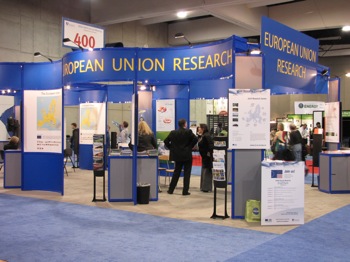
European Union exhibit at AAAS. Some attendees commented that the exhibit hall seemed sparse this year. Photo: Craig Millerl
European Union exhibit at AAAS. Some attendees commented that the exhibit hall seemed sparse this year. Photo: Craig Miller

National Climate Service

NOAA chief Jane Lubchenko used the occasion of the conference to talk up her agency’s new National Climate Service, funded by legislation last year. The new branch will provide one-stop shopping for climate research and tools for policymakers, including those at the state and local level. Lubchenko says she hopes to have the new unit operational by October, when the federal fiscal year turns over.
Bridging the Science Gap

SAN DIEGO — Scientists from 50 nations are gathered here this week for the annual meeting of the American Association for the Advancement of Science (AAAS). This year’s theme is “Bridging Science and Society”–not surprising as recent surveys reveal there’s a lot of bridge building to do.

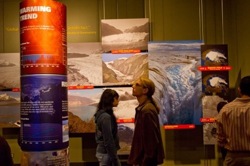
Birch Aquarium's "Feeling the Heat" exhibit. Photo: Birch Aquarium, La Jolla

During a two-day pre-conference for “informal educators” (science museums, aquariums, zoos, and the like) on “climate literacy,” speakers painted a mostly grim picture of Americans’ understanding of climate in particular and science in general. Jean Johnson of the nonpartisan research organization Public Agenda pointed to research in which, when asked to “name a fossil fuel,” only four in ten could. Similarly, 56% surveyed thought that nuclear power contributed to global warming. There is still considerable confusion between climate change and the much publicized ozone “hole.”

Speakers from Yale, George Mason University* and the Pew Research Center all highlighted the recent trend toward rejection of contemporary climate science, despite several decades of accumulated evidence that affirms human impacts on climate. Several speakers, including former IPCC climatologist Richard Somerville (Coordinating Lead Author in Working Group I, for the 2007 Fourth Assessment Report) laid the blame for this chiefly on what was characterized as a well-coordinated, well-financed campaign of disinformation, organized by industries opposed to regulation of carbon emissions.

Some noted other factors, such as topic “fatigue” (people tired of hearing about it) and the current dismal state of the economy, which has shuffled personal priorities. Layered on all of that, “We live in an age of skepticism,” said Johnson of Public Agenda, in which trust in traditional institutions like government (and the media) is flagging. She pointed to the need for “credible neutral explainers” to act as translators between working scientists and the public. Anthony Leiserowitz of Yale, co-creator of the Six Americas project, noted that despite growing skepticism, there is still strong public support for climate and environmental education.

Birch_Heat2_blog

Frank Niepold, education coordinator for NOAA’s Climate Program Office, pointed to what he calls the “solutions barrier.” He noted that while the likely effects of climate change are often discussed in K-12 classrooms, there’s a lack of attention to potential solutions. Other speakers said climate impacts and solutions should be more closely linked to issues that are consistently rated as high priorities among households, such as energy independence and public health.

*Climate Watch partnered with Yale and George Mason researchers to create our climate survey, “A Matter of Degree,” which is featured on Facebook and on the Climate Watch website.

The New Streamliners: Big Rigs Save Fuel, CO2

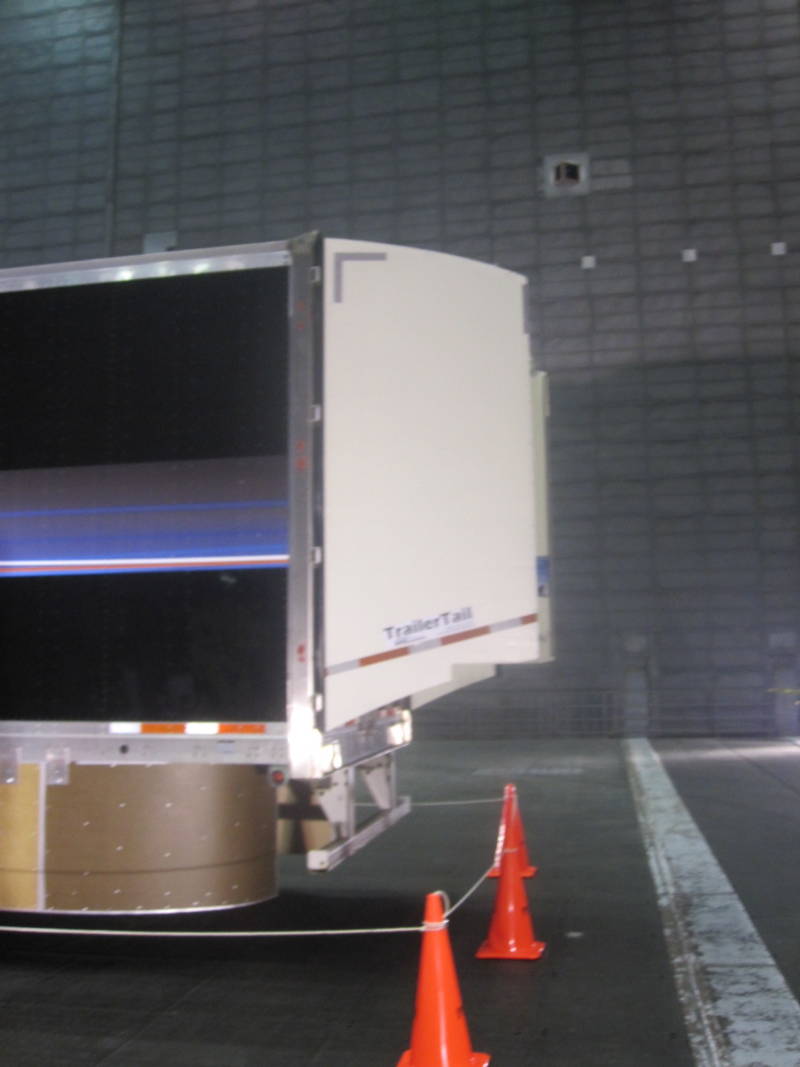
Not exactly the Space Shuttle: A big rig in the wind tunnel at NASA Ames Research Center. Photo: Gretchen Weber

A companion radio piece to this post aired on The California Report.

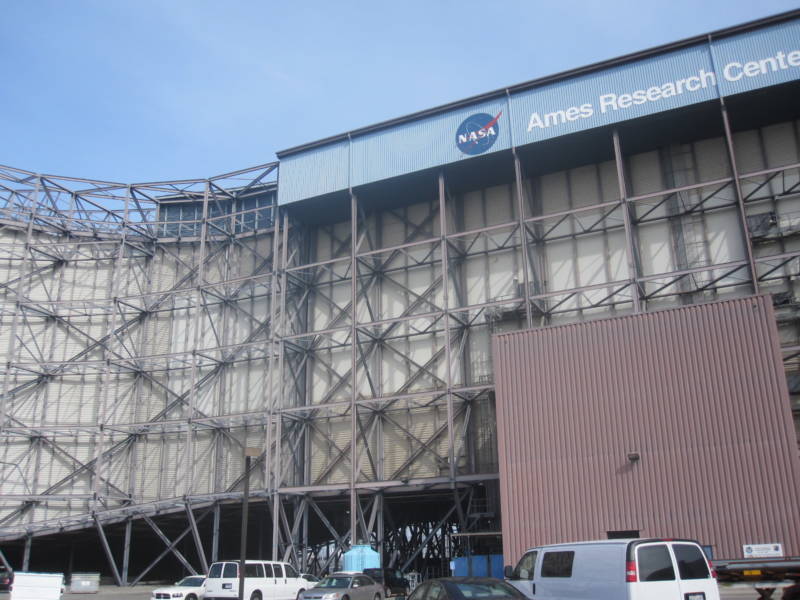
The wind tunnel at NASA’s Ames Research Center in Mountain View is the largest in the world. According to Ames deputy director Lou Braxton, at various times it has housed a Boeing 747 and an America’s Cup racing yacht. But parked inside this week was a relatively diminutive semi-truck with a 53-foot trailer. The truck is called the ProStar, and according to its manufacturer, Navistar, it’s the most aerodynamic truck on the road.

The wind tunnel was open to the media because Ames, Lawrence Livermore National Lab (LLNL), Navistar, and the Air Force (which manages the tunnel) were showcasing their ongoing project designed to identify, develop, and test devices that reduce the aerodynamic drag of “big rigs.” The wind tunnel wasn’t activated for the press event but the media gathered inside the cavernous space could envision how the tests might work.

At highway speeds, more than 50 percent of the energy produced by a truck’s engine is used to overcome aerodynamic drag. Therefore, reducing that drag can produce significant fuel savings. In fact, testing thus far has determined that existing aerodynamic design adjustments and attachments can increase fuel efficiency by 12 percent, which, when applied to the US trucking fleet, could save more than three billion gallons of diesel fuel per year, a cost savings of more than $10 billion at current prices. This savings in diesel translates to a reduction of 36 million metric tons of CO2 per year.

Inside the wind tunnel, the truck’s trailer was outfitted with various attachments designed to reduce drag at critical points such as the trailer base, the under body, and the gap between the tractor and trailer. Some, such as the TrailerTail, are already commercially available, while others are still in development. For the next three weeks, scientists will test various devices and combinations. The best ones will be track tested and then road tested over the next year.

Currently, semi-trucks make up about 12 percent of US petroleum consumption; about 21 million barrels a day, according to LLNL.

The TrailerTail (Photo: Gretchen Weber)
Outside the National Full-Scale Aerodynamics Complex (NFAC) at Ames, where the wind tunnel is located (Photo: Gretchen Weber)

States at Crossroads for Climate Action

Tom Banse is a Seattle-based public media reporter and a regular contributor to Climate Watch.

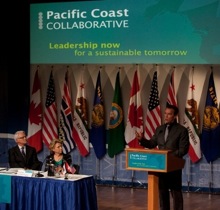
West Coast governors meet in Vancouver. Photo: Office of Gov. Arnold Schwarzenegger

By Tom Banse

When two West Coast governors sat down with the head of British Columbia’s provincial government for a pre-Olympic confab today, the occasion brought to mind some things I’d picked up during a short fellowship in Denmark and Germany last week.

Two months after the chaotic United Nations climate summit ended, edgy “Hopenhagen” posters are one of the few visible reminders of the high-stakes gathering of world leaders, recently concluded in Copenhagen.  Ironically, the summit dashed the hopes of many climate activists for a legally binding treaty to reduce global warming emissions.

They’re not giving up, but in the aftermath acting locally may gain more prominence than acting globally.

“The Copenhagen hangover is over.  Now countries including the United States have to act,” said Denmark’s energetic Minister of Energy and Climate Lykke Friss.

The Danes are engaging other countries to try to revive momentum for international climate negotiations. “We should fight all the way for a deal in Cancun,” where the next United Nations climate summit will convene at the end of this year.  “But that depends on the will of the moment,” she said.  “There is no doubt this is a difficult process,” Friss acknowledged.

In European capitals, policymakers are eager for any clues or cues regarding the willingness of American lawmakers to regulate greenhouse gases. Cap-and-trade legislation has been stalled in the U.S. Senate for the past five months.

“If it’s not realistic that the U.S. would sign a binding international [climate] treaty, what is below this?” asked a German parliament member in Berlin.  The answer may not lie in Washington, DC.

“We do think the pendulum is starting to swing back to states,” said the former co-chair of the Western Climate Initiative Janice Adair.  In 2008, seven Western U.S. states and four Canadian provinces developed a framework to regulate greenhouse gas emissions independent of their national governments.  The plan has not taken effect.

“More and more, the UN and the national governments recognize that the ‘sub-national’ governments are really the ones that, in the end, can put the pressure on and create the action that is needed,” said Governor Arnold Schwarzenegger, on Friday.  Schwarzenegger spoke in Vancouver, Canada after a mini-summit of Pacific Coast leaders timed to coincide with the opening of the 2010 Winter Olympics. British Columbia Premier Gordon Campbell hosted the meeting to discuss common environmental topics. Washington Governor Christine Gregoire and Oregon Secretary of State Kate Brown also attended.

Gregoire said when it comes to cap-and-trade, she still maintains that a national program is better than a regional one.  Yet state and local governments can do other things to control emissions, namely what policymakers such as Adair call “complementary” measures. Schwarzenegger specifically mentioned California’s Million Solar Roofs Initiative, which seeks to attain that number of rooftop solar arrays by 2016.  Some other examples include creating incentives for consumers to buy electric cars, increasing recycling or improving rail service.  Oregon and Washington have recently toughened their building codes to increase energy efficiency in new construction.

Gerry Pollet, the director of the Seattle-based environmental watchdog group Heart of America Northwest, recently urged his members to write Oregon and Washington’s governors and legislators, “saying you want Northwest states’ climate change legislation put back on the front burner – which is a good investment for our economy as well as for the health of our planet and children.”

As in Congress, there is hesitancy in state legislatures. “Our concerns are very much is this going to put us at a distinct competitive disadvantage,” said Shelly Short, a conservative legislator from Northeast Washington. [Ed. Note: Arizona Governor Jan Brewer cited the same concern in her executive order ending that state’s participation in the WCI cap-and-trade plan]. Short says she is given pause by current controversies involving climate scientists, notably the one involving hacked e-mails that has been dubbed “Climategate” by global warming skeptics. “I’ll be honest and say some of the issues that have come forward really leave it up to whether this is something we need to be doing,” said Short.

Meaningful climate change legislation has not come up for debate this winter during the short 2010 sessions of the Washington and Oregon Legislatures.  But all the players on this issue expect global warming to return to the forefront in Salem and Olympia in 2011.

WCI Shows More Signs of Unraveling

88367460On Ground Hog Day, Arizona saw the shadow of regional carbon trading looming over it…and retreated.


In an executive order issued on February second but not widely reported until yesterday, Arizona Governor Jan Brewer rejected the regional cap-and-trade program known as the Western Climate Initiative (WCI).

In April of last year, Climate Watch first called attention to the apparent lack of momentum within the WCI, an agreement among 11 US states and Canadian provinces, in which Arizona was a founding partner.

In her order, Governor Brewer wrote that imposing cap-and-trade at this time would “cost investment and jobs in Arizona” and put the state at a “competitive disadvantage,” as industry would be forced to pay fees for their carbon emissions.

Arizona relies on coal for about a third of its electricity production (36% as of 2007, according to the US Energy Information Administration’s tally) and its renewable energy goals (15% by 2025) are less ambitious than California’s (30% by 2020). But Arizona also has a larger nuclear power component. Governor Brewer cited this in last week’s executive order, as part of the reason why Arizona’s per capita greenhouse gas emissions are “about one third less than the national average.” The Governor’s order affirms that Arizona seeks “pragmatic” approaches to climate change mitigation and implies that Arizona officials would rather wait and see what carbon regulation develops at the national level, than proceed with a regional plan.

The state’s move comes as several energy companies mount an eleventh-hour push for a national cap-and-trade program, which has languished in the Senate.

The WCI comprises both “partner” and “observer” states. The Brewer order says that Arizona will “continue to be a member of the WCI to ensure that Arizona’s unique perspective will be advanced,” but that the state will not implement regional cap and trade. As of this morning, Arizona was still listed on the WCI website as a “partner” and there was no mention of the action.

California officials have long said that while a regional carbon trading pact would be preferable, California could “go it alone” if necessary.

Air Board: GHG Sniffers for Research, Not Enforcement

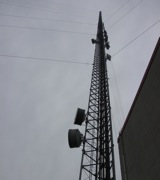
This tower in Walnut Grove is decked out with equipment to detect and measure atmospheric gases. Photo: Craig Miller
This tower in Walnut Grove is rigged with equipment to detect and measure atmospheric gases, monitored by NOAA. Photo: Craig Miller

A companion radio piece to this post aired on The California Report.

Scientists in California have begun setting up a statewide network of monitors to track California’s greenhouse gas emissions. Similar equipment has been in place for years as part of a continental network established by the National Oceanic & Atmospheric Administration (NOAA). But officials at the California Air Resources Board (CARB) say this new system will be the first of its kind.

“The unique thing about this is that we’re actually looking at the local emissions, rather than the global average, says Jorn Herner, who heads the Greenhouse Gas Technology & Field Testing Section of CARB’s research arm. “Nobody has done that before.”

Scientists have been systematically tracking atmospheric CO2 on a broad scale since 1958. California’s network of GHG sniffers will be capable of tracking CO2, nitrous oxides and other known greenhouse gases, and will initially focus on methane.

But CARB officials say the network is not part of a “Big Brother” strategy for emissions compliance. “This is initially a research project,” said Herner. He says the new network will provide a “second data point” to augment the state’s current method of estimating GHG emissions. Currently California’s current climate law, AB-32, relies on a “bottom-up” system of estimating emissions from individual sources, then adding them up to arrive at total emissions for the state.

“The modeling won’t tell you each individual source but what you’d be able to do is develop a gridded inventory. So you’ll be able to say in this square mile of land over here, it looks like emissions are much higher than in this square mile next to it.”

The greenhouse gas analyzers are about the size of a desktop computer. Photo: Craig Miller

The Air Board has purchased seven “next-generation” analyzers from Picarro Instruments in Sunnyvale. Five will go to fixed locations, such as a tower on Mt. Wilson, above the Los Angeles Basin. The two others will be on “mobile platforms;” electric vehicles that can roam the state taking ground-level readings. The units cost about $50,000 apiece but Picarro executives say they are self-adjusting and require far less human intervention than previous models, which will ultimately make them more cost-effective.

Picarro’s CEO, Michael Woelk, says a nationwide network of 500-to-700 detectors could yield a comprehensive GHG map of the US with resolution down to ten kilometers (a little more than six miles).

If California regulators are successful at putting in place a statewide or regional cap-and-trade system for greenhouse gases, industrial emitters will have to pay fees for the carbon they pump into the air. Horn agrees that at that point, some kind of check on the current system of self-reporting will “probably” be needed, but, he says, “that’s not the goal of this monitoring network at this time.”

“The science is really young,” he explained. “We’re really just trying to find out the potential of what we can do with this network. How it’s used in the future is still up in the air.”

…so to speak.

This animation below shows the methane levels detected by a Picarro analyzer as it is driven from Livermore, CA, to Sacramento.

No Protection for American Pika

American Pika, Photo: Doug Van Gausig
American Pika, Photo: Doug Von Gausig

The high-alpine rabbit relative, the American pika, does not warrant protection under the Endangered Species Act, according to a ruling Thursday by the U.S. Fish and Wildlife Service. The decision was required by a court order stemming from a lawsuit brought by the San Francisco-based Center for Biological Diversity against the agency, for failing to respond to a petition submitted by the Center in 2007.

The CBD petition cited climate change as the cause for population decline in pika populations in the mountains of Nevada’s Great Basin. Because the creatures can die from overheating at temperatures as low as 78 degrees, and research suggests that a warming climate has led to major losses in lower-elevation populations, pushing pika to migrate to higher elevations. Some biologists are concerned that if temperatures rise high enough, they may reach the mountain-tops and run out of hospitable habitat.

“By not listing the pika, the decision is not respecting the best available science,” said Shaye Wolf, a staff biologist at the CBD. “The science is very clear. Scientists in the Great Basin will tell you that their research is showing that pika are disappearing and that the losses are linked to climate change: heat stress in the summer and loss of snowpack in the winter.”

Wolf said that the federal agency is required to use the “best available science” in making its ruling. She said that the CBD may challenge the decision on this basis.

“The (government’s) interpretation of the studies is that even though pika are disappearing and will continue to disappear, they will be able to cope,” said Wolf. “That’s not consistent with what we’re seeing. It’s a bizarre argument that pika will adapt. There’s no basis for that claim.

Had the federal agency ruled the other way, the pika would have been the first animal to make the endangered list as a direct result of climate change.  Last year, the Obama Administration denied a similar petition for the Alaskan spotted seal, Wolf said.

The scientific community itself is split about whether the pika warrants a federal listing. While research shows that some populations of pika are declining, such as in the Great Basin, not everyone agrees that the entire species is facing extinction.

The CBD also has a pika case still pending at the state level.  The California Fish and Game Commission has twice denied CBD requests for a status review of the American pika. The organization is currently challenging the state’s second denial.

For more background on the CBD’s efforts to list the pika, see Craig Miller’s blog posts from May 2009.

Climate Concern Flags Amid Support for Policies

app_full_proxy
One possible outcome "badge" from KQED's Facebook survey, "A Matter of Degree"

Despite being far less concerned about climate change than they were a year ago, a large majority of Americans supports the the passage of federal climate and energy policies, according to a national survey released last week by researchers at Yale and George Mason Universities.  (The full survey is available as a PDF on the Yale Project on Climate Change website.)

More than 1,000 adults were surveyed in late December and early January, and their responses compared with the results of a similar survey from the fall of 2008.

Key findings include:

  • Only 50% of Americans now say they are “somewhat” or “very worried” about global warming, a 13-point decrease
  • The percentage of Americans who think global warming is happening has dropped 14 points, to 57%
  • The percentage of Americans who think global warming is caused mostly by humans activities dropped 10 points, to 47%.

These results echo a similar survey by the Pew Research Center for People and the Press, which found that between April 2008 and October 2009, the proportion of Americans who believed there was solid evidence for global warming dropped 14 points, from 71% to 57%.

While both reports indicate a flagging of public concern about climate change in general, the Yale/GMU report finds that public support for the passage of federal climate and energy policies is strong, even across party lines. Majorities of Republicans and Democrats surveyed support renewable energy research, tax rebates for people buying fuel-efficient vehicles or solar panels, and regulating CO2 as a pollutant.

“The good news is that even though some Americans are becoming more skeptical that global warming is happening, nevertheless, there is still support for some of the basic climate policies,” said Anthony Leiserowitz, director of the Yale Project on Climate Change and one of the study’s principal investigators.

But the poll also revealed low levels of awareness about the policy debate in general: 60% of Americans surveyed said they’d heard “nothing at all” about cap-and-trade legislation, while just 12% said they’d heard “a lot.”  When the concept of carbon permit trading was explained to survey respondents, 58% supported the policy, but that support dropped to 40% when respondents were told that one hypothetical outcome would be to drive up household energy costs by $15 a month.  Support rebounded to 66% if a yearly household bonus of $180 were supplied to offset higher energy costs.

Bipartisan support for some climate-related policies amid fading concern about climate change, is not as contradictory as it might seem.  While some respondents approve of supporting research funding for renewable energy technologies as efforts to reduce global greenhouse gas emissions, others support this policy on national security and energy-independence grounds.  Leiserowitz noted that while support for renewable energy research has been high for years, the current public support for cap and trade could “go either way” in the near future, depending on how the public debate plays out.

Climate Watch has partnered with the Yale Project on Climate Change and the George Mason Center for Climate Change Communication to create our climate survey A Matter of Degree, which is available on the Climate Watch website and on Facebook.   A Matter of Degree uses data from the Yale and GMU researchers’ Global Warming’s Six Americas survey to help survey respondents determine where they fall on the spectrum of American beliefs about climate change.

EPA’s New Regional Chief: Act Locally

New EPA regional chief Jared Blumenfeld. Photo: EPA

Yesterday I spoke with Jared Blumenfeld, the former head of San Francisco’s Department of the Environment–aka the guy who brought mandatory recycling to San Francisco and banished the phrase “Paper or plastic?” from the city’s supermarkets–by banning the plastic.

Blumenfeld now occupies a vast corner office in the EPA’s Region 9 headquarters, overseeing a territory that includes four Western states and 20 of the country’s largest cities. Born 40 years ago, just as Region 9 came into being, this week he was briefing reporters on his plans to “revolutionize” the region with a tighter focus on environmental justice, enforcement, and making small businesses more efficient.

What do these things have in common? For one thing, they’re all pretty local: specific communities with specific complaints and needs (a profile, incidentally, that fits Blumenfeld’s first initiative to a “T”).

So what about more sweeping changes on, say, climate? You could argue that it’s not the job of a regional head to get mixed up in Beltway politics. But given all the recent drama in Washington around cap and trade, maybe Blumenfeld’s local focus is intentional.

How, I asked him, has the mood in Washington affected his ambitions for EPA Region 9?

“I was looking at a recent poll that showed how many fewer people understand climate change last year than this year,” he replied. “I think the environmental movement has gotten away from the people. We’ve become overly specialized, jargony, focused on large problems no one person can solve.”

Having made San Francisco a considerably “greener” place, maybe Blumenfeld’s first task is to export small initiatives that–for the moment at least–make environmental problems feel local and solveable.

Amy Standen is the lead radio reporter for Quest, KQED’s multimedia science initiative.

MAP: California’s Climate Lobby

Climate Watch now features a new page that brings together all of the interactive maps we’ve created so far. For the launch we’ve added an interactive map to our coverage of climate lobbying efforts in Washington. See our recent blog post, “The Climate Lobby Bulks Up” for more on who’s been spending big to influence climate legislation on Capitol Hill.

View KQED: Climate Lobbying in California in a larger map
The data for the map is from the Center for Public Integrity’s The Climate Change Lobby project. CPI tracks money helping to fuel the climate change legislation debates and maintains a database compiled from lobbying disclosure reports filed with the Secretary of the Senate’s Office of Public Records. (Read about the project’s methodology here.) The data does not include lobbying activity aimed at state laws and regulations, or dollars spent on advertising campaigns.

Climate Watch intern David Ferry combed the data and mapped the lobbying efforts based in California.  Chevron and PG&E top the list with $36 million and $34 million spent since 2003, respectively. Intel ranks third with $12 million. Our map skims the top of the database, showing only those organizations with more than a half-million dollars in spending.

Click here to view a larger map and to see a list of the CA lobbying efforts.
View KQED: Climate Lobbying in California in a larger map

Don’t forget to visit the new Climate Watch Maps page, where you’ll see this map as well as all of the interactive maps we’ve created to illustrate data from various sources, including the Department of Water Resources, the California Air Resources Board and The Center for Public Integrity.