All posts by Gretchen Weber

Warmer Temperatures Threatening CA Fruit Crops?


Increasingly warmer temperatures  in the Central Valley could pose a serious threat to California’s  fruit and nut crops in the not-too-distant future, according to a new study out of UC Davis.   The study finds that winter chill, which is an important factor in the productivity of tree crops, is likely to decrease by more than 50% by 2100, making the region less hospitable for crops like walnuts, peaches, plums, and cherries, unless changes in growing techniques are adopted.
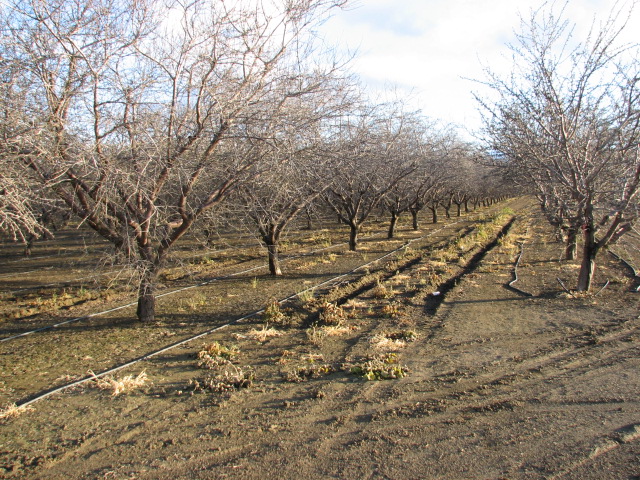
Almond trees in winter, Photo by Sahsa KhokhaTree crops go dormant in the winter when temperatures drop to a certain level for a certain period of time.  Each crop then needs a certain number of  ‘chilling hours’ – between 32 and 45 degrees Fahrenheit – in order to break dormancy and resume growth.

If crops don’t recieve their specific chilling requirement during the winter,  problems arise.  Flowering time is disturbed, which could be devastating for crops such as walnuts and pistachios that depend on simultaneous male and female flowering for pollination.   And if crops don’t recieve enough winter chill to go dormant in the first place, they will continue producing buds and sprouting branches, but they may not yield fruit, having dire consquences for California’s $7.8 billion fruit and nut industry, explained study author Minghua Zhang.

“We hope that people will take this study as a wake up call,” said Zhang. “Crops are going to be seriously impacted.”

Zhang and her fellow reaserchers found that in certain parts of the Central Valley, winter chill declined by nearly 30% between 1950 and 2000.  They expect that the decline will be 60% by 2050 and 80% by the end of the century.

“There is a problem coming up that we need to prepare for,” said Eike Luedeling, another of the study’s authors. “So far low chilling requirement haven’t even been a breeding goal, but we are going to need a long-term strategy to cope with this.”

The researchers found that by 2000, winter chill had declined to the point that only 4% of the Central Valley was suitable for growing apples, cherries, and pears, down from 50% earlier in the 20th century.  They predict that by the end of the century, the region might no longer be suitable for growing these crops as well as walnuts, pistachios, peaches, plums, and apricots.   Crops like almonds and pomegranates will most likely be affected the least, as they have low winter chill requirements.
California Climate Champions: Project Carpool

Patrick Ouziel
Photo by: Patrick Ouziel

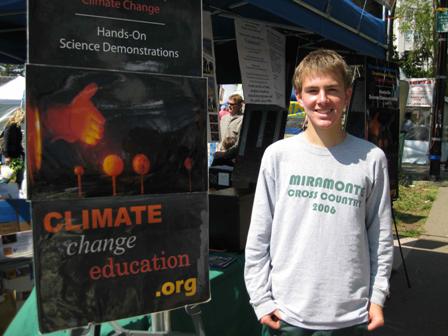
Devin Finzer is a 2008 California Climate Champion from Orinda who graduated from Miramonte High School in June. In this guest post for the Climate Watch blog, he describes how he and fellow Champion Patrick Ouziel were able to start a carpooling program at his school.

Walking to my high school each morning, I trekked past long lines of backed-up traffic. Driver after driver waited anxiously for his or her chance to round the corner into the Miramonte High School lot and hunt for a coveted parking spot. For the most part, each car contained just one person. The passenger seats of large SUVs and mini-vans were often left completely empty. The early-morning situation involved stress, traffic congestion, and unnecessary pollution. Fellow student Patrick Ouziel and I decided we could do something about it.

As California Climate Champions sponsored by the California Air Resources Board and the British Council, Patrick and I are engaged in local and international efforts to take action and spread awareness about climate change. One of the main environmental issues we noticed at our high school was the way students get around. With after-school sports and club activities, juniors and seniors take advantage of their newly earned driver’s license, but by driving only themselves, they often missed out on easy, cost-beneficial, and eco-friendly ways to group together with other students traveling their same route.

Patrick and I are proud to have lobbied for the expansion of our school’s carpool system, which provides carpoolers with designated parking spots each morning. During the school year, we produced several videos promoting eco-friendly transportation and climate awareness, and linked these videos to a web site where students could demonstrate their support for increasing the percentage of carpool spots at our school. We also provided an option where students could sign up as “potential carpoolers” in order to find other ride-sharers who lived close by.

The result?  With the support of students and the administration, we transformed our parking lot reserved for high school seniors into a lot exclusively for carpoolers. Now 80 spots, about 30% of our entire lot, are reserved exclusively for carpoolers.

What are the environmental benefits for the new program? While differing gas mileages and travel distances make exact calculations difficult, we do know that carpooling with just one other person already cuts per-person emissions, as well as gas costs, in half, and we can estimate that our carpool system inspired about 40 additional carpool groups.

While deciding to carpool almost seems almost like a no-brainer, Patrick and I did face significant barriers when we emphasized the importance of ridesharing. From the get-go, one of the main obstacles we had to address was the relationship between driving and teenage independence. Every sixteen-year-old remembers the day he earns his license: the fresh feeling of the driver’s seat and the thrill of taking the wheel, free from parental supervision. Americans clearly love to drive, and apparently, many of us love to do it by ourselves — a 2005 U.S. Census Bureau survey says 77 percent of American workers drive to and from work alone.

In our awareness videos, Patrick and I emphasized that carpooling doesn’t have to be a sacrifice of this independence. Rather, it can be an effective symbol of collaboration: sharing a ride is an opportunity to spend time with friends, or to get to know new people. Teenagers are social beings who feel most content when they are connected with their peers. That’s why we emphasized the importance of a collective carpool movement built on the strong sense of community at our school.

Advocating carpooling can be a great way to start a green movement at your own school or workplace. There are a number of web sites that match potential carpoolers and make ridesharing easy. I’ve reviewed a few of the better-known ride-matching sites on my blog.

Patrick and I will both be going to school on the East Coast next year, Patrick at Yale and myself at Brown. We plan to continue our climate change activism. In particular, I’d like to encourage the installation of solar panels on the roofs of high schools and universities. Our continued environmental efforts will be documented on my blog.

Special thanks to Climate Watch intern Kristine Wong for help with this post.

Head-to-Head: Chevron and The Sierra Club

Two giants of California’s energy debate squared off at a Commonwealth Club forum in San Francisco last night.

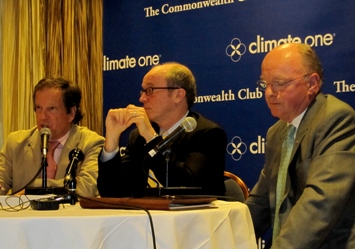
Chevron CEO Dave O’Reilly and Sierra Club Executive Director Carl Pope fielded questions from moderator Alan Murray of The Wall Street Journal and a sometimes impassioned audience, about renewable energy opportunities, reducing greenhouse gas emissions, and predictions for the future of the United States’ energy economy. Several questions also concerned Chevron’s high profile court battle in Ecuador and the oil company’s presence in Richmond, the Bay Area city where a major Chevron refinery dominates the skyline–and some say, local governance

Carl Pope, ED of Sierra Club Alan Murray, Executive Editor of WSJ Online Dave O'Reilly, CEO of Chevron. Photo: Gretchen Weber
From left to right: Sierra Club chief Carl Pope; WSJ Online Executive Editor Alan Murray; Dave O'Reilly, CEO of Chevron. Photo: Gretchen Weber

In what was less of a debate than a discussion, Pope and O’Reilly agreed that the United States needs to make major changes towards greater energy efficiency and that the country must begin to rely more on renewable energy sources.

Their views diverged significantly, however, on the timeline for such changes. While Pope supports a 90% reduction of greenhouse gas emissions from today’s levels by 2050 and says he believes this goal possible, O’Reilly projected that by 2050, the United States will have reduced its GHG emissions by no more than 20-25% from today’s levels.

O’Reilly said that even if the U.S. replaced the entire transportation system with a zero-emissions system, the country would reduce GHG emissions by just 34%–and that doing likewise with the nation’s power generation would reduce GHGs by another 40%.

“So we have to ask ourselves, can we replace our entire energy system–transportation and power–in just a few short decades?” said O’Reilly. “I think the transition is going to take some time.”

According to O’Reilly, his company is already the largest provider of geothermal energy in the world and yet only 2% of Chevron’s income currently comes from renewable energy.

“The challenge of scale demands that we acknowledge that conventional energy sources will remain indispensable for decades,” said O’Reilly. “We must be realistic. For the foreseeable future we need to develop it all: conventional as well as non-conventional energy, as well as renewables and alternatives.”

When asked what his prediction was for how much of Chevron’s income would come from renewable energy sources by 2050, O’Reilly said he thought the number would be about 10-15%.

Pope responded, “The world will have room in 2050 for a very small company, 90% of whose energy comes from fossils [fuels]. The world will not have room, or tolerance, in 2050 for a big energy company [that does], so if Chevron wants to be successful, I think Chevron’s going to need to change those numbers.

Pope also called on Chevron to “come to the table” with local communities in which Chevron operates, such as Richmond, CA, and he proposed that all oil companies donate 10% of their profits to a global fund to clean up areas of the world damaged by the petroleum industry.

Not surprisingly, Pope and O’Reilly agreed that the highest priority for reducing GHG emissions is to replace coal with natural gas or another less carbon-intensive energy source, and while on stage, the men shook hands on an agreement to lobby the issue together in Washington.

KQED will broadcast the entire Commonwealth Club event at 8 p.m. on Friday, June 19, with a rebroadcast at 2 a.m. the following morning.

New Report Finds More Clean Energy Would Grow CA Economy

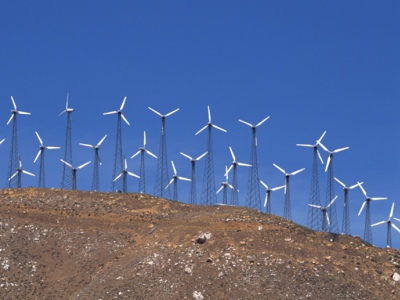
wind-powersmThe think tank known as Next 10 is the Voice of Eternal Optimism, when it comes to the economic potential of decarbonization. Its latest report poses the question: “Can California afford clean energy now?” You can probably guess the answer.

The study [PDF], which was funded by Next 10 and authored by UC Berkeley professor David Roland-Holst and a team of researchers from the Department of Agricultural and Resource Economics, concludes that California will face greater economic uncertainty if the state continues on a “business-as-usual” path in terms of energy. A greater investment in clean energy, the report finds, will spur sustained economic growth.

The study analyzes five new energy scenarios including  three different degrees of Renewable Portfolio Standards (RPS): 20 percent, 33 percent, and 50 percent as well as a 50 percent RPS plus energy efficiency increases of 1.0 and 1.5 percent per year.

According to the Executive Summary [PDF], the study’s most ambitious scenario, 50 percent renewable fuels and a 1.5 percent efficiency increase, could generate 420,000 additional jobs with more than $100 billion in cumulative payrolls over 40 years (2008-2050).   Without the energy efficiency  increases, however, the numbers are much lower. The report finds that a 50 percent RPS alone would create about 60,000 new jobs, whereas 33 percent would create just half that number.

California’s current RPS is intended to increase from 12 to 20 percent by 2010.  Last November, Governor Schwarzenegger set a target for California to have 33 percent of its electricity provided by renewable resources by 2020.

Global Call for Climate Change Stories

Want a trip to Copenhagen to cover this year’s UN climate talks, but not sure how to pay for it?

earthshine_nasa
Photo: NASA

Internews, an international media development organization, today launched The Earth Journalism Awards, a competition for the world’s best climate change reporting.  Applicants can register and submit stories on the EJA website until September 7, 2009, when 14 winners will be selected to be flown to Copenhagen in December to cover the UN talks for their home countries and local media outlets.

“The media has a hugely important role to play in helping to raise awareness about climate change, and environmental issues,” said James Fahn, the director of Internews’  Earth Journalism Network.

Winners will be selected for seven regions: Eurasia, South Asia, East Asia, Sub-Saharan Africa, Europe, and Australia. EJA will make awards for reporting in categories such as Human Voices, Energy, Forests, Nature and Climate Change. Then the non-profit will invite the public to vote online for the best story out of 14 finalists, which will be awarded the Global Public Award.

The competition is open to both professional “citizen” journalists from all over the world, and Fahn says there’s a special emphasis on engaging reporters from developing nations.

“The people and communities most vulnerable to climate change often have the least information about it.  It’s the marginalized, poor communities that have the most exposure to the impacts of climate change.  They can generally see that climate change is happening but they don’t always know why, or what’s in store for the future.  It’s important for us to fill this information gap,” said Fahn.

Fahn says more than 300 journalists from eleven countries have already entered. EJA will fly the winners to Denmark for the next major round of UN climate talks in December.

Climate Watch will feature EJA selected entries on this website.

Navigating the Urban Water Jungle

Follow Gretchen’s radio journey to cut her own water use by 20%. Her story aired May 29 on The California Report weekly magazine.


Gretchen Weber
Photo: Gretchen Weber
Saving water when you live in an apartment isn’t as hard as it might seem.

I know the motivation might not be there to take shorter showers when you see your neighbors watering their lawns in the middle of the day or local restaurants hosing down the sidewalks, but cutting back on your water use (or at least feeling less guilty about those long showers) can be as simple as swapping out your old shower head for a lower-flow model, screwing some aerators onto your faucets, and, for the sufficiently motivated, talking to your landlord about installing higher-efficiency toilets.

For me, the first and last stop was calling my utility company, San Francisco Public Utilities.  They sent out a water expert armed with free devices for my flat, and in less than an hour we’d outfitted the kitchen and bathroom to be much more water efficient.   Save our H2O, a website sponsored by the California Department of Water Resources, has tons of conservation resources including a rebate finder and a list of the state’s local water agencies.

But since I know not every utility offers free devices to customers, last night I dropped by The Home Depot in Daly City, to see what’s available.  I have been inside one of these orange megabox retailers exactly three times in my life and it’s always a bit of sensory overload.  There must have been close to 100 shower heads to choose from, but it wasn’t easy finding one with a low-flow (1.5 gallons per minute) rating.  No matter the price or the size, every model I picked up was either 2.5 gpm, or I couldn’t find the flow rate on the packaging.

Gretchen Weber

Faucet aerators at The Home Depot

I finally asked a salesman who at first couldn’t find one either.  But eventually, he found one tucked in among the others: the Delta Water Amplifying Shower Head, for $12.75.  It’s actually 1.6 gpm, and it looked kind of  small and cheap,  although it may work fine.  I felt a little disappointed that this was my only option.

Hoping for better luck, I wandered over to the aerator section one aisle over.  There I found aerator aficionado heaven.  Once again, the selection was a little overwhelming.  There were probably 40 aerators to choose from–aerators, no less.  Low-flow, 1.5-gpm models like the kind the SFPU gave me ranged in price from $2.99 to $17.39 for the upscale brushed-nickel variety.

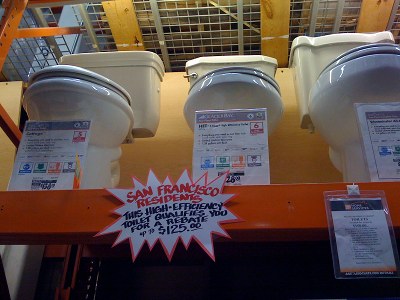
Across from the aerators were the toilets.  I scanned the high shelf and saw several low-flow models (1.6 and 1.28 gallons per flush) that were priced between $90 and $128.  Taped to the toilet shelf was a sign reading that San Francisco residents may be eligible for a $125 rebate on a low-flow model, which could basically mean a free toilet.  Other cities and counties in California have similar rebates.

As I turned to leave the toilet/aerator aisle, I bumped into a large box sitting on the floor.  There, far from all the others, was the shower head I’d been looking for:  a 1.5 gallon-per-minute WaterPik EcoFlow with five different pressures, including something called “Powerspray.”  Touting a 40% water savings, these puppies were on sale for $44.95.

Gretchen Weber
Water Pik Eco Flow Shower Head Photo: Gretchen Weber

Rick Soerhen, the Deputy Director of Water Use Efficiency for the California Department of Water Resources told me that people living in apartments most likely already get “gold stars” for water conservation because they probably aren’t watering lawns and gardens.

So, flat-dwellers, be proud. But if you really want to be as water efficient as possible, devices like these can make a big difference on your total usage — without requiring three-minute showers.

Climate Change: The Next Generation

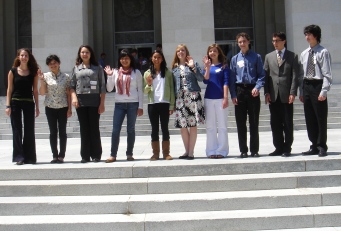
California's 2009 Climate Champions in Sacramento. (April 27, 2009)
California's 2009 Climate Champions in Sacramento (April 27, 2009) Photo by Amanda Dyer

Don’t let anyone convince you that today’s teenagers  are all too busy watching Gossip Girl to notice what’s going on the world.   At least some of them are all too aware that they’ll be inheriting whatever their elders leave them in the way of climate policy–a promising start or a global Gordian knot.

So, in Sacramento on Monday, California Air Resources Board chair Mary Nichols witnessed some thoughtful, engaged, youth-in-action as she fielded sophisticated questions from the newly-inaugurated 2009 California Climate Champions.

Over lunch, these ten high school students asked Nichols about the  future of electric cars in the state, how to help low-income Californians reduce emissions, the availability of renewable energy sources, and how CARB is dealing with political resistance to California’s Global Warming Solutions Act,  AB 32.

Mark Bessen, a 2009 Climate Champion from Palos Verdes High School in Rolling Hills Estates, asked Nichols how society can translate science into political action.

“That is the secret of life,” she replied.

Now in it’s second year, the California Climate Champions program selects high school students from across the state to serve as educators about global warming and to “champion” projects that address climate change issues in their own communities.

This year’s students are planning a diverse set of projects that include alternative fuels, solar power, water conservation, and large-scale composting.  For example, Nicholas Dahlquist  from Rim of the World High School in Lake Arrowhead plans to use chemistry to explore the potential for powering school buses with waste vegetable oil.

“The idea is to take used vegetable oil from deep frying and convert it into a fuel you can use in any diesel engine,” said Dalquist. “The process is relatively straightforward.” Currently, using vegetable oil as a diesel fuel requires some engine modification.

The challenge, he says, is getting people to actually use the fuels, so raising awareness about alternative fuels and working with local transportation authorities to explore possibilities are both aspects of his project plan.

“Biodiesel from waste oil, unlike biodiesel in general, does not require food crops in order to create it.  It’s basically a renewable resource that would otherwise be waste,” he said.

Other champions include Soraya Okuda, a student at Lowell High School in San Francisco, who is working to establish a composting system at San Francisco State University and at the nearby Stonestown Galleria. Another, Jason Bade, from Aragon High School in Foster City,  plans to lobby cities to develop programs that help homeowners purchase and install rooftop solar panels.

Read about the rest of the 2009 Climate Champions and check in on the progress of last year’s Champions and their projects at www.climatechamps.org.

Girding Against the Fire Season

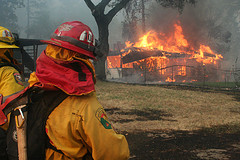
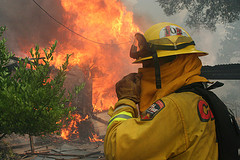
Firefighters at the Martin Fire in the Santa Cruz mountains near Bonny Doon, CA in June, 2008. Photos by Tim Walton.
caption caption

Tonight, on KQED Public Television, Quest: California at the Tipping Point explores some of the ways in which climate change will likely affect our state, including an increased risk of wildfire.

Last year, California’s fire season got off to an early and catastrophic start–and this year, generous spring rains could not cover the shortfall from two previous years of scarce precipitation. The late rains might forestall fire conditions for a while but more fires are inevitable.

Last June, more than 1,000 wildfires started in one weekend.  Throughout the course of the season, thousands more fires burned and hundreds of homes were damaged.  But if you’re among those who live in the “urban-wildland interface,” there are steps you can take to lower your home’s vulnerability to wildfire.

In the video clip below, a CalFire official tells Vicki Liviakis, who lost her home in the 1991 Oakland Hills firestorm, how vegetation around the house can feed a wildfire, and explains how Californians can create landscapes that reduce fire risk.  (You can watch the full 28-minute video, co-hosted by Liviakis and Climate Watch Sr. Editor Craig Miller, on YouTube.)

CalFire maintains this map, which tracks current fire incidents in California.  You can check this throughout the fire season for an overview of the state’s burns.

On tonight’s Quest program, Climate Watch Sr. Editor Craig Miller talks with CalFire’s Chief Deputy Director Crawford Tuttle about the increasing fire risk California faces due to rising temperatures and changing precipitation patterns.

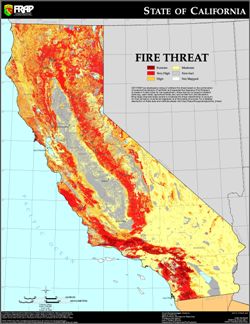
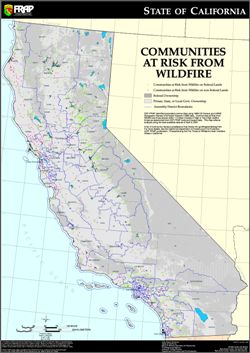
Below are the latest maps from CalFire depicting California’s regions and communities most at risk.

CalFire's map of statewide fire threat
CalFire's map of California communities at risk

Planet Forward

planet_forward_logoThe creators of a new PBS program want your opinions about the future of energy and climate change.

Part online interactive discussion, and part television broadcast, Planet Forward is looking for regular folks as well as experts to submit written and video commentaries making a case for how the United States should deal with its current and future energy challenges.

Hosted by Emmy-award winning CNN reporter Frank Sesno, the television broadcast, which airs April 15, will feature the best online submissions and a panel of scientists, policymakers, and business leaders debating the issues they raise.

Planet Forward began accepting submissions on March 6, and they are available for viewing on the program’s website.  Luminaries such as Christine Todd Whitman, Newt Gingrich, and actor Ted Dansen have already submitted videos.  So has UC Berkeley renewable energy professor Dan Kammen.

Register here to join the conversation.

Western Cap-and-Trade Plan Taking Heat

Proponents of the Western Climate Initiative’s (WCI) climate action plan encountered some vocal critics on Tuesday as nineteen U.S. Senators and House members from 10 states challenged western governors to rethink the plan’s approach to cutting carbon emissions.

In a letter to the governors, members of the Congressional Western Caucus, including three from California, expressed particular concern about capping carbon during the most severe economic slump in the post-war period.

WCI is a cooperative plan by 11 western U.S. states and Canadian provinces to create a regional cap-and-trade system for greenhouse gases.  Craig Miller reported on the plan in September for KQED’s The California Report.

The critics’ letter takes issue specifically with what it says are the WCI’s plans to rely on “renewable technologies and demand destruction” and to allow “for virtually no new baseload power plants deployed in the West through 2020 that are powered by natural gas, clean-coal-with-carbon-capture, renewable hydropower or nuclear energy”.  They say the region will lose billions of dollars in investments in green technology due to a plan that prevents new fossil-fuel power plants, even those with CO2 capture and sequestration technology.

At issue seems to be the WCI’s plan for the emissions caps, which are slated to be a “flat line” from either 2012 or 2015, depending on the source.  According to the WCI’s recommendations, the line would be set using “the best estimate of expected emissions for sources covered in the cap and trade program” in 2012.  Under this system, there would be very little room for increased emissions from any new power source covered by the program (i.e. electricity generation, combustion at industrial and commercial facilities,  and oil and gas processing).

The letter refers to a recent economic analysis commissioned by the Western Business Roundtable that found that the WCI would be expensive, cause job losses, and would not affect global climate.

California congressmen Dan Lungren, Elton Gallegly and George Radanovich were among the signers.