
All posts by Gretchen Weber

Big Journeys Begin with Small Steps

kayla-c-headshotSaturday is an “International Day of Action” organized by Greenpeace, which claims 4,800 events are scheduled around the world toward “a safe climate future.”

This seems like a good time to check in with one of our 2009 California Climate Champions. In this post, Kayla Clark of Atascadero describes her efforts to reduce greenhouse gases by targeting those ubiquitous disposable water bottles  at her school.

In my observation, sometimes when faced with the reality of climate change, we’re frightened. It can be a normal reaction to run back to our previous habits, jump in the large SUV, leave the lights on, and plead ignorance.  It’s indisputable that there is a serious issue that must be dealt with, but only through breaking down the problem to approachable and accessible goals can we hope to improve the situation.

My name is Kayla Clark, and I am a California Climate Champion and a junior at Templeton High School.  California Climate Champions is a program sponsored by the British Council in partnership with California Air Resources Board that selects young people throughout the state who are leaders in communicating about climate change to their communities.  There are 25 of us all together and the program enables us to work with one another to discuss climate change with a wider audience.

Each California Climate Champion is responsible for completing an individual project to communicate about climate change to his or her own community.  My project is to reduce the number of plastic water bottles purchased at my school and in my community by selling reusable water bottles on campus, as well as coordinating the development of a more attractive water source on campus.  For two years, I have seen hundreds of disposable water bottles purchased daily at Templeton High School. We do have recycling bins on campus but many students don’t utilize these bins. I estimate that maybe twenty students occasionally use reusable water bottles on my campus.

The goal of my project is to use water bottles to share a wider message. We can reduce greenhouse gas emissions by reducing student consumption of disposable water bottles, and we can permanently change behavior–even if that means affecting only the smallest of lifestyle choices.  At the core of these goals has always been communication. For me, that has meant sharing information at my high school, collaboration with my campus environmental club, and committing to speaking engagements and volunteer opportunities.

I realize that I can’t undertake my water bottle task alone. For that reason I’ve contacted and partnered with my school’s environmental club and my school principal so that we can work together on this project, and they have both been extremely supportive. Having a local network is very encouraging.

I’ve also had a couple of great opportunities to speak with different groups about climate change. I have addressed the Air Pollution Control District (APCD) at their July board meeting and the San Luis Obispo Exchange Club.  Both experiences were really interesting, as many of the audience members had basic questions about climate change and the science behind it, so answering their questions was really exciting.

My presentations are also leading to an expanded network with new opportunities.  From my presentation with APCD, I was given the chance to volunteer at my local farmers’ market for the APCD “Food Miles” booth.  We gave out free reusable grocery bags, and educated the community about food transportation and its impact on our climate, as well as the benefits of eating locally to reduce greenhouse gas emissions.

It’s true that as a concerned teenager implementing reusable water bottle usage, my audience isn’t the largest. But my project is more than giving students a new water bottle and telling them to fill it up daily. I am trying to influence behavior.

I feel that my actions are part of a ripple effect and by raising awareness to the pressing issues, more ripples are being made and more students and adults are opening their eyes.

The California Climate Champions program is the U.S. component of the British Council’s International Climate Champions program, which identifies young people around the world who are leaders in communicating about climate change and engaging their communities in action. In the US, the program is co-sponsored with the California Air Resources Board (ARB) and selects 10-15 high school students from across the state each year.

See photos from the International Day of Action event in San Francisco.
New Plan: 100% Renewables by 2030

Wind, water and solar energy can provide more than enough energy to power the world, according to a new plan proposed by two California scientists in the November issue of Scientific American.
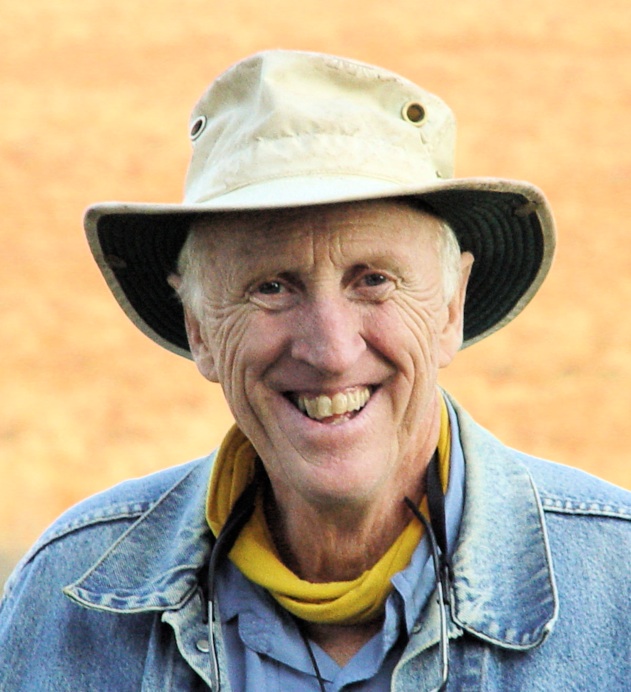
Stanford civil and environmental engineering professor Mark Z. Jacobson and UC Davis researcher Mark Delucchi crunched the numbers and have concluded that if the world used existing technology to convert entirely to electricity (and hydrogen powered by these renewables) by 2030, the world’s power demand would be reduced by 30%, from the expected 16.9 terawatts to 11.5 terawatts.  They base this expected reduction on the premise that fossil fuel and biomass combustion are inefficient, losing up to 80% of the produced energy to heat. With energy produced by electricity, only 20% is lost as heat.

Even without this reduction in world energy needs, the two researchers assert that there is more than enough renewable energy available to meet the world’s needs (their data pegs the potential worldwide energy from wind at 1,700 TW and solar at 6,500 TW).  When difficult-to-reach areas and protected lands are excluded from their calculations, the scientists find at least 40 TW available from wind and 580 from solar.   Currently, they find, we generate only .02 TW of wind and .008 of solar.

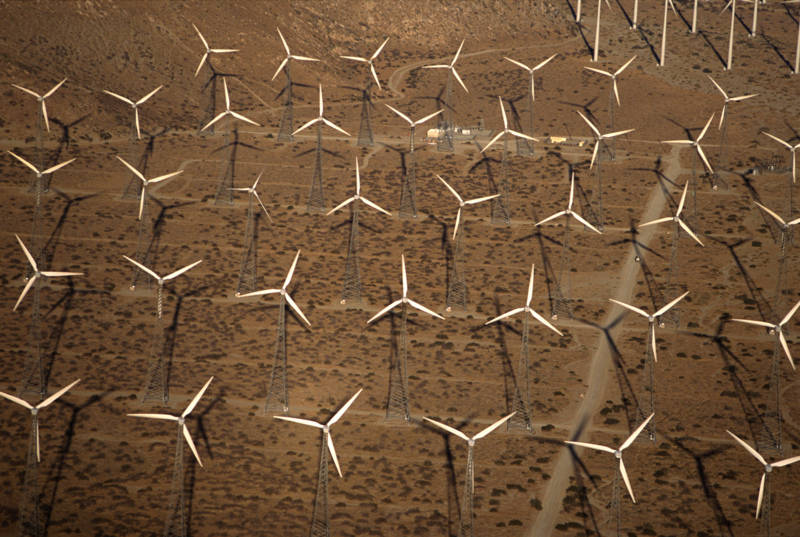
The ambitious plan calls for 3.8 million large wind turbines, which, when spaced appropriately would occupy 1% of the Earth’s land, and 89,000 300-megawatt photovoltaic and concentrated solar power plants, which would occupy .33% of the Earth’s land surface.  The plan also requires 490,000 tidal turbines; 5,350 geothermal plants; 720,000 wave converters; and 1.7 billion rooftop photovoltaic systems.  Less than 2% of these energy producing installations current exist.  The plan also requires 900 hydroelectric plants, of which 70% are currently operational.

“I know it’s possible,” said Jacobson. It’s just a question of whether people want to do it.”

Of course, overhauling the entire world energy economy in 20 years is a Herculean task to say the least, and the researchers are upfront about the obstacles their plan faces.   They concede that not only would there need to be significant political support in the form of feed-in-tariff (FIT) programs, taxes on fossil fuels, and significant investment in long-distance transmission systems, but materials availability could also be a barrier in the long term.

“It’s all a question of politcal will,” said Jacobson. “It’s not a technical problem. If we shifted subsidies to things that are clean, that’s being smart. Why invest in something that puts out more carbon and air pollution rather than something that doesn’t?”

The idea of shutting off all of the world’s coal and nuclear plants and building hundreds of miles of wind farms and solar arrays  is controversial to say the least.  Aside from (not exactly minor) political, social, and economic obstacles, there is the issue of baseload power–what’s available around the clock, rain or shine, to keep the lights on–which we currently draw primarily from nuclear and fossil fuel plants.   Proponents of nuclear power like Stewart Brand argue that until there’s a massive storage system for wind and solar energy, renewables will remain supplemental sources of energy.

Jacobson and Delucchi do address this issue in their article. “Intermittency problems can be mitigated,” they write, “by a smart balance of sources, such as generating a base supply from steady geothermal or tidal power, relying on wind at night when it is often plentiful, using solar by day and turning to a reliable source such as hydroelectric that can be turned on and off quickly to smooth out supply or meet peak demand.”

An Hour with Stewart Brand

Photo by Ryan Phelan

Climate Watch sat down with ecologist and futurist Stewart Brand to talk about the rethinking of “traditional green pieties” that he says environmentalists will have to confront, in order to address climate change. In his new book, Whole Earth Discipline, he argues for a major change in the way “greens” have traditionally thought about stewarding the planet — one that calls for managing the earth’s natural infrastructure “with as light a touch as possible and with as much intervention as necessary.”

What do you think the world is facing in terms of climate change?

“I pretty much buy James Lovelock‘s approach that we’re warming toward an equilibrium of maybe five degrees warmer than now, which doesn’t sound like much, but the last time we were that was 55 million years ago and crocodiles were swimming around in the polar oceans. [Lovelock] thinks the carrying capacity for humans in a world that’s five degrees warmer would be about a billion to a billion-and-a-half people. And it could happen fairly quickly because there are various positive feedbacks that are self-reinforcing, amplification of change going on. A four-or-five-billion person die-back is horrible to contemplate. Nothing like it has ever happened in human history, and it does get your attention.

“I am persuaded by a number of data points he looks at and climatologists he listens to and the system dynamics of climate, which is tremendously non-linear. It has lots of these positive feedbacks in it and various thresholds. Sometimes we know where the threshold is, and sometimes we find out after we’ve passed it. Abrupt climate change, it turns out, is pretty common in the historical record and that’s what we could be looking at this century, maybe even in the first half of this century.”

You write in your book: “Accustomed to saving natural systems from civilization, Greens now have the unfamiliar task of saving civilization from a natural system: climate change.” Can you talk more about this?

“I wonder if there will be people turning up soon saying, “Let the climate do what it wants. Gaia’s just having her usual carryings-on and we must not stand in her way.” [Ed. Note: There are people already saying this] I think when it cuts this close to home, environmentalists do realize that when humans are an endangered species we’ve got to rise to the occasion and be green to protect this species and its habitat as well.

“There’s a shift that goes on because the standard, deep, ideological, emotional stance of environmentalists is that nature is always right and humans are always wrong, and this is a case when actually, nature is up to something we really, really don’t like and we have to do, as humans, something that’s right to head that off. That’s a switch. And it’s my point of leverage in the book which is to say, okay, bear that switch in mind, now think through all the things you’ve had opinions about for 20 or 30 years and revisit them.

“The climate crunch gives us permission, indeed encouragement, to rethink nuclear power, to rethink genetically-engineered food crops, to rethink how we feel about cities, and to start thinking in a serious way and an encouraging way about geo-engineering, which is direct intervention in the climate.”

The idea of “playing God” with nature can raise a lot of emotion and controversy…

“The thing is, we’ve been having god-like power in nature for a very long time, probably at least 10,000 years, maybe 55,000 years when we started doing massive burning to change the landscape in a way that we liked. In ecology, the current term is “niche construction” or “ecological engineering.” We don’t have a choice not to do it because it’s what we are doing. One of the terms for our era geologically is the ‘Anthropocene;’ the human-dominated era of geology. And so we’re already terraforming the Earth, and we’re doing it badly. So, is the choice to stop terraforming the Earth? No. Actually that’s no longer an option. The only choice is to stop doing it badly and start doing it well.”

It’s a large laboratory that we’re talking about in terms of learning from our mistakes, because we’ll be conducting our experiments (geo-engineering, bio-engineering, etc) in the world.

“We’re running an experiment in the world anyway by raising the greenhouse gas percentage in the atmosphere, and we’re starting to get results from that experiment, and we don’t like them, so we’re already doing interventionist science outside the lab in the laboratory of the world. If we don’t like what’s happening so far, we have no choice but to do better experimentation and better science and start getting the results that are better.”

How do you respond to Amory Lovins’ recent article on Grist, criticizing your position on nuclear power?

“I think it’s great that Amory Lovins, who is an old friend, has put up a rebuttal to my chapter on nuclear in the book. I think that’s absolutely fair and right since my whole chapter is basically a rebuttal of his anti-nuclear arguments.* I respect him enormously for most of the things I think he’s right about. I think he’s wrong about nuclear. He thinks I’m right about most things, and that I’m wrong about nuclear, so that’s the debate.”

*Last week we posted highlights from a conversation with Amory Lovins, aired originally on KQED’s Forum program. Brand’s name was not evoked in those excerpts but Lovins was critical of the idea of a nuclear power revival, dismissing it as financially unsupportable.

Governor: RPS Order “Stronger than Law”

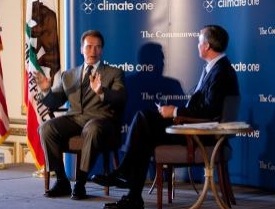
Gov. Schwarzenegger fields questions from Greg Dalton of the Commonwealth Club's Climate One initiative. Photo: Governor's Office

Governor Arnold Schwarzenegger is defending his planned veto of two renewable power bills, saying the executive order he issued instead is “stronger than the law” because it places fewer limitations on electricity imported from other states.

At the tail end of the legislative session, California’s assembly and senate passed separate bills requiring the state’s utilities to draw a third of their energy from renewable sources by 2020. But during a Q&A session at San Francisco’s Commonwealth Club Thursday, the Governor said that the recently passed bills were “for special interests” and that they “represented protectionism,” the latter a reference to limits on how much energy could be imported from neighboring states. The Governor’s own executive order has the same proportional requirement or “renewable portfolio standard” (RPS) as the bills but sets no limits on imported power. Also unlike the legislature’s bills, the order does not exclude particular sources, such as hydro-electric from the definition of “renewables.”

Critics contend that succeeding governors might simply rescind the order, which Governor Schwarzenegger does not deny. He faces an October 11 deadline to veto the bills.

Governor Schwarzenegger’s appearance was designed to mark the third anniversary of the state’s adoption of AB 32, the Global Warming Solutions Act of 2006, a law which has its own detractors.

Meg Whitman, the former CEO of eBay, who is running for governor said last week that she would issue a moratorium on most AB 32-related rules on her first day as Governor.  When asked about  Whitman’s remarks Schwarzenegger dismissed her comments as “just rhetoric.”

“I think she will probably reconsider what she has said and will see that the greatest thing that can happen for California is to move forward. I’m sure she does not want to be counted as one of those Republicans that want to move us back to the Stone Age,” he said.

Touting the state’s achievements in renewable energy innovation, emissions reductions,  and technology, the Governor painted a rosy picture of an invigorated economy, new jobs, and a cleaner environment throughout the state.

“A wave of green innovation is washing over our state right now,” he said.  “In last three years,  scientists and entrepreneurs have pumped more than $6 billion of venture capital into California.  Since 2005, green jobs in California have grown ten times faster than other jobs. California companies hold more than 40% of the nation’s new patents in solar and wind technology, and solar installations this year alone in California have gone up by 120%.”

Focusing largely on projected economic benefits, he made a case for continuing on the path California started three years ago with AB 32 and is continuing under his executive order from earlier this month, saying that the current path offers far more economic opportunity than economic risk.

“I know that it’s possible to protect the environment and the economy at the same time,” he said. “Technology will save us all. It’s all about technology, technology, technology. ”

Not all of the speech was about legislation, green technologies and the economy, however. The Governor did respond to a question from  group of fourth-graders attending the talk, asking what he says to his children about climate change.

“I’ve had major fights with my kids,” he said.

He said he has imposed a five-minute shower rule in his house and that he sometimes “spies” on his children to make sure they are obeying his order.

“If their showers are more than five minutes, there will be consequences.”

He added that other environmental steps his family has taken at home are to install solar panels nearby to provide energy for the family swimming pool and jacuzzi, and that they have converted the regular engines on their Hummers to hydrogen or bio-fuel engines.

Seeding Clouds for Hydropower

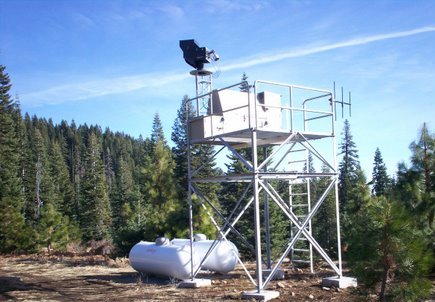
PG&E cloud seeders located near Burney Falls, CA. Photo: PG&E

Christina Aanestad’s radio feature for Climate Watch airs Monday morning on The California Report.

Wringing Hydropower Out of the Clouds

By Christina Aanestad

When cloud seeding began in the 1950’s there were no laws governing weather modification. According to Maurice Roos, Chief Hydrologist with the state Department of Water Resources (DWR), it wasn’t until the late 1970’s when a storm in a seeded area near Los Angeles flooded, that regulations governing weather modification were included in the state’s water code. In the West, “Most of the states have legislation that governs the conduct of weather modification activity,” says Brant Foote, director of the Research Applications Lab at the National Center for Atmospheric Research (NCAR) in Boulder, Colorado.

Government oversight has changed over the years. Today in California, state regulations have slackened. “As for the State’s role, it is mainly informational. There are no permits or licenses,” said Roos. According to Roos, all cloud-seeding projects required permits until the law was reformed. “The old law required licenses and permits but it was repealed in the 1980’s. There was a general move toward deregulation in the government–mainly to reduce costs.” Today, according to Roos, Sponsors of cloud-seeding projects must notify DWR and county governments of the project, “This can be a letter or, for DWR, an e-mail notice,” he said. “They also have to publish a Notice of Intention in the county or counties affected by their proposed operations.”

Most of what this reporter learned was from Roos’ institutional memory, and going directly to sponsors of cloud-seeding operations–about 15 intermittent projects around the state. Data on cloud seeding at the state level is scattered, according to Roos. “We used to have an annual report that was published. Last time I tried to find it, it was in an archived box and nobody knew where it was,” said Roos, who added that budget cuts and deregulation mostly gutted the oversight program.

Despite lax oversight, the State of California wants to use weather modification as part of its 2009 Water Plan, which states:

“Cloud seeding has advantages over many other strategies for providing water. A project can be developed and implemented relatively quickly…it could offset some of the loss in snow pack expected from global warming.”

According to the plan, some regulation remains: weather modification sponsors need to comply with the California Environmental Quality Act [CEQA]. But not all seeding has to comply with environmental regulations. PG&E contends that an environmental impact report is not required for its Pit-McCloud River project because it is privately funded, with equipment on private lands,” said Roos.

That has locals groups near Mount Shasta concerned with PG&E’s proposed project in the Pit and McCloud River watersheds. “It’s a clear unequal treatment between public agencies and private entities,” said Angelina Cook with the Climate Council and the Mount Shasta Community Rights Project. “Private corporations require more government oversight and regulation to ensure accountability for the their practices.” But compiling all cloud-seeding data in California into one reference source today would be “a labor of love,” says Roos. “There’s no funds for it,” he said.

Cook says she is working on a cloud-seeding ban in Mount Shasta City, which may include a chemical trespass for silver iodide, the common chemical used in cloud seeding. “If silver iodide is found in the area, PG&E would be liable,” said Cook.
But Roos, who says cloud seeding is mostly benign, asks where one would draw the line. “There’s all kinds of influences on the air like people driving their cars, diesel trucks running around,” said Roos. Just as California has increased its regulations on air emissions in the state, some like Cook would like to see tougher regulations for weather modification as well.

Meanwhile, the state’s 2009 water plan also urges more research and development into cloud-seeding. Research could include cloud seeding’s impact on global climate change, and it’s effectiveness. The plan also identifies areas that could provide optimal results from cloud seeding, mostly in Northern California, along the Sacramento, Trinity and Russian Rivers.

Cloud Seeding Projects in California

View Cloud Seeding Projects in California in a larger map

To find references to cloud-seeding in the state’s water plan, look under Volume 3, then for “Precipitation Enhancement.”

Major Shifts in California Bird Movements

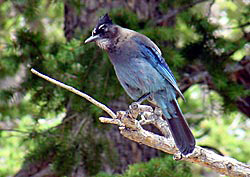
Stellar's Jay,  Photo: National Park Service
Stellar's Jay. Photo: National Park Service

Climate change has California’s birds on the move, but not in the usual direction or at the same pace, a new study has found.  Research suggests that warming temperatures and changing precipitation patterns will cause bird species distributions to shift independently, resulting in new bird “communities” appearing in up to half the state.

In some cases, these new communities will create combinations of birds that have never existed before, a situation that could disrupt the delicate balance of species interactions with potentially unanticipated consequences for whole ecosystems, the report authors concluded.

One of the co-authors, Stanford biologist Terry Root, told Climate Watch: “This will not be just a few species in a few locations–this tearing apart of communities could be quite extensive across California.”

Root was among  researchers from Stanford’s Woods Institute for the Environment, PRBO Conservation Science, the University of California-Santa Cruz, and the Klamath Bird Observatory, who collaborated on the study.  They used bird survey data and climate model projections for California to map current and future bird distributions for 70 species.  Many species often found together, such as acorn woodpeckers and western bluebirds, are projected to shift and adapt in different ways, resulting in these new assemblages.

PBRO has posted interactive maps of the future projections for individual species distributions on its Climate Change, Birds, and Conservation website, in the section called “Where will the birds be?“.

The study authors, including Terry Root of Stanford and Diana Stralberg and John Wiens of PRBO, write that the emergence of new bird communities in the coming decades present enormous conservation and management challenges.  They assert that rapidly changing habitats and ecological communities are going to require new approaches to conservation and management. “As new combinations of species interact, some species will face new competition and/or predation pressures, while others may be released from previous biotic interactions,” they wrote. “Managers and conservationists will be faced with difficult choices about how, where, and on which species to prioritize their efforts and investments.”

Root pointed to experience with wolves, coyotes and foxes, in which wildlife managers tried to control one,  only to see unexpected spikes in the population of another: “Here is a community of only 3 canines to which we purposely forced changes, and we had two big surprises.  Now we are talking about 70 species of birds shifting without any control of the force or the species being changed.  I guarantee there will be a lot of surprises.”

Stanford Studies Clean Coal Tech for China

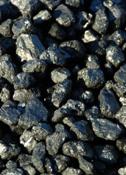
coal_blogChina, the world’s largest emitter of CO2, is the focus of a new $2 million investment in clean coal technology research by  Stanford’s Global Climate and Energy Project (GCEP).
The project will fund research into large-scale carbon sequestration in underground geological formations. China relies heavily on coal for electricity generation and in 2006 was reported to be building the equivalent of one new coal-fired power plant every week.

“China is growing so rapidly, and if they’re going to be able to lower their emissions, they are going to need a whole suite of technologies,” said Sally Benson, director of GCEP.  “They are doing a lot with solar technologies and energy efficiency but China is not abandoning coal.  So, we’re looking for ways they can reduce their emissions from coal.”

The three-year project is an international collaboration among the University of Southern California (USC), Peking University (PKU) and China University of Geosciences at Wuhan (CUG). It will focus on the technical aspects of stashing carbon in saline aquifers, such as chemical reactions between the rock and carbon and understanding what portions of the aquifers can actually be filled up.  The research will involve 39 scientists and students, and will integrate geological modeling, reservoir simulation and laboratory experiments.   The results may shed needed light on China’s overall carbon storage potential.

“Saline aquifers have been shown to have the biggest storage capacity across the world,” said Benson, “and China has a tremendous need.”

China’s not the only country with a tremendous need.  As the second largest emitter of CO2 (and still bigger than China per capita), the United States has yet to deploy large-scale CCS. Yesterday, the U.S. Department of Energy announced $27.6 million in new funding for 19 projects exploring potential carbon storage technologies.

Unlocking the Grid

Sarah Kass was the program producer for Unlocking the Grid, a collaboration between Climate Watch and KQED’s Quest program, which airs tonight at 7:30 on KQED Channel 9.

Wind Power: A Personal Perspective

By Sarah Kass

Last summer I visited the Netherlands, the original home of the windmill. Surprisingly, I saw hardly any of the quaint structures we associate with Dutch wind power. One hundred years ago Holland had about 10,000 wooden windmills dotting its landscape. Today, barely 10% remain. What I saw instead were high-tech wind turbines, white and spare and gracefully generating electricity with wind from the North Sea.

Many view these modern-day towers as an eyesore, but I see them as a sign of hope. Like giant flowers across a landscape, they symbolize for me a clean energy future. But wind power–and solar–have a handicap that fuels doubts that renewables will ever be more than a small percentage of U.S. power. These energy sources can’t be counted on when night falls or the wind subsides. Their inconsistent nature poses a problem for a world with an enormous appetite for electricity. If only excess power could be stored on a grand scale, it might solve many of our energy problems.

It isn’t that electrical energy isn’t currently storable, but as Andrew Tang, Senior Director of PG&E’s Smart Meter program points out, the current generation of batteries can’t store electricity at a price that’s cost-effective. But both he and Steve Berberich from California System Operators were optimistic about future storage possibilities. Tang described an experimental project that uses a sodium sulfur battery the size of an 18-wheeler trailer. The battery would be located next to a substation or somewhere in the network, and its stored power would be used during times of peak demand. He also talked about the future of plug-in electric cars, whose batteries could both store energy and in theory, put it back onto the grid when the car’s not in use.

Berberich envisioned several possibilities for storing excess power. He proposed converting it to hydrogen, which could be burned in a gas plant or could be used in a fuel cell. And he suggested using power to compress air, which could be injected into the ground and called upon when the wind’s not blowing and the sun’s not shining.

Whatever the final solution to storage, you can guarantee it will be a game changer in the renewable power industry. No longer will wind and solar be looked upon as unreliable. Hopefully this missing puzzle piece will go a long way toward helping us detach from our dependence on fossil fuels. But we’ll still be left with the challenge of getting all that clean, green energy onto the power grid. And you can be sure that environmental concerns, zoning, aesthetics, and cost will undoubtedly be cantankerous issues for years to come.

Watch the TV show online, and view exclusive web-only videos on energy-saving technologies for the home on Climate Watch’s Smart Grid special series page.

California Climate Champions Abroad

Jason Bade

Jason Bade is a 2009 California Climate Champion from Foster City, who graduated from Aragon High School in June.  In this post, Bade reports on his trip to Germany earlier this month, where he met with other young activists from across the globe, to discuss strategies for combating climate change.

World Youth Coalesce Around Climate Goals

By Jason Bade

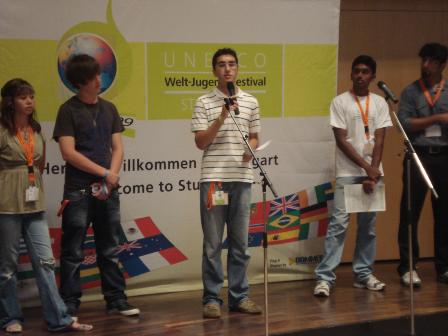
Greetings from Stuttgart, Deutschland! I’m here attending the UNESCO World Youth Festival. Essentially the festival is a chance for youth from all over the world to exchange ideas and culture as well as to be educated on particular issues affecting the world.

For two of the days, there was a World Youth Congress, which focused on energy and climate change. I was one of fourteen International Climate Champions from six countries who came to help lead the climate change workshops, speak at the opening ceremony, and formulate the Stuttgart Declaration [PDF], the ultimate goal of the conference.

On Wednesday evening, several ICCs and I spent time with staff from the festival to formulate all the ideas born in the workshops into that single, cohesive document. In it, we detail a call to action from the youth of the world to the business community, the science community, our elected leaders, and ourselves, in which we expound on what we feel must be done by each respective group, in order to effectively combat and adapt to climate change. The Declaration was then presented on Friday to a local representative from each of those communities in Stuttgart.

While the document itself may contain no groundbreaking concepts, the fact that such a diverse crowd of youth assembled to discuss solutions to these problems–without attention to national pride, patriotism, or selfishness–is significant. Regardless of the actual substance produced on paper, the real benefits of this festival are the connections and friendships made among youth of such myriad cultures. It is when people have these experiences early in their lifetimes that they grow up to treat and respect others’ cultures with zeal unseen in those who have only been confined to their own people. It was an experience I wish others could only be so lucky to enjoy!

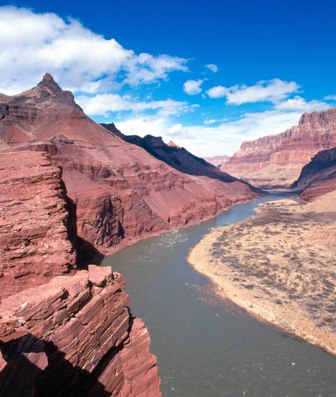
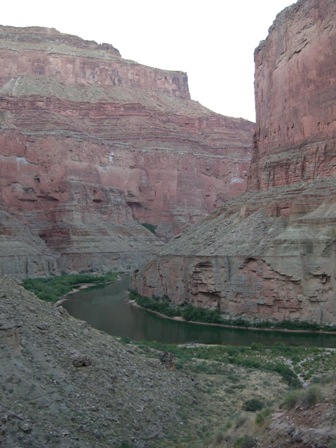
Threats to Colorado River Water Supply

Photo: National Park Service

The Colorado River supplies water to approximately 27  million people in seven states and irrigates more than three million acres of farmland. In Southern California alone, it supplies 18 million Metropolitan Water District customers with 40 percent of their water.

So last year, when a study out of Scripps Institution of Oceanography reported that there’s a 50 percent chance that the Colorado River’s largest reservoir (and the largest reservoir in the United States), Lake Mead, will be dry by 2021, the news generated a lot of buzz.

But a new study out from the University of Colorado Boulder finds that despite a 10-year drought in the Colorado River system, the odds of draining the river’s delivery system before 2026 are pretty slim — below 10% in any given year.  Researchers say this is primarily due to the massive reservoir storage capacity along the Colorado — more than 60 million acre feet, which includes Lake Mead.  The reservoir system of the Colorado is currently at 59 percent of capacity, according to the study.

But the scientists predict that by mid-century, the Colorado could become less reliable unless water-management strategies change.

The researchers found that if climate change causes a 10 percent reduction in the Colorado River’s average stream flow as some recent studies predict ([PDF]), the chances of fully depleting the system’s reservoirs will exceed 25 percent by 2057.  If there is a 20 percent reduction in stream flow, the chances of deleption rise to 50 percent.

“On average, drying caused by climate change would increase the risk of fully depleting reservoir storage by nearly ten times more than the risk we expect from population pressures alone,” said lead study author Balaji Rajagopalan in a press release about the study.

The authors of the study conclude that the magnitude of the risk will depend not just on the amount of drying the region experiences, but also the types of water management and conservation strategies that are implemented in the near future.

For the last decade, California’s annual use of Colorado River water has varied from 4.5 to 5.2 million acre feet.

Photo by Adrian Fogg
Photo: Adrian Fogg