
All posts by Gretchen Weber

Stop and Count The Poppies

ca_poppy2Here’s a new reason to take time to stop and smell the roses. Or at least count them.

A consortium of scientists called the USA-National Phenology Network (USA-NPN) is recruiting volunteers from across the country to help track the effects of climate change on ecosystems.

Described by executive director Jake Weltzin as a project “for people interested in participating in climate change science, not just reading about it,” the network will collect data from government, academic, and “citizen” scientists to track the life-cycles of more than 200 plants, including California Poppies and Ponderosa Pines.  The project will begin tracking animals next year.

Phenology is the study of the seasonal cycles of plants and animals, such as plants sprouting, flowering and fruiting.   Abrupt changes in these patterns, due to climate change or other reasons, can be extremely disruptive to ecosystems.

USA-NPN hopes that the data collected will help scientists and resource managers “predict wildfires and pollen production, detect and control invasive species, monitor droughts, and assess the vulnerability of various plant and animal species to climate change. ”

Weltzin said that he hopes 100,000 citizen scientists will volunteer to help with the project.   Detailed information on how to participate is located at www.usanpn.org.

Listen here to an interview with Weltzin about the project on the U.S. Geological Survey’s website. Look for episode #85.

PG&E Proposes New Solar Initiative

PG&E plans to produce up to 500 megawatts of new solar power over the next five years according to a plan announced by the California utility on Tuesday.  The project will focus on northern and central California and by 2015 is expected to deliver more than 1,000 gigawatt hours of power each year, equal to the annual consumption of about 150,000 average homes, according to the company. solar-panel

The proposal, which needs approval from the state Public Utilities Commission, calls for half of the new solar power to be generated by PG&E and the other half and to be built and owned by independent developers.

Rather than establishing a giant solar array in the desert and then having to transmit the energy huge distances before it can be used, this project takes a “solar infill” approach, which uses small or mid-sized installations located within PG&E’s service area to minimize the cost and delays of connecting them to the grid.

PG&E estimates that the project will meet 1.3 percent of the utility’s energy demand and will add $.32 to each PG&E customer’s monthly electricity bill.

For more, see this in-depth article from Greentech Media.

Was 2008 Relatively Warm or Cool?

Answer: Both. It depends on your historical time frame.

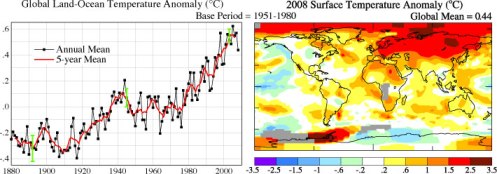
With a global average surface temperature of 79 degrees Fahrenheit, 2008 was the coolest year since 2000, according to climatologists at the NASA Goddard Institute for Space Studies (GISS). But it’s also the ninth-warmest year since 1880, so it’s probably not time to invest in a ski resort just yet.

Including the 2008 dip, the 10 warmest years on record (since 1880) have all occurred between 1997 and 2008, according to NASA.

The NASA scientists attribute 2008’s relatively lower temperature to a cooler Pacific Ocean, due to a strong La Nina pattern in the first half of 2008. La Nina and El Nino are opposite phases of a natural oscillation of  upwelling and subsequent temperatures in the equatorial Pacific Ocean.

2008 temperatures in the United States were cooler than any other year this decade, but, as illustrated on the map below, other parts of the world such as Eurasia and the Arctic were exceptionally warm.

Director of GISS James Hansen predicts that because a shift to El Nino is expected to start this year or next, it “still seems likely” that we’ll see a new record high for the average global surface air temperature in that time frame.

smallmain_graph_temp_lg1

The Cost of Ignoring Climate Change

sunheat_smMuch of the debate over addressing climate change hinges on the cost of proposed mitigation efforts.  Some say we can’t afford the extraordinary measures required to cut greenhouses gases, particularly in the current economic train wreck.  What gets less attention is the cost of doing nothing.
This has been a controversial idea since the Stern Review called attention to the issue in 2006. That report concluded that unless one percent of global GDP was diverted to mitigate the worst effects of climate change, the world could lose up to 5% of  global GDP each year and the total damage could claim as much as 20%.

A set of new reports out of the University of Oregon inserts fresh numbers into the debate. According to researchers, three western states are each likely to lose more than $3 billion a year in climate change-related costs by 2020, if nothing is done to reduce greenhouse gas emissions.  By 2080, the projected annual costs range from $9-to-$18 billion for each state.

The reports, which focus on Washington, Oregon, and New Mexico, assume a business-as-usual scenario where both carbon emissions and temperature continue to rise at rates similar to those seen in recent years. Under these conditions, these states (and California, according to the prevalent research) can expect more severe droughts and floods, less snowfall,  more wildfires and habitat loss, and a higher incidence of climate-associated health problems and deaths.

In New Mexico, the study’s authors expect summer temperatures to climb 12.6 degrees above current averages by 2080,  spiking air-conditioning costs, health-care complications, and the state’s death rate.  By 2020, annual climate-related health care costs in New Mexico alone are expected to top $1.3 billion.

California’s temperatures, under business-as-usual scenarios, are widely expected rise between six and ten degrees by the end of century.  Even in a relatively cool state like Washington, health care impacts would make up $421 million, or 32%, of total annual climate-related costs, under this pr0jection.

The study attributed the largest costs (more than $1 billion annually in each state) to inefficient consumption of energy, a projection that might not pan out, given the Obama Adminstration’s focus on green technology and clean energy efforts.

Other costs cited by the study include reduced salmon populations and food production, lost recreational opportunities (sell your snowboard now), and more intense and frequent wildfires and storms.

Thin Climate Strategy in Bay Area Transit Plan

3273414070_fd61bfa09a_mThe new Draft Transportation 2035 Plan released Wednesday by the Bay Area’s Metropolitan Transportation Commission calls for $226 billion in spending over the next 25 years to “confront global warming and traffic congestion.”  But close up, the plans seems more like a sorely needed band-aid to patch up the region’s ailing transit infrastructure.  Fully 82% of the plan’s funding is designated for upgrading and maintaining the existing system, with 13% allotted for transit expansions.

The plan includes $400 million (0.2%) for a “Transportation Climate Action Campaign”  to raise public awareness about climate change and individual actions that residents can take to reduce the region’s carbon footprint. The campaign will also include a grants program to subsidize demonstration projects  for reducing auto emissions with alternative fuels or car-sharing projects.  An additional $1 billion is set aside for bicycle facilities and programs.

But when, by the MTC’s own numbers, 40% of the Bay Area’s emissions come from the transportation sector, $1.4 billion to fight greenhouse gas emissions seems paltry given that this is the plan to carry us through to 2035. By law, California’s greenhouse gas emissions need to be reduced approximately 30% by 2020.

MTC Executive Director Steve Heminger said the plan “tees up two strategies that we have consistently indentified as the most important in making progress in reducing environmental emissions like CO2, in reducing vehicle miles of travel, and those are road pricing, and a better link to land use without transportation investment.”

The idea is that reducing traffic congestion by increasing the cost of driving, be it with higher bridge tolls or charging drivers to use HOV lanes,  greenhouse gas emissions will decrease.  And by upgrading aspects of the region’s transit system, more people will choose to forgo the car and opt for public transit.

“From an infrastructure perspective, I think this plan is about as climate positive as it could be,” said Heminger.

Use the audio players to hear Heminger explain how the plan attacks climate change:


The End of Ag? Chu Drops a Climate Bomb

arizona-drought-small.jpgHigher temperatures and drier conditions could destroy California’s vineyards by the end of the century if Americans do not act fast to slow global warming, Secretary of Energy Stephen Chu said Tuesday in his first interview since joining the Obama cabinet.  Chu, a California native, warned that increased water shortages in the West and a loss of up to 90 percent of the Sierra snowpack are likely to have a severe impact on the state’s agricultural industries as well as California’s cities.

“I don’t think the American public has gripped in its gut what could happen,” Chu told the Los Angeles Times.  “We’re looking at a scenario where there’s no more agriculture in California.”

Californians may appreciate this kind of attention in Washington to what is shaping up as potentially the worst drought in the state’s history.  The California Department of Water Resources reports $308.9 million in agricultural losses last year due to drought in the state, and if January was any indication of what’s to come, that number will be even higher for 2009.  The Santa Rosa Press Democrat reports that grape growers in the counties of Sonoma and Mendocino are facing a difficult choice this month as they decide whether to use some of their reduced water allotments for frost protection. With such a rapidly dwindling supply, water used now could mean none for irrigation later in the season.

This morning on KQED’s Forum, California water experts discussed the direness of the situation and the probability of water rationing and other measures to deal with it.

The California Department of Water Resources website has extensive information about drought conditions and mitigation efforts across the state, including this fact sheet updated for January 2009.

Photo by Reed Galin

AB 32: It’s All About the Numbers…or Not

3239422267_691b4f3488_m.jpgWith its legal mandate to reduce greenhouse gas emissions approximately 30% by 2020, California leads the nation in plans to combat climate change. But unlike Gov. Schwarzenegger and Al Gore, not everyone thinks reaching 80% of current emissions levels in 11 years is a plausible target.

At a U.S. Fish and Wildlife Service conference this week in San Francisco, Stanford professor Stephen Schneider called the 2020 target “an impossible dream” and argued that setting unrealistic targets such as this one could ultimately hurt the emissions reduction process by reducing credibility, and perhaps, momentum.

Schneider, a member of the U.N.’s Intergovernmental Panel on Climate Change (IPCC) and a senior fellow at Stanford’s Woods Institute for the Environment, said that instead of focusing on specific percentages, policymakers should be focused on investing in the right technologies so that by 2020, our economy will be ready and able to handle a sustainable, long-term reduction in emissions.

“We need to get off the numbers and get on (the) investments,” said Schneider. “We’re not going to be credible if we get focused on something that can’t happen.”

Proponents of AB 32, like Google CEO Eric Schmidt, argue that the goals set by California’s 2006 Global Warming Solutions Act (AB 32) will foster clean energy technology–the type of investment that Schneider advocates. No one denies that reaching the 2020 target will be a challenge. And earlier this month California Air Resources Board Chair Mary Nichols seemed to echo Schneider’s sentiments when she told VerdeXchange News that rather than using the AB 32 as a “counting game,” the the goal “is to achieve real transformation in our energy economy.” She cited the requirement that the law be updated every five years, thus leaving room for a mid-course correction down the road.

Read the full Nichols interview here.

California Lobbies for Early Action on EPA Waiver

cars.jpgWasting no time, California officials sent letters to the Obama Administration on its first day, asking that the EPA approve the state’s request for a Clean Air Act waiver, which would allow California to set stricter standards for passenger vehicle greenhouse gas emissions.

As Sasha Khokha recently reported for The California Report, Sacramento requested the waiver from the EPA in 2005, only to see it denied in March 2008, a move that has blocked the state from enforcing its own laws designed to reduce tailpipe emissions.  The state has been fighting for the waiver for the last year along with several other states that have adopted the same regulations.

If granted, the waiver would allow California to take steps to reduce emissions from passenger cars 30 percent by 2016.

In his written appeal, Gov. Schwarzenegger asked that President Obama “direct the EPA to act promptly and favorably on California’s reconsideration request so that we may continue the critical work of reducing greenhouse gas emissions and their impact on global climate change.”

California Air Resources Board chair Mary Nichols also spoke out Wednesday, in a letter to the new designated EPA head Lisa Jackson, stating that “the decision made by the former adminstrator to deny  California the waiver to enforce our clean air car laws was flawed, factually and legally, in fundamental ways.”

At her confirmation hearing, Jackson said only that she promised a “speedy review” of California’s waiver issue.

This fact sheet from CARB explains more about California’s emissions standards for cars and the agency’s take on the waiver controversy.

Methane Sources and the “Dark Side” of Solar

plants.jpgPlants don’t produce methane after all, a new study out of the UK contends.  The results refute a 2006 report that suggested plants could account for almost half the world’s production of this potent greenhouse gas. But according to authors of the latest study, plants are more like little methane pipelines; they convey methane from the soil to the air, but they don’t actually produce it.

No one said that climate change was simple.

Neither are the solutions, apparently.  An article in the LA Times reports on the “dark side” of solar, outlining the toxic materials used in cells, the difficulty of recycling some components, and the fossil fuels burned in the production and transportation process of cells and panels.

And don’t let this weird weather confuse you either.  As the Thin Green Line reports, this week’s freezing temperatures in the Midwest don’t mean climate change isn’t happening.

Primer: Climate Change in the San Francisco Bay Area

baynaturegraphic.jpgFor a fairly comprehensive overview of how climate change is affecting the San Francisco Bay Area, check out “Taking the Heat,” a new special supplement from Bay Nature magazine, written by former San Francisco Chronicle environmental reporter Glen Martin. The report focuses on the region’s landscape, watershed, and ocean ecosystems, and it highlights specific climate change research being done in the Bay Area.

David Loeb, Bay Nature’s publisher and editor of “Taking the Heat,” said that conservationists need to be considering climate change as they develop projects to restore habitats and save endangered species.

“The fact is, climate change is a wild card,” said Loeb. “It’s not just straight warming.  There is unpredictability.  As we go about restoring ecosystems, we need to take that unpredictability into account.”

Illustration from the supplement by David Fierstein.