Craig is a former KQED Science editor, specializing in weather, climate, water & energy issues, with a little seismology thrown in just to shake things up. Prior to that, he launched and led the station's award-winning multimedia project, Climate Watch. Craig is also an accomplished writer/producer of television documentaries, with a focus on natural resource issues.
Electrical generation may be changing the climate but the reverse is also true
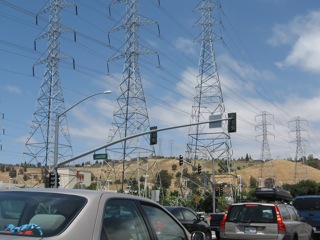
As temperatures rise, the power grid stands to become less efficient. Transmission lines could lose 7-8% of their peak carrying capacity by 2100.
Planners, policymakers and scientists are starting to look more closely at the crossroads of climate change and energy production in California.
For years the focus has been on how energy production affects the climate through emissions of greenhouse gases. Now the converse has come center stage: What happens to energy production in a changing climate? Some heavy-hitters in California climate and energy circles gathered at the California Energy Commission this week, to weigh the question. Some highlights: Continue reading Where Climate and Energy Intersect: The Flipside→
But communities that depend more on rain, less on the snowpack are looking good
In mid-January, much of the Sierra remained snowless.
Despite what felt like a late-season deluge, this will go down as a dry winter in California’s record books.
The season’s final survey of the Sierra snowpack by California water officials confirms that even heavy spring rains and fresh mountain snow as recently as last week didn’t make up for a late start to the rainy season and one of the driest Decembers on record. Today’s survey finds water content of the mountain snow at just 40% of the long-term average. That puts four out of the last five years on the dry side, though last year was a gullywhumper. Continue reading California Winds Up “Wet” Season on the Dry Side→
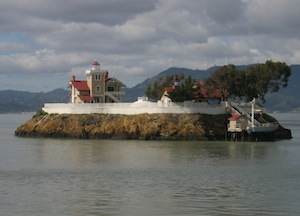
East Brother Island, with the 19th-century lighthouse on the left and fog signal building on the right.
On foggy mornings, I wake up to a faint symphony of foghorns. From my condo on a windy bluff above the Mare Island Strait, the horn on the Carquinez Bridge is the bassoon in the back row, accompanied by the assorted boops and beeps of all the other fog signals within earshot of where the Sacramento River empties into San Pablo Bay.
But the orchestra plays a different tune than it did in decades past. Technology and politics are changing the navigational soundscape of coastal America. Complaints from coastal residents about the repetitive blasts of sound and modern electronic navigation aids have relegated the foghorn to a lesser role in the maritime chorus. Continue reading Foghorns and the Changing Coastal Soundscape→
There was talk on Friday of this being a “record number” but Riley says the Weather Service doesn’t actually track that. It happens that a forecaster in Monterey added up the strikes from this event that showed up on NASA’s Lightning Detection Network. Riley says that figure includes only “ground strikes,” not the bolts that travel cloud-to-cloud. Continue reading Lightning, Twisters, Snow and Waterspouts (Oh My)→
A reluctant combatant in the “Climate Wars” has learned to embrace the role
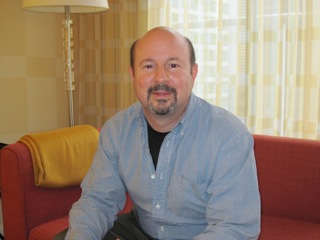
Michael Mann, the climate scientist, not the movie director.
Anti-intellectualism isn’t a new phenomenon in America. But the current war of words over climate science has taken on the tone of a religious war. Comments on this very blog often testify to that. As some scientists have discovered, the war has escalated beyond words, to tactics that include espionage, intimidation, and even attempts at prosecution.
UPDATE: Founder asks for leave of absence in the wake of impersonation scandal
Founded in 1987, the Pacific Institute is housed in this Oakland Victorian.
ANALYSIS
The old blue-and-gray Victorian in Oakland’s preservation district is familiar turf for me and other journalists on the resources beat. It’s long been a place we could rely on for solid information and interviews.
The analysts who inhabit the rabbit warren of offices at the Pacific Institute are doing honest work on issues that are critical to the future of California and the West, notably where our water will come from. There are few issues more deserving of study than that one.
California could benefit from the controversial technology behind “clean coal”
It's not just for coal: Natural Gas-fired power plants could use carbon capture technology, too.
A prominent researcher says it would be foolhardy to abandon plans to siphon off the carbon dioxide from industrial emissions and store it underground. The concept, known widely as “carbon capture and sequestration,” or CCS, has been a slow starter in the U.S. In fact, worldwide, there are only a handful of working projects.
“It never had a chance,” said Sally Benson, following a panel at a major science conference. Benson directs the Global Climate & Energy Project at Stanford University, and is a proponent of CCS — though she says companies that were leading the charge are now “wavering.” She told me that the 2010 UN climate talks in Copenhagen were a turning point; when it became apparent that governments weren’t about to put serious restrictions on carbon emissions, she says investors backed away from CCS, which is still in the pilot stage of development and very pricey. Continue reading Are We Giving Up Too Soon on Carbon Capture?→
Given the forecast for the final week of February, now it really is down to a “March Miracle” to salvage the California water season.
So this time they didn’t even wait for the next snow survey. Water managers are pulling back on estimates of how much water they’ll deliver to contractors on major water projects. With winter precipitation running about half of normal, today the California managers set probably deliveries at half of what contractors (mostly irrigation districts) on the State Water Project are asking for — that’s ratcheted down from 60%. Continue reading California, Feds Ratcheting Back on Farm Water→
New research includes first-ever global death toll from landscape fires: more than 300,000
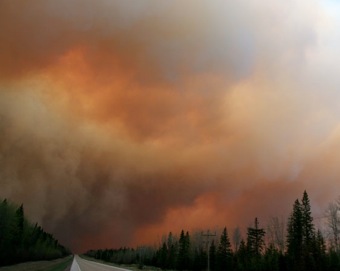
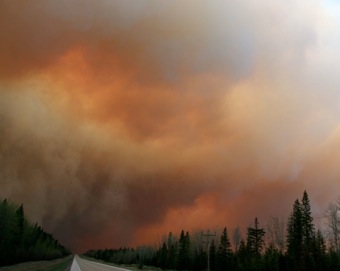
Flames and smoke from the 2011 Slave Lake fire in Alberta. Evacuations are likely to increase, partly from smoke.
Research continues to suggest that this century will be a brutal one for wildfires.
The reasons seem pretty straightforward: “The warmer it gets, the more fires we have,” fire scientist Mike Flannigan told reporters at a major science conference in Vancouver this weekend. Flannigan is a professor at the University of Alberta and also works for Canada’s natural resources agency.
Flannigan says fires already claim an area roughly the size size of India each year (If you’re wondering how that’s even possible, he says the acreage includes grasslands, which can actually burn more than once a year). And he says the toll will rise, driven by three main factors: Continue reading Wildfire Trends: You Ain’t Seen Nothin’ Yet→
Combined QUEST/Climate Watch unit wins for its report on rising seas
A team of producers and editors at KQED was honored this weekend with a prestigious Kavli Science Journalism Award. Only a few projects are selected each year by the Washington-based American Association for the Advancement of Science.
The KQED team, a collaboration of the QUEST and Climate Watch science reporting units, was recognized in the Television Spot News/Feature Reporting category for its segment on rising sea levels in the San Francisco Bay Area.
In its announcement last fall, AAAS noted:
“The QUEST/Climate Watch co-production ‘used the visual medium of television effectively as it laid out the facts—and uncertainties—surrounding rising sea levels,’ said Richard Harris, a science correspondent for NPR who served as a judge.”
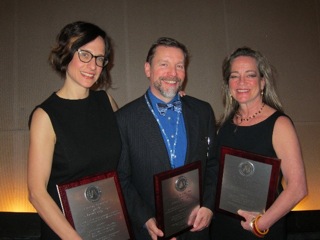
L-R: Amy Miller, Craig Miller, and Rachel Silverman represented the QUEST/Climate Watch team at the Kavli Awards in Vancouver.
Rachel Silverman produced the segment, which I reported. Others honored included QUEST TV series producer Amy Miller, managing editor Paul Rogers, associate producer Lindsay Kelliher, and video editor Linda Peckham.
During the segment, we join scientists for some mud coring along the Marin bayshore, to document prehistoric sea level patterns, review projections for sea levels over the next several decades, talk to urban planners in Hayward who are grappling with decisions on how to protect infrastructure, and visit with residents of the tiny South Bay hamlet of Alviso, which sits several feet below current sea level.
The awards, funded by an endowment from the Kavli Foundation, were announced in November and presented this weekend at the AAAS annual meeting in Vancouver. Winners are chosen by independent panels of science journalists.
Another winner for climate coverage was Christine Peterson of the Caspar Star-Tribune, who, with Kerry Huller and Wes Watson, reported on receding glaciers in Wyoming.