All posts by Craig Miller

Craig is a former KQED Science editor, specializing in weather, climate, water & energy issues, with a little seismology thrown in just to shake things up. Prior to that, he launched and led the station's award-winning multimedia project, Climate Watch. Craig is also an accomplished writer/producer of television documentaries, with a focus on natural resource issues.

The “Magic Dust” that Brings More Sierra Snow

Dust from across the Pacific seeds Sierra snowflakes

Researchers found that heavy snowfall in the Sierra is connected to the amount of dust floating over from Asia.

In a weird twist on the “butterfly effect,” evidence is that Asian dust storms can mean more snow in the Sierra. The strange finding surfaced in research by scientists working on NOAA’s CalWater program. Scientists compared two Sierra storms, and found the one that contained dust particles from Asia had 40% more precipitation than the one that did not. The other storm had more particulate matter from sources in California, for instance, from burning trees or grass.

The researchers, including Kim Prather and Doug Collins from the Scripps Institute of Oceanography at UC San Diego compared the two storms from the air.

Continue reading The “Magic Dust” that Brings More Sierra Snow

Leaked Documents Describe Corporate Agenda to Discredit Climate Science

Bay Area climate scientist named in disputed document

The climate corner of the Blogosphere exploded this week with the alleged leak of numerous documents from one of the nation’s most ardent opponents of action to slow global warming.

It started when DeSmogBlog published a series of documents that its editors said were leaked to them, revealing much of the playbook for the Heartland Institute. If authentic, the documents would validate longstanding complaints that corporate interests have been bankrolling a deliberate campaign of disinformation, aimed at casting doubt on legitimate climate science, and that Heartland has been an important channel for this campaign. Continue reading Leaked Documents Describe Corporate Agenda to Discredit Climate Science

Dunno Much about Hydrology: Californians Clueless about Delta’s Role in Their Water

Most respondents statewide said they knew nothing about the Delta or hadn’t heard of it

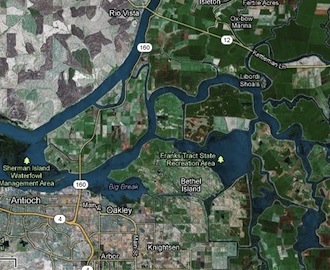
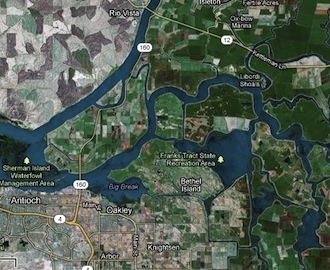
The Sacramento-San Joaquin Delta is a key to the water supply for 25 million Caliornians.

Quick: What is the Sacramento Delta?

Not where. What. According to a new statewide poll commissioned by Southern California water interests, three out of four surveyed could not answer that question correctly…or at all. This despite the fact that the maze of channels around the confluence of the Sacramento and San Joaquin River is a crucial cog in the water supply of 25 million Californians and the subject of intense, ongoing political and legal skirmishes.

According to Probolsky Research, which conducted the survey, 78% of respondents statewide said they either knew nothing about the Delta or hadn’t heard of it. About four percent knew that it plays a role in supporting endangered fish species, but only 2.3% cited the Delta as a “source of water.” (The poll has a margin of error of +/- 3.7%). Water from California’s northern rivers is funneled from the Delta to serve thirsty customers as far south as San Diego. Continue reading Dunno Much about Hydrology: Californians Clueless about Delta’s Role in Their Water

Drought Is in the Eye of the Beholder

Are we in one? Water officials say the answer is “Yes and No”

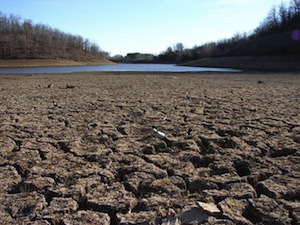
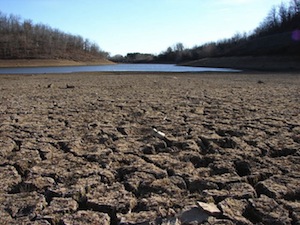
How do you define a "drought?"

As state surveyors trudge into the mountains this week for the season’s second official survey of the Sierra snowpack, the auspices aren’t good. Remote sensors currently show that statewide, water content is averaging just 38% of the average for this date, and less than a quarter of what water managers would hope to see on April first — just two months away.

Consequently, the “D-word” is being nervously bandied about. Are we in a drought?

The state’s newly revamped Current Water Conditions website takes on the question with a definitive “Yes and no.” Drought status, it says “can be very different depending on your location.” Continue reading Drought Is in the Eye of the Beholder

Requiem for Yucca Mountain: Federal Commission Says to Move On

The problem of where to put nuclear waste goes back to the drawing board

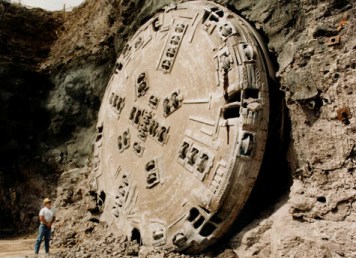
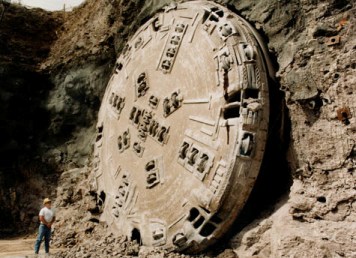
Dead End? The giant boring machine pokes through a rock face at Yucca Mountain.

In its final report, a federal blue-ribbon commission suggests that it may be time to throw in the towel on Yucca Mountain, the embattled project to store high-level nuclear waste in Nevada. Billions have already been spent on the project, which appears to have reached a dead end.

But the urgency to find a safe, permanent home for nuclear waste in the U.S. was tragically underscored last March by the destruction of three Japanese reactors and their storage pools of spent fuel rods, after an ocean tsunami overwhelmed the Fukushima plant’s coastal defenses. Continue reading Requiem for Yucca Mountain: Federal Commission Says to Move On

Jerry Brown Braves the Big Chill in Talking Climate

But the California governor relies largely on existing programs for progress

Governor Jerry Brown spent much of his State of the State address on California's environmental goals.

In a speech described by one Orange County Republican as “vintage Jerry,” Governor Jerry Brown tried to re-conjure the image of California as a can-do state. Brown also devoted a large portion of his annual State of the State address to environmental and climate-related topics.

Showing none of the climate timidity that has overtaken national politics, Brown declared that, “fossil fuels, particularly foreign oil, create ever rising costs to our economy and to our health.” By contrast, President Obama avoided using the word “climate” even once in last year’s State of the Union message, and gave global warming only the slightest nod in a recent address to science-friendly staffers at the Environmental Protection Agency. Continue reading Jerry Brown Braves the Big Chill in Talking Climate

Follow the Carbon: Find the Biggest Greenhouse Gas Emitters Near You

An interactive map with fresh data and more selective features

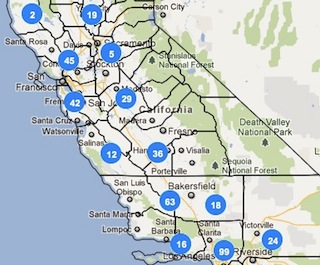
Detail from EPA's interactive map of greenhouse gas emitters.

The federal Environmental Protection Agency has just made tracking greenhouse gases a lot easier. The agency has produced its own map of major GHG producers, with fresh data and customizable features.

Two years ago, when we produced our map of California emitters for Climate Watch, we had to cobble it together with raw data from the state Air Resources Board emissions inventory, numbers that were relatively hard to find and infrequently updated. The EPA’s new map allows you to select your state, zoom into specific regions and view emissions by type and volume. Continue reading Follow the Carbon: Find the Biggest Greenhouse Gas Emitters Near You

Who Generated the Most Climate “B.S.” in 2011?

Despite flagging media coverage, there was plenty to go around, says a Bay Area scientist

Despite a dozen billion-dollar weather catastrophes in the US alone, year-end tallies show that overall, coverage of climate change continued to flag in the mainstream media.

That isn’t to say that there wasn’t plenty of public jabber about it, much of it wrong, according to Peter Gleick, who heads the Oakland-based Pacific Institute. Gleick is a hydrologist and one of the more outspoken science figures on Western water and climate issues. As a countermeasure against what he calls climate “disinformation,” Gleick and some colleagues have started handing out yearly Climate B.S. (Bad Science) Awards. In so doing, Gleick doesn’t spare the media itself. His list of 2011 “winners” came out today (gratefully we’re not on it). The following are Gleick’s words. Some of the links are mine. May I have the envelope, please: Continue reading Who Generated the Most Climate “B.S.” in 2011?

Sierra Snow Outlook is Bleak

Water users may be relying heavily on leftover water storage from last year

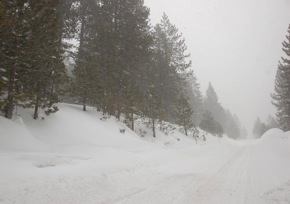
Hard to imagine now: A snowed-over road near Lake Tahoe in March.

It was startling to see the state’s lead snow surveyor kneeling on bare grass near Echo Summit, trying to find enough snow to measure the water content. But so it went with the first official survey of the season, conducted by California’s Dept. of Water Resources.

The manual survey affirmed what remote sensors had already relayed — that water content in the Sierra snowpack stands at just 19% of the average reading for this time, right around New Year’s. The readings are just seven percent of where things usually stand on April first, meaning we have a long way to go, to get back to “normal.” Continue reading Sierra Snow Outlook is Bleak

Poll: Indy Californians Still Support Climate Action

Independent-voter survey says two-thirds consider themselves “conservationists”

Independent California voters are feeling the heat from climate change, according to a new poll.

The nearly unanimous rejection of climate science by Republican presidential candidates has not swayed most independent voters in California, according to a new poll.

The survey, commissioned by the California League of Conservation Voters Education Fund, finds that nearly two-in-three (63%) voters who decline to state a party affiliation, agree that “climate change is occurring and is a major problem that needs to be addressed.” Thirty-one percent said that climate change is not an issue worth addressing, as the science is still unclear. Continue reading Poll: Indy Californians Still Support Climate Action