All posts by Craig Miller

Craig is a former KQED Science editor, specializing in weather, climate, water & energy issues, with a little seismology thrown in just to shake things up. Prior to that, he launched and led the station's award-winning multimedia project, Climate Watch. Craig is also an accomplished writer/producer of television documentaries, with a focus on natural resource issues.

UN Climate Talks: Durban Deal Does Little But Save Face

In overtime, climate negotiators fall short of the end zone but gain a few yards

Climate activists set the table for major progress in Durban but went home hungry.

Negotiators from more than 190 countries head home after two weeks of talks toward a new accord to curb carbon emissions.

The final deal extends the expiring Kyoto treaty and levels the playing field for the US, but triggers no immediate action.

A condensed diary from Week Two of the Durban conference:

Sun: There’s a glimmer of hope when word circulates that China might consider some kind of binding agreement to reduce carbon emissions.

Tue: UN Secretary General Ban Ki Moon says “The world cannot accept ‘No’ for an answer in Durban. Negotiators continue to provide “No” for an answer. Richard Harris reports for NPR that attaining the soft goal of stopping warming at 2 degrees Celsius (3.6 F) is “proving to be a stretch” with the current voluntary emissions targets. Continue reading UN Climate Talks: Durban Deal Does Little But Save Face
Communicating Climate Science: A Little “Song & Dance” Can’t Hurt

The first Stephen H. Schneider Award goes to a climatologist who sings, dances and hosts PBS specials. Maybe that’s what it takes.

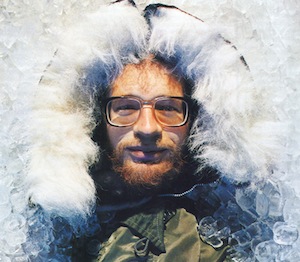
Earth scientist Richard Alley's engaging style has won him an award for climate communicators.

I’ll be candid here: When teamed up with climate modeler Ben Santer and economist Larry Goulder behind the microphone, his rendition of “Teach Your Children” could use a little work. The rest of Richard Alley’s work speaks eloquently to his talent for making sense of climate science for the rest of us.

This week, in a ceremony at the Commonwealth Club in San Francisco, Alley, a professor of geosciences at Penn State University, was given the first Stephen H. Schneider Award for his work in breaking down climate science and getting the word out to the public and policymakers in digestible form. Continue reading Communicating Climate Science: A Little “Song & Dance” Can’t Hurt

California’s “Radical Experiment” in Carbon Trading

A national perspective on the cap & trade program that starts next month

Operators of oil refineries fret that they'll bear the brunt of California's new cap on carbon emissions.

For three years we’ve been watching the process leading up to implementation of California’s plan to push greenhouse gas emissions back to 1990 levels by 2020. As the green flag is about to drop, you’ll start to see more national media attention focused on it.

To wit, this morning’s debut of a two-part series by NPR’s Christopher Joyce on what will be the nation’s first industry-wide cap on carbon emissions.

Joyce describes the program, authorized by the 2006 Global Warming Solutions Act, a “radical experiment” and “a risky step at a time when the state’s economy is shaky.”

The story starts by airing out fears that the program will drive jobs from the state, an effect delicately described by economists as “leakage.” Then Joyce seeks to balance the ledger with prospects for new jobs and industries that the regulations are already spawning.

Joyce profiles two businesses that stand to benefit from the new rules, Propel Fuels of Redwood City and a Washington state-based appliance recycler with a facility in the Bay Area.

Technically the program goes into effect in January but regulators have floated full “compliance” to 2013.

UN Climate Talks: The Highlights Reel

All you need to know about this year’s round, without going all the way to South Africa

Despite the Iwo Jima imagery, there are few signs of victory for climate activists in Durban.

The 194 nations that, for nearly 20 years, have been hashing out prospects for putting the brakes on global warming, are at it again — this time in Durban, South Africa. Whereas at one time the world was looking to the US for leadership on a climate solution, the theme of Week One appeared to be the emergence of the US as an obstructionist force in the process.

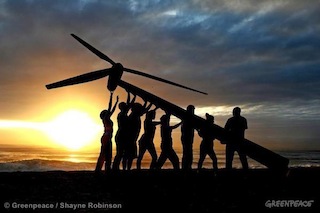
Sun: Activists wasted no time in creating iconic images for the conference (see photo). Continue reading UN Climate Talks: The Highlights Reel

Santa Ana Wind Season May Be Stretched by Climate Change

Could set the stage for more severe spring wildfires

Hear my companion radio feature for The California Report.

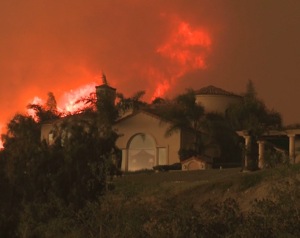
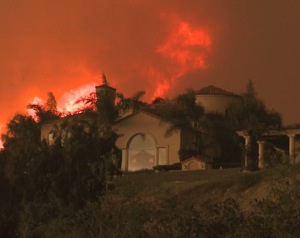
Wind-driven flames threaten a house during the 2009 Jesusita Fire.

Gusty winds up and down California have grounded aircraft and left hundreds of thousands without power this week. But so far, we’ve avoided the most feared consequence — major wind-driven wildfires. This is high season for the notorious winds known in the Southland as “Santa Anas,” and research suggests our changing climate may mean that season gets longer.

In Northern California, they’re called “Diablos” but the physics behind these legendary winter winds is essentially the same: air moves from high pressure to low. Continue reading Santa Ana Wind Season May Be Stretched by Climate Change

Solar Energy: What To Do When the Sun Sets

A big solar developer makes a major move toward storing electricity

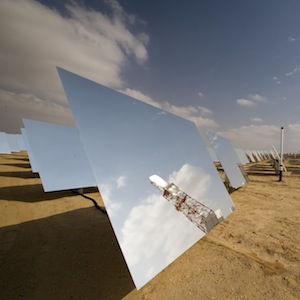
Solar-thermal plants use mirrors or “heliostats” to focus sunlight on a tower receptor that produces steam to generate electricity.” credit=”BrightSource Energy

A major barrier for solar power has always been that it doesn’t work at night (Duh). A few years ago, developers of big “utility-scale” solar projects were able to shrug this off to some degree. But Oakland-based BrightSource Energy has reversed field and decided to add to several projects the ability to store electricity for distribution after dark.

BrightSource managers say times have changed. Where utilities once wanted all the renewable capacity they could get, to meet state requirements, the priority has since shifted to having those renewable electrons available when they’re needed.

“The challenges of integrating photovoltaics and wind into the grid have driven a much deeper appreciation for those that can be highly reliable,” BrightSource CEO John Woolard told me in a phone interview. Continue reading Solar Energy: What To Do When the Sun Sets

Sea Level Suit Returns to San Francisco Courtroom

Alaskan village blames oil & power companies for rising seas

The coastal hamlet of Kivalina, Alaska, is already known for literally making a federal case out of rising sea levels.

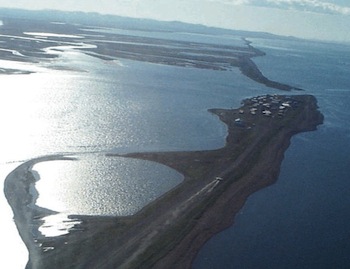
The village of about 400 residents sits exposed on a barrier island in the Chukchi Sea. In 2008, local officials filed a federal lawsuit against about two dozen corporate entities, including ExxonMobil, BP and San Ramon-based Chevron Corp., claiming that coastal erosion was forcing the town to relocate.

Kivalina appears in the distance, on the tip of this barrier island in the Chukchi Sea.

The original case was dismissed — but on Monday, the case lands in San Francisco’s Ninth Circuit Court of Appeals, where the town’s lawyers will again argue that major oil and power companies are responsible for the threatening rise in sea level, as the result of their collective greenhouse gas emissions. The appearance is timely, as only a week ago a major Arctic storm reportedly caused some damage to the settlement. Continue reading Sea Level Suit Returns to San Francisco Courtroom

Huge Transformation Required to Meet California Climate Goals

A new study suggests one word: Electrification

A new study suggests that massive electrification will be required to meet California's 2050 goal for greenhouse has reductions.

Chances are you’ve at least heard about California’s legal requirement to wind back greenhouse gas emissions to 1990 levels by 2020. But the state has a longer-term goal to knock another 80% off that by 2050. Is that even possible?

A new study suggests that it is — but not without a wholesale transformation from an “oil economy” to an “electric economy.”

The study, a collaboration of economists and energy forecasters at several institutions, including Lawrence Berkeley National Lab, three fundamental resets will be required to make that goal: Continue reading Huge Transformation Required to Meet California Climate Goals

Analysis Highlights Tricky Business of Carbon Accounting

San Francisco’s carbon footprint as political football

 ” credit=”Craig Miller / KQED

As business and public entities face more pressure to lower their carbon footprints, an entire industry has sprouted to quantify and verify their progress. The whole enterprise can be tricky business, as San Francisco officials are finding out.

Props to The Bay Citizen for looking beyond the claims and doing its own analysis. As John Upton writes in Citizen:

“…some energy experts and environmentalists have raised questions about the city’s calculations. Although San Francisco has taken significant steps to shrink its carbon footprint, these critics said, the numbers are misleading, and the end result is not nearly as green as the city claims.”

Specifically, TBC looked into the claim that the City and County of San Francisco has cut its carbon emissions by 12% since 1990, driven mostly by the shutdown of two gas-fired power plants in the city. The article features a graph that shows its own tracking of greenhouse gas emissions clocking in well below the City’s estimates.

San Francisco was given high ratings recently in at least one independent study, for its “political leadership and commitment” to climate planning.

UN Panel Says More Severe Weather On the Way

But it’s still hard to pin down what, where and how bad

Climate change is likely driving some of the extreme weather events we’ve been seeing and more such weather is on the way, according to a much-anticipated report from the Intergovernmental Panel on Climate Change (IPCC).

“This is a pretty hard-hitting report,” says Chris Field, a Stanford climatologist and one of the co-chairs for the report. “What we can say is that some kinds of extremes are occurring more frequently,”

Some kinds. The UN panel carefully couches all of its findings in terms of probabilities and confidence levels, which vary widely depending on the type of weather event. Hence (italics are mine):

Sea Level Rise: “It is very likely (90-100% probability) that mean sea level rise will contribute to upward trends in extreme coastal high water levels in the future.” Continue reading UN Panel Says More Severe Weather On the Way