Writer Dave Eggers returns, this time with a much-anticipated new novel “A Hologram for the King,” which follows a struggling, middle-aged American businessman working in Saudi Arabia. Eggers joins us to discuss the book and one of its central themes: the decline of American manufacturing.
The Education Blog
June 5, 2012
Written By Katy Murphy
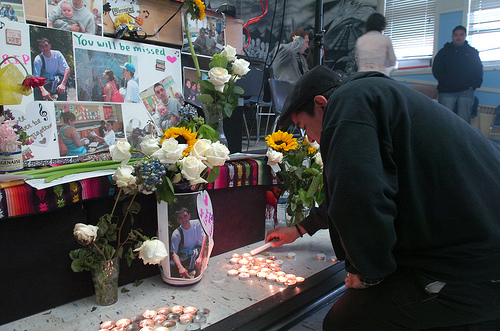
Yesterday in the school auditorium at Life Academy, school employees and grief counselors stood in a circle and quietly discussed their plan for the memorial assembly in 18-year-old Alejandro Aguilera‘s honor. Some of them had puffy eyes. Most looked exhausted.
Apart from the sorrow and the heaviness in the room that day, something else hit me: Everyone seemed to know what to do. One teacher noted that her students erected altars for the dead with a disturbing degree of expertise.
A little-known proposal from Governor Jerry Brown would eliminate the state’s mandate that all high school students get two years of science education. Sacramento says it’s in the name of fixing the budget. But many argue that subjects like science and math are only rising in importance, and nixing science is too high a price to pay.
Caleb Cheung, science manager for the Oakland Unified School District
H.D. Palmer, deputy director, external affairs for the California Department of Finance
Kerry Benefield, reporter for the Santa Rosa Press Democrat
Rick Pomeroy, professor in the UC Davis School of Education, president of the California Science Teachers Association and former science teacher for 20 years
MindShift Blog
June 4, 2012
Written By: Ann Murphy Paul
Parents and teachers expend a lot of energy getting kids to pay attention, concentrate, and focus on the task in front of them. What adults don’t do, according to University of Southern California education professor Mary Helen Immordino-Yang, is teach children the value of the more diffuse mental activity that characterizes our inner lives: daydreaming, remembering, reflecting.
Yet this kind of introspection is crucial to our mental health, to our relationships, and to our emotional and moral development. And it promotes the skill parents and teachers care so much about: the capacity to focus on the world outside our heads.
Giving Back to the Community One Project at a Time
Written By Abby Loomis, Program Manager, America SCORES Bay Area
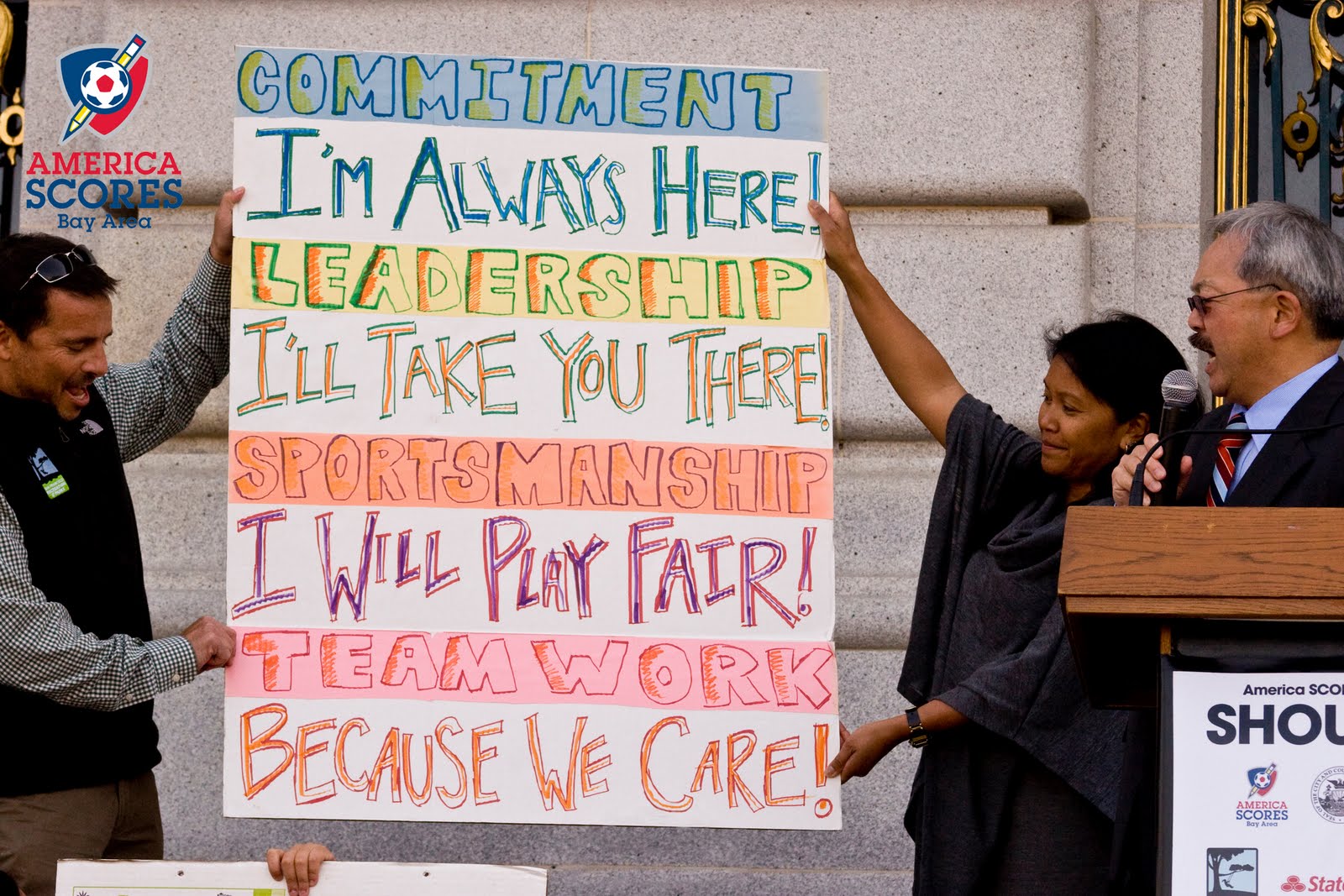
In March, when J. Serra (4th) grader Diego raised his hand to suggest an idea for his team’s service-learning project, he didn’t know that very same hand would soon be shaking that of San Francisco Mayor Ed Lee.
This unlikely duo came together to celebrate the first ever SHOUT! at Civic Center on May 15, 2012, where the Mayor honored four SCORES teams whose service-learning projects demonstrated commitment, teamwork and compassion.
Ironically, the J. Serra boys team project idea emerged from a moment of intolerance: when one of Diego’s teammates suggested that they help the homeless, another asked, “but won’t they just spend that money on drugs and alcohol?” Instead of simply lecturing the student, J. Serra Coach Edgar took the opportunity as a teaching moment. He shared about his own friends and family members who had experienced life on the streets, and the variety of reasons that had led them to end up there.
“The students weren’t aware of different people’s situations,” said Edgar. “It was a great opportunity to change their perspective on homelessness.”
The team eventually decided to base their project on a collaboration with Street Soccer San Francisco, a homeless soccer team who would soon be competing in New York City for a chance to play in the Homeless World Cup. They invited Street Soccer director Rob and two of his players, Carlos and David, to the school to run an informal practice. As they stretched, Carlos and David shared stories and talked about the importance of listening and setting goals. “It was interesting,” said Diego, “Because Carlos escaped from his house, and his family, and that’s very rough.”
After this meeting, the boys got into action. They crafted a letter describing their project and went door to door, raising a dollar for every ten toe-touches they performed. With the money the boys raised, Coach Edgar purchased soccer equipment for the new Street Soccer women’s team. The Jaguars also put their artistic talent to use by creating an enormous flag for the Street Soccer team to take with them to the tournament in New York City.
The Education Blog
May 29, 2012
Written By Katy Murphy
The Sustainable Urban Design Academy is slated to expand this fall as part of Castlemont’s controversial merger and redesign — which was the subject of an early morning protest on the campus last week; another is planned for tomorrow morning.
The students have undertaken a number of projects on the campus, including a community mapping initiative featured in the below video. They have been documenting the strengths and challenges of their neighborhood from various perspectives: public health, economic opportunity and the natural vs. “built” environment, among others.
In addition to learning about various `green’ career paths, the students hope to weigh in on city and school district projects. The MacArthur Boulevard strip outside the high school campus could sure use a little TLC.
The Education Blog
Tuesday, May 22nd, 2012
Written by Katy Murphy
This morning, Urban Strategies Council released a series of reports about the experience of black boys in the Oakland school district: one on out-of-school suspensions, one on chronic absenteeism, and lastly, an analysis of numerous factors to estimate how many children are on track to graduate high school — beginning in elementary.
There is so much data here that the short story in today’s Tribune (which is long by today’s standards) and blog post can’t do it justice. Each school will receive a data profile to further the district’s African American Male Achievement initiative. These reports were produced in partnership with OUSD as part of the initiative.
Some of the stats that I pulled for the paper on African-American boys in OUSD. The suspension rates are the percentage of individual students that received an out-of-school suspension at least once during a single school year.
Written by Yo Ann Martinez Interviewed: Davin Thompson, Artist Mentor @ BUMP Records and Jason Jakaitis, Factory Manager
KQED and the Bay Area Video Coalition (BAVC) Factory and BUMP Records are working together to produce an original soundtrack and short film vignettes whose central purpose will be to counteract the high school drop out rate in Oakland from the youth’s perspective. Here are some of the questions we asked the coordinators of the program.
KQED will be uploading three vignettes before the final projects are due. Look out for them in this blog.
What is the students’ creative process?
JJ: First the filmmakers acquire stories – spoken word poetry from Queen Shabazz and Cesar Cruz, plus iPhone testimonials from OUSD youth – and then they begin to plan out who these stories can be told in an engaging, visually compelling fashion. Then they write a script, create shot lists and storyboards, cast their actors, shoot the film, edit the content into a rough for feedback, and finally polish their rough cut into a fine cut.
DT: These particular young artists came in to the project with their own opinions and ideas about what they wanted to say and how they wanted to say it. My job was more about helping to frame their thoughts and align the perspective with the larger mission of achieving a well rounded project. So the process consisted of a lot of group check-ins and one-on-one sessions with me and the artist involved.
What has been most exciting for them in this process?
Jason Jakaitis, Factory Manager
JJ: It’s definitely been taking the stories of individual like Cesar Cruz and Queen Shabazz and visualizing them stylistically – accentuating their voice with light, color, composition and sound.
DT: Aside from the stipend payment and being place one a national stage, I’d say it is the opportunities express themselves using an art form and the love on a topic they’re passionate about. For some of the individuals involved some excitement came from the challenge having to talk about things they weren’t used to. For our producers the excitement came from producing a whole project. Over all I’d say the whole process have been exciting though.
How many of them have been touched by this issue? Example.
JJ: All of our participants know young people who have dropped out of high school and all of them have seen the social and economic consequences of these students not having received their diploma. And many more of their friends are struggling with the choice – they fail to see their education as something that will benefit them.
DT: One of the producers of the BUMP/KQED collaboration project has had quite a few difficulties with school over the past couple of years, from the administration of the school to the actual location of the school he’s been through it. On the track “Perfect School” he gets a chance to thoroughly express his experience via his 1st recorded rhyme! I interpreted his process as being very cathartic.
What are their thoughts/experiences on the dropout issue? How are they translating that into film and music?
JJ: They believe deeply that the dropout crisis is something that is institutionally manufactured to perpetuate class inequity and maintain the status quo. They are creating stories that they hope will address young people directly and speak to their lived experiences while still providing them with helpful information and resources that will encourage them to stay in school.
DT: The artist in BUMP records definitely empathize with the students who drop out of school. They recognize how imperfect the educational system is in this country and dissect it with sharp criticism. These artists have done a wonderful job at looking at the whole picture and have attempted to incorporate this into the music and the writing. Even though the artist them selves can empathize with the dropouts they still value education and encourage their peers to stick it out and fight the good fight for a better life and a brighter future.


 The Education Blog