Navigating the Urban Water Jungle

Follow Gretchen’s radio journey to cut her own water use by 20%. Her story aired May 29 on The California Report weekly magazine.


Gretchen Weber
Photo: Gretchen Weber
Saving water when you live in an apartment isn’t as hard as it might seem.

I know the motivation might not be there to take shorter showers when you see your neighbors watering their lawns in the middle of the day or local restaurants hosing down the sidewalks, but cutting back on your water use (or at least feeling less guilty about those long showers) can be as simple as swapping out your old shower head for a lower-flow model, screwing some aerators onto your faucets, and, for the sufficiently motivated, talking to your landlord about installing higher-efficiency toilets.

For me, the first and last stop was calling my utility company, San Francisco Public Utilities.  They sent out a water expert armed with free devices for my flat, and in less than an hour we’d outfitted the kitchen and bathroom to be much more water efficient.   Save our H2O, a website sponsored by the California Department of Water Resources, has tons of conservation resources including a rebate finder and a list of the state’s local water agencies.

But since I know not every utility offers free devices to customers, last night I dropped by The Home Depot in Daly City, to see what’s available.  I have been inside one of these orange megabox retailers exactly three times in my life and it’s always a bit of sensory overload.  There must have been close to 100 shower heads to choose from, but it wasn’t easy finding one with a low-flow (1.5 gallons per minute) rating.  No matter the price or the size, every model I picked up was either 2.5 gpm, or I couldn’t find the flow rate on the packaging.
Gretchen Weber

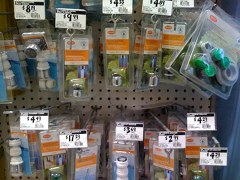
Faucet aerators at The Home Depot

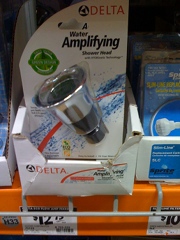
I finally asked a salesman who at first couldn’t find one either.  But eventually, he found one tucked in among the others: the Delta Water Amplifying Shower Head, for $12.75.  It’s actually 1.6 gpm, and it looked kind of  small and cheap,  although it may work fine.  I felt a little disappointed that this was my only option.

Hoping for better luck, I wandered over to the aerator section one aisle over.  There I found aerator aficionado heaven.  Once again, the selection was a little overwhelming.  There were probably 40 aerators to choose from–aerators, no less.  Low-flow, 1.5-gpm models like the kind the SFPU gave me ranged in price from $2.99 to $17.39 for the upscale brushed-nickel variety.

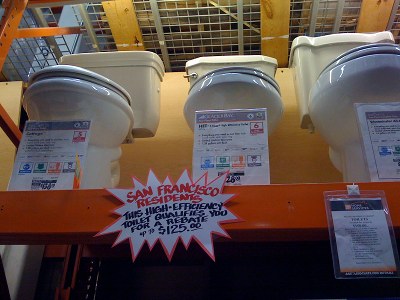
Across from the aerators were the toilets.  I scanned the high shelf and saw several low-flow models (1.6 and 1.28 gallons per flush) that were priced between $90 and $128.  Taped to the toilet shelf was a sign reading that San Francisco residents may be eligible for a $125 rebate on a low-flow model, which could basically mean a free toilet.  Other cities and counties in California have similar rebates.

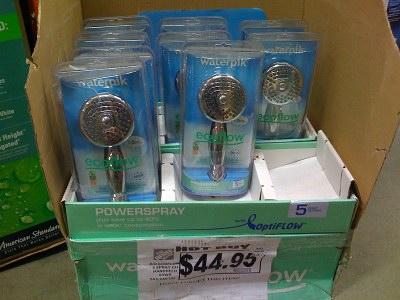
As I turned to leave the toilet/aerator aisle, I bumped into a large box sitting on the floor.  There, far from all the others, was the shower head I’d been looking for:  a 1.5 gallon-per-minute WaterPik EcoFlow with five different pressures, including something called “Powerspray.”  Touting a 40% water savings, these puppies were on sale for $44.95.
Gretchen Weber
Water Pik Eco Flow Shower Head Photo: Gretchen Weber

Rick Soerhen, the Deputy Director of Water Use Efficiency for the California Department of Water Resources told me that people living in apartments most likely already get “gold stars” for water conservation because they probably aren’t watering lawns and gardens.

So, flat-dwellers, be proud. But if you really want to be as water efficient as possible, devices like these can make a big difference on your total usage — without requiring three-minute showers.

No Crystal Ball for Fusion Power

Lawrence Livermore Nat'l Lab
Photo: Lawrence Livermore Nat'l Lab

Now here’s a guy with some historical perspective: For something north of a half-century, David Perlman has been covering science for the San Francisco Chronicle. On KQED’s Forum program this morning, he noted that “40 years ago, they said ‘in 20 years, we’ll have unlimited energy from fusion’.”

The record will show that we didn’t quite get there–but that hasn’t stopped them from trying. The long quest for bottled fusion will pass another milestone this week, when the US Dept. of Energy formally cuts the ribbon on the National Ignition Facility (NIF) at Lawrence Livermore National Lab.

Comparing the hardware with other titanic undertakings, like the CERN particle accelerator in Switzerland, Perlman called the 192-laser assembly “one of the most amazing machines–if it succeeds–and one probably won’t know for the next two, three years.”

That’s the hopeful time frame for creating fusion in a fuel pellet the size of a BB (artistically rendered in the image, above) Will they? Perlman says: “I would not dream of putting a bet on it.”

Nor would sparking some mini-fusion at NIF quickly translate to a national solution for clean, safe energy. Scaling that ignition up to practical size for reactors would likely require decades more.

A NIF technician appears to be gazing into a "crystal ball," which is actually used to amplify laser beams--but not much good for predicting the future. Photo: Lawrence Livermore National Lab
A NIF technician appears to be gazing into a "crystal ball." Precision-ground crystals are used to amplify laser beams--but not much good for seeing into the future. Photo: Lawrence Livermore National Lab

Earlier this week, in an interview with NASA scientist James Hansen, I asked him about the potential for nuclear power to make a comeback with new technology. Rather than waiting for fusion, Hansen favors the technology known as “fourth-generation nuclear,” which he says could “burn nearly all of the fuel, where at present, the nuclear technology that we’re using burns only one percent of the energy in the uranium.” From one percent to “nearly all” would represent a drastic reduction in the current radioactive waste problem.

There may be some wishful thinking in that. An early report published in the magazine 21st Century Science & Technology describes these “Generation IV” reactors as “about 50% more efficient than conventional nuclear reactors.”

Other nations have moved ahead with Gen-IV reactors. The French expect to have one under construction by 2020.

Meanwhile, as the US pursues a parallel Gen-IV research program, it will press on toward the Holy Grail of fusion with its Livermore megalaser, described by Perlman as “already a mini-Manhattan Project.” Costs so far have run to nearly triple the original budget of more than a billion dollars. DOE expects to spend $140 million per year to run the NIF. So, it would be–you know–nice if something comes of it.

Carbon Offsets in the Air

Friday on The California Report’s weekly magazine, Rori Gallagher reports on ways to assuage your carbon guilt with a quick stop at an airport kiosk.

By Rori Gallagher

Reed Galin
Photo: Reed Galin

I first got the idea to do a story on carbon offsets back in December, when San Francisco International Airport announced it was partnering with a private company called 3Degrees to install carbon offset kiosks.

Originally, the kiosks were supposed to be installed sometime “in the spring.” But there seems to be a delay with the contract negotiations. I kept checking in with 3Degrees about a launch date. At first they were saying Earth Day–then it was pushed to May, and now “by the end of June.”

But there are already other options out there. I found that Virgin America, the only major airline based in California, was the first to offer carbon offsets in the sky. Other airlines do offer customers the chance to purchase offsets but Virgin allows you to do it during the flight through the in-flight entertainment system.

Carbon offsets are supposed to stop carbon emissions that would have otherwise taken place. That’s really difficult to substantiate. Projects like wind farms for example, certainly seem good for the environment but likely most of them would be built anyway and produce power without this type of third-party incentive.

Virgin’s program managers say they stringently vetted carbon offset programs, and that theirs are among the most credible out there. But as I point out in my radio story, there is very little regulation of the voluntary carbon offset industry and it’s difficult to know if they’ll do what they say they will.

There are some independent efforts to separate the sheep from the goats, for example the Natural Resources Defense Council has produced a buyer’s guide for carbon offsets.

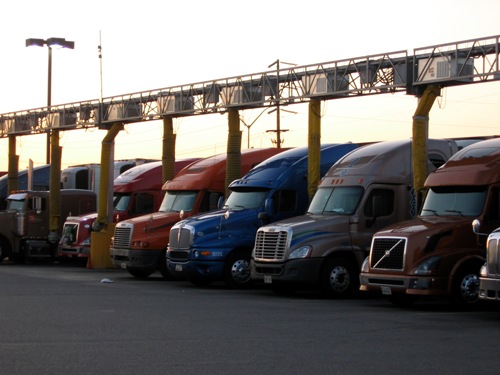
Trucks line up at an IdleAire terminal, which provides "carbon offsets" for airlines. Photo: Rori Gallagher

Heat Relief for Coral Reefs?

This post is condensed from a Stanford News Service release. Cassandra Brooks is a science-writing intern at the Woods Institute for the Environment at Stanford.

Reed Galin
Photo: Reed Galin

Stanford scientists find heat-tolerant coral reefs that may resist climate change

By Cassandra Brooks

Some experts say that more than half of the world’s coral reefs could disappear in the next 50 years, in large part because of higher ocean temperatures caused by climate change. But now Stanford University scientists have found evidence that some coral reefs are adapting and may actually survive global warming.

“Corals are certainly threatened by environmental change, but this research has really sparked the notion that corals may be tougher than we thought,” said Stephen Palumbi, a professor of biology and a senior fellow at Stanford’s Woods Institute for the Environment.

Palumbi and his team began studying the resiliency of coral reefs in the Pacific Ocean in 2006. “The most exciting thing was discovering live, healthy corals on reefs already as hot as the ocean is likely to get 100 years from now,” said Palumbi, director of Stanford’s Hopkins Marine Station. “How do they do that?”

Coral reefs form the basis for thriving, healthy ecosystems throughout the tropics. They provide homes and nourishment for thousands of species, including schools of fish that feed millions of people across the globe.

Corals rely on partnerships with tiny, single-celled algae called zooxanthellae. The corals provide the algae a home, and, in turn, the algae provide nourishment, forming a symbiotic relationship. But when rising temperatures stress the algae, they stop producing food, and the corals spit them out. Without their algae symbionts, the reefs die and turn stark white, an event referred to as “coral bleaching.”

During particularly warm years, bleaching has accounted for the deaths of large numbers of corals. In the Caribbean in 2005, a heat surge caused more than 50 percent of corals to bleach, and many still have not recovered, according to the Global Coral Reef Monitoring Network, an international collaboration of government officials, policymakers and marine scientists, including Palumbi.

Havens of healthy reefs

In recent years, scientists discovered that some corals resist bleaching by hosting types of algae that can handle the heat, while others swap out the heat-stressed algae for tougher, heat-resistant strains. Palumbi’s team set out to investigate how widely dispersed these heat-tolerant coral reefs are across the globe and to learn more about the biological processes that allow them to adapt to higher temperatures.

In 2006, Palumbi and graduate student Tom Oliver, now a postdoctoral researcher at Stanford, traveled to Ofu Island in American Samoa. Ofu, a tropical coral reef marine reserve, has remained healthy despite gradually warming waters.

The island offered the perfect laboratory setting, Oliver said, with numerous corals hosting the most common heat-sensitive and heat-resistant algae symbionts. Ofu also has pools of varying temperatures that allowed the research team to test under what conditions the symbionts formed associations with corals.

In cooler lagoons, Oliver found only a handful of corals that host heat-resistant algae exclusively. But in hotter pools, he observed a direct increase in the proportion of heat-resistant symbionts, suggesting that some corals had swapped out the heat-sensitive algae for more robust types. These results, combined with regional data from other sites in the tropical Pacific, were published in the journal Marine Ecology Progress Series in March 2009.

Global pattern

To see if this pattern exists on a global scale, the researchers turned to Kevin Arrigo, an associate professor of environmental Earth system science at Stanford and an expert on remote satellite sensing of marine microalgae. Arrigo gathered worldwide oceanographic data on a variety of environmental variables, including ocean acidity, the frequency of weather events and sea-surface temperature.

Oliver then compiled dozens of coral reef studies from across the tropics and compared them to Arrigo’s environmental data. The results revealed the same pattern: In regions where annual maximum ocean temperatures were above 84 to 88 degrees Fahrenheit (29 to 31 degrees Celsius), corals were avoiding bleaching by hosting higher proportions of the heat-resistant symbionts.

Most corals bleach when temperatures rise 1.8 F (1 C) above the long-term normal highs. But heat-tolerant symbionts might allow a reef to handle temperatures up to 2.6 F (1.5 C) beyond the bleaching threshold. That might be enough to help get them through the end of the century, Oliver said, depending on the severity of global warming.

A 2007 report by the United Nations International Panel on Climate Change concluded that the average surface temperature of the Earth is likely to increase 3.6 to 8.1 F (2 to 4.5 C) by 2100. In this scenario, the symbiont switch alone may not be enough to help corals survive through the end of the century. But with the help of other adaptive mechanisms, including natural selection for heat-tolerant corals, there is still hope, Oliver said.

Heat-resistant corals also turn out to be more tolerant of increases in ocean acidity, which occurs when the ocean absorbs excess carbon dioxide from the atmosphere–another potential threat to coral reefs. This finding suggests that corals worldwide are adapting to increases in acidity as well as heat, Oliver said, and that across the tropics, corals with the ability to switch symbionts will do so to survive.

“Although we are doing things to the planet we have never done before, it’s hard to imagine that these corals, which have existed for a quarter of a billion years, only have 50 years left,” Palumbi said. “And part of our job might be to figure out where the tougher ones live and protect those places.”

For more on this story:

MICRODOCS: BRINGING THE LAB TO THE REEF

MICRODOCS: EXPERIMENTING WITH GLOBAL WARMING

New Tailpipe Regs are an “Alternate Reality”

Amy Standen specializes in science and environmental reporting for Quest. She’s among the guests today on KQED’s Forum program. Listen to the archived program here.

Hazy day in L.A. Photo: Craig Miller

Yesterday afternoon, as I started working on my news spot about the new federal standard for tailpipe emissions, I dug up my notes from over a year ago, the last time I covered this story in any depth.

The contrast in tone between then and now amazed me. Back then, I was describing accusations of outright lying, government actions that California enviros called “completely illegal,” and California officials “sharpening their knives” as they marched into battle with EPA former Administrator Stephen Johnson. It was September, 2007, and Democratic lawmakers, led by Henry Waxman (D-CA), were accusing the White House of strong-arming the EPA into denying California its “waiver,” or permission to regulate auto tailpipe emissions. The mood between California environmentalists, many of the state’s elected officials, and the Bush administration couldn’t have been more hostile.

Today, it’s as if we’ve landed in an alternate reality.  Not only has California been given its more fuel-efficient cars, but those same laws are taking effect nationwide. The new rules actually exceed anything that California–traditionally the most ambitious state in the union, when it comes to greenhouse gas regulation–could have asked for.

Instead of knives being sharpened, California enviros are singing the praises of “an historic blueprint to carry out rigorous greenhouse gas emission standards,” to quote one email I received today. Another group told the New York Times: “This is the single biggest step the American government has ever taken to cut greenhouse gas emissions.” Compared to the fall of ’07–actually make that since ’05, when California first asked for the waiver and the EPA first started stalling–it’s like night and day.

Still, listening in to the White House background press briefing on Monday afternoon, you could hear the seeds of criticism taking root in a few reporters’ questions.

Sure, American automakers will be making more fuel-efficient cars, one reporter asked, but what is the White House doing to encourage consumers to buy them? (in addition to restricting tailpipe emissions, the new rules also substantially increase fuel efficiency standards for manufacturers’ fleets–SUVs and trucks will still be available; they’ll be more fuel efficient than before, but less efficient than smaller cars.) The question takes on new relevance as the federal government finds itself a major stockholder in auto companies.

President Obama says the new regs will have the equivalent impact of taking 177 million cars off the road.

Paddling to the Sea

Jessie Raeder is Bay Area Organizer for the Tuolumne River Trust. More than 200 paddlers are expected to take to the river between now and June 7, for this river awareness relay. Raeder offers this dispatch from the starting line, near the headwaters in Yosemite National Park.

By Jessie Raeder

Paddle to the Sea got off to a roaring start over the weekend.  Melting snow caused by an early heat wave in the Sierras had the river pumping at much higher flows than rafters typically face. The Tuolumne is usually rated Class 4–but goes to Class 5 when flows get over 4000 cubic feet per second.   This weekend saw the river flowing at 7000 cfs! For a while it looked like we might have to cancel all the whitewater trips due to safety concerns, but in the end one trip did go on and needless to say it was an epic journey for our Paddle-to-the-Sea team.

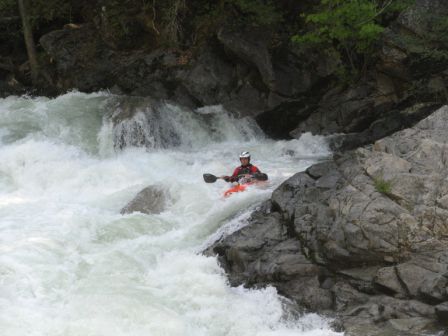
A paddler takes on the Clavey. Photo:
A paddler takes on the Clavey. Photo: Patrick Koepele, Tuolumne River Trust

Meanwhile, an international team of 12 hotshot kayakers ran the Clavey River, a tributary of the Tuolumne and one of only three remaining free-flowing rivers in the Sierra.  The Clavey is a class 5+ river that’s rarely run and only by experts.

Paddle to the Sea is a three-week festival to foster stewardship of the Tuolumne River. Hundreds are joining in this epic journey from the Sierra to the Sea. Kayakers and rafters will begin on the upper stretches of the Clavey and Tuolumne Rivers, travel through the Central Valley where canoers take the lead, pass through the confluence of the Tuolumne and San Joaquin Rivers, and sea kayakers will finish the trip in San Francisco Bay.

A changing and increasingly unpredictable water supply will be the first way that most people in California experience climate change affecting their own lives.  Here in the Bay Area, tap water for 2.5 million people comes from the Tuolumne River, whose headwaters start with melting snow from the Lyell Glacier (picture attached).  That glacier is on the retreat, and more frequent droughts are expected throughout the Sierra.

Paddle to the Sea is meant to demonstrate that issues that affect one section of the river ripple up and down the watershed.   Bay Area water users share this resource with farmers in Modesto, anglers in Yosemite, the commercial salmon industry on the Pacific, and a host of native fish, plant, and wildlife species, many of which are endangered.

As population and demand for water continues to grow, California will be faced with many questions about how we use water, and where it will come from.  The Tuolumne River Trust is working to ensure that we turn to water efficiency and water recycling as much as possible–alternatives which are far more sustainable and renewable than continuing to take additional water from the Tuolumne River, which has been the solution most turned to in the past.


California’s Water Meter Rebellion Withers

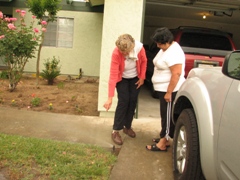
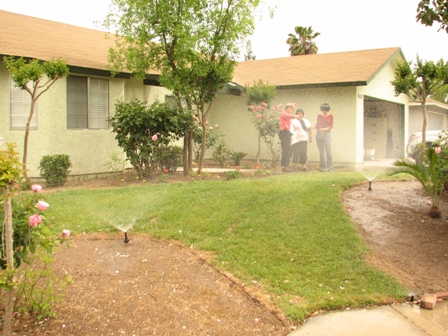
City water conservation specialist Marilyn Creel shows Fresno resident Mary Ann Evans how to adjust her sprinklers to point them away from the sidewalk.

Monday on The California Report, Central Valley Bureau Chief Sasha Khokha tracks one city’s longstanding rebellion against water meters–and says the day of reckoning is nearly at hand. Listen to Sasha’s story here.

I admit it. I wanted to do this story because I saw so many of my neighbors watering their driveways. What I learned is that unmetered cities are a long and slow-dying tradition in the Central Valley.

Martin McIntyre, who used to head Fresno’s water agency, explained how vehement anti-metering forces swayed voters and banned meters in the city charter:

“They were really false arguments. The simple phraseology was ‘meters are taxing machines,’ and they’re going to use meters to fund city hall activities. And, in fact, as is the case for all municipal water supply systems, the funds collected from ratepayers by law can only be used for the operation and improvement of the water supply system. Nonetheless, that resonated with some of the public and it was very easy for a handful of people to get prominent headlines above the fold simply by saying city hall is taxing us to death.”

State lawmakers overrode Fresno’s rule, because they understood that cities with meters use less water.

Ellen Hanak, a water researcher with the Public Policy Institute of California, has found that metered cities use about 15 percent less water than unmetered cities. And cities with a tiered rate system save an additional ten percent on top of that. In addition to usage, her report compares different cities’ water rates. Of course, San Franciscans get away with using less water because–guess what? Many of them don’t have front yards.

Hanak crunched statewide residential water rate numbers and determined that more than half of San Joaquin Valley residents don’t have water meters. (For further details, read the survey disclaimer.)

But meters are coming, one way or another.

There are basically three laws that will eventually require the entire state to install water meters. One says that all homes built after 1992 must have meters. Another dictates that cities that get federal water (like Fresno) have to install meters by 2013. And yet another law says that all California cities (including holdouts like Sacramento) have to be metered by 2025.

Fresno is gearing up to install its first meters this year. They’ve even created a handy Q&A for skittish customers.

And if you thought Central California was the only laggard, this might make you feel better: many Chicago residents don’t have meters, either.

But they probably don’t have the sprinkler ladies–who can fix any leaky, squeaky, spritzy sprinkler, and make sure it’s pointing away from the sidewalk.

KQED’s Sasha Khokha braves sprinkler spray to record Fresno’s city water conservation team at work.

“The Australian Reality”

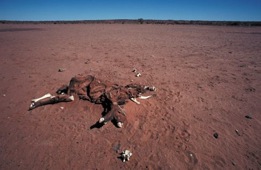
Australia's Simpson Desert. Photo: Mike Gillam

Referring to Australia’s seven-year drought, that’s how the state’s top water manager describes the new paradigm for water planning at the Dept. of Water Resources.

Speaking to a packed house at the annual forum of the Sacramento River Watershed Program yesterday, DWR Director Lester Snow said his staff is assuming that 2010 will be another dry year. Snow warned about “loss of resilience” in the state’s water system, calling it “completely unsustainable” in it’s present form, given predictions for population growth, coupled with anticipated effects of climate change.

All speakers at the forum seemed to agree that a paradigm shift is in order. Thomas Philps, a strategist at SoCal’s Metropolitan Water District, pointed out that in Victoria’s capital city of Melbourne (Australia), per capita water consumption runs about 40 gallons per day, while in California’s capital, it’s 280 gallons. As Sasha Khoka will report Monday morning on The California Report, Sacramento is just one of several cities in the Central Valley that still doesn’t meter its water use. Philps added that the Sacramento region is “on a trajectory” to use the same volume of water as Los Angeles, though he did not say by when.

UC Davis geologist Jeff Mount cautioned against relying on additional surface storage to secure California’s water future. Not only does storing water become “very expensive” year over year, but dams and reservoirs “don’t create any new water,” he said. (If some think Mount is taking a “jaundiced view” of the situation, it might be because he braved a bout of hepatitis to deliver his morning talk)

In a panel discussion on resource planning, moderator Greg Zlotnick of the Santa Clara Valley Water District asked panelists to respond with “true” or “false” to a quote from the Pacific Institute’s Peter Gleick in a story aired on NPR last week. The quote, as given by Zlotnick, was: “Government has built infrastructure and made promises that can’t be kept.” Here are the panelists’ responses:

Tina Swanson, The Bay Institute: “True.”

Philps: “True, but…” (Generally true but MWD doesn’t really expect to get its full contractual allocation of water anymore, anyway)

Don Glaser, US Bureau of Reclamation: “False, but…” (Water allotments from his agency’s Central Valley Project are intended to be “supplemental contracts,” to augment use of groundwater and other sources, but Glaser sees the statement becoming “more and more true in the future.”)

Snow: “Hell, no.”

Dancing With the Devil

Sometimes that’s what it feels like, confronting another fire season in California. But last week, network news videographer Tim Walton found himself literally in that position, while covering the Jesusita Fire near Santa Barbara.

Walton spends much of his time chasing the state’s most threatening wildfires, shooting video for outlets like NBC Nightly News.

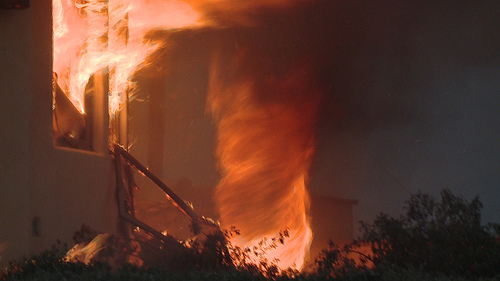
Santa Barbara "Fire Devil." Photo: Tim Walton

On Wednesday (5/6) he was shooting a “fully involved” home, when he was visited by a dangerous and awe-inspiring presence. In an email, he writes:

“I was filming the house when it felt like someone was standing next to me. I panned the camera over and this “fire devil” was spinning around outside the burning house. It came out a window for a few seconds and went right back where it came from in the house (of course “it” is just gases that were sucked out of the burning house by the wind and ignited by the heat).  The vortex stays as long as the wind.

BTW this fire started on the same date as the Summit Fire did last year, I observed the same type of fire behavior we saw early last season. I think we are in for a very interesting year. “

Fire devils are also referred to as “fire tornadoes” or “fire whirls.” Walton’s remarkable collection of photos from California wildfires is posted at his Flickr site. The photo of this “devil” is actually a still frame from some of his HD video:

NPR Spotlights California Water Issues

farm_0799_blog1

NPR’s Morning Edition launched an “occasional series” on California’s water woes this morning. Veteran correspondent John McChesney begins with the impact on agriculture in the Central Valley’s Westlands Water District, the nation’s “biggest irrigated region.”

KQED’s Central Valley Bureau Chief and Climate Watch contributor Sasha Khokha will have three stories in the series, two of which will debut on The California Report in the weeks ahead:

WATER METERS: Many California cities are preparing for or implementing mandatory water rationing this summer. But there are still cities and towns, particularly in California’s Central Valley, where water can’t be rationed because residents don’t even have water meters.  Residents are charged a flat rate for any amount of water they use. Khokha looks at the city of Fresno, where water meters will be phased in, but not until 2013.

MENDOTA PROFILE: The town of Mendota in California’s Central Valley is at the heart of the economic crisis spawned by drought and the loss of farm jobs.  Sam Rubio grew up here, the son of a Mexican farmworker.  He went off to college, and was planning to become a doctor, but instead has returned to this town to teach biology, mentor local kids, and run a café that’s become a haven for the farmworker youth.

AG ADAPTING TO DROUGHT: California farmers are facing an increasingly uncertain water supply, brought about by drought, environmental restrictions on pumping, and climate change. How will farmers adapt? Some of them are yanking out water-intensive crops and replacing them with more drought-tolerant ones. But others are trying to keep growing the same crops with improved technology. We’ll follow a new tech start-up that’s helping farmers use water more efficiently by tracking how much moisture reaches each plant in their fields–and sending a satellite message to their cell phones. We’ll also talk with a researcher who says there are ways California can grow some key crops, like oranges and nuts, using less water.