New American Media
January 26, 2012
Arun Ramanathan
OAKLAND, Calif. — Around this time every year, millions of parents in California are working through the school enrollment process. Unfortunately, while many don’t have a choice regarding what school their child will attend, those who do often find their options bewildering.
My wife and I are both educators (her currently, me formerly). We know the education system well, and what qualities to look for in a school. Still, even we were confused when we moved from San Diego to Oakland and began looking at local public schools.
After months of research and hours spent talking about the pros and cons of schools, we filled out our “options” form with our top three school choices. In some ways, this final step was a leap of faith. The school we picked had low scores but we liked the Spanish immersion program and believed that the principal and teachers could turn it around.
Our experience is not uncommon, as conversations with numerous other parents showed us. As parents, we know that the schools we select will have lifetime implications for our children’s success. But as we make these choices, we lack high-quality information on school performance.
The first problem is the school rating system. Read further about California school’s two separate ratings.
New York Times
January 25, 2012
Written by Henry M. Levine and Cecilia E. Rouse
Oliver Munday and Ryan LeCluyse
ONLY 21 states require students to attend high school until they graduate or turn 18. The proposal President Obamaannounced on Tuesday night in his State of the Union address — to make such attendance compulsory in every state — is a step in the right direction, but it would not go far enough to reduce a dropout rate that imposes a heavy cost on the entire economy, not just on those who fail to obtain a diploma.
In 1970, the United States had the world’s highest rate of high school and college graduation. Today, according to the Organization for Economic Cooperation and Development, we’ve slipped to No. 21 in high school completion and No. 15 in college completion, as other countries surpassed us in the quality of their primary and secondary education.
Only 7 of 10 ninth graders today will get high school diplomas. A decade after the No Child Left Behind law mandated efforts to reduce the racial gap, about 80 percent of white and Asian students graduate from high school, compared with only 55 percent of blacks and Hispanics.
Like President Obama, many reformers focus their dropout prevention efforts on high schoolers; replacing large high schools with smaller learning communities where poor students can get individualized instruction from dedicated teachers has been shown to be effective. Rigorous evidence gathered over decades suggests that some of the most promising approaches need to start even earlier: preschool for 3- and 4-year-olds, who are fed and taught in small groups, followed up with home visits by teachers and with group meetings of parents; reducing class size in the early grades; and increasing teacher salaries from kindergarten through 12th grade.
Originally Written in the Detroit Public TV American Graduate Blog
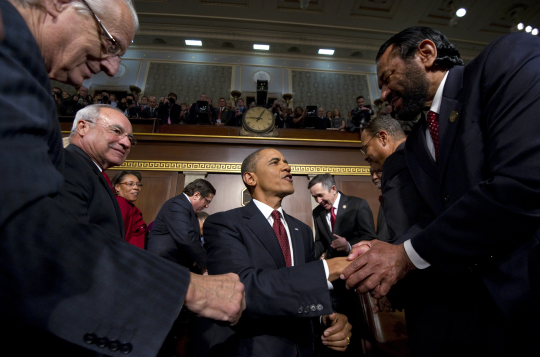
During the State of the Union address on Tuesday, President Obama made a bold call for new action against the drop out epidemic.
Obama called for the nation’s sates to enforce a new requirement which would keep students who have not already graduated from high school or turned 18 in school.
Currently, more than 7,000 students drop out of school every day in America. These numbers have implications to impact not only the lives of youths leaving school, but also the future of America’s economy.
It is proven those who graduate are more likely to earn higher earnings over the course of their lives, than those who do not. Individuals without diploma or a GED, struggle in a highly competitive job market. Lacking a high school diploma is a serious barrier to a career path.
“When students are not allowed to drop out, they do better.” Is Obama’s observation, and seems to hold true.
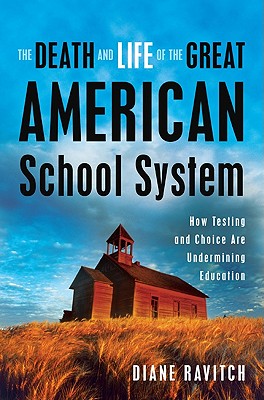
Influential education expert Diane Ravitch was on KQED’s Forum radio program with Michael Krasny on Wednesday, January 18, 2012.
Once a champion of reform policies such as vouchers and charter schools. Now, she has emerged as a leading defender of public education. We talk to her about the state of schools in California and across the country.
Listen to this valuable conversation on Forum with Michael Krasny.
Could being on the high school football team prepare you just as well for the workplace as taking an advanced placement class? By forcing all students onto a college-bound track, we ignore the fact that there are other trajectories towards success and gainful employment, according to Russell Rumberger, who currently serves as provost in the Office of the President at the University of California, and director of the California Dropout Research Project.
Rumberger recently published a book called, Dropping Out: Why Students Drop Out of High School and What Can be Done About It. According to Rumberger, roughly 25 percent of U.S. high school students do not graduate. And he says that our country is only making the problem worse by trying to prepare everyone for college.
Turnstyle spoke with Rumberger about how to re-define success in high school by creating multiple pathways for students to achieve inside and outside of school.
Silicon Valley Education Foundation
January 13, 2012
Written by Kathryn Brown California schools are the poster child for Gov. Brown’s new budget mantra that the state can’t spend what it doesn’t have. The latest Quality Counts report from Education Week ranks California 47th overall in how much it spends per student – $8,667 when adjusted for regional cost differences, about $3,000 below the national average of $11,665.
This is a drop over last year, when California spent $8,852 per pupil, with a ranking of 43rd in spending adjusted for regional cost-of-living variations. Of course that was before the state faced a nearly $27 billion dollar deficit.
The state also falls short when it comes to education spending as a percentage of state and local taxable resources. That comes to 3.3 percent according to the report, putting California in 40th place. The national average is 3.9 percent. For another perspective, Vermont puts 6 percent of its taxable resources into education; and even Texas does a little better than California at 3.7 percent.
The picture is better in the equity analysis. California ranks 12th on a measure called the wealth-neutrality score. This is defined by EdWeek as the “degree to which state and local revenue are related to the property wealth of districts.” The state’s 0.038 average means that poorer districts receive more funding than wealthy ones on a weighted per pupil basis.
It’s interesting to note the differences in where states get the bulk of their education funds. In California in 2008-09, local revenues contributed $21 billion or 29.6 percent; another $9.2 billion, 13 percent, came from the federal government (above the national average of 9.6 percent); the state ponied up the remaining $40.6 billion. Nationwide, according to the National Center for Education Statistics, state shares ranged from a low of 27.6 percent in Illinois, to a high of 85.7 percent in Vermont.
For more information please go to Spending Near Bottom.
San Francisco Chronicle
January 10, 2012
Written By Nanette Asimov
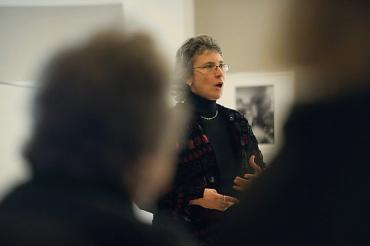
Shelley Glazer, chairperson and instructor of the older adults department at San Francisco City College, talks with students at the Jewish Community Center in San Francisco. California community college leaders voted on a systemwide overhaul that could end many free classes for older adults.
Over the objections of angry college students and worried faculty members, California community college leaders voted Monday to support a systemwide overhaul that could end many free classes for older adults and squeeze out students who fail to move quickly through the system.
The 22 recommendations approved by the college system’s Board of Governors are intended to address a devilish problem: Essential classes are in critically short supply and thousands of students are turned away from classes they need because of the state’s economic crisis.
Board member Peter MacDougall, chairman of the Student Success Task Force that drew up the recommendations over the last year, said colleges can no longer afford to put out the welcome mat they have offered for generations.
“As wonderful as having open admission is, if it’s a false promise, it fails,” he said.
Under the new plan, all students will be expected to set up an education plan to move quickly toward an associate’s degree or vocational certificate. If they linger too long or take too many classes unrelated to their goal, they lose registration priority. Others poor enough to quality for a fee waiver would lose that benefit after 110 credits, well beyond the 60 credits needed to transfer.
These changes, including a shift in key decision-making from the 112 campuses to the state chancellor’s office, won’t be automatic. Legislation is required for several of the proposals.
But Monday’s vote, unanimous with two abstentions, was a significant step toward implementing them.
“This is the most significant issue that’s come before the board,” said Board of Governors President Scott Himmelstein.
Supporters include the Community College League of California and other groups that say the recommendations will focus more attention on students who fall through the cracks.
Scott Lay, president of the league, said it was “unconscionable” that higher education has been cut $2 billion this fiscal year. “But it’s more unconscionable that we have a 20-point achievement gap between white and black students. We cannot ignore this any longer,” he said.
Dozens of opponents addressed the board, fearful that students who don’t fall within the scope of the recommendations will be shut out.
Many said that 110 credits isn’t enough time for some students, especially those who have had troubled childhoods, are single parents or former offenders.
“These recommendations are discriminatory,” said Paul Munoz, who works with needy students at Ventura Community College.
Ed Murray, an instructor at City College of San Francisco, where many opponents were from, urged the board to oppose the recommendations.
“Don’t cut out the poorest of our society. Where are they going to go if they can’t go to community college? To prison?” Murray asked.
Several of the speakers oversee programs for older adults, which offer free classes from memoir writing to music appreciation.
The recommendations direct colleges to spend their dollars first on students with academic or vocational goals. Only then should scarce resources be spent on free enrichment classes.
Chancellor Jack Scott told the audience that he has nothing against older adults. “I happen to be one of them,” said the white-haired former state senator.
Scott also addressed those who criticized the rationing of education, an expression he has used himself.
“We’re already rationing education,” he said. “We’re just doing it haphazardly.”
Abstaining from the vote were board member Natalie Berg, also a City College of San Francisco trustee,and Danny Hawkins.
As the board members voted, students stood, interrupting with “Mike check!” the Occupy movement’s signature statement. They paused only long enough to allow the board to finish voting, then shouted:
“We’ll be back! We shut down the Port of Oakland – twice – and we’re coming for you!”
MindShift Blog
January 6, 2012
Written By Tina Barseghian
Thirteen-year-old Ebony Green has hopes for a career in science.
For Ebony Green, a career as a scientist might have seemed unlikely just last year.
The stereotypical outcome for girls like Ebony, an eighth-grader at Frick Middle School in a rough part of East Oakland, isn’t necessarily a high-paying job in science, math, engineering or technology. In fact, 40 percent of Oakland Unified School District students drop out.
Still, despite her surroundings and the legacy of her race, gender, family background, and income bracket, Ebony sees a different future for herself. She wants to be a pediatrician, or maybe a vet, and she’s starting to take steps to get there. To read the rest of this compelling article go to: MindShift
As part of the PBS American Graduate Program, I produced a segment for the PBS NewsHour on Ebony Green and Techbridge with correspondent Spencer Michels. Here’s the segment.
Education Blog
Wednesday, January 4th, 2012
Written By Katy Murphy
This evening, after the Oakland school board picks a president and vice president for 2012, it moves onto its facilities master plan.
The presentation posted on the agenda (links below) covers enrollment and demographic trends, facts about the number, age and size of district buildings, and a list of projects that might be undertaken if OUSD had the money.
If OUSD tackled every project on that list it would cost an estimated $1.46 billion, not including change orders and cost overruns. (The figure is listed on one slide as $1,460 million, which — though probably standard for these kinds of reports — sounds a little like someone saying they’re five-foot-twelve.)
It includes: $145 million in projects from the 2005 master plan that never materialized, such as upgrades to fire alarms; $333 million in seismic safety improvements; $457 million in modernization projects; $53 million in solar and energy efficiency; $300 million to replace portable buildings and $172.5 million for community kitchens, health care centers and other “site optimization” projects.
As most of the Measure B funds have been allocated or spent, this project prioritization appears to be in preparation for another bond measure campaign, which the board discussed last fall (election date and amount TBD).
You can find links to the relevant documents here and the projects list below. Come 6 p.m., you’ll find a link to a live video stream of the meeting here – and something called “eComment,” which I hadn’t noticed before.
Huff Post
December 30, 2011
Written by Linnie Frank Bailey The road to U.C. Berkeley was not an easy one for Moreno Valley’s Jamal Samuel. It included 4:15 am treks along the barren landscape of the former March Air Force base to catch the first of two buses that would get him to Riverside’s North High School.
Unbeknownst to most of his fellow students and teachers, Jamal spent his junior and senior year of high school living at King Hall — a homeless shelter on the base run by Path of Life Ministries. Once military housing, the barracks have been converted into small one-room apartments for the homeless.
Read this inspirational story at The Jamal Samuel Story

 OAKLAND, Calif. — Around this time every year, millions of parents in California are working through the school enrollment process. Unfortunately, while many don’t have a choice regarding what school their child will attend, those who do often find their options bewildering.



 Education Blog