








Gone Home: A Video Game as a Tool for Teaching Critical Thinking Skills

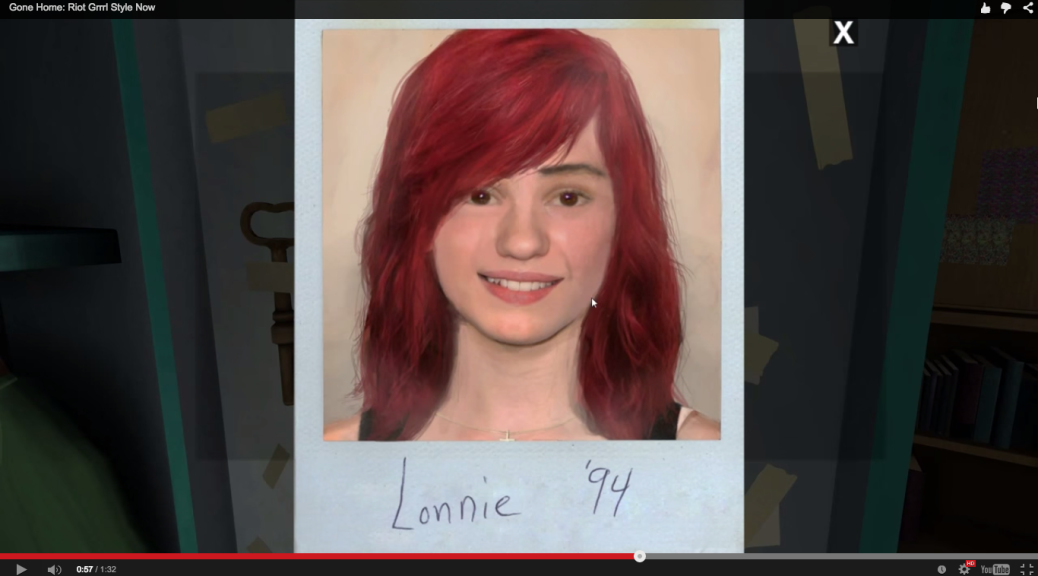
A screen grab from the Gone Home trailer.
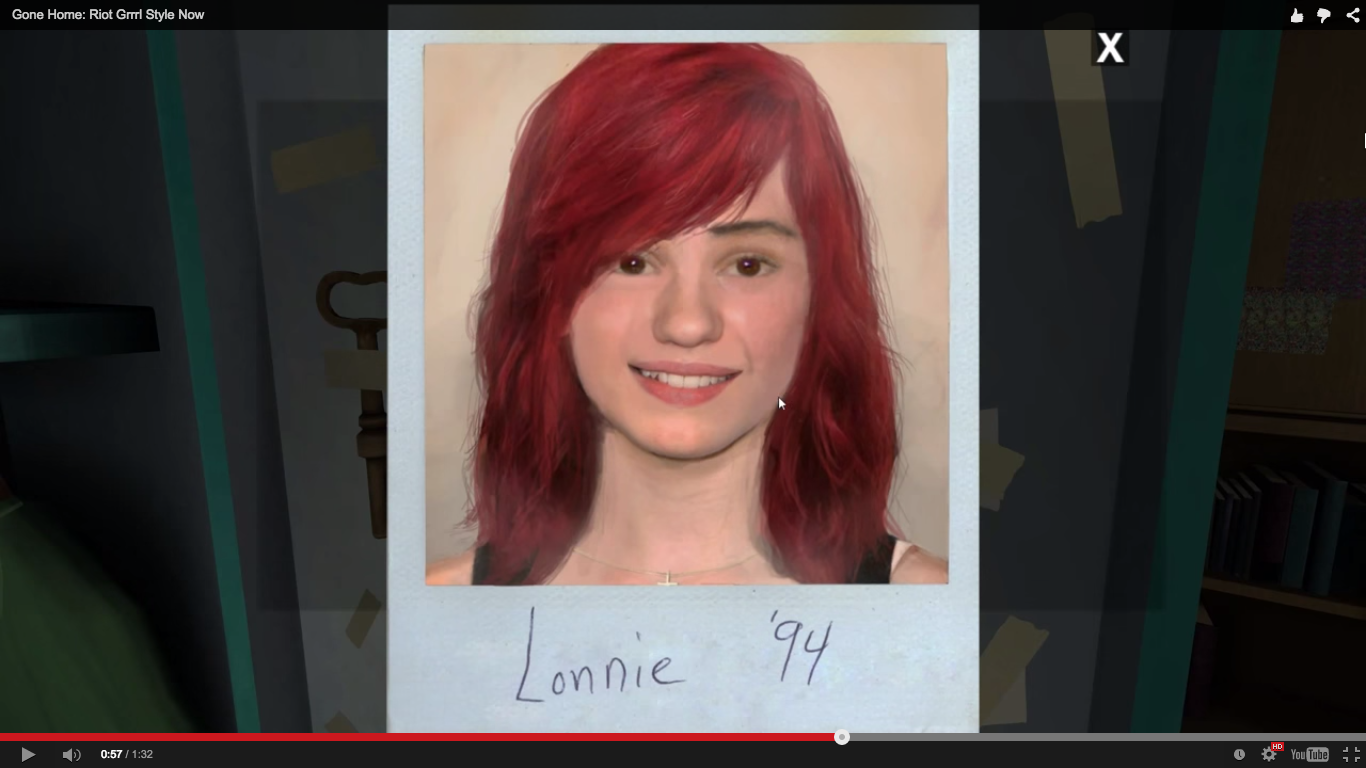
A screen grab of a clue found in the Gone Home trailer.

By Matthew Farber

Educators are held responsible for several aspects of English-language arts competency with their students: critical thinking, writing, assessing narrative structures, thinking about how characters develop and how setting affects character. Teachers have a variety of vehicles for conveying those lessons, but a new tool has emerged for learning with digital games.

Books have a linear format; films have an arc; art has a focal point; stanzas in a poem are read in order. But a recently published game called “Gone Home” is testing the traditional progression of learning by flattening the story. Players have questioned whether it qualifies as a game since it doesn’t include traditional points, prizes and leveling up (the game is self-titled as “a story exploration video game”). Critics have praised “Gone Home” as a new way of storytelling, and it’s beginning to make its way into the classroom, as a viable substitute for traditional text. The game is non-linear and players have a great deal of agency for filling in the gaps to arrive at their conclusions.*

Solving a Mystery

The game begins with a typical opening of suspense and mystery. The main character, Kaitlin “Katie” Greenbriar, comes home on a dark and stormy night to her family’s house in Oregon after a year abroad. She discovers that no one is home, and it appears her family has left in a hurry. Signs of the suspended life appear in notes, food in the refrigerator, messages on an answering machine — and all of those pieces serve as clues for discovering what happened to Katie’s family.

[contextly_sidebar id=”WZQ9GHYJjUa0NkuSU4rYdN8ALZYWiTVu”]

The mind veers to the obvious. Were they harmed? Are they still alive? There are notes from parents, tidbits of information about “psycho” relatives, a journal and secret rooms that reveal clues about what’s happened in Katie’s yearlong absence. And it’s the space between the clues and the possible conclusions that make the game a valuable teaching tool for educators. (Note: spoilers are easily found online)

“The story isn’t going to exist without the player’s participation and interpretation of the individual pieces they find,” explained Steve Gaynor, the game’s lead writer.

In order to give his students the opportunity to interpret the experience for themselves, Toronto-based teacher Paul Darvasi (who also writes about games for MindShift) sought a volume discount on game licenses. That way each student in his all-boys English class had his own login when Darvasi began using “Gone Home” in the classroom in 2013.

In order to offer some sense of structure to his students’ experience, he created objectives for students around characters and themes. The house in “Gone Home” is filled with nods to the genre of games that inspired it; one subtopic challenged students to collect the hidden references. Others conducted “1995 Archeology” — the year “Gone Home” was set. The goal was to find objects from the time period, from telephone books to VCR tapes to audiocassettes. “Riot Grrrl” subculture from the 1990s — especially as it pertained to the protagonist’s character development in the story — was another topic. The findings of each subtopic were presented to the class as a “visual museum,” via PowerPoint. Students were ultimately assessed on their presentations.

“I wanted it to become a more deliberate process than just running around,” he said. “ ‘Gone Home’ is a game in which you have to invest yourself. You have time to look through the documents and examine the artifacts. You have to be fairly methodical when you go through the house.”

The next challenge pertained to individualized assessments. Measuring how well one plays a game is tricky. The assessment shouldn’t be perceived as an added obstacle to the experience, nor should it be based on whether the student wins. “The beauty of  ‘Gone Home’ is the agency you enjoy as a player, freedom to move around freely,” Darvasi explained. “The single greatest mechanic is exploration — the thrill of finding something new while snooping around somebody’s house. I didn’t want to impair that in any way.”
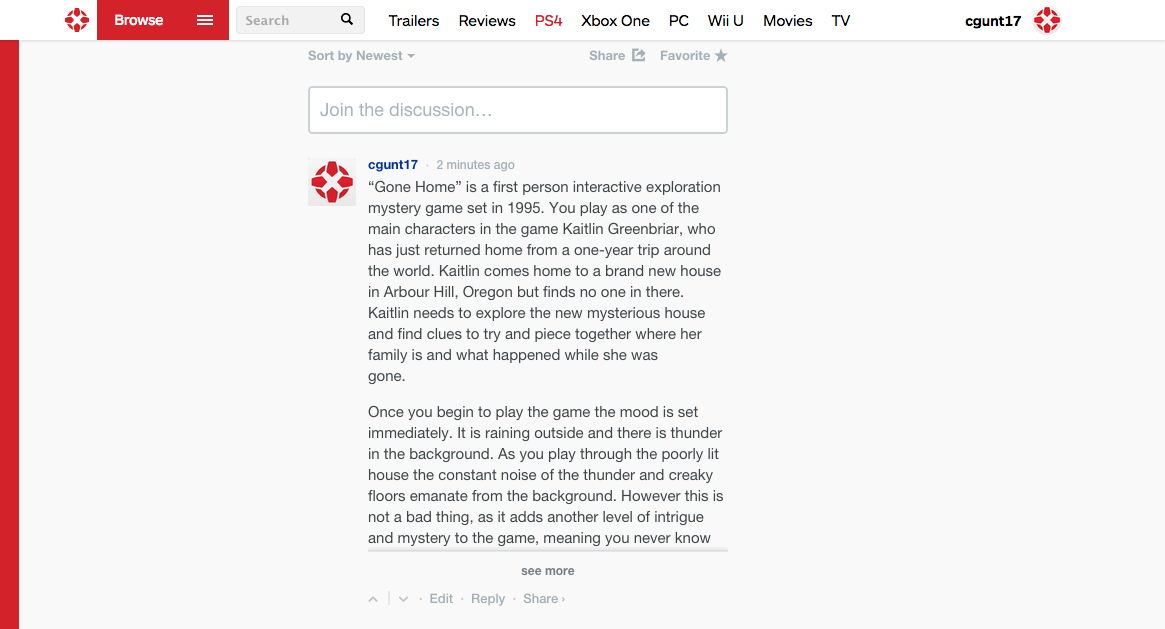
A review submitted by a student to a games website.

As a result, Darvasi kept the assessments close to the genre of gaming, specifically the participatory cultures that exist outside virtual environments. Each student was required to write a review, similar to those posted on community forums like Metacritic and IGN. The second assessment piece gave students choices. He created subtopics that could be tracked using screen shots and notes as each moved about the empty house.

“Whenever they stumbled upon or discovered something that related to their topic, they pulled that evidence out and kept it,” Darvasi said.

The learning outcomes intentionally correlated to the Common Core State Standards relating to English-language arts. “In a sense, it played out similar to a typical literature unit — except that you are substituting written text with a game’s text,” Darvasi explained.

International Collaboration

Putting a game at the center of a close-reading exercise can depend on the teaching style of the specific educator. In the spring of 2014, Aleksander Husøy, an English teacher at Nordahl Grieg Secondary School in Bergen, Norway, came across Darvasi’s blog posts about his use of “Gone Home” in the classroom. “There are plenty of different games that can be effective when used by the right teacher for the right group of students,” Husøy explained. “When I look for games to put in the classroom, I use the same approach as any other media. Start with objectives that you want students to cover.” Following that approach, Darvasi and Husøy connected and decided to co-deliver the unit in the fall of 2014.
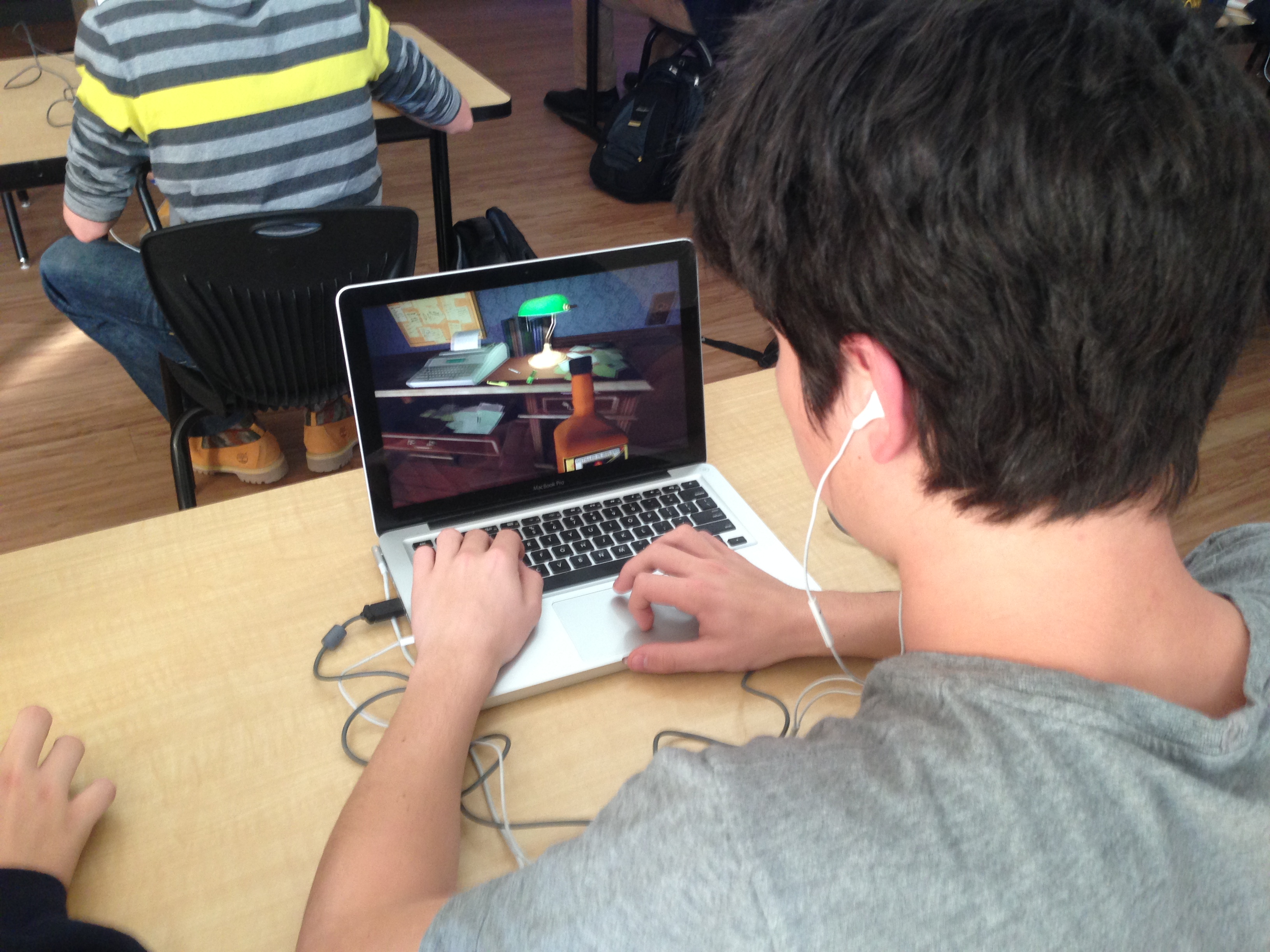
A student explores objects found in the house of "Gone Home." (Courtesy  of Paul Darvasi)
A student explores objects found in the house of “Gone Home.” (Courtesy of Paul Darvasi)

Students in each school collaborated using asynchronous tools, such as posting to blogs and commenting to a private Facebook group page. Two of the student groups decided to go further, collaborating with Google Hangout to create their final project assessment.

When the reader is put in the role of investigator, story details can become even more compelling. “Players paint the final picture of what those individual pieces mean and then discuss it with other people,” Gaynor said. “We are really proud that there are classrooms where ‘To Kill a Mockingbird’ or ‘Catcher in the Rye’ are taught alongside ‘Gone Home’ as texts about young people and the issues they face.”

Several of “Gone Home’s” designers had previously written blockbuster games, including “Bioshock 2” and “Bioshock: Infinite.” In those titles, the story unfolded as the player discovered audio recording and messages between violent action sequences. Several members of the design team eventually left the publisher to create the Fullbright Company, an independent game studio. They decided to make a game in which piecing together a non-linear story would be a central mechanic of the game. “ ‘Gone Home’ is a clear demonstration of how much the narrative process happens in your head, as opposed to on the page or on the screen,” Gaynor stated.

*Note: An earlier version of this post suggested that players can alter the game’s story based on the decisions they make throughout the game. The game’s narrative and ending can not be changed. Every player encounters the story differently depending on the choices they make while playing.
The MindShift Guide to Digital Games and Learning

How can games unlock a rich world of learning? This is the big question at the heart of the growing games and learning movement that’s gaining momentum in education. The MindShift Guide to Digital Games and Learning [PDF] explains key ideas in game-based learning, pedagogy, implementation, and assessment. This guide makes sense of the available research and provides suggestions for practical use.

The MindShift Guide to Digital Games and Learning started as a series of blog posts written by Jordan Shapiro with support from the Joan Ganz Cooney Center at Sesame Workshop and the Games and Learning Publishing Council. We’ve brought together what we felt would be the most relevant highlights of Jordan’s reporting to create a dynamic, in-depth guide that answers many of the most pressing questions that educators, parents, and life-long learners have raised around using digital games for learning. While we had educators in mind when developing this guide, any lifelong learner can use it to develop a sense of how to navigate the games space in an informed and meaningful way.

MindShift-Guide-to-Digital-Games-and-Learning-Cover

Here’s a preview of the table of contents:

Introduction: Getting in the Game (Page 4)
An overview of games in the classroom from Katie Salen Tekinbaş, executive director of the Institute of Play.

What the Research Says About Gaming and Screen Time (Page 6)
Much of the research around digital games and screen time is evolving. Pediatricians, academics, educators, and researchers are working to find answers to how games and technology affect learners of all ages.

How to Start Using Digital Games for Learning (Page 14)
Since each learning environment is unique, here are some steps to assessing your resources before committing to a particular game or platform. See how some educators are using digital games in the classroom and how they find support.

How to Choose a Digital Learning Game (Page 19)
The sheer volume of games classified as educational can be overwhelming. This section gives you a starting point for game selection by providing an understanding of the types of games available in the marketplace and how to go about selecting them.

Overcoming Obstacles for Using Digital Games in the Classroom (Page 27)
As game use in the classroom continues to grow, barriers to deployment also need to be addressed. A recent survey of teachers outlines exactly which obstacles get in the way of successful implementation; solutions to those concerns are outlined in this section.

How Teachers Are Using Games in the Classroom (Page 30)
Examples of how teachers use games are embedded throughout the guide (including video examples), but this section takes an in-depth look at how some teachers are using games in the classroom and their real-life struggles and victories.


How Digital Games Help Teachers Make Connections to Lessons and Students

Brad Flickinger/Flickr

It’s not unusual for educators to use analog games in the classroom, but as more classrooms gain access to technology, digital games are also making a strong showing. A recent Joan Ganz Cooney Center survey of 694 K-8 teachers found that 74 percent of those surveyed use digital games in the classroom, up from 50 percent two years ago. Many of the teachers finding the most success are good at creatively connecting the game back to the curriculum, while allowing it to maintain the qualities of a good game. These teachers are often more comfortable with games themselves, playing for fun in their spare time, and are thus more likely to see valuable classroom connections. It’s one thing to have empirical evidence that digital games are growing in popularity and another to get an in-depth look at how and why teachers see them as a valuable use of precious class time.

INTRODUCING GLOBAL HISTORY

Zack Gilbert teaches a course called “Ancient Civilizations” at a middle school in Normal, Illinois. He’s been using game simulations in his classroom since 1995, but when he started playing the commercial game “Civilization IV” for fun he immediately recognized its potential to get sixth-graders hooked on history.

“Especially for ancient civilizations, you want to make it as exciting as you can,” Gilbert said. “This is their first real taste of history for the world; most kids have no concept of what the history is in other countries.” When playing the game, students build up their own civilizations in different time periods, making choices in five categories: government, legal, labor, economy and religion.

“It gives the kids a visual,” Gilbert said. “They’re actually acting out and making decisions on things that people who lived thousands of years ago would have had to make.” He acknowledges that games like “Civilization IV” aren’t appropriate for class use all the time and he doesn’t use them exhaustively. However, getting kids excited about the high stakes that historical figures faced is a great jumping-off point for writing assignments, discussions and interactive learning.

“When they’re building their first city, they have to look at the terrain around them. They have to look at the resources to see if this is a good place to build,” Gilbert said. Students often make mistakes in the game, and Gilbert has to restrain himself from trying to correct them immediately, instead letting them figure out where they went wrong. Students often build their cities on flood plains and watch as their citizens get sick and die. That experience prompts them to try a different approach next time. They now understand viscerally the devastation that choice would have brought to ancient civilizations.

“It all starts connecting,” Gilbert said. “When you get into the game it all connects to the state standards.” For example, if students build monuments in the game, they’re using math skills but also thinking about the artistic relevance of such a symbol. “You as the teacher need to know what your goal is for them, and then set them up so they can succeed,” Gilbert said. “If you have a good enough game, they’re going to gain more knowledge than you expect.”

Sandbox games are Gilbert’s favorites — there are lots of ways to win or lose, and students get to show off their creativity and critical thinking. He also thinks commercial games are some of the best tools because of their rich graphics and strong game mechanics. “Civilization IV” is sometimes criticized for not being historically accurate, but Gilbert sees that flaw as a teachable moment. “You can turn the things that might not be necessarily correct into learning experiences,” he said.

Gilbert points out that the hardest part of any teacher’s job is reaching a variety of learners, all at different stages of development and academic skill. He’s noticed that while not all his students love playing video games for class, struggling learners often come out of their shells and prove they can deliver some of the most innovative solutions. Succeeding in one area of class helps them gain confidence for other tasks, like writing and group projects.

This anecdotal observation bears out in the Cooney Center research, which found that 55 percent of teachers who use digital games report they are a good tool for motivating low-performing students. Teachers see that motivation translating into academic performance. too: 78 percent of teachers using digital games saw improved performance on curricular subjects due to gameplay, and 71 percent saw improvement in extracurricular subjects.

Like many other teachers, Gilbert says it can be hard to integrate games into the curriculum when the focus is overwhelmingly on standards and state tests. “Things are becoming more regimented in the classroom,” he said. He understands that many teachers don’t have time to rework their whole curriculum to include games, especially if they themselves aren’t comfortable with digital gameplay.

GAMIFYING CLASS

Students in Caryn Swark’s Grade 6 class (she teaches in Alberta, Canada) come to school and immediately find themselves immersed in a fictional world where the king has been kidnapped and they must rescue him. Students have avatars and “level up” throughout the year as they master different skills. This gamified environment is part of the class DNA, so it’s no surprise that Swark is also using digital games to help students engage and connect with the material she’s teaching.

“There’s a lot of games that are basically worksheets in disguise,” Swark said. “I try to avoid those games as much as possible. They’re not really games and kids aren’t stupid.” Like Gilbert, Swark believes there are lots of educational merits to some commercial games, especially if teachers think expansively about how to build on game narratives and skills.

Swark uses Nintendo DS games like “Professor Layton and the Curious Village,” a game that is basically like reading a novel embedded with math problems and puzzles. The first time she played it, Swark was struck by how similar some of the puzzles were to things she had asked students on worksheets. When kids play the game, they are doing lots of reading and math, but they like it.

Similarly, “Prodigy,” a commercial math computer game, is built around a wizarding world where students do battle by solving math problems. Swark wishes the math were a little more integrated, but students still find the game fun and engaging.

[contextly_sidebar id=”zulTEeon8xg6R0Ol2bdivxOsLsl6uWu9″]

“Instead of thinking about a checklist of curricular needs that I have to meet, I think about how this fits into what I need,” Swark said. She has found that not only are kids more interested in what they’re learning through gameplay, but they stick with tricky problems longer, work together better and are more open to trying over and over again. The stakes are lower when a student fails within the game, and she doesn’t see any of the test anxiety that has begun to plague her students.

“Framing things in terms of gameplay helps get through blocks for kids who get to Grade 6 and are already convinced that they can’t learn,” Swark said. She’s seen her weaker students gravitate toward gameplay and make significant gains. Games are one part of her yearlong goals to break students of the notion that they will fail even when they try.

As a female teacher and a “gamer,” Swark has often found bringing games into the classroom helps her connect more to her male students. And students who are alienated socially have become popular because of their abilities to help others in games like “Minecraft.”

Swark got inspired to try games in her classroom after reading Lee Sheldon’s book, The Multiplayer Classroom: Designing Coursework as a Game, and jumped in feet first. She’s built on her success and retooled her failures, just as she’s asking her students to do with their schoolwork. Parents and administrators have been more supportive than she expected — she’s even suggested parents expose their struggling readers to fan fiction to get them reading.

But not all teachers work in such supportive environments. In those cases, or when an educator is more hesitant, Swark recommends teachers check out game-rating sites like “Graphite,” run by the nonprofit Common Sense Media, to choose games that clearly align with the grade and standards they teach. She also says it’s easier to start with overtly educational games and work up to the more open-ended games. Lastly, she says there’s a lot to learn from other educators.

“There’s a lot of people online who are doing this stuff,” Swark said. “They’re making lesson plans involving games, and you can find those. And then you don’t have to spend the time playing a video game for hours.”