As anyone who got stuck in the traffic knows, President Obama made a call at one of the Bay Area’s new darlings of green tech, Fremont-based Solyndra Inc., which he called a “testament to American ingenuity and dynamism.”
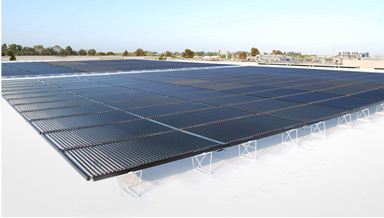
The firm is tapping more than a half-billion dollars in federal loan guarantees to build a manufacturing plant for its photovoltaic (PV) technology. Governor Schwarzenegger and Energy Secretary Steven Chu have also used Solyndra as a backdrop for showcasing California’s burgeoning clean tech sector. The company has developed a new type of PV technology designed for commercial rooftops.
Solyndra's rooftop solar panels use a new type of cylindrical module. Image: Solyndra, Inc.
Today in Silicon Valley, the big, green hype machine was running at full tilt. Solyndra’s CEO, Chris Gronet, talked up the California location. “If our factory was someplace else (outside the US), we probably would not have the supply chain across 29 US states,” he told KQED’s Cy Musiker today.
Mike Mielke of Silicon Valley Leadership Group added to the frenzy: “Clearly California’s leadership in the emerging trillion-dollar clean energy technology market has put us in an ideal investment position,” he said in a statement issued after the Presidential appearance. “We would not be as competitive without the state’s landmark clean energy policies like AB 32.”
But some temperance was injected into the festivities by Severin Borenstein, co-director of the Energy Institute at UC Berkeley’s Haas School of Business. Asked if investments in solar panel production necessarily translate to permanent job growth, he told Musiker: “The evidence from a longer-run perspective really doesn’t support that.”
Borenstein says what history does demonstrate is that dominance in a given technology lasts just about as long as the government subsidies supporting it. He pointed to both Germany and Spain, both of which have recently lost some of their edge in production of solar components. Much production of solar and wind energy products has already moved to China.
“This idea that you’re going to create a permanent competitive advantage in producing green technology by subsidizing it now is really not very well born out in the data,” said Borenstein, who doesn’t deny that federal stimulus funding has “helped push forward” some key technologies. In the absence of a meaningful price mechanism for carbon emissions, Borenstein says that “pushing forward on some of these alternative technologies is the best thing we can do.”
Regarding California’s landmark climate law, the aforementioned AB 32, Borenstein agrees with the state’s Legislative Analyst that implementation would not have a significant impact on California’s overall economy, in either direction. But Borenstein doesn’t see the point in abandoning the state’s primary comprehensive climate strategy to save jobs, as some have suggested it would. “Climate change is real and it is potentially catastrophic,” said Borenstein. “If every time we have an economic setback, we put the environment second, we’re never going to make any progress.”
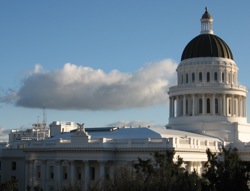
Clouds linger over California's cap-and-trade future. Photo: Craig Miller
The notion may be losing momentum in Washington but in Sacramento, California’s Air Resources Board continues the trudge toward a carbon trading program mandated under the state’s 2006 climate law, AB 32. This week its staff held the latest in a series of public meetings to discuss “program development” and “allowance allocation.” The topic may be a certified snore for most people but the CalEPA auditorium in Sacramento was nearly packed with representatives from utilities, environmental groups, public health advocates and an assortment of other interested parties, many with diametrically opposed views of how carbon allowances should be meted out for trading.
One of them was Chris Busch of the Center for Resource Solutions, who gave voice to a contingent disillusioned with what they read as momentum toward giving away allowances to industry. Busch coined what was probably the phrase of the day, accusing the Air Board of some “creative re-framing” of how carbon allowances might be distributed. Environmentalists have been pushing for something close to a “100% auction” of permits, while many business interests are hoping to get them free of charge, at least in the early stages of the program.
To many in the room, the update from the Air Board staff appeared to indicate a drift toward free permits. The Board’s Kevin Kennedy stressed that the staff had never come out officially for a 100% auction and said they’re “taking a close look” at how best to distribute them. His colleague, Matt Zaragoza put it more bluntly, saying “We’re strongly considering the need for free allocations.”
Regarding the state’s plan to join in a regional carbon market with several other states and some Canadian provinces known as the Western Climate Initiative, Kennedy insisted that “reports of it’s death have been greatly exaggerated.” But when pressed on how many US states are actually prepared to move forward, he confirmed that only New Mexico is in lockstep with California. Arizona’s governor recently signed an executive order pulling that state out of the proposed regional carbon market.
Here in the Golden State, industry is still angling for anything it can get to keep emissions fees to a minimum. Some complain that valid considerations are being left out of the plan.
“A lot of us are producing products today that are very focused on energy savings.,” said Phil Newell, who heads energy and environmental affairs for Guardian Industries, a maker of “low-E” glass products which promote energy efficiency. Newell says that a system of traded carbon permits and offsets should account for the energy savings achieved by his company’s products. “Every time we use a unit of energy in producing a coated product, we’re reducing 500 units of pollution elsewhere,” Newell claimed in a hallway interview. “We need some recognition of that.” Newell said that without that recognition, the high cost of carbon allowances might force his company to shut down manufacturing in California. Guardian operates a plate glass manufacturing plant near Fresno.
The Air Board’s staff says it is pushing for a “design document” describing a plausible allowance system by mid-summer.
A hefty stack of reports issued by a top national science board appears to affirm California’s response to the challenges of climate change.
The National Research Council, an arm of the National Academies of Science today released three reviews of the current climate science, each focusing on a different aspect of it. The first report, a 400-page assessment of the state of the science, affirms the prevailing view among scientists that global warming is proceeding apace, propelled largely by emissions of greenhouse gases, and that some of the early impacts are already upon us.
Stanford’s Pamela Matson, a specialist in biogeochemical ecology and lead author of the science assessment, said these conclusions are supported by “multiple lines of evidence” and have “stood firm” in the face of intense scientific scrutiny. Matson conceded, however, that much uncertainty remains in the science, and that the credible range of global warming projections runs from two, to eleven degrees, Fahrenheit, by the end of this century.
Two companion reports focused on mitigation and adaptation strategies, respectively (for a closer look at the latter, see Nicole Heller’s post at Climate Central).
Robert Fri, who led the NAS panel on “limiting the future magnitude of climate change,” said that federal policies should “enable flexibility and experimentation in policies at state & local level.” Fri cited California and Alaska as leaders in climate response policy at the state level. Mary Nichols, who chairs California’s Air Resources Board and effectively heads the implementation of the state’s climate strategy, also sits on the “Limiting Panel” of the NAS review. Nichols has been a vocal promoter of state and regional efforts, such as the Western Climate Initiative.
When queried about pending federal legislation that might nullify state programs to regulate carbon, Fri said that “the bar ought to be pretty high for federal preemption. States have already done a lot,” he said, and it’s important not to act in a way that reverses the progress.”
Likewise Fri’s colleague, Tom Wilbanks, head of the study’s adaptation panel, said that what’s needed is “not a federal response but a national response,” and that Washington’s role should be to “create a framework” of policies and resources that “reinforce each other rather than get in each others’ way.”
The recommendations come as California’s sweeping 2006 climate strategy, known widely as AB 32, is under attack from Republican gubernatorial candidates and a well-funded initiative campaign to suspend most regulations under the law. Likewise both the House and Senate bills pending in Washington would either preempt or temporarily freeze state programs to reduce carbon emissions.
Fri also provided the morning’s most eyebrow-raising moment when he said that current technology will not be up to the task of reducing warming. “We can’t get there by just deploying what we know how to do,” he said, noting that brand new technologies will be required. “And we probably won’t be doing it at least cost,” he added.
The NAS reports released today do not recommend specific targets for GHG emissions. The three reports are the first in a series of five requested by Congress as part of the program called America’s Climate Choices.
A webcast of the one-hour public rollout of the reports is available at the NAS website.
Most of the discussion regarding the highly anticipated Senate energy and climate change legislation, which Senators John Kerry (D-MA) and Joseph Lieberman (I-CT) introduced last week following months of negotiations, has focused on the bill’s provisions pertaining to offshore oil and gas drilling, incentives for renewable energy, and cap on carbon emissions for certain economic sectors.
Although the bill’s carbon dioxide (CO2) emissions reduction targets–an 80 percent emissions cut by 2050 compared to 2005 levels–would yield significant long-term climate benefits, the bill also addresses man-made climate change in the shorter term.
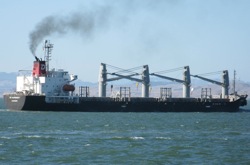
Stack emissions from a bulk freighter in San Francisco Bay. Photo: Craig Miller
A little-noticed portion of the bill concerns short-lived air pollutants such as black carbon (otherwise known as soot) and tropospheric ozone. These pollutants disrupt the climate on far shorter timescales than CO2, which scientists consider the most important greenhouse gas and the main villain in the climate change story.
Once emitted by the burning of fossil fuels, the use of solid-fuel cooking stoves or biomass burning, among other sources, black carbon only stays aloft for days to a few weeks before being washed out of the atmosphere by precipitation. This means that once black carbon emissions are reduced, there would be almost immediate climate benefits.
The Kerry-Lieberman bill would direct the US EPA to use its existing authority under the Clean Air Act to reduce black carbon emissions from diesel engines, using devices called diesel particulate filters which trap soot emissions before they escape from a vehicle’s tailpipe.
It would also call upon the EPA to publish a report on black carbon “sources, impacts, and reduction opportunities,” including an examination of how foreign assistance programs could help reduce emissions in other nations. In addition, the bill would establish an inter-agency process to facilitate “fast mitigation strategies” that focus on non-CO2 warming agents. This process would involve agencies such as the EPA and the Energy Department (DOE).
How big a climate player is black carbon?
Black carbon is thought to be a powerful warming agent in many regions, particularly snow and ice-covered areas such as the Himalayas and the Arctic. As its name suggests, black carbon particles are dark in color, and are therefore strong absorbers of incoming solar radiation. They warm the atmosphere and alter cloud characteristics, and when they land on brightly colored snow and ice, they darken the surface, causing a large uptick in the absorption of solar radiation, which hastens melting.
In the Arctic, black carbon contributes to a feedback loop that has helped cause a rapid melting of sea ice cover and drive temperatures upward at nearly twice the rate of the rest of the world. The decade from 1999-2008 was the warmest ten-year period in the Arctic of the past 2,000 years, according to a study published in the journal Science in 2009.
In addition to Arctic warming, black carbon has been shown to alter regional climate patterns such as the Indian monsoon, and human inhalation of soot particles is known to be a major health hazard worldwide.
In recent years numerous scientists, most prominently V. (Ram) Ramanathan of the Scripps Institution of Oceanography and James Hansen of NASA have called for significant cuts in short-lived air pollutants as a way to reduce climate change in the near term, while efforts continue to address CO2 emissions in the long run. Ramanathan’s studies have shown that black carbon may be the second largest contributor to global climate change.
In March testimony before the House Select Committee for Energy Independence and Global Warming, Ramanathan stated that the current global warming effect of black carbon “may be as much as 60 percent” of the CO2 warming effect. He noted, however, that there are significant uncertainties about black carbon’s role in the climate system.
Ramanathan told House lawmakers that reducing black carbon emissions “may provide a possible mechanism for buying time to develop and implement effective steps for reducing CO2 emissions.”
Bill is aligned with recent scientific advice
The Kerry-Lieberman bill’s inclusion of rapid mitigation strategies is consistent with advice contained in a new paper from an interdisciplinary panel of scholars, published on May 11 by the University of Oxford in the UK. The paper argues that non-CO2 drivers of climate change have been overlooked “for reasons of convenience in framing policy” rather than due to scientific concerns, and it presents a vision for an overhaul of climate policy that would include a much more prominent role for addressing emissions of short-lived air pollutants.
“Since action on these non-CO2 ‘forcers’ may have quicker impact and large, immediate primary benefits, we would give them priority, now. In contrast to long and arduous tasks, these can be ‘quick hits’,” the report states.
The bill’s provisions are also consistent with the findings of a scientific panel that examined options to address rapid Arctic climate change. In a 2008 report, the panel strongly endorsed pursuing emissions reductions of black carbon and other short-lived air pollutants. “…Curbing short-lived climate forcing agents, through rapid international action and Arctic nation leadership, may prove to be the best and perhaps only viable strategy for slowing Arctic warming in the time frame of years to a decade,” the report stated.
Considering that the Kerry-Lieberman bill itself faces a highly uncertain future, with significant resistance in both political parties, it may yet take even longer to address what many experts consider to be a ripe, low hanging fruit of the climate challenge. This does not bode well, given the much more difficult work that lies ahead to reduce CO2 and other longer-lasting greenhouse gases.
In April, Molly Samuel reported on the effects of black carbon and snow albedo on the California’s water forecasting efforts.
The latest version of a federal climate bill sets a series of national targets for greenhouse gas emissions and would halt California’s plans for state and regional carbon trading.
Unveiled by Senators John Kerry and Joe Lieberman today, the American Power Act aims to push GHG emissions down to slightly below 2005 levels by 2013, then sets a longer-term reduction timetable of 83% (of 2005 levels) by 2020, 58% by 2030, 17% by 2050 (or to flip it around, an 83% reduction from 2005 levels by 2050), in line with the promise that President Obama made following the “Copenhagen Accord.”
The 987-page bill regulates seven greenhouse gases, with room for the Environmental Protection Agency to add others under the Clean Air Act. The cap-and-trade provisions focus on “7,500 factories and power plants,” which is to say those that put out more than 25,000 metric tons of carbon per year. That’s the same benchmark used by the federal EPA in its proposed regulations.
Like previous drafts, this one nullifies state and regional carbon regulation, setting up “one clear set of rules” for industry and providing “compensation for the revenues lost as a result of the termination of their cap-and-trade programs,” such as California’s AB 32, and regional efforts, such as the Western Climate Initiative. California’s Legislative Analyst has estimated that the state has committed about $120 million so far, to the implementation of its 2006 climate law. California regulators have already weighed in on the concept of “federal preemption,” warning against leaving the job of carbon reduction to the federal government alone. The Kerry-Lieberman bill requires “consultation” with states that currently have their own emissions plans.
Significantly, the first several sections of the Senate bill address development of energy sources. The reduction goals for greenhouse gas emissions aren’t even spelled out completely until page 265. Energy provisions that may come to bear on California policy include:
Agribusiness:
– All farms appear to be exempt from cap & trade but benefit from offset programs
Oil Industry:
– According to a summary of the bill from Kerry’s office: “Producers and importers of refined products” will get a fixed price for their carbon allowances.
– Offshore drilling is included as part of the energy strategy but states can prohibit leasing within 75 miles of the coast
Nuclear Power:
– Provides several incentives, including an “expedited procedure for issuing combined construction & operating licenses for qualified new nuclear reactors.”
– Increases loan guarantees to $54 billion
Missing from the bill is a comprehensive national strategy for storage of spent nuclear fuel, an unresolved issue that prevents California utilities from any expansion of nuclear power.
Governor Schwarzenegger issued a statement that barely acknowledged federal preemption, saying only that “California has been an unparalleled leader in clean energy, pioneering policies that have benefited the entire nation, and we must be able to continue our important, groundbreaking work that will both improve the environment and help our economy.”
Some environmentalists have already responded with raspberries. In a statement based on draft summaries of the bill, the group Friends of the Earth called it “dangerous,” claiming that the bill would “scrap crucial tools for solving the climate crisis” and provide “billions in giveaways to corporate polluters.” In a statement from the Environmental Defense Fund, on the other hand, its western regional vice president said that the bill’s announcement “marks real progress in the fight against climate change.”
It looks like there will be a measure on November’s statewide ballot to block full implementation of California’s greenhouse gas regulations.
Groups supporting the measure they call the “California Jobs Initiative” claim they gathered more than 800,000 signatures, nearly twice what they needed to qualify the proposal as a statewide referendum.
The existing climate law, known widely as AB 32, allows for the Governor to declare an emergency suspension of up to one year. But John Kabateck, who heads the California branch of the National Federation of Independent Businesses, says small businesses in particular can’t wait to see what the next governor might do; that the measure is needed to “stop the madness.” Kabateck said it’s time to “just push the pause button and please stop loading small businesses with new costs, new mandates and new regulations at a time when we need to crawl out of the hole.”
Studies have reached varying conclusions about what effect the state’s current regulatory path for carbon emissions would have on the California economy. Opponents of the measure have already formed their own campaign, trying to keep momentum behind the three-year-old climate law known as AB-32.
Steve Maviglio, who works for the the pro-AB 32 Californians for Clean Energy and Jobs, formed to oppose the ballot initiative, says he doesn’t think all those signatures necessarily signify broad support. “I think what that represents is the travesty of the initiative system and how out-of-state oil companies can buy their way onto the ballot,” he told me, in a telephone interview. The push to get the measure on the ballot has been financed largely by Texas-based oil companies and a somewhat obscure organization called the Adam Smith Foundation, based in Missouri.
“It took them $2 million to round up these signatures” said Maviglio. “And if you look at every single poll, you can see that Californians know we can have both clean air and a strong economy, and that we’re not going to be fooled by Texas oil companies,” he added.
The proposed ballot measure would freeze AB-32 until the state’s unemployment level dropped to five-and-a-half percent—or lower–for one full year. That’s something that’s happened only three times since the mid-1970’s: once in the late 1980s (for about ten quarters), a similar stretch in the late ‘90s, and once in 2005-06. After the deep recession of the early ‘80s, it took the state’s unemployment rate about four-and-a-half years to move from its 11% peak back to the 5.5 percent threshold.
Governor Arnold Schwarzenegger today called the effort to halt AB-32 “the work of greedy oil companies.”
Jeff Dozier approaches the instrument tower on Mammoth Mountain.
When Jeff Dozier, a hydrologist at UC Santa Barbara, goes to work, he gets to enjoy quite a view. His snow lab is perched halfway up Mammoth Mountain in the central Sierra. We took a gondola to get up there; the other passengers were skiers and snowboarders itching to get out on the freshly fallen snow.
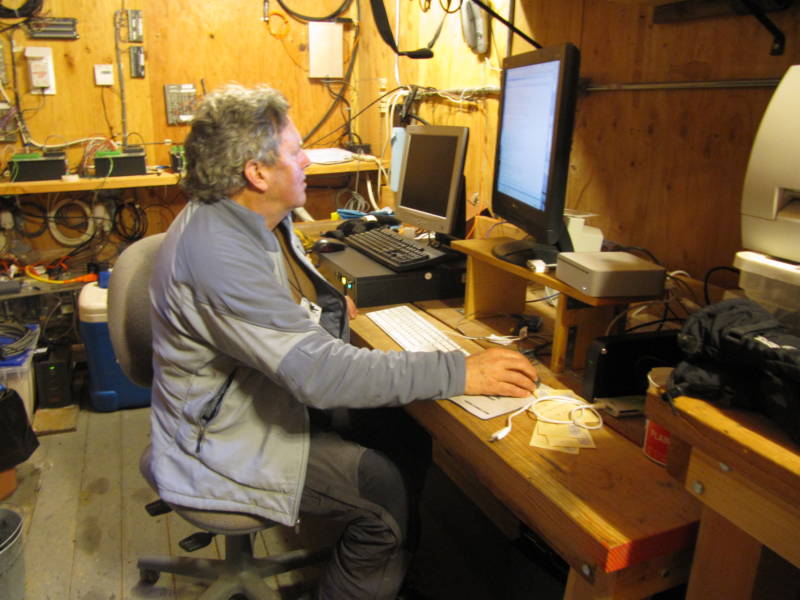
But the instrument platform from which we enjoyed views of the White Mountains is really only half the story. Dozier’s computer lab has much less of a view. In fact, it has no view. It’s buried under the snow, accessible only through what he calls a “Santa Claus entrance” (in the picture above, you can see the entrance–it’s the white tubular “chimney” extending down into the snow from the center of the platform).
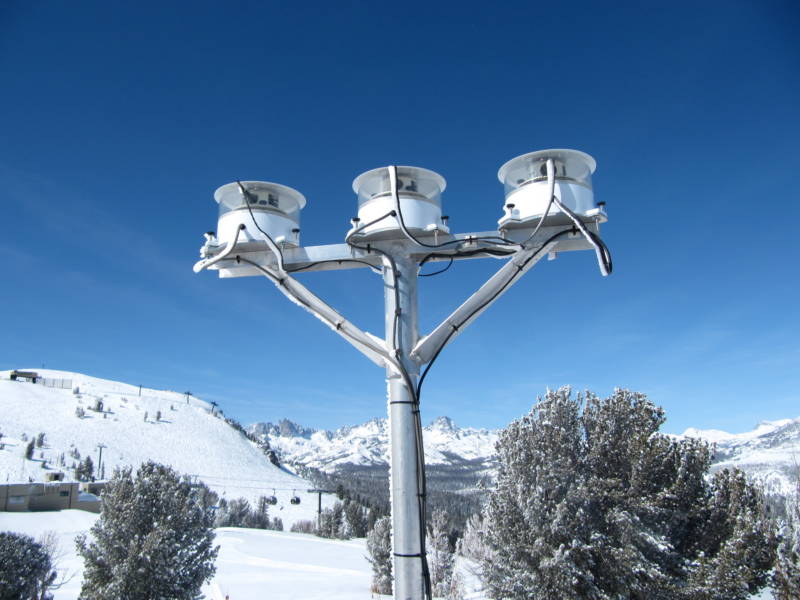
Radiation is an important one. Instruments called radiometers are mounted on the tower. Some point up, measuring the radiation coming from the sun; others point down, measuring how much is reflected back to the sky by the snow.
“Albedo” is the measurement of how reflective the snow is. Something completely white that reflects all of the sun’s energy has an albedo of one; something black, that absorbs all the energy, is zero. Bright, freshly fallen snow has a high albedo, typically above 0.8.
Even if the term is new to you, albedo is probably a familiar concept. As I reported for KQED’s The California Report this morning, Hans Moosmuller of the University of Nevada’s Desert Research Institute explains it in terms of outfits: on a sunny day, if you wear a black sweater you’ll be warmer than if wear a white one. You may notice it with roofs, too. I grew up in Atlanta, in a house with a black roof. Before my parents got an air conditioner, the upstairs bedrooms were unbearable in the summer. If we’d had a white
These radiometers measure radiation coming from the sun. Photo: Molly Samuel
roof, it would have been a little more bearable (though I can’t say it would have helped with Atlanta’s other charming summer attributes, humidity and mosquitoes).
The color sweater you wear has no bearing on the earth’s climate. Roof color could have an effect on a large enough scale. What really matters are the huge swaths of dark and light that cover the globe: ocean and snow.
When warming causes sea ice near the poles to melt faster, areas that had a high albedo (ice is very reflective) become areas with a very low albedo (the blue ocean absorbs more radiation than forests or plain dirt). Moosmuller says it creates a feedback loop. The more dark spots there are, the more radiation is absorbed. So melting speeds up, and warming increases, exposing even more dark areas, and so on.
Pollution plays an important role that’s coming under increasing scrutiny. Deposits of soot or dust make the snow darker, so it melts faster, exposes more dark ground, and there’s that feedback loop again. In the Himalayas soot, also known as black carbon, from stoves, tailpipes, factories, and fires is having a measurable impact.
In the Rockies, there’s a similar problem caused by dust kicked up from ranches. Tom Painter of the University of Utah says the snow in the Colorado River Basin melts a full month earlier than normal. The difference the dust makes is so drastic, Painter says, that “We’re in an entirely new regime for snow melt…it would be like if we started measuring climate impacts fifty years from now.”
No one has yet done a long-term study on the effects of dust and soot on the Sierra Nevada snow pack. Moosmuller says he’s beginning to look into it now. In the summer, black carbon drifts into the mountains from California’s cities, ports, highways and farms in the Central Valley. Tony Van Curen, in a research project at UC Davis, has found that soot blows over from Asia, too.
There is good news in all of this: Black carbon, unlike most greenhouse gases, lingers in the atmosphere only for a couple of weeks. So reducing emissions could have a relatively quick impact.
Next week the US Senate will take the wraps off a long-awaited national energy and climate bill, which–even before its unveiling–is already making California businesses and regulators nervous.
Though exact language has not been revealed, the compromise bill reportedly includes sections that would nullify state and regional programs to regulate carbon emissions. That does not sit well with Mary Nichols, California’s chief carbon regulator. “When it comes to energy policy and the environment, one size truly does not fit all,” Nichols told reporters in a Tuesday conference call. Nichols chairs the California Air Resources Board, which is the lead agency charged with implementing the state’s Global Warming Solutions Act, passed in 2006.
The state has already invested three years and more than $100 million dollars (approximately $40 million per year, according to a policy brief issued last week by the state’s non-partisan Legislative Analyst’s Office), laying the groundwork for sweeping new regulations, including a carbon trading scheme with several other Western states. The regional cap-and-trade program known as the Western Climate Initiative could also be jeopardized by the current Senate bill, though from most appearances, the program is already languishing.
Businesses also have much at stake. Jan Smutny-Jones heads the Independent Energy Producers Association, whose members generate almost half the electric power produced in California. “My members are making literally billion-dollar decisions about infrastructure that’s going to be around in California generating electricity or transporting electricity to customers for the next 40-50 years, and they kind of need to know sooner rather than later, in terms of what the actual rules of the road are gonna be,” Smutny-Jones told me in his Sacramento office on Monday. “Having the rules change is disruptive,” he said.
California Senator Barbara Boxer, who co-sponsored the first Senate version of the bill last fall, says she does “not support federal preemption” but also wants to avoid overlap between the state and federal systems. “It depends on how the bill is written,” Boxer told reporters at the recent state Democratic Convention. “I’ve had environmentalists say ‘Well if we do a trading system on the credits, we want one system, we don’t want two systems,’ so there’s some areas where it may make sense.”
Nichols offered little latitude in her remarks on Tuesday. “We need to put down a marker here and remind the senators that they will not have an effective climate program without the states,” she said. “We don’t want there to be any room for doubt about whether states are permitted to do things that advance their economic and energy agendas.” Nichols cited large amounts of “green” venture capital flowing into California as fruit already borne by the state’s actions toward reducing carbon emissions.
The Senate bill is expected to be rolled out on Monday. Optimists are hoping that a finished bill could reach the Senate floor by June or July, according to a report from Reuters news service.
Environmentalists have registered much consternation over the fact that out-of-state oil companies have been bankrolling a ballot measure to freeze implementation of AB 32, backbone of the state’s climate strategy.
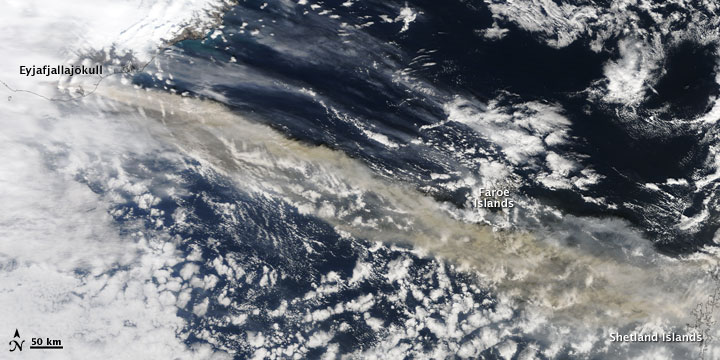
Ash plume across the North Atlantic from Iceland’s Eyjafjallajökull Volcano (Photo: NASA’s Earth Observatory)
As we reported last month for The California Report and on the Climate Watch Blog, the subject of geoengineering, or deliberate climate intervention, is becoming an increasingly hot topic; ideas such as brightening clouds to reflect sunlight away from the Earth or shooting aerosol particles into the stratosphere to block it. They’re just two of the science-fiction-sounding ideas garnering interest from the scientific community and the public as prospects dim for CO2 mitigation efforts across the world.
This morning on KQED’s Forum program, host Dave Iverson was joined by Ken Caldeira, climate scientist at the Carnegie Institution’s Department of Global Ecology at Stanford University, and Martin Bunzl, professor of philosophy at Rutgers University and director of the Rutgers Initiative on Climate and Social Policy.
At the outset, Caldeira explained the distinction between two basic kinds of intervention: one bucket of strategies that focus on removing carbon from the atmosphere, which tend to be expensive, but less controversial, and a second bucket of strategies that are being designed to reflect or block sunlight to cool temperatures, irrespective of CO2 levels.
This second bucket is where the bulk of the controversy lies for various reasons, including environmental and political concerns, as well as a fear by some that the more attention geoengineering gets, the less likely people will be to do the critical work required to reduce greenhouse gas emissions.
“The only real way to solve our climate problem is to reduce greenhouse gas emissions,” said Calderia. “But I’m concerned that we’re not doing that, and I’m thinking, what will we do in the event of an emergency?””
Because climate modeling is not yet sophisticated enough to capture the regional and local effects of geoengineering strategies, and because with current technology, it would likely be impossible to limit the effects to a specific area of the planet, both Caldeira and Bunzl expressed the need for caution when considering deployment. Caldeira said that more research needs to be done on potential environmental impacts of geoengineering, something Bunzl said might be premature. Bunzl advocated that research be focused on improving computer modeling before taking any experiments into the field.
“I’m concerned about the limitations of our climate models in predicting regional effects, and especially regional effects due to precipitation. Until and unless those climate models become a lot better with their fine-grained prediction, its a crapshoot,” said Bunzl.
One concern Climate Watch readers and listeners have raised about using sulfur aerosol for solar radiation management is acid rain. Caldeira said that this strategy could produce a “small acid rain problem,” but that it would not be consequential given the relatively small amount of particles that would be used (a few percent, compared with what we’re already emitting in other ways). In a separate interview last month, Rutgers geoengineering expert Alan Robock dismissed the acid rain concern by saying that the amount of sulfur that would be used in geoengineering strategies would be close to negligible, compared with the sulfur already spewing into the atmosphere from coal plants. In fact, Robock said he recently removed acid rain from his list of “20 reasons why geoengineering may be a bad idea” list.
After the Forum broadcast, I asked Caldeira about the volcano erupting in Iceland that is currently grounding flights across Europe. Could Eyjafjallajokull be another Mt. Pinatubo? (The massive 1991 eruption of Mt. Pinatubo in The Philippines sent so much ash into the stratosphere, that it was responsible for cooling the Earth’s atmosphere 1/2 degree Celsius.) Not likely, said Caldeira. While the Icelandic volcano is wreaking havoc on air travel, he said, the eruption is too small to disrupt global climate. The only effects Californians might see, he said, are “better sunsets.”

 The latest version of a federal climate bill sets a series of national targets for greenhouse gas emissions and would halt California’s plans for state and regional carbon trading.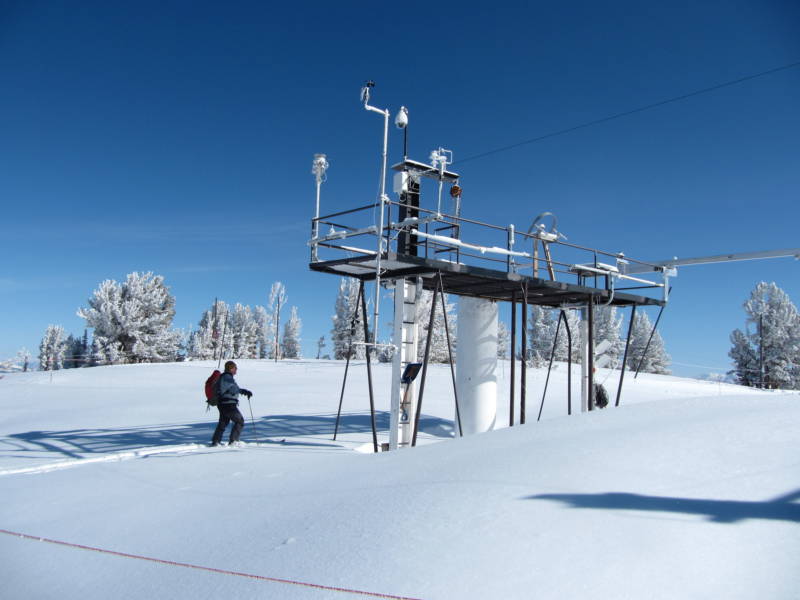
 Environmentalists have registered much consternation over the fact that out-of-state oil companies have been