
In what are believed to be his first public remarks on the subject, US Energy Secretary Steven Chu came out against California’s Proposition 23 today. Chu said passage of the measure, designed to suspend the state’s landmark climate law known as AB 32, would be “a terrible setback.”
Continue reading DOE Secretary Opposes Prop 23
Tag Archives: Emissions
Nichols: No Solo Cap-and-Trade
Cap-and-Trade is a lonely business these days. But according to the state’s top regulator in charge of implementing it, California won’t go it alone.

Mary Nichols, who chairs the state’s Air Resources Board, made the remark in a Silicon Valley panel discussion today. The ostensible topic of the event was renewable energy but it turned into a pep rally against Proposition 23, the statewide ballot measure designed to halt California’s comprehensive climate law, AB 32. Nichols was joined on the panel by executives from Google, PG&E and venture capitalist Vinod Khosla, all of whom voiced strong opposition to Prop 23.
When asked about the cap-and-trade provisions of AB 32, Nichols said: “We won’t launch this program without partners to trade with. It doesn’t make sense for an economy even as big as California, to try to do this all by ourselves.” The comment came days after congressional leaders threw in the towel for the summer, on a federal bill to address climate change and energy security. “To get the kind of leverage that you really need to make this program succeed, the US has got to step in,” said Nichols.
California is part of a nascent regional trading pact known as the Western Climate Initiative. But among the seven US states and four Canadian provinces signed on to the WCI, only California, New Mexico and Quebec are prepared to move forward with a working carbon trading market. Others still lack enabling legislation, and Arizona has overtly pulled out of the carbon trading plan, raising the question of how many “partners” California will have, even with WCI in the mix.
“I don’t expect to be faced with this dilemma,” Nichols told me after today’s event, “but if the worst were to happen and none of these states were able to move forward with their own programs, I think we would think long and hard about whether we would actually start enforcing the program, unless and until we were really confident that our state had the ability to do it in a way that would not put us at a competitive disadvantage.”
Proponents of Prop 23 contend that full implementation of AB 32 will give other states and nations a competitive edge over California, resulting in “leakage” of jobs and businesses to regions with fewer regulations.
The panel, entitled “Electric Bills and Oil Spills: Will California Continue To Be a Clean Energy Leader?” was held on the Google corporate campus in Mountain View.
Whitman Commits on Prop 23 — Sort of
The mystery of whether Republican gubernatorial candidate Meg Whitman does or does not support Proposition 23 would appear to be solved. After weeks of steadfastly refusing to take a stand one way or the other on the ballot measure to freeze the state’s climate law known as AB 32, Whitman conceded on a radio broadcast that “In all likelihood I will vote ‘No’ on Prop 23.” Continue reading Whitman Commits on Prop 23 — Sort of
A Glimpse of How Regional Carbon Trading Might Work
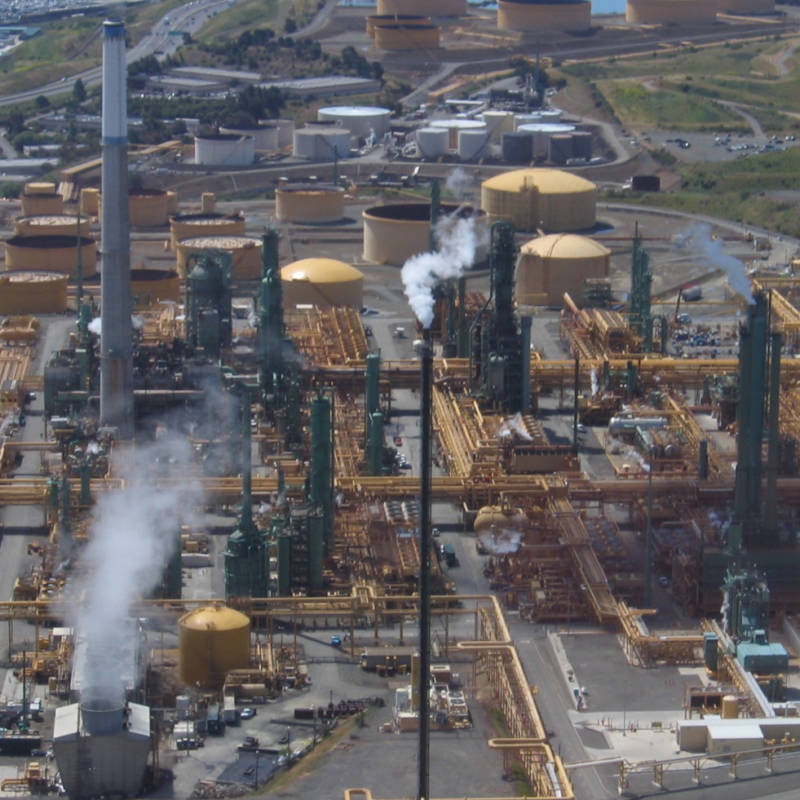
After three years of deliberations, participants in the regional carbon trading pact known as the Western Climate Initiative have released a “comprehensive strategy” for how the coalition will achieve its goals of reducing emissions 15% below 2005 levels by 2020. The plan, “Design for the WCI Regional Program” lays out details for a regional cap-and-trade system, offsets and incentives, and energy efficiency programs. Continue reading A Glimpse of How Regional Carbon Trading Might Work
Climate Action May Be Up to the States
Just a couple of weeks back, some stalwarts still held out hope for a federal climate bill this summer. But with the capitulation by congressional leaders on Thursday, this week the legislative landscape looks undeniably bleak. And with flagging expectations for multinational climate talks, the heat is now turned up once again on the so-called “sub-national” actors, like states and provinces. It also lends more gravitas to efforts like Governor Schwarzenegger’s announced third climate summit for sub-national leaders, scheduled for November at UC Davis. Continue reading Climate Action May Be Up to the States
Another Climate Change Impact: Smog
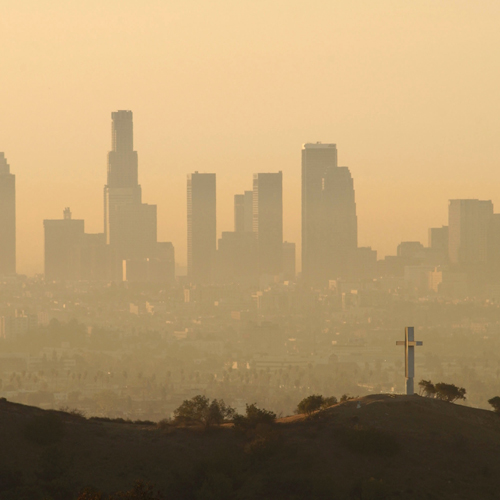
Air pollution, already a problem for much of central and southern California, will get worse as temperatures warm, according to a new report from scientists at UC Davis and UC Berkeley.
By mid-century, trouble spots like the Central Valley and Los Angeles could experience between six and 30 more days per year when ozone concentrations exceed federal clean-air standards, depending on how much temperatures rise, and assuming that pollutant emissions in the state remain at current levels, the scientists project. Continue reading Another Climate Change Impact: Smog
In the (Climate) News
We know there’s a lot happening out there. In case you missed them, here are a few recent climate stories that have been on our radar this week.
1. Charges against “Climategate” scientists dismissed for the third time
Another independent review of British researchers in the “Climategate” scandal came to the same conclusion of previous investigations: The researchers did not manipulate their data. However, the review does fault the researchers for being less-than-forthcoming with their data at times, and for being lax in response to critics.
(Read more at the Los Angeles Times, Newsweek, and BBC.com)
2. Utility giant PG&E opposes AB 32 blocker
CEO Peter Darbee released a statement in opposition of Proposition 23 saying that “…unchecked climate change could cost California’s economy alone tens of billions of dollars a year in losses to agriculture, tourism, and other sectors.” Prop 23, which qualified for the Nov. 2 ballot last month, would suspend AB 32 until unemployment falls to 5.5 percent for four straight quarters.
(Read more at the The Sacramento Bee and CleanTechnica.com)
3. Federal funding for carbon capture and storage research
This week the Department of Energy announced approximately $67 million for ten projects designed to develop technology for CO2 capture and storage from coal power plants, a strategy considered central to reducing global CO2 emissions. Menlo Park-based Membrane Technology and Research, Inc. is slated to receive almost $15 million of the funds.
(Read more at The New York Times Green blog.)
5. Cloud seeding could make things wetter
Spraying seawater into clouds to combat glo bal warming could yield wetter seasons, a Stanford study found. The analysis used computer simulations of the global climate system with increased CO2 levels and more reflective clouds over all of the world’s oceans. Researchers said they were surprised by the findings because previous computer simulations have found that using geoengineering to whiten clouds and decrease solar radiation could make the Earth drier, not wetter.
Chistopher Penalosa is a Climate Watch intern.
Humans and Climate, Past and Future

Two new studies out of Stanford’s Carnegie Institution for Science raise interesting questions about human influence on the future of the world’s climate and about our role in global warming thousands of years ago.
The first study, authored by Ken Caldeira and Long Cao, used models to examine the climatic effects of actively removing CO2 from the atmosphere. What they found is that even if all CO2 emissions were magically halted, and CO2 levels in the atmosphere were instantly reduced to pre-industrial levels, the resulting drop in temperatures would offset less that half of the CO2-induced warming.
This discrepancy, the scientists say, is due to complexities in the carbon cycle. First, as CO2 in the atmosphere drops, the ocean, which acts as a carbon sink by absorbing CO2 from the air, will release more of its stored carbon. Second, the carbon balance on land will change, too. As temperature and CO2 concentrations change, soils will begin to release more carbon than plants take in.
Therefore, in order for CO2 scrubbing to be effective, said Caldeira in an email, we may have to commit to it for a long time. “To maintain atmospheric CO2 at low levels would require removing CO2 from the atmosphere as it degassed from the oceans and land surface. This process takes many decades, even centuries,” he wrote.
That revelation, “has obvious implications for the public and for policy makers as we weigh the costs and benefits of different ways of mitigating climate change,” according to Caldeira.
The second study, which has been the target of some skepticism in the blogosphere, suggests that humans may have been influencing the climate thousands of years ago, long before was previously believed. In the paper, authors Chris Doughty, Chris Field, and Adam Wolf, all of the Carnegie Institute, propose that the extinction of mammoths 15,000 years ago, caused in part by human hunters, may have contributed to global warming by causing a change in the albedo of the land surface in the far north. Mammoths ate birch, which kept the dark green plant in check across the grasslands of North America and present-day Russia. As the population of the large mammals declined, the authors assert, the birch spread and dominated the lighter-colored grasslands, which effectively changed the color of the landscape. A darker land surface absorbs more heat than a light one. This in turn heats up the air, creating a positive feedback loop that encourages the spread of more birch.
The authors estimate that the mammoth extinction could account for approximately one-quarter of the spread of birch at that time, and that the increased birch cover could have warmed the planet .18 degrees F over several centuries.
Linking Sprawl and Climate Change

Transportation is the top source of greenhouse gas emissions in California. So in a state where car culture rules, what will it take to get us out of our cars?
That’s the goal behind SB 375, a bill passed in 2008 that links greenhouse gases to urban sprawl. Under this first-in-the-nation policy, the state’s 18 regional planning organizations must reduce the emissions coming from vehicles through land use and transportation planning. This week, the Air Resources Board is expected to release the draft emission reduction targets that the agencies must meet by 2020 and 2035.
While the chances of getting Californians out of their cars completely are slim, the idea is to reduce the number of miles traveled through more public transit, more “walkable” communities and denser development. (Learn more about that in this Quest story about transit villages).
According to a report released today, that development approach can have some dramatic benefits, considering how California is expected to grow. By 2050, some projections put the population at 60 million, adding seven million new households.
The planning firm Calthorpe Associates looked at those housing needs and ran a number of growth scenarios, in a study funded by the California Strategic Growth Council and California High Speed Rail Authority. They compared a business-as-usual approach of low-density suburbs (30% urban and compact growth) to a “growing smart” scenario with more urban in-fill and transit-oriented development (90% urban and compact growth). While that last scenario may sound like the land of endless condos, according to Peter Calthorpe, it would still be 53% single family homes. Calthorpe calls it “a shift back to what California used to build–bungalows.”
Here are some of the benefits they found for the scenario by 2050:
- Reduces the number of vehicle miles traveled by nearly 3.7 trillion
- Saves more than $194 billion in capital infrastructure costs
- Saves 19 million acre-feet of water
- Prevents the release of 70 million metric tons of carbon dioxide equivalent, or 25% less than business-as-usual
- Saves California households $6,400 per year in auto-related costs and utility bills.
In-fill development can often cost more than low-density development and this report doesn’t take housing prices into account. Indeed, costs may be one of the biggest challenges for SB 375, since both the state and cities are facing budget crises and a lull in the housing market.
Under the bill, state transportation funding will be prioritized for projects that meet the SB 375 goals. But according to Hasan Ikhrata, Executive Director of the Southern California Association of Governments (one of the regional organizations doing the planning), financial incentives will be key to reaching the goals. “I think the biggest challenge is to find incentives to help cities, because cities want to do this, but they don’t have the resources to do it without help,” he said.
Population: The “Other” Climate Debate
Recently I saw a startling graph, plotting world population from the Middle Ages to projections for 2050. The red line remains relatively flat for several centuries, starts ramping up around the time of the 19th century Industrial Revolution, and then takes off like a Roman candle right about the time of my own birth, in the mid-1950s. Granted, the steep rise was enhanced by the drawn-out time scale of that particular graph. As you shorten the time frame you’re looking at, the slope flattens out. But the numbers paint a sobering picture on their own.
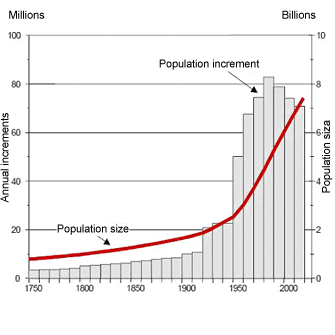
I decided to plot some of my own family history against that curve. When my father entered the world on the eve of the Great Depression, there were barely two billion people populating the globe. By the time I came along, the number had nudged above three billion. This was America’s legendary Baby Boom and the beginning of the Roman candle phase (an exponential growth trajectory which continues today). Should I be so fortunate (or unfortunate) to make it to my own century mark, demographers project that by then (2055), the Earth will be asked to support more than nine billion people. That’s a tripling of the world’s population just in my (theoretical) lifetime.
Population growth seldom takes center stage in discussions of climate change, though the connection is undeniable (heck, nine billion people just breathing is a lot of CO2).
 Biologist William Ryerson, President of the Washington-based Population Institute, says that population growth is “not an inconsequential impact on the climate crisis.” But breathing is not the problem; it’s consumption. Appearing on KQED’s Forum program with Michael Krasny, Ryerson said that were that prediction of nine billion people by 2050 to be realized, it would be “the climate equivalent of adding two United States to the planet.”
Ryerson, who also heads the Population Media Center in Vermont, says we’ll be lucky to make it to nine billion. Ryerson said that in his view, “the resources just aren’t there,” for a doubling of the current population. He cites research by Stanford biologist Peter Vitousek, indicating that humans are already appropriating half of the total global “products of photosynthesis, i.e. all green plants.”
It seems that after decades of being dismissed by mainstream economists, 18th-century philosopher Thomas Malthus is getting a fresh hearing. Malthus made his reputation as a doomsayer in 1798, when he wrote that “the power of population is indefinitely greater than the power in the earth to produce subsistence for man.”
As procreation and climate change accelerate in tandem, the two forces may place a double bind on basic resources like water (see also Gretchen Weber’s post on “peak water“). Ryerson, who recently visited Pakistan, says that nation currently has 20% of the water that they had 50 years ago, on a per-capita basis, and “they’re on a 30-year doubling time,” meaning 368 million people by 2040.
The entire Forum program is available online.