The blog post for today’s broadcast of my nuclear power segment on The California Report weekly magazine has been updated from the original post on August 24.
And don’t forget to check out Amanda Dyer’s interactive “Atomic Timeline,” with key milestones in the history of nuclear power development.
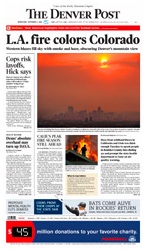
Earlier this week I got an email from a colleague in Boulder, Colorado, remarking on the crimson sunsets and brown haze that had settled across the Front Range, apparently caused by drifting smoke from California’s wildfires. At that point the Station Fire complex in Los Angeles County had already charred nearly 150,000 acres.
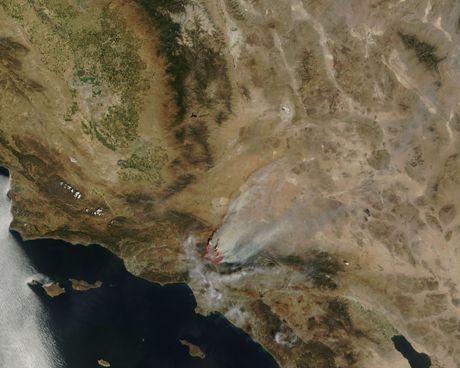
Smoke fans out from L.A. fires this week. Clickable image: NASA
My colleague Dan Brekke, an ardent watcher of elemental stuff like water and fire, featured a map of the spreading haze in his personal blog.
By Wednesday evening Brekke relayed that flames had consumed an area about the size of Chicago (and no, he couldn’t resist the low-hanging Mrs. O’Leary reference). With less than 30% containment, smoke had spread over about three-quarters of the state. Beyond California, NOAA had tracked the plumes “northward and eastward…across southern Nevada, Utah, Colorado, and Kansas.”
“Joe Ramey, a meteorologist with the National Weather Service in Grand Junction, said that a high-pressure system is continuing to pump smoke from several California fires and 17 fires currently burning in Utah into the state. He said a fire near Nucla in south-central Colorado also may be contributing to the haze…Most of the smoke, however, is being generated by the 190-square-mile fire burning near Los Angeles, he said.”
Atmospheric scientists classify smoke as an “aerosol” (any airborne particulate matter), which has a complicated set of feedbacks on the climate. For instance, aerosols encourage cloud formation and clouds have both positive and negative feedback effects on global warming. But it’s clear that smoke plumes generate greenhouse gases and also carry toxic air pollutants such as carbon monoxide.
Briefing journalists last month at the National Center for Atmospheric Research (NCAR)–in Boulder, no less–atmospheric chemist Gabriele Pfister said that wildfires have multiple effects on the atmosphere. They “disturb the carbon cycle,” interfering with energy exchanges and generating greenhouse gases. Itinerant smoke can generate ozone pollution far from the initial fires. This presents a challenge for local regulation of “ground-level” ozone, since it’s often likely an import from distant fires.
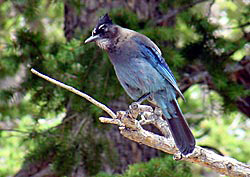
Climate change has California’s birds on the move, but not in the usual direction or at the same pace, a new study has found. Research suggests that warming temperatures and changing precipitation patterns will cause bird species distributions to shift independently, resulting in new bird “communities” appearing in up to half the state.
In some cases, these new communities will create combinations of birds that have never existed before, a situation that could disrupt the delicate balance of species interactions with potentially unanticipated consequences for whole ecosystems, the report authors concluded.
One of the co-authors, Stanford biologist Terry Root, told Climate Watch: “This will not be just a few species in a few locations–this tearing apart of communities could be quite extensive across California.”
The study authors, including Terry Root of Stanford and Diana Stralberg and John Wiens of PRBO, write that the emergence of new bird communities in the coming decades present enormous conservation and management challenges. They assert that rapidly changing habitats and ecological communities are going to require new approaches to conservation and management. “As new combinations of species interact, some species will face new competition and/or predation pressures, while others may be released from previous biotic interactions,” they wrote. “Managers and conservationists will be faced with difficult choices about how, where, and on which species to prioritize their efforts and investments.”
Root pointed to experience with wolves, coyotes and foxes, in which wildlife managers tried to control one, only to see unexpected spikes in the population of another: “Here is a community of only 3 canines to which we purposely forced changes, and we had two big surprises. Now we are talking about 70 species of birds shifting without any control of the force or the species being changed. I guarantee there will be a lot of surprises.”
KQED’s Los Angeles Bureau Chief and frequent Climate Watch contributor Rob Schmitz is spending six weeks in Japan, as part of the Abe Fellowship for Journalists. In the weeks to come he’ll file a series of special reports on Japan’s extraordinary strides in energy efficiency–and what we might learn from them.
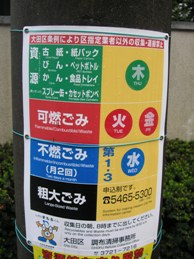
Today was combustible garbage day in my neighborhood. On Tuesdays and Fridays, residents place all their garbage deemed ‘burnable’ out on the curb. At promptly 8 a.m., it is taken away and, presumably, burned.
Burn after reading? Trash day instructions in Japan.
I had a lot of questions about what was considered combustible and the sign on the light post advertising the pick-up days wasn’t very helpful. My wife and I brought our 11-month-old son here. Were diapers considered ‘burnable’? I knocked on the Webers’ door to ask. Terry and Sherry Weber live next door. They’ve been working as teachers in Tokyo for 27 years. They told me that up until recently, plastic products were not considered burnable items, but all of that changed this year, and now it’s apparently fine to deposit plastic items like diapers on the curb on combustible garbage day. Either way, they told me, if the sanitation officials see that I’ve tried to sneak in some non-combustibles on the incorrect day, they’d leave it on the curb with a note, scolding me for screwing it all up.
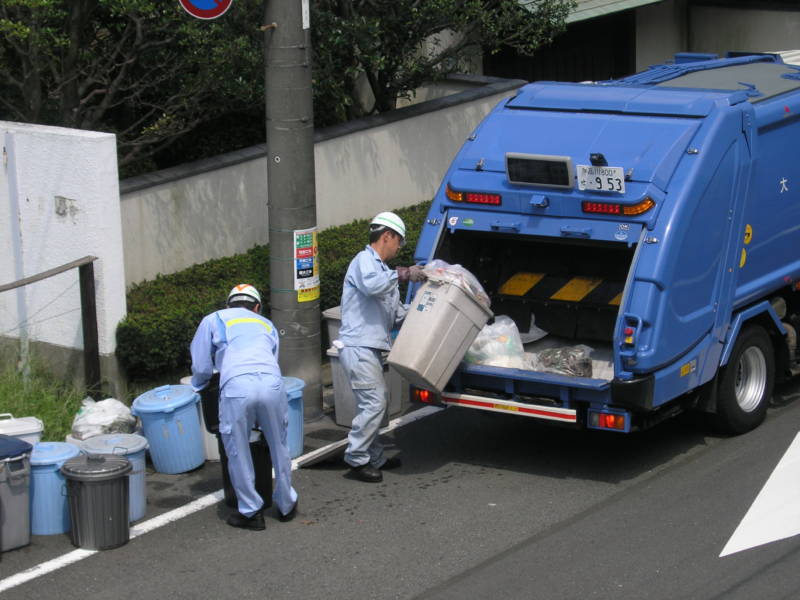
I put a bag of diapers and another bag of what I thought were burnable items on the curb, nervous that I’d be the laughing stock of my new neighborhood. An hour later, the garbage truck arrived, two men got out, inspected my garbage, and dumped all of it into the back of their truck.
The dreaded Tokyo city sanitation department gives me a passing grade on my burnable/non-burnable garbage sorting skills.
Whew. Now I’ve got to prepare for Thursday, which is recyclables day. I’m supposed to separate all of my recyclables into paper, cardboard, plastic, and cans, and bundle each of them with string. Wish me luck.
Elsewhere on the waste disposal front:
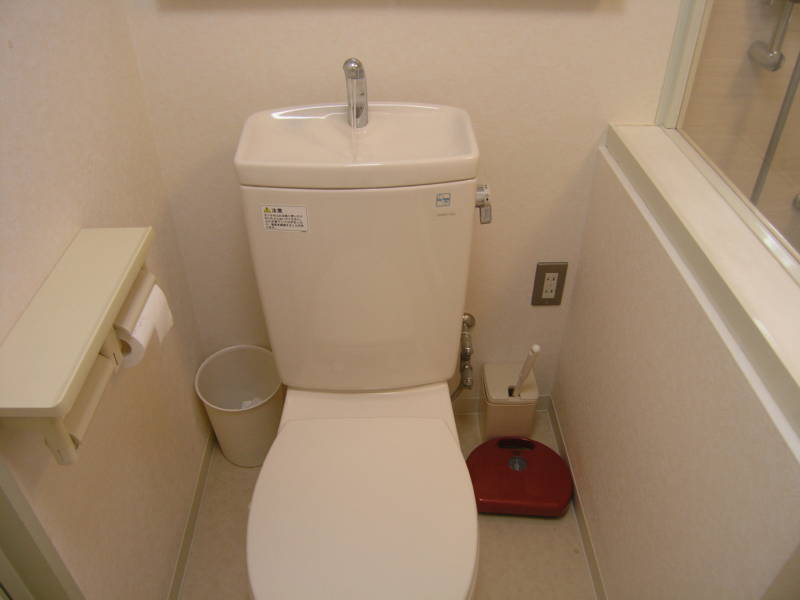
I usually don’t get excited about toilets. But the toilet in my apartment here in Tokyo has inspired me to great heights.
It doesn’t look exciting. But look more closely…
The toilet gives the user two types of flushes: the ‘big’ flush, or the ‘small’ flush, so that you can control how much water you’ll need, thereby conserving this precious resource.
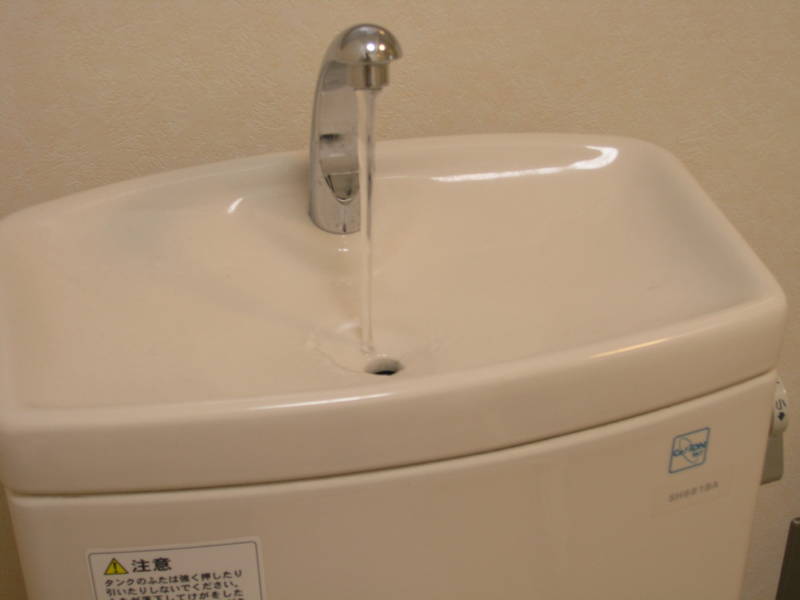
Parched water districts of California: Please start importing these for your customers!
But that’s not what got me excited. What I was really impressed by was when you flush the toilet, water is pumped into the tank at the back of the toilet via a faucet. It runs into a basin on top of the tank where you can wash your hands with the water before it enters the toilet for the next flush. Genius. Pure genius. Why don’t we see more of these in California, where water is an even more precious resource than it is here?
Editor’s Note: Dual-flush toilets are now available in California. But the piggy-back sink–that’s a new one for me. –CM
KQED’s Los Angeles Bureau Chief and frequent Climate Watch contributor Rob Schmitz is spending six weeks in Japan, as part of the Abe Fellowship for Journalists. In the weeks to come he’ll file a series of special reports on Japan’s extraordinary strides in energy efficiency–and what we might learn from them.
Yesterday Japan held a national election. My neighbor won it. Well, technically, his party won it, but it’s assumed that my neighbor, who heads the Democratic Party of Japan, will become Prime Minister within a couple of weeks when the party formally elects him.
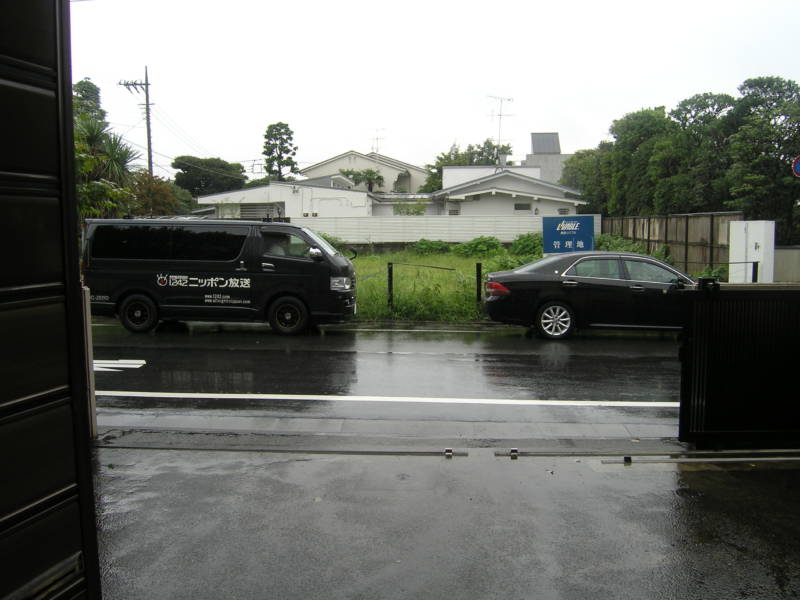
A peek outside my door yesterday revealed media vans and limos outside the house of my new neighbor and Japan’s new prime minister-elect, Yukio Hatoyama.
My neighbor is Yukio Hatoyama. He lives in a large house across the street from the apartment I’m renting here in the tony Tokyo suburb of Denenchofu. Yesterday morning an elderly police officer knocked on my door clutching a map, explaining to me in slow, metered Japanese that his men would be establishing a perimeter around our neighborhood to keep out protesters, non-credentialed journalists, and anyone interested in engaging in general tomfoolery near the Hatoyama residence (an English-speaking neighbor helped translate). I mustered the only Japanese response I knew (“Arigato!”), not having sufficient language skills to explain that I, in fact, was one of those “non-credentialed journalists.” He smiled, bowed, and moved on to the next residence.
As early results on the afternoon television news began to confirm that Hatoyama’s party was on the path to victory, my neighborhood, which was virtually silent for my first few days here, started buzzing with activity. Police officers on foot patrol, random passers-by who somehow got past the perimeter stopping in front of Hatoyama’s house to stand and stare before being ushered away, and members of the “credentialed” Japanese press sitting on the curb in the rain, quietly watched over by the around-the-clock security presence in front of Hatoyama’s home. My wife and I are thinking of baking our neighbor a cake as a congratulations gift–if we could just get by security.
Apart from the amazing coincidence that the apartment I rented happened to be located across the street from the incoming prime minister, my new neighbor has a lot of work ahead of him. Japan is suffering its worst unemployment ever, and many here are fed up with the Liberal Democratic Party, which, despite its name, is the conservative party that has ruled Japan for 50 years.
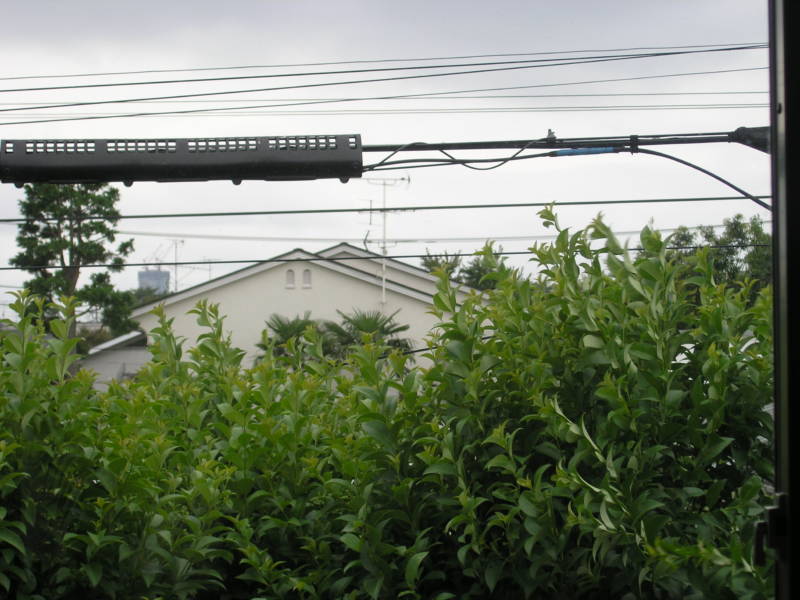
View of Hatoyama’s house from my living room. “May I borrow some sugar, Hatoyama-san? …and perhaps an interview?”
Hatoyama has promised the Japanese more social welfare programs and fewer incentives to big Japanese business but some experts wonder if it’s a good idea to tinker with a system that’s helped Japan become one of the world’s biggest success stories.
Hatoyama has a strong California connection: His doctorate in engineering is from Stanford University, where he met his wife. He speaks English well–well enough to have written a provocative Op-Ed in the New York Times this past weekend; a timely critique of U.S.-led globalism and unbridled capitalism, and a call for Japan to retreat from this system, to a more regional and sustainable economic framework.
More to the purpose of my reporting here, Hatoyama has pledged to make Japan a more prominent world leader in battling climate change. He’s pledged to cut the country’s greenhouse gas emissions by 25% from 1990 levels by 2020, and has promised to generate more jobs for Japanese workers by helping develop the clean-tech industry here.
He also heavily favors on a bigger reliance on nuclear power for Japan; a stance that is not as controversial as you may think in this country. In recent polls, the majority of Japanese respondents say they’re open to a larger reliance on nuclear power. In a country that imports all of its fossil fuels, nuclear power means more energy security and fewer greenhouse gas emissions. On the other hand, it heightens the thorny debate of what to do with radioactive waste–a debate that, despite poll numbers, is of big concern to many Japanese. With all these issues to tackle, it’s likely that my neighbor won’t be spending too much time at home in the coming weeks. Maybe I should offer to house-sit.
Thayer Walker is a San Francisco-based freelance writer, who first reported on development of the Wave Glider for The New York Times. His radio segment for Climate Watch, was produced by Nathanael Johnson and is scheduled to air Monday, 8/31 on KQED’s The California Report.
Red Flash in the Sunset
By Thayer Walker
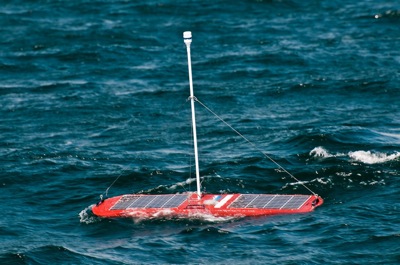
A Silicon Valley engineering firm called Liquid Robotics recently launched a new device called a Wave Glider off the California coast. It’s the latest and perhaps, the most ingenious design in the growing network of “autonomous ocean samplers,” which is to say sea-going science robots. The glider is a sensor-carrying platform powered entirely by wave energy and it has the potential to collect an enormous amount of data about the ocean, which in turn will give scientists a better understanding of climate change.
"Red Flash" at sea. Photo: Liquid Robotics
Jim Bellingham, Chief Technologist at the Monterey Bay Aquarium Research Institute, calls the device a “transformational development” in the field of ocean science and technology, but when the inventors came up with the idea they weren’t trying to revolutionize marine studies, they were trying to eavesdrop on humpback whales.
In 2005, Joe Rizzi, the chairman of Liquid Robotics, wanted to listen to the song of humpback whales off the coast of his home in Puako, Hawaii. He anchored a hydrophone near the shore, but instead of picking up whale song he heard the sound of frying bacon. Snapping shrimp, a small crustacean that uses its powerful claw to generate sound blasts that stuns its prey, had drowned out the call of the whales.
When Rizzi moved the hydrophones into deeper water he captured clear whale sounds, but kept losing the moored devices to rough seas. “The difficulty,” says Rizzi “was holding a hydrophone anchored in 600 feet of water during winter storms.” Rizzi realized that to keep a hydrophone stationary, he would need a powered device. “You’re not going to do that with a battery and a motor and a solar panel,” he explains. “The amount of power to hold station in a 60 mile per hour wind and 10 foot waves is thousands of watts. We recognized that it’s an energy problem.”
Rizzi presented the problem to Liquid Robotics CEO Roger Hine, who quickly came up with a design, and the Wave Glider was born. “We weren’t sitting around thinking this thing would have a lot of scientific uses,” says Rizzi, “but as it turns out, there are a lot more uses for this device than just listening to whales.”
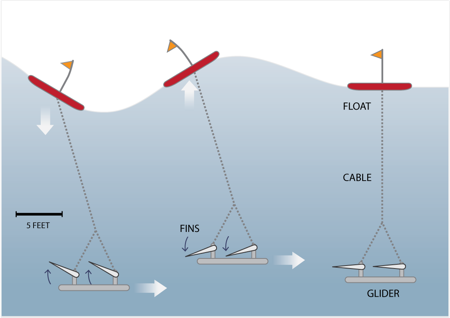
The Wave Glider's passive propulsion system harnesses the up-and-down motion of sea swells for locomotion. Diagram: Liquid Robotics
China, the world’s largest emitter of CO2, is the focus of a new $2 million investment in clean coal technology research by Stanford’s Global Climate and Energy Project (GCEP).
The project will fund research into large-scale carbon sequestration in underground geological formations. China relies heavily on coal for electricity generation and in 2006 was reported to be building the equivalent of one new coal-fired power plant every week.
“China is growing so rapidly, and if they’re going to be able to lower their emissions, they are going to need a whole suite of technologies,” said Sally Benson, director of GCEP. “They are doing a lot with solar technologies and energy efficiency but China is not abandoning coal. So, we’re looking for ways they can reduce their emissions from coal.”
The three-year project is an international collaboration among the University of Southern California (USC), Peking University (PKU) and China University of Geosciences at Wuhan (CUG). It will focus on the technical aspects of stashing carbon in saline aquifers, such as chemical reactions between the rock and carbon and understanding what portions of the aquifers can actually be filled up. The research will involve 39 scientists and students, and will integrate geological modeling, reservoir simulation and laboratory experiments. The results may shed needed light on China’s overall carbon storage potential.
“Saline aquifers have been shown to have the biggest storage capacity across the world,” said Benson, “and China has a tremendous need.”
China’s not the only country with a tremendous need. As the second largest emitter of CO2 (and still bigger than China per capita), the United States has yet to deploy large-scale CCS. Yesterday, the U.S. Department of Energy announced $27.6 million in new funding for 19 projects exploring potential carbon storage technologies.
Sarah Kass was the program producer for Unlocking the Grid, a collaboration between Climate Watch and KQED’s Quest program, which airs tonight at 7:30 on KQED Channel 9.
Wind Power: A Personal Perspective
By Sarah Kass
Last summer I visited the Netherlands, the original home of the windmill. Surprisingly, I saw hardly any of the quaint structures we associate with Dutch wind power. One hundred years ago Holland had about 10,000 wooden windmills dotting its landscape. Today, barely 10% remain. What I saw instead were high-tech wind turbines, white and spare and gracefully generating electricity with wind from the North Sea.
Many view these modern-day towers as an eyesore, but I see them as a sign of hope. Like giant flowers across a landscape, they symbolize for me a clean energy future. But wind power–and solar–have a handicap that fuels doubts that renewables will ever be more than a small percentage of U.S. power. These energy sources can’t be counted on when night falls or the wind subsides. Their inconsistent nature poses a problem for a world with an enormous appetite for electricity. If only excess power could be stored on a grand scale, it might solve many of our energy problems.
It isn’t that electrical energy isn’t currently storable, but as Andrew Tang, Senior Director of PG&E’s Smart Meter program points out, the current generation of batteries can’t store electricity at a price that’s cost-effective. But both he and Steve Berberich from California System Operators were optimistic about future storage possibilities. Tang described an experimental project that uses a sodium sulfur battery the size of an 18-wheeler trailer. The battery would be located next to a substation or somewhere in the network, and its stored power would be used during times of peak demand. He also talked about the future of plug-in electric cars, whose batteries could both store energy and in theory, put it back onto the grid when the car’s not in use.
Berberich envisioned several possibilities for storing excess power. He proposed converting it to hydrogen, which could be burned in a gas plant or could be used in a fuel cell. And he suggested using power to compress air, which could be injected into the ground and called upon when the wind’s not blowing and the sun’s not shining.
Whatever the final solution to storage, you can guarantee it will be a game changer in the renewable power industry. No longer will wind and solar be looked upon as unreliable. Hopefully this missing puzzle piece will go a long way toward helping us detach from our dependence on fossil fuels. But we’ll still be left with the challenge of getting all that clean, green energy onto the power grid. And you can be sure that environmental concerns, zoning, aesthetics, and cost will undoubtedly be cantankerous issues for years to come.
Watch the TV show online, and view exclusive web-only videos on energy-saving technologies for the home on Climate Watch’s Smart Grid special series page.
This is an updated re-post from August 24th, when my radio feature first aired on KQED’s Quest series. That report repeats on this week’s magazine edition of The California Report.
More people appear to be saying “yes” these days, even if grudgingly. The question is: Is it too late?
The Public Policy Institute of California has been tracking public support for expanded nuclear power over the past several years. Survey participants are offered a menu of four potential energy options, one at a time.
The question posed is: “Thinking about the country as a whole, to address the country’s energy needs and reduce dependence on foreign oil sources, do you favor or oppose the following proposals?” Then the four options are offered, including: “How about building more nuclear power plants at this time”
As recently as 2002, adults surveyed in California opposed the idea by a margin of 59% to 33%. But that gap has been closing steadily in the years since and by this July, Californians were split just about down the middle on the question, with 46% in favor and 48% opposed. The poll has a margin of error of about 2%, making it a virtual tie.
When you dig into the numbers a little deeper, some demographic preferences emerge. Support increases with both age and education. Californians 55 and older support more nuclear by a wide margin (58% to 36%) as do college graduates (50%-43%).
Many people use cost as an argument against nuclear but just as the PPIC was phoning around for opinions on the matter, the Palo Alto-based Electric Power Research Institute was finishing up its own report, concluding that trying to reach greenhouse gas reduction goals without baseload technologies like nuclear power, could end up costing much more.
Dan Kammen, who runs an energy lab at U.C. Berkeley, would appear to agree. He said in a recent interview for Climate Watch that “Without knowing exactly where things will come down on nuclear, I think that it absolutely has to be part of the equation in a way that it has not been in the past. Energy costs from fossil fuels are rising at almost 5% a year now, and the damage we are doing and are going to do more of, if we don’t stop our fossil fuel expansion, in terms of greenhouse warming, is so large an issue that these technologies have to be back on the table.
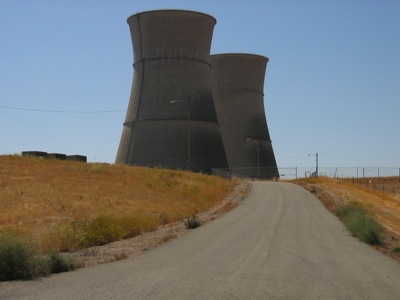
Is the road back to nuclear a dead end? Cooling towers at the decommissioned Rancho Seco nuclear power plant.
But there are serious doubts whether the nation–let alone the state–is in a position to embrace nuclear as it did in the 1960s. Kammen is also a professor of nuclear engineering, and noted with some alarm the rate at which the industry is “graying.” Now in his mid-forties, he told me that when he attends technical meetings for nuclear engineers, he’s often “the youngest guy in the room–by 20 years.” Since the U.S. more or less abandoned its nuclear hopes following the Three Mile Island debacle, the nation has ceded most of its nuclear industrial capacity to other nations, and few young people have chosen to enter the field.
Reports from new projects around the world have not been encouraging of late. Finland is struggling mightily to get its newest reactor up and running. This goes directly to doubts expressed by Kammen and others, that the industry can cowboy up fast enough for nuclear to play a meaningful role in meeting CO2 reduction targets.
The effective ban on new nuclear plants that California has had in place since 1976 could be reconsidered. But ultimately electric utilities will have to want it and I sense a certain “nuclear fatigue” in that arena.
Managers at the Sacramento Municipal Utility District (SMUD) shut down its only reactor in 1989, after a thumbs-down referendum. When I called to ask for an interview on the prospects for a nuclear revival, they declined. They didn’t even want to talk about it. Managers at PG&E, whose twin reactors at Diablo Canyon produce nearly a quarter of the utility’s output, still claim an interest in nuclear. But when I asked CEO Peter Darbee about it recently, he said he had the sense that most people in California would prefer to look elsewhere for energy solutions.
I’m spending the week in Boulder, CO, attending a series of lectures and discussions at the National Center for Atmospheric Research (NCAR). The center is a hub for climate modeling using some of the world’s most advanced computers–but scientists here are working on a dizzying array of projects, from “wind prospecting” models for siting utility-scale wind farms in Colorado, to tracking the ozone drift from California wildfires, to studying the relationship between weather and meningitis in Sub-Saharan Africa.
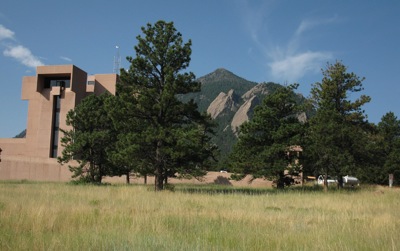
With the Flatiron Mountains as a backdrop, architect I. M. Pei used the Mesa Verde cliff dwellings as inspiration for the NCAR headquarters building, in Boulder. Photo: Craig Miller
While NCAR works closely with NOAA (which also has a major research center in town), it is not part of it. NCAR is funded by the National Science Foundation and managed by something called the University Corporation for Atmospheric Research (UCAR), a consortium of about 75 North American universities, as well as major institutions abroad.
About 400 scientists work under the NCAR umbrella, including Kevin Trenberth, a leading authority on the link between El Nino and global climate. Right before hopping a plane for Australia this week, Trenberth, head of NCAR’s Climate Analysis Section, reaffirmed what NOAA and others have been saying; that we may be in for a significant El Nino event this fall and winter.
“There are good signs below the surface of the ocean in the tropical Pacific that this is the real deal,” said Trenberth. He echoed some of the optimism expressed by many Californians that the result could be an overdue dousing after three years of accumulating drought conditions. “The odds are, if it’s a good El Nino,” said Trenberth, “that there is more likelihood of a southerly storm track that’ll bring a lot of weather systems into southern California in particular. It’s not always clear what happens in northern California but the odds are that there’s a much more active southern storm track right across the U.S. and in particular in California.”
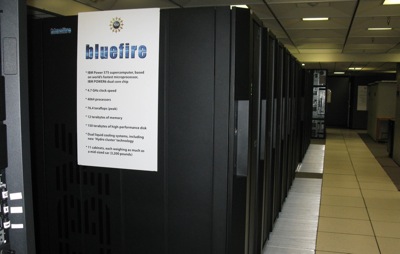
The IBM Bluefire 76-teraflop computer, centerpiece of NCAR's supercomputing center. Photo: Craig Miller
NCAR scientists continue to refine their climate models, which have been downloaded by more than 10,000 scientists around the world. UCAR invests $20-to-$30 million every four years in it’s Computational & Information Systems Lab (CISL), to maintain it’s state-of-the-art status. CISL chief Rich Loft says it’s probably the most advanced supercomputing center devoted largely to climate analysis.
Even so, NCAR is busy building a bigger, faster one–but not here. The new supercomputer, which may be ready by 2012, will be sited near Cheyenne, Wyoming, mostly to take advantage of the cheap, abundant electric power in that area. Loft and NCAR Director Eric Barron both concede the paradox that the most advanced computer assault on global warming is itself a huge gobbler of electricity, much of which comes from coal-fired power plants. The Wyoming facility will suck down 4.5 megawatts of power. Barron says at least there’s a major wind farm “right next door.”
The center’s carbon footprint is probably also swollen slightly by its own air force. NCAR operates two aircraft packed with advanced instrumentation; a hulking C-130 Hercules and a sleek, high-altitude Gulfstream V. Sadly, no rides were offered this week.


 China, the world’s largest emitter of CO2, is the focus of a new $2 million investment in clean coal technology research by Stanford’s