Japan’s Zero Emissions Fever

Sekisui House’s Green First Home-It looks like a normal house, but take a closer look at those roof tiles…yup. PV.

Since arriving in Japan almost a month ago, I’ve visited a “zero-emissions house,” a house that claims to be zero emissions but really isn’t (more on that later), and an “EcoHouse.” It’s fair to say the housing industry in Japan is going ga-ga over reducing carbon emissions. The obsession began a little over a year ago, when Japan’s largest companies (collectively known as “keiretsu“) came together to build the zero-emissions house.

The home, which purportedly produces zero or negative emissions over the course of its lifetime, was built especially for the 2008 G8 Summit in Toyako, on Japan’s northern island of Hokkaido (you can see my video tour of the home at KQED’s YouTube site). Originally nestled on a hillside overlooking a lovely lake during the G8 summit, the home has moved to more modest surroundings: It now sits in a drab parking lot outside Sekisui House‘s noisy prefabricated homes factory in Koga, 40 miles north of Tokyo. The home’s greenhouse gas-reducing technology includes:

– A 14-kilowatt solar array on the roof

– A hydrogen fuel cell which generates energy by taking hydrogen from natural gas and using the byproduct, heat, for the home’s hot water supply and space heating during the winter

– A window with photovoltaic (PV) film inside of it

– A ‘waterless’ washer/dryer, and of course, every energy-efficient appliance you can think of.

Kimikazu Kondo, spokesman for Sekisui House, tells me that nobody’s offered to buy the home yet. Until they do, it’ll be sitting in that parking lot, looking a little lonely.

The interior of the Green First Home. If this is prefab, sign me up.

Kondo also showed me Sekisui’s Green First home, the company’s newest prefab. Sekisui estimates that the average Japanese household spends around the equivalent of  $3,000 on energy per year. Kondo told me that if you buy the Green First home, you’ll spend around five hundred. The home’s roof tiles are made of PV thin film. The house has a hydrogen fuel cell, LED lights, etc. When I first toured the home, Kondo told me it was a zero-emissions home, too. But when I asked specific, pointed questions at how they arrived at that determination, he backed down and told me that over the life of the house, it would reduce 70% of greenhouse gas emissions over an average home in Japan. Not a true zero emitter, but not bad.

But I started to wonder how Sekisui House was marketing this home to Japanese buyers. Were they touting it as a “zero-emissions” house, despite the fact that it isn’t? Hmm. Sekisui’s Kondo did take me on a very interesting tour of his prefabricated home factory. I shot a short video there of a machine that punches holes through steel beams.

A control panel inside the Green First home which gives the homeowner information on how much electricity is being generated from the solar panels on the roof. On this day, it was only 340 watts. It was cloudy.

Each prefabricated home that Sekisui builds has more than a hundred thousand parts built for it in a factory. They’re actually more durable than your average site-built Japanese home. Prefab homes make up about 15% of the housing stock in Japan. Kondo told me Sekisui has no plans to bring its homes to the American market, but it is now starting to sell them in Australia.

A Climate of Quietude

This week conservationists issued their annual list of the “most endangered” national parks, including two in California (Joshua Tree and Yosemite). There are many ways to measure the health of a park; the air, the water. This week on Quest radio, I examine an often overlooked vital sign: the sound. Thanks to Climate Watch contributor Sasha Khokha, Bob Roney, Bernie Krause and the staff at NPS Ft. Collins for many of the sounds you hear in that segment, nicely mixed by Ceil Muller.

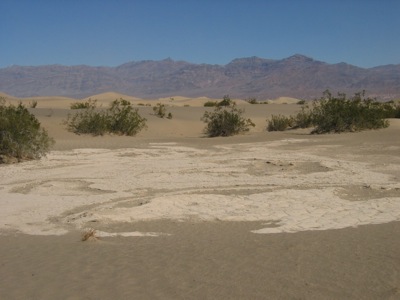
Sand dune near Stovepipe Wells, Death Valley. Photo: Craig Miller

The quietest place I’ve ever been was in a national park and I don’t think I’ll ever forget what it was like.

Okay, “quiet” is a somewhat subjective thing. When I lived on the upper (way upper) west side of Manhattan in the 1980s, any interval without hearing a car alarm seemed like blessed relief. Quiet can be measured, of course, with sound pressure meters. Anything below about 40 decibels is pretty darn quiet for most people’s purposes (a state that I doubt was ever attained in my apartment on West 119th St.).

The National Park Service (NPS) says the quietest place it has yet measured is a spot in Great Sand Dunes National Park, where Vicki McCusker, who helps oversee the natural sounds program for the Park Service, says it was “bottoming out” their meters.

I’ve never been there but it’s hard to imagine greater quietude than an afternoon I spent in Death Valley. Coincidentally this was also on a sand dune, near Stovepipe Wells. It was also Christmas Day, which kept the tourist traffic to a minimum. It was at a point in my life when I was in desperate need of some deep introspection, so I parked my car along Highway 190 and trekked into the dunes, found an accommodating slope and sat down. Occasionally a fly (or something) would buzz by. Other than that, the loudest thing was the buzzing in my own head, which I can only hope would’ve been inaudible to anyone with me.

Looking across the dunes in Death Valley. Photo: Craig Miller

It’s interesting how, when things get really quiet, our bodies try to make up for it with ringing ears and internal chaos. The noted bioacoustician Bernie Krause talks about the time he and his wife, Kat were hosting guests from New York, who literally had to leave the Krause’s semi-secluded Glen Ellen “sanctuary” because the night-time quiet was creeping them out.

I asked Krause what he could draw from that. “Well, it tells me that we’re more insane than I ever thought in the first place,” he mused. “I mean, we’re definitely verging on pathological.  Because it’s exactly those kinds of sounds–the urban acoustic envelope in which we enfold ourselves–that kind of urban noise that’s driving up the numbers of prescriptions for Prozac.”

Surveys of national park visitors would seem to bear that out.  In the early 1990s, NPS surveyed 15,000 visitors in 39 parks, about noise issues (NPS manages 391 “units” nationwide, 58 of which are designated as “parks”). More than nine out of ten visitors surveyed cited “enjoyment of natural quiet” as a reason for visiting. This survey provided some juice for the ongoing natural sounds program in the parks.

An open question is: where does it go from here? Much of the current effort in the parks appears to be geared toward developing “air tour management plans,” a response to concerns that first arose over the increasingly crowded skies above the Grand Canyon. McCusker told me that while aircraft overflights are the most pervasive noise issue across the parks, the most common complaint is probably over loud motorcycles (note to “straight-pipe” Harley owners).

Krause, who conducted a year-long project documenting soundscapes in Sequoia-Kings Canyon National Park, hopes the research will also be used to develop new rules governing on-the-ground noise pollution. “If the parks can set aside places where people can go and hear the natural world as it is, at any season of the year, then that will be a really big benefit for visitors coming to the parks,” he says. “Otherwise, you’re seeing the parks with the wrong soundtrack. It’s like watching Star Wars without a soundtrack.”

Leave a comment with your own “quietest place.”

In 2003, Bernie Krause & I co-produced a short film for the National Park Service, which takes you on a 4-and-a-half-minute journey from the “urban sound envelope” to a restful spot in Sequoia National park.

Tune in to PBS this week for the premiere of Ken Burns’ new series: The National Parks: America’s Best Idea. Also Quest television explores the Golden Gate National Recreation Area, an urban national park. This program is now available for viewing at the Quest site (see previous link).

Governor: RPS Order “Stronger than Law”

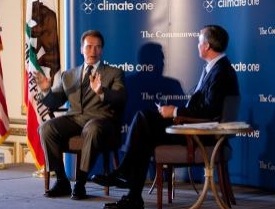
Gov. Schwarzenegger fields questions from Greg Dalton of the Commonwealth Club's Climate One initiative. Photo: Governor's Office

Governor Arnold Schwarzenegger is defending his planned veto of two renewable power bills, saying the executive order he issued instead is “stronger than the law” because it places fewer limitations on electricity imported from other states.

At the tail end of the legislative session, California’s assembly and senate passed separate bills requiring the state’s utilities to draw a third of their energy from renewable sources by 2020. But during a Q&A session at San Francisco’s Commonwealth Club Thursday, the Governor said that the recently passed bills were “for special interests” and that they “represented protectionism,” the latter a reference to limits on how much energy could be imported from neighboring states. The Governor’s own executive order has the same proportional requirement or “renewable portfolio standard” (RPS) as the bills but sets no limits on imported power. Also unlike the legislature’s bills, the order does not exclude particular sources, such as hydro-electric from the definition of “renewables.”

Critics contend that succeeding governors might simply rescind the order, which Governor Schwarzenegger does not deny. He faces an October 11 deadline to veto the bills.

Governor Schwarzenegger’s appearance was designed to mark the third anniversary of the state’s adoption of AB 32, the Global Warming Solutions Act of 2006, a law which has its own detractors.

Meg Whitman, the former CEO of eBay, who is running for governor said last week that she would issue a moratorium on most AB 32-related rules on her first day as Governor.  When asked about  Whitman’s remarks Schwarzenegger dismissed her comments as “just rhetoric.”

“I think she will probably reconsider what she has said and will see that the greatest thing that can happen for California is to move forward. I’m sure she does not want to be counted as one of those Republicans that want to move us back to the Stone Age,” he said.

Touting the state’s achievements in renewable energy innovation, emissions reductions,  and technology, the Governor painted a rosy picture of an invigorated economy, new jobs, and a cleaner environment throughout the state.

“A wave of green innovation is washing over our state right now,” he said.  “In last three years,  scientists and entrepreneurs have pumped more than $6 billion of venture capital into California.  Since 2005, green jobs in California have grown ten times faster than other jobs. California companies hold more than 40% of the nation’s new patents in solar and wind technology, and solar installations this year alone in California have gone up by 120%.”

Focusing largely on projected economic benefits, he made a case for continuing on the path California started three years ago with AB 32 and is continuing under his executive order from earlier this month, saying that the current path offers far more economic opportunity than economic risk.

“I know that it’s possible to protect the environment and the economy at the same time,” he said. “Technology will save us all. It’s all about technology, technology, technology. ”

Not all of the speech was about legislation, green technologies and the economy, however. The Governor did respond to a question from  group of fourth-graders attending the talk, asking what he says to his children about climate change.

“I’ve had major fights with my kids,” he said.

He said he has imposed a five-minute shower rule in his house and that he sometimes “spies” on his children to make sure they are obeying his order.

“If their showers are more than five minutes, there will be consequences.”

He added that other environmental steps his family has taken at home are to install solar panels nearby to provide energy for the family swimming pool and jacuzzi, and that they have converted the regular engines on their Hummers to hydrogen or bio-fuel engines.

Notebook Lost, Work Ethic Found

Rob Schmitz continues his dispatches from Japan, where he’s reporting on that country’s aggressive approach to energy efficiency–and what lessons we might take from them. Rob returns to KQED’s Los Angeles Bureau in October–with his notebook.

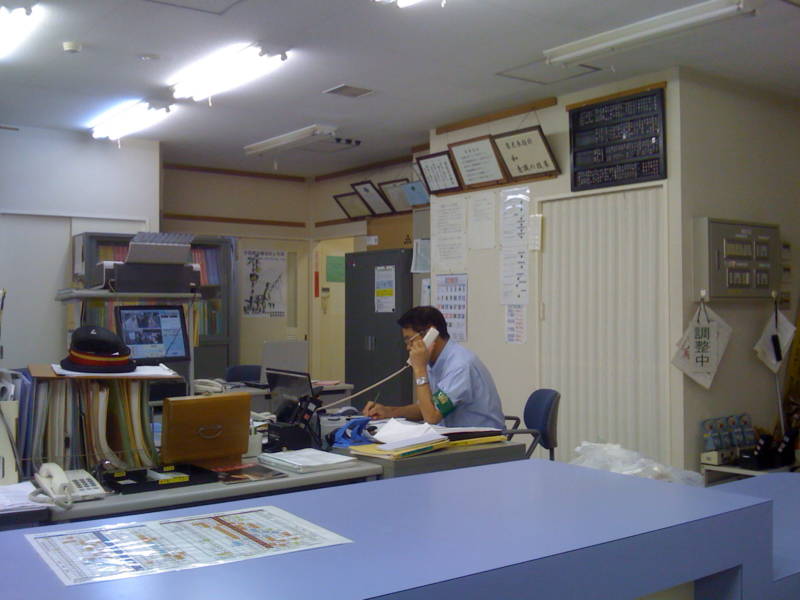
Today I left my notebook on the train to Ota. In it were notes of all the interviews I had conducted since arriving in Japan. Throughout my day of reporting, I repeatedly asked to borrow my interpreter’s notebook, and by the end of the day, I was depressed with the thought of having to listen to hours of tape that I had meticulously transcribed over weeks of interviews. When we returned to the station, my interpreter, Chiaki, took me to the station master’s office. That’s where I met Mr. Aiba.

My Travelling Notebook

Aiba-san was in his 50s, tall, thin, graying hair, glasses, and, like most Japanese in his position, incredibly polite. He wore a blue uniform and a green band around his arm with ‘security’ written on it in Kanji. Aiba-san listened intently to Chiaki’s every word describing the notebook, where I left it, and how important it was to me. He asked follow-up questions: “What are the approximate dimensions of the notebook? Is your name on the notebook?” and so on. As Chiaki answered, he took notes.

When he was finished, he offered us a seat, briskly walked to his desk, and picked up the phone. He called other stations, he called cleaning companies, and he consulted timetables. In between calls, he updated us: “The train you were on has made three round trips from Tokyo to Akagi today. Cleaning crews in many cities have cleaned the train several times.” Aiba-san briefly left the room while he waited to hear from the cleaning crews. He returned with some tea for us. A minute later, he received a call from the cleaning crew in Akagi, a city in the mountains at the end of the line: they found my notebook. Nobody had claimed it, so it had been tossed into a recycling bin. It was waiting for me on the platform there.

Aiba-san, getting the job done.

“But you’ll have to hurry,” said Aiba-san, looking at his watch. “The train to Akagi leaves in less than one minute.” He escorted us, running frantically in the lead, to the platform. We barely made the train. I had a few seconds to reach into my bag to give him a box of See’s chocolates that I had brought as a gift for my interviewees. He sternly declined the gift, but I insisted.

When we arrived to the tiny Akagi station, two elderly custodians with brooms in their hands were waiting for us on the platform. They bowed in unison to me and handed me my notebook. They had neatly wrapped it in a copy of the train’s timetable. This is just one of many examples of the generosity and commitment to service that I’ve experienced in my short time in Japan. Had I lost my notebook on a train or a bus back home, would anyone care? They probably would’ve laughed me out of the station at the thought of tracking it down.

Now, take this behavior to a macro level and you start to see why Japan, an island nation with no fossil fuels and few resources of any kind, has become the second largest economy in the world. When Japan puts its collective mind to something, it not only gets the job done, but it oftentimes excels at it. From my conversations with government officials, business leaders, and those in the non-profit sector here, it’s obvious that Japan is not only committed to reducing greenhouse gases, but perhaps more importantly, it wants to make a lot of money from doing so.

In short, it wants to ensure that its companies own and make as much of the technology that goes towards this global effort as is possible, and it’s got a head start. Japan leads the world by a long shot in registered patents in the green technology sector, according to a report from CERNA, the Centre d’Economie Industrielle. Check out the final pages of that report, which compare countries, and you’ll see Japan leads in every patent category except one. Japan is getting the job done, just like Aiba-san stepped up to do his job when I sought his help. It’s a spirit that’s refreshing to be around. We could use a few more Aiba-sans back home.

A Sea Change in Ocean Policy Promised

Reed Galin
Photo: Reed Galin

A phalanx of high-level federal officials marched into San Francisco today to announce a major shift in the way the federal government oversees the oceans.

The top-level administrators from the White House and several agencies held a public meeting to launch efforts toward a first-ever National Ocean Policy, in which they say restoring a healthy ecosystem will be a top priority.

The newly formed Interagency Ocean Policy Task Force is led by Nancy Sutley, chair of the White House Council on Environmental Quality and one of President Obama’s top advisors on the environment. She arrived surrounded by representatives from the National Oceanic and Atmospheric Administration (NOAA), EPA, Navy, Coast Guard and Dept. of Interior (which, odd as it sounds, is responsible for vast tracts on the outer continental shelf).

Asked why we’re just getting around to a unified national ocean policy, Sutley said that “Too often the federal government sits in its stovepipes,” with each agency taking a narrow view. This effort is an attempt to break through traditional parochialism in favor of a more holistic approach to the challenges.

Task force member Jane Lubchenco, who heads NOAA, said that for the first time, policy makers are saying loudly that “healthy oceans matter.” And right now, she says, they’re not real healthy.

“At a global scale, I would say that oceans are in critical condition,” said Lubchenco. ” Most people are unaware of how much disruption and depletion has occurred within the oceans. We’re seeing the symptoms of much of that. It’s time to get on with the solutions.”

The task force will address a growing array of concerns, from shrinking fisheries to higher acid levels in the ocean—many of which are likely related to climate change.

Lubchenco, who is also an Undersecretary of Commerce, told me that “Climate change is exacerbating many of the existing challenges for ocean uses. There’s very good evidence that climate change is already having very significant impacts on oceans.” Lubchenco also cited “the related problem of ocean acidification,” and reeled off a laundry list of  climate impacts, including “loss of biological diversity, increasing transport of invasive species, nutrient pollution, habitat loss, and over-fishing.”

Lubchenco added “That sum total of stresses on ocean ecosystems means that we need to be taking new approaches.” The most sweeping of those “new approaches” will be “ecosystem-based management,” a term used repeatedly in the Interim Report issued by the task force this month.

According to the report:

“The implementation of ecosystem-based management embodies a fundamental shift in how the United States manages these resources, and provides a foundation for how the remaining objectives would be implemented…It would provide the opportunity to ensure proactive and holistic approaches to balance the use and conservation of these valuable resources. This broad-based application of ecosystem-based management would provide a framework for the management of our resources, and allow for such benefits as helping to restore fish populations, control invasive species, support healthy coastal communities and ecosystems, restore sensitive species and habitats, protect human health, and rationally allow for emerging uses of the ocean, including new energy production.”

The task force will also be taking its own stab at some long-term solutions for the troubled Sacramento River Delta. The interim report is open for public comment until October 10.

Copenhagen Sans Congress

KQED’s Los Angeles Bureau Chief and frequent Climate Watch contributor Rob Schmitz is spending six weeks in Japan, as part of  the Abe Fellowship Program. He’s filing a series of blog posts and radio reports on Japan’s extraordinary strides in energy efficiency–and what we might learn from them.

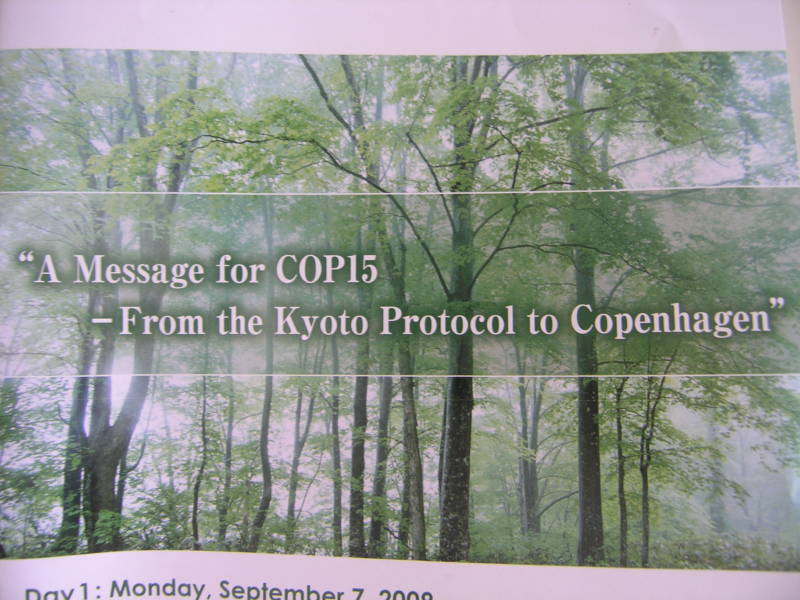
…And a message for the US from Yvo de Boer–An official program from last week’s Asahi World Environment Forum in Tokyo.

With the United Nations Climate Change Conference in Copenhagen two and a half months away, it’s becoming increasingly likely that lawmakers on Capitol Hill will not pass legislation on greenhouse gas reductions in time. A commonly accepted premise seems to be that without domestic climate legislation enacted at home, the U.S. won’t be able to sign a global deal on climate change in Copenhagen, either.

Not true, said UN Climate chief Yvo de Boer last week at the Asahi World Environment Forum here in Tokyo. de Boer told a packed house that in recent conversations he’s had with Senator John Kerry (chairman of the Senate Foreign Relations Committee) and senior advisors to President Obama, it was clear to him that the United States doesn’t need Congress to act in order to sign a deal in Copenhagen. (Listen to an audio clip of his remarks using the player below.)

[audio:http://kqed03.streamguys.us/anon.kqed/climatewatch/YvodeBoer.mp3]

This isn’t the first time de Boer has said this, nor is it the first time this notion has been floated. Last year, Marc Ambiner, political editor for The Atlantic, wrote in his blog about how the administration could bypass Congress for comprehensive energy reform by using the Clean Air Act as a platform. It seems that some of Obama’s environmental advisors believe that the act not only gives the Environmental Protection Agency the power to regulate greenhouse gases but also to institute a cap-and-trade regime on its own. Going around Congress for such an important policy shift would no doubt be a controversial step, but if such powerful and influential figures are hinting at it to de Boer, maybe we’ll see a little Copenhagen surprise on the part of the American delegation.

Scotland Rising to Carbon Challenge

This dispatch came in from Alison van Diggelen after a recent visit to her home country. Van Diggelen is a freelance writer and interviewer and founder of the Fresh Dialogues website and podcast. Originally from Glasgow, she now makes her home in Silicon Valley.

Scotland Aims to Beat California on Climate Change Action

By Alison van Diggelen

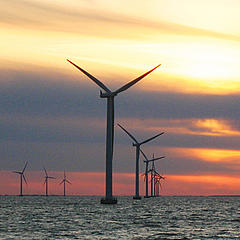
Wind turbines off Scottish coast. Photo: World Wildlife Fund

It’s not often that Scotland is ahead of the game compared to California, but on the issue of climate change, this small northern country has taken a legislative lead that has put it on the green map of the world.

As the California Legislature this week grapples with new laws* requiring utilities to get 33% of their energy from renewable sources by 2020, Scotland is sitting pretty. It is already close to its 31% target of energy from renewables by 2011 and has an even bolder target of 50% by 2020.

On a trip to Scotland this summer, I met with Lena Wilson, CEO of Scottish Enterprise, a government-funded organization that promotes Scottish interests both at home and abroad. She told me that the fight against global warming is a crucial part of the government’s strategy because ultimately a low carbon future is an economic stimulus and job creator for the country.

But how did Scotland muster the political will to set such ambitious targets? Scotland’s First Minister, Alex Salmond is passionate about renewable energy, Wilson told me; and establishing Scotland as a hub of green energy and green-tech is key to his strategy. Part of the plan is to harness its natural resources – powerful wind and wave power, estimated to account for a quarter of Europe’s potential. Salmond recently opened the largest wind farm in Europe to drive home that point. It’s on the outskirts of my home town of Glasgow and makes me rather proud.

Yet, making bold targets isn’t the end of the story. Scotland must create a whole ecosystem to make green growth attractive in Scotland. It launched the Saltire Prize last year to stimulate innovation in wave and tidal power; but still has ground to cover. As well as the financial, administrative and logistical challenges, there’s the issue of NIMBY-ism. Although Wilson insisted they’re pursing a popular green agenda, some of the locals I talked to in Scotland were less enthusiastic about the aesthetics of wind turbines.
And then there’s the “nuclear option.” Just as in California, the issue is red hot. Salmond is publically against it, but if he wants to keep shining his low carbon credentials, he may be forced to rethink his position.

One final note: When I asked Wilson, is your boss, Alex Salmond the Al Gore of Scotland? Her response was enlightening. She almost choked. Being a staunch nationalist, union man and former socialist, she doubted he’d enjoy the comparison. On my next trip, I hope to discuss this with the man himself and find out exactly how his passion for green took root. Stay tuned.

*State legislators passed two bills during their overnight session on Friday. Here’s a summary provided by the advocacy group Environment California:

AB 64 (Krekorian) & SB 14 (Simitian): AB 64 and SB 14 are companion bills that together set California on the path toward producing 33% of its electricity from renewable resources like solar and wind power. While there was much controversy over amendments to the bill that add in language for PG&E to potentially build large hydroelectric dams in British Columbia and call it renewable energy as well as amendments pushed by British Petroleum and Chevron that put 7,000 MW of fossil fuel burning combined heat and power plants ahead of renewable energy, the two bills still stand to become the biggest renewable energy mandate in the country”

Few Surprises as Climate Symposium Opens

A broad spectrum of scientists, entrepreneurs and public officials are meeting in Sacramento this week for the sixth annual Climate Change Research Symposium, sponsored by the California Energy Commission (CEC).

Today and tomorrow are packed with technical lectures on topics ranging from “Decadal Changes in the El Nino Pattern and Impact on the Hydroclimate…” to “Climate and Wine Grape Phenology in Napa Valley.” But yesterday it was up to the policy honchos to set the scene.

There was little in that preamble that hasn’t been heard before. When asked about recently expressed doubts that the state’s utilities can attain a one-third proportion of renewable energy within the next decade, air board chief Mary Nichols said “Not only can we do it, we have to do it.” Nichols, probably the state’s highest-profile point-person on climate policy,  said the the state’s broader, longer-range goal for cutting greenhouse gas emissions simply can’t be achieved without it.

Just as if they’d heard her, legislators tonight passed SB 14 out of committee. The bill requires utilities to meet the 33% renewable portfolio standard (RPS) by 2020 (in other words, to derive a third of their power from low-carbon sources). Green energy activists lamented language in the current version that allows utilities to slip that deadline, if there are delays in bringing new renewable energy sources online.

There was a clear signal from yesterday’s symposium speakers that, as we’ve previously discussed in this space, adaptation is taking center stage on the policy front. California has set targets for “mitigation” of global warming and put some of the wheels in motion. Now attention has turned to preparing for inevitable climate change effects, already in the pipeline.

The CEC’s newest Commissioner, Julia Levin, warned against the onset of “NIMBY” syndrome as measures are implemented across the state, such as the build-out of solar and wind “farms.”

And Stanford scientist Chris Field, who heads the IPCC’s Working Group II, noted that while growing interest in the “other” greenhouse gases (methane, nitrous oxides, etc.) is justified, the focus should remain on controlling carbon dioxide.  “As long as the world maintains an aggressive focus on economic growth,” said Field, “It’s the economic growth that’s the driver of future emissions and that’s why strategies to find ways to grow the economy without increasing carbon emissions are so important.” While some of the other gases are more potent greenhouse gases, Field says they’ll see little or no growth in volume in coming years.

Field previewed some of what he sees as the focal points of the next major IPCC climate report, known as AR5. Field predicted that we’ll see a shift in focus from making the case that global warming is real and human-induced, to providing more and better information that “stakeholders” can act upon. Field cited a recent study projecting that corn yields in Africa could fall 30% by 2040, due to climate forces.

Japan’s Climate Plan: Too Ambitious?

KQED’s Los Angeles Bureau Chief and frequent Climate Watch contributor Rob Schmitz is spending six weeks in Japan, as part of  the Abe Fellowship for Journalists. In the weeks to come he’ll file a series of special reports on Japan’s extraordinary strides in energy efficiency–and what we might learn from them.

Saturday night, on my way home from an interview, I witnessed one of the more interesting orchestrated movements of humanity the world has to offer. I shot this video when I was changing trains at Shibuya station, one of Tokyo’s busiest. The intersection shows how well Japan engineers pedestrian movement–but how well will it engineer its residents’ greenhouse gas emissions?

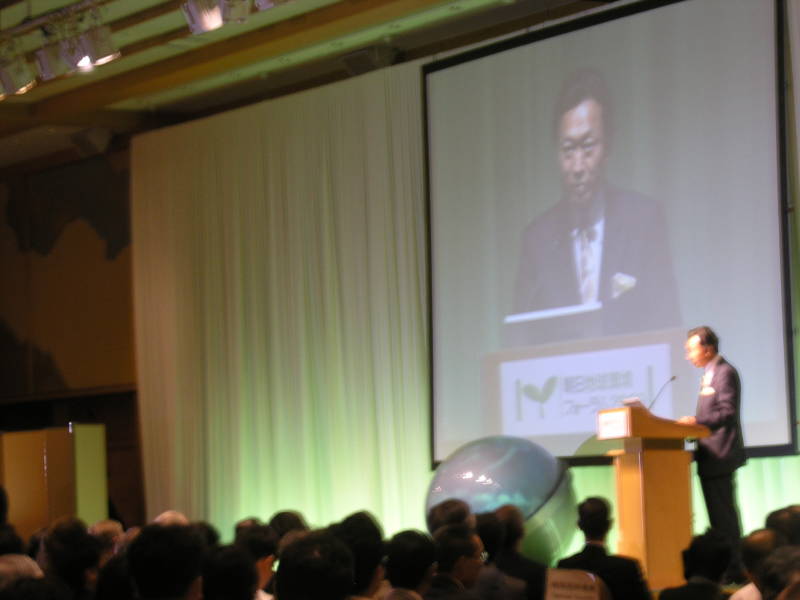
On Monday, I attended the Asahi World Environment Forum, where all the bigwigs on climate change were in attendance (including Yvo de Boer and Rajendra Pachauri, among others). The surprise visitor was Japan’s Prime Minister-elect Yukio Hatoyama.

Hatoyama makes his climate change pledge.

He told a packed house that Japan will aim to reduce its greenhouse gases by 25% from 1990 levels by 2020.

“In my personal opinion, that’s impossible,” Hidetoshi Nakagami told me last week. Nakagami is President of the Jyukankyo Research Institute and holds a coveted seat on the advisory committee to Japan’s powerful Ministry of Economy, Trade, and Industry, or METI. “Hatoyama’s pledge is pure politics,” he said. “It’s not practical, it’s not possible, and there’s not enough time.”

Nakagami is not a pessimist. He played a large role in creating Japan’s very successful Top Runner program, a 1997 policy that searches for the most efficient model of any given electrical appliance and then makes that model the industry standard, requiring other companies to adhere to it when making new models of the same appliance. The program was one of Japan’s most ambitious energy efficiency measures, and Nakagami had to fight against Japan’s largest companies in order to help craft the policy into law.

While Nakagami would like to see a one-quarter reduction in greenhouse gases from 1990 levels in the next decade, he says it’ll cost the average Japanese dearly. When former Prime Minister Taro Aso pledged to cut Japan’s greenhouse gases by 15% of 2005 levels, Nakagami’s institute estimated that the effort would cost each Japanese household, on average, 70,000 yen–a little over USD $700–a year. Even that, says Nakagami, would be a tall order in this economy.

In the end, Hatoyama may not fill this order. His historic pledge, which during his campaign, seemed to have no strings attached to it, now has an important caveat. At Monday’s forum, he told the audience that Japan will embark on this journey as long as other major countries also set similar ambitious targets.

Japan’s future hanging in the balance.

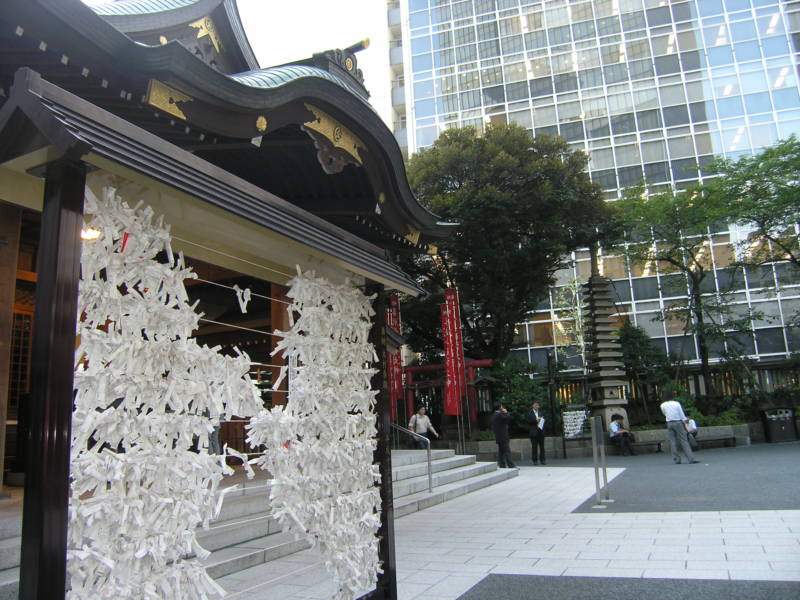
After the forum concluded, I walked outside into Tokyo’s rush hour: pedestrians everywhere, taxis speeding by me. I stopped at a Shinto shrine built among enormous glass skyscrapers. In front stood an Omikuji shrine, where believers tie a paper copy of their fortune, with hopes that it’ll come true. Hundreds of paper fortunes rattled in the hot, summer wind. I wondered if one of them was Hatoyama’s.

Seeding Clouds for Hydropower

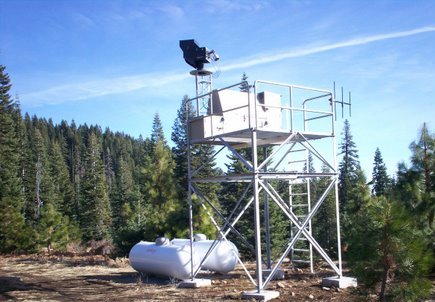
PG&E cloud seeders located near Burney Falls, CA. Photo: PG&E

Christina Aanestad’s radio feature for Climate Watch airs Monday morning on The California Report.

Wringing Hydropower Out of the Clouds

By Christina Aanestad

When cloud seeding began in the 1950’s there were no laws governing weather modification. According to Maurice Roos, Chief Hydrologist with the state Department of Water Resources (DWR), it wasn’t until the late 1970’s when a storm in a seeded area near Los Angeles flooded, that regulations governing weather modification were included in the state’s water code. In the West, “Most of the states have legislation that governs the conduct of weather modification activity,” says Brant Foote, director of the Research Applications Lab at the National Center for Atmospheric Research (NCAR) in Boulder, Colorado.

Government oversight has changed over the years. Today in California, state regulations have slackened. “As for the State’s role, it is mainly informational. There are no permits or licenses,” said Roos. According to Roos, all cloud-seeding projects required permits until the law was reformed. “The old law required licenses and permits but it was repealed in the 1980’s. There was a general move toward deregulation in the government–mainly to reduce costs.” Today, according to Roos, Sponsors of cloud-seeding projects must notify DWR and county governments of the project, “This can be a letter or, for DWR, an e-mail notice,” he said. “They also have to publish a Notice of Intention in the county or counties affected by their proposed operations.”

Most of what this reporter learned was from Roos’ institutional memory, and going directly to sponsors of cloud-seeding operations–about 15 intermittent projects around the state. Data on cloud seeding at the state level is scattered, according to Roos. “We used to have an annual report that was published. Last time I tried to find it, it was in an archived box and nobody knew where it was,” said Roos, who added that budget cuts and deregulation mostly gutted the oversight program.

Despite lax oversight, the State of California wants to use weather modification as part of its 2009 Water Plan, which states:

“Cloud seeding has advantages over many other strategies for providing water. A project can be developed and implemented relatively quickly…it could offset some of the loss in snow pack expected from global warming.”

According to the plan, some regulation remains: weather modification sponsors need to comply with the California Environmental Quality Act [CEQA]. But not all seeding has to comply with environmental regulations. PG&E contends that an environmental impact report is not required for its Pit-McCloud River project because it is privately funded, with equipment on private lands,” said Roos.

That has locals groups near Mount Shasta concerned with PG&E’s proposed project in the Pit and McCloud River watersheds. “It’s a clear unequal treatment between public agencies and private entities,” said Angelina Cook with the Climate Council and the Mount Shasta Community Rights Project. “Private corporations require more government oversight and regulation to ensure accountability for the their practices.” But compiling all cloud-seeding data in California into one reference source today would be “a labor of love,” says Roos. “There’s no funds for it,” he said.

Cook says she is working on a cloud-seeding ban in Mount Shasta City, which may include a chemical trespass for silver iodide, the common chemical used in cloud seeding. “If silver iodide is found in the area, PG&E would be liable,” said Cook.
But Roos, who says cloud seeding is mostly benign, asks where one would draw the line. “There’s all kinds of influences on the air like people driving their cars, diesel trucks running around,” said Roos. Just as California has increased its regulations on air emissions in the state, some like Cook would like to see tougher regulations for weather modification as well.

Meanwhile, the state’s 2009 water plan also urges more research and development into cloud-seeding. Research could include cloud seeding’s impact on global climate change, and it’s effectiveness. The plan also identifies areas that could provide optimal results from cloud seeding, mostly in Northern California, along the Sacramento, Trinity and Russian Rivers.

Cloud Seeding Projects in California

View Cloud Seeding Projects in California in a larger map

To find references to cloud-seeding in the state’s water plan, look under Volume 3, then for “Precipitation Enhancement.”