NASA: 2009 Tied for Second-Warmest Year

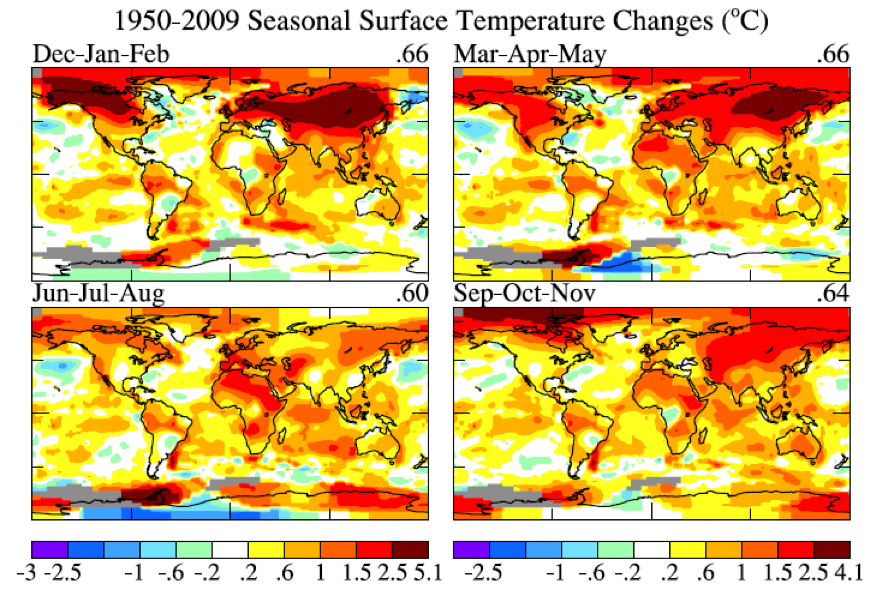
Parts of the northern hemisphere may have had an extremely cold December, but nevertheless, last year tied for the second-warmest in 130 years of global instrumental temperature records, according to the latest surface temperature analysis of the NASA Goddard Institute for Space Studies (GISS).  The analysis finds that global temperatures were so similar in 1998, 2002, 2003, 2006, 2007, and 2009, that they are all tied for second place. In the Southern Hemisphere, 2009 set the record as the warmest year, according to this report.

James Hansen, head of NASA’s GISS, and his team have released their end-of-year summary for 2009, initially posted on the Real Climate blog.  It’s pretty dense, but here are some additional highlights:

– The scientists offer an explanation for an apparent data discrepancy over whether 1998 or 2005 was the warmest year.  In short, it comes down to the difference in the way GISS and HadCRUT (Hadley Centre/University of East Anglia Climatic Research Unit) assign or do not assign temperature data for areas without observing stations.  (HadCRUT leaves them out of the analysis, while GISS assigns values based on various factors outlined in the summary.)  GISS maintains that 2005 was the warmest year.

– According to the report:

“There were strong negative temperature anomalies at middle latitudes in the Northern Hemisphere, as great as ‐8°C in Siberia, averaged over the month. But the temperature anomaly in the Arctic was as great as +7°C.”

In other words, 2009’s cold December in certain areas of the planet, as well as an unusually cold 2009 summer in the United States and Canada, do not reflect overall global temperatures nor signal a cooling trend:

“It is obvious that in December 2009 there was an unusual exchange of polar and mid‐latitude air in the Northern Hemisphere. Arctic air rushed into both North America and Eurasia, and, of course, it was replaced in the polar region by air from middle latitudes. The degree to which Arctic air penetrates into middle latitudes is related to the Arctic Oscillation (AO) index, which is defined by surface atmospheric pressure patterns…”

According to GISS data, December 2009 was the most extreme negative Arctic Oscillation since the 1970s.

– The report underscores that monthly temperature anomalies tend to be greater than seasonal anomalies and that the the mean temperature of a particular month might not be the best way to identify global warming. Instead, one needs to look at measurements over the long-term, which, according to GISS data, indicate general warming over at least the last 50 years, just about everywhere on the planet.

The summary concludes with a sort of admonishment:

“The bottom line is this: there is no global cooling trend. For the time being, until humanity brings its greenhouse gas emissions under control, we can expect each decade to be warmer than the preceding one. Weather fluctuations certainly exceed local temperature changes over the past half century. But the perceptive person should be able to see that climate is warming on decadal time scales.”

Nature Always Bats Last

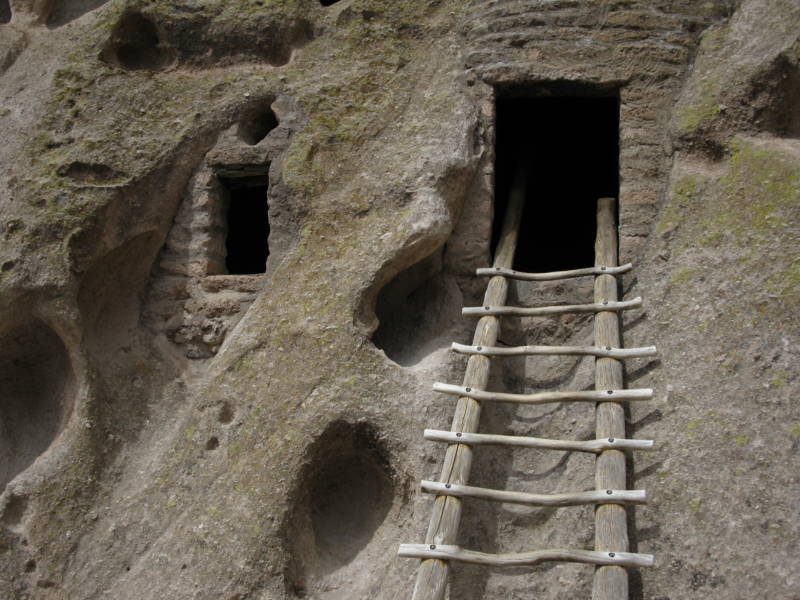
Cliff dwellings at Bandelier National Monument, New Mexico Photo: Craig Miller

Mike Newland is an archeologist at Sonoma State University’s Anthropological Studies Center. A version of this essay was originally broadcast as part of KQED’s Perspectives series.

Nature Always Bats Last

By Mike Newland

I’ve been pondering a 3,000 year old mystery that makes me uneasy about our current plight. Starting around 2,000 B.C., people in the Great Basin and Mojave Desert really got into big-game hunting.  We see this in the archaeological record—all of this big-horn sheep and antelope bone shows up in larger quantities.  Up in the mountains, great panels of rock art are chock full of hunters chasing sheep, and evidence of their hunting camps is tucked in shelters and around springs.

Big-game hunting isn’t that efficient.  You’re better off going for a wide range of edibles close by.  You get more food for less work.  This is an important point, because after 3,000 years of this big game hunting, this culture died out, and was replaced by folks that hunted and collected a broader range of food.

Bill Hildebrandt and Kelly McGuire, two archaeologists from Far Western Anthropological Research Group in Davis, have made a compelling argument about why people were so obsessed with hunting—they did it for status.

Good hunters were revered for their abilities to provide food and hunting trips could serve political and social functions.  But big game hunting was eventually done at the expense of the rest of the population: archaeologists still discuss whether the bow and arrow, probably introduced to California by groups coming out of Oregon, was such an effective hunting tool that the hunters wiped-out most of the big game, or whether the devastating effects of the Medieval Climatic Anomaly, which caused major droughts throughout the Great Basin and desert areas, pushed these people over the edge.  But it is clear that serious changes took place, and big game hunting became unsustainable.  By the time the next group of folks came along, the big-game hunters were on the verge of collapse.

This is one of the reasons why archaeology is important—we can look at past cultures and see how we, as a species, have dealt with big problems.

This research makes me uneasy because archaeology has shown repeatedly that cultures not in balance with nature die out.  For millennia, people have sat around campfires debating whether to make the changes necessary to adapt to a shifting climate or depleted resource base, and invariably they said no. As a result, the graveyards of history are full of the corpses of cultures that failed to change when they needed to.

Now it’s our turn. History shows that nature won’t hesitate to take us out.  We’re lucky in that we have probably one of the most adaptive cultures in history: we’ve made major changes—abolition of slavery, passing of environmental legislation, the Equal Rights Amendment—when we thought it was in our collective best interest. Even still, these landmark changes required decades of hard work and dedication to educate the broader population.  We have our work cut out for us.  We can either rise to the occasion, and make the investments necessary to stem climate change, or we can take our place with the rest of the dead in the graveyard.

Climate and Development Affecting CA’s Butterflies

Atlantis Fritillary butterfly at Sierraville, CA Photo: Jennifer Wolf

California’s butterfly populations are suffering from the combination of a warming climate and increased land development, according to a new analysis from scientists at UC Davis.

The study, scheduled to be published online this week in the journal Proceedings of the National Academy of Sciences, draws from butterfly expert Arthur Shapiro’s database of more than three decades of observations of 159 species from 10 sites in the Sierra Nevada at varying elevations, from sea level to tree line.

The data shows that over the last three decades butterfly species diversity declined at half of the sites, with the most severe reductions occurring at the lowest elevations, where habitat destruction is greatest.  The sites in the middle range showed evidence of habitats shifting upslope, as lower elevation butterflies began appearing at higher elevations.  The only site studied where butterfly biodiversity and abundance has increased is at the highest elevation site, at 2,400-2,775 meters.

“These patterns are quite consistent with other studies on a variety of organisms,” said Shapiro.  “The trend is for organisms to seek the climate to which they are adapted. So if it’s getting warmer, that means you go north, or you go up.”

While the population shifts appear consistent with warming temperatures (Both average maximum temperatures and average daily minimum temperatures increased across the majority of the sites), the study finds that warming alone is not enough to account for the loss of biodiversity at low and middle elevations.  Researchers analyzed county land use data at the sites, and found that it correlates with the butterfly population data.  The authors propose that habitat destruction due to urban and suburban development is most likely the leading cause of butterfly population deterioration at the lower elevation sites.

Citing pressures from human development as the main cause for species loss, the United Nations declared 2010 to be the International Year of Biodiversity.  At the Johannesburg summit of 2002,  governments agreed to achieve “significant reduction” in the rate of biological diversity loss by 2010, but according to the BBC, conservation organizations are acknowledging that this target is not going to be met, and that, in fact, the problem may be worsening.

Committee: No Free Lunch for Carbon Emitters

California’s cap-and-trade program took another baby step toward fruition on Monday, with the release of the state-appointed Economic and Allocation Advisory Committee’s final report on implementing carbon regulation.

Stopping just short of recommending a 100% auction of emission credits, the report, which is non-binding and was written to help the California Air Resources Board develop an economically sound cap-and-trade program, advises the state to sell off the majority of its carbon permits to emitters — with a few exceptions. Industries that “rely heavily” on carbon-based energy or compete directly with firms that do not face carbon regulation, the report says, should be “provided with assistance” or given funds earned from the auction.

The report pointedly advises against handing out free permits to utilities. Although the state’s utilities will almost certainly pass increased costs onto customers, the committee predicts that the price spike will provide an incentive for Californians to start saving energy. The committee’s press release says the report takes a “household friendly” approach to cap-and-trade, recommending that at least 75% of the proceeds from selling carbon permits be returned to households through either tax cuts or direct financial transfers.

Even before the report was released on Monday, the looming possibility of a carbon permit auction was causing anxiety in industrial circles. The AB-32 Implementation Group, an organization that aims to protect California business interests, claimed last week that if the price of carbon is set to $60 per ton, “large employers could be subject to an ‘Auction Tax’ of up to $143 billion by 2020.” Environmental groups have been urging the Air Board to auction off all the carbon permits initially offered.

In a written statement, Governor Arnold Schwarzenegger responded to the committee’s report, saying “the best program will be one that returns value to the people through tax cuts, rebates or dividends, and I applaud the Committee for recognizing those options.”

Here’s a quick run down of the rest of the report’s key recommendations:

Protect Low Income Households

The report recommends returning some of the auction’s profits to low income households, since such households tend to spend a greater percentage of their income on energy.

Invest in a Low Carbon Economy

The committee recommends that the state create an independent Investment Advisory Board to help make it reach its low carbon targets.

Simple Auctions

The state’s carbon permit auctions should simple and allow the public to sell permits in the auctions along with the state.

State Senators Hear Cap-and-Trade Caveats

Craig Miller
Photo: Craig Miller

The dark underbelly of cap-and-trade was somewhat exposed in a four-hour hearing today before the Senate’s Select Committee on Climate Change and AB-32 Implementation. AB-32, of course, is shorthand for California’s Global Warming Solutions Act of 2006, which mandates a carbon trading program be in place by 2012.

Here’s my “highlights reel” from the panel of experts who testified, in order of appearance:

Mary Nichols, Chair, California Air Resources Board

– On carbon pricing: “There is no approach that does not involve administrative costs & headaches” but cap-and-trade “seems like a pretty good mix” of certainty provided by an enforced cap and market flexibility (versus an outright carbon tax of some sort).

– On California going “solo” with carbon trading (i.e. without the other states and provinces currently signed to the Western Carbon Initiative): The larger the territory, the more potential for “bad actors” but the greater the potential for meaningful savings & benefits to the economy.

Michael Wara, Stanford Law Professor

– On carbon offsets: “…difficult to administer;” to ensure real reductions, changes in behavior, has proven to be “a significant and ongoing challenge, in practice.”

– California appears to be “opting for prudent limits” on allowable offsets, at an anticipated 4%, versus more than 30% in the Waxman-Markey bill that has cleared the US House of Representatives.

– “Very few [offset] programs have been run without controversy.”

Ken Alex, California Attorney General’s Office

– On enforcement: “Every system has cheaters, especially where billions of dollars are involved.”

– Cap-and-trade provides “a permanent incentive for cheaters.” Unassailable data is essential for regulators.

– Regulators “must have sufficient authority” to assess meaningful penalties. Alex, who was involved in sorting out the state’s energy crisis of 2000-2001, recalled that “million-dollar penalties were irrelevant.”

Dallas Butraw, Economist, Resources for the Future

– Warned against a “phone book-sized” regulation.

– Cost of carbon emissions permits will be passed along to consumers but could be offset by tax breaks or a dividend system similar to what oil & gas companies pay to residents of Alaska.

David Harrison, Economist, NERA Economic Consulting

– On lessons from Europe: Despite a rocky start for the EU’s “pilot” program, the system for carbon trading in 27 countries has “evolved over time” to become “very successful.”

– The EU experience “really does show that cap & trade works. Emissions have been reduced.”

– There is “no silver bullet” for determining allocations; that in Europe has been a “messy” and “contentious” process.

– In spite of it all, the EU experience demonstrates that cap-and-trade is “not perfect but it really is better than the alternatives,” and provides a good laboratory for California.

The committee, chaired by Fran Pavley (D-L.A.), also heard from several business and environmental groups. At one point a speaker from the Natural Resources Defense Council (NRDC) argued briefly with a utility representative about whether electric rates are actually higher or lower in California, compared to the nation as a whole (apparent compromise: rates may be higher but average bills are lower).

Utilities complained that the system, as proposed, forces power companies to bear the brunt of the burden. Business interests warned that unbridled implementation of AB-32 “could add to an already alarming increase in job losses,” claimed that the state has no authority to hold carbon permit auctions under AB-32, and asked for initial permits to be given away to industry. Environmentalists asked for the opposite, urging that 100% of initial permits be auctioned off, i.e. that emitters be made to pay for them.

Numerous speakers expressed nervousness over validity of carbon offset programs. Regarding the various schemes for carbon storage in forests or soil, Assemblyman Jared Huffman (D-San Rafael) said “This one makes my head hurt.” There’ll be a lot of Excedrin passed around before this is through.

Western Lakes Warming Up Rapidly

Photo: Craig Miller

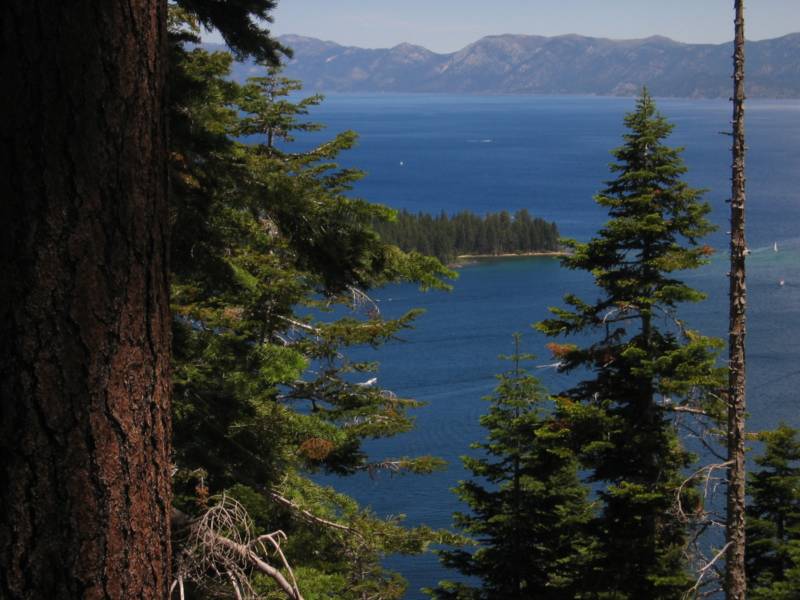
Some lakes in Northern California and Nevada are warming twice as fast as the surrounding air temperature, raising concerns that climate change may be affecting aquatic ecosystems more rapidly than terrestrial ones, according to a recently published study.

Researchers from the Tahoe Environmental Research Center, UC Davis and NASA’s Jet Propulsion Laboratory in Pasadena, studied Lake Tahoe, Lake Almanor, Clear Lake, and Mono Lake in California, and Nevada’s Pyramid and Walker Lakes, by analyzing 18 years of temperature data from satellite sensors.

Long-established instrument buoys provided a flow of temperature data for Tahoe, dating back to 1968, which allowed the team to calibrate satellite readings, raising confidence in data gathered from the other lakes. Previous studies have documented the warming of Lake Tahoe but John Reuter, associate director of the Tahoe Environmental Research Center (TERC), says the new study takes that information one step further.

“This study really shows that this phenomenon is happening on a much larger scale than just Lake Tahoe,” said Reuter.

All of the lakes studied showed a strong warming trend among summer nighttime temperatures between 1992 and 2008.  The two lakes that warmed the most during that time, Almanor and Mono, warmed 4.3 degrees (F).  During that time Lake Tahoe’s surface waters warmed 3.7 degrees, averaging .23 degrees annually.  In contrast, Tahoe City’s air temperature increased just .1 degree each year.

TERC director Geoffrey Schladow, who co-authored the study, said there is no doubt in his mind that rising lake temperatures are related to climate change, and he expects that it’s happening across the world, not just in Northern California and Nevada.

“The significance of this study is that across the western United States these very different lakes are displaying signs of warming.  It’s not just a Tahoe issue, it’s a regional issue.  And in all likelihood, it’s a global issue,”said Schladow.

Over the next six months, researchers will be using the remote sensors to extend the study to 50 lakes across the world to evaluate whether or not large lakes everywhere are warming at similar rates.

Warmer temperatures can affect water circulation, which influences the amount of oxygen and nutrients available throughout the lake.  A 2008 study from TERC predicts that warming due to climate change could dramatically affect the amount of mixing in Lake Tahoe, which would deplete the bottom water of oxygen and drastically disrupt the food web.

“Temperature is one of the conditions that dictates who lives in the lakes,” said Schladow. “Warmer temperatures may make the lakes more hospitable to invasive species and put native species under stress.  I’m not saying this is happening yet, but it could.”

In his article about the study, Matt Weiser of the Sacramento Bee has some examples of how warmer temperatures can affect lake ecosystems. And KQED news editor Dan Brekke has assembled an interactive map (below), showing the locations and some temperature data for lakes in the study.


View California’s Warming Lakes in a larger map

The Heated Debate Over Temperatures

87583224As the war over warming perception spills into a new decade, the last month of 2009 provided fresh ammo for the prevailing view. According to a preliminary report from the World Meteorological Organization (WMO), the “noughties” may have been the warmest decade on record.
And despite the rare sprinkling of snow we woke up to one December morning in the Bay Area, the report also says that 2009 will likely go down as one of the hottest years in modern history. Based on climate data from January to October, the WMO says that 2009 will likely be the fifth warmest since scientists began keeping records in 1850.

If that last claim seems improbable, you’re likely in Canada or the United States: The data shows that every continent but North America saw above-average temperatures in 2009, and that parts of Asia and Africa experienced their warmest year yet.

Dean Moosavi, a professor at the University of Massachusetts, Dartmouth, chalked the apparent discrepancy up to the Pacific ocean phase known as La Nina, and said it’s important to note the difference between weather and climate. “Snow in Houston this week, for example, is not proof of the absence of global warming any more than a large drought in the summer is proof that global warming is occurring,” Moosavi wrote in an email to Climate Watch. “You have to look over much longer periods of time…decades at the least before you can see a climatic trend of significance.”

This is perhaps a good place to acknowledge the oft-heard claim that the planet has actually been cooling down for more than a decade. In an article published in NOAA’s online magazine ClimateWatch (not affiliated with KQED Climate Watch), David Easterling of NOAA’s Climatic Data Center explains the statistical quirk that produces that mirage.

But Moosavi says he’s not quite ready to make a pronouncement. “I am not yet convinced that the 2000’s were warmer than the 90’s at this point,” Mossavi wrote. “Given the political and economic stakes of a statement of this type…I would be very cautious before declaring the 2000’s the warmest decade.”

Stanford’s Mark Jacobson, on the other hand, was less equivocal: “As 8 of the 10 warmest years in the history of surface measurements are in the 2000’s, it is clear that the 2000s was the warmest decade on record,” he wrote in an email.

The WMO findings come on the heels of a pair of reports that indicate that despite the global recession, average temperatures are on track to rise between 4 and 6 degrees Celsius by the end of the century.

For some perspective, the California Climate Change Center’s 2006 report on the risks of global warming predicts that a 6 C increase would have a devastating effect on the state. The report projects that a 10.5 F increase (just a little under 6 C) would result in up to 100 extra days of “extreme heat” in Los Angles and Sacramento, a 90% reduction in the Sierra snowpack and a 2-to-3-foot increase in sea levels.

The half-dozen climate scientists contacted for this post agreed that the 6 C prediction was within the realm of possibility, and most had the same answer when asked how the world should combat this risk. Stanford professor Ken Caldeira chose to respond in capital letters: “WE HAVE TO ACT NOW.”

“The question isn’t so much whether we need to take action this year or next, but rather how much more expensive and difficult are the solution and the impacts, if we delay,” Chris Field, director of the Carnegie Institution’s Department of Global Ecology, said. “Delaying action on climate is sort of like delaying action on paying your credit card bill. You may get by for a few months, but the problems get worse through time and more expensive to address.”

No Surprises in Season’s First Snow Survey

California’s Department of Water Resources (DWR) today released the first of the season’s surveys of snow conditions, an indicator of how much runoff we can expect to fill reservoirs in the spring.

Snow surveyor Frank Gehrke at the Phillips Station survey site. Photo: Gretchen Weber

At the Phillips Station survey site, just off U.S. Highway 50, lead surveyor Frank Gehrke found about the conditions he expected; water content of the accumulated snowfall there weighed in at 75% of normal. For the five survey sites in the region defined by DWR as the Central Sierra, and for all Sierra survey sites combined, water content was a slightly healthier 85%. While the average represents a slight improvement over last year at this time, when statewide water content clocked in at 76%, DWR officials emphasized that conditions are still below normal. And with the accumulating effects of three prior relatively dry years, some major reservoirs remain at low levels. A sobering example from today’s DWR release:

“Lake Oroville, the principal storage reservoir for the State Water Project (SWP), is at 29 percent of capacity, and 47 percent of average storage for this time of year.”

With several months remaining in the state’s traditional “wet” season, the January survey is perhaps the least reliable indicator of final runoff. According to Gehrke, the season can “go either way from here.”

In a 110-page California Drought Update just released, DWR wrote that:

“Impacts being experienced in the present three-year drought are relatively more severe than those experienced during prior dry conditions – such as the first three years of the 1987-92 drought.”

As such, the agency says it “will move aggressively forward to plan for a potentially dry 2010…”

In February Governor Schwarzenegger declared a drought state of emergency for nine counties that is technically still in effect, though appeals to the federal government for disaster relief have gone unanswered. The Governor has also called on all urban water consumers to cut back their use by 20%.

Not Giving Up on Central Valley Nuke

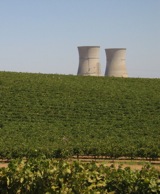
Cooling towers from the defunct Rancho Seco nuclear power plant rise above vineyards near Lodi. Photo: Craig Miller

According to a report in the Fresno Bee, the notion of building a nuclear power plant near Fresno is still alive, if on life supports. California still has an effective ban on new nuclear plants. That hasn’t stopped some from pushing the plan, as Amy Standen reported for Quest last spring.

And apparently some French investors haven’t given up, either.

Maybe they were inspired by the juxtaposition of vineyards and cooling towers at the site of the Sacramento Municipal Utility District’s (SMUD) decommissioned Rancho Seco nuclear plant, near Lodi.

Last summer I reported on the prospects for expanded nuclear power as part of California’s low-carbon energy push. Then in November, the advocacy group Environment America issued a report down-playing the potential role of nuclear. The report, bluntly entitled “Generating Failure,” made the claim that: “Even if the nuclear industry somehow managed to build 100 new nuclear reactors by 2030, nuclear power could reduce total U.S. emissions of global warming pollution over the next 20 years by only 12 percent.”

Proponents of nuclear point to its mportance as a steady source of “base load” power, generated 24/7, as opposed to the intermittent or cyclical nature of many renewable sources.

Climate Lobby Bulks Up

Some California corporations figure prominently in a new tally of climate-related lobbying activity.

A continuing study from the non-partisan Center for Public Integrity (CPI) shows that climate-relating lobbying reached a fever pitch in the third quarter of this year, with 140 new organizations showing up in government-required registrations. That brings the total number of registered climate lobbyists to 1,160, with most activity centered on two climate bills–one passed by the House and another pending in the Senate.

The Center’s latest report is called “The Climate Lobby from Soup to Nuts”–and they mean it literally. CPI reports that registered climate lobbyists now include such diverse interests as the makers of Campbell Soup and Blue Diamond Growers (“a can a week” may not be all they ask, after all).

Not surprisingly, “Big Oil” is a big spender. San Ramon-based Chevron Corp. clocks in at more than $36 million since 2003. And PG&E, one of California’s largest utilities, is shown spending more than $34 million just in the last two years ($19 million in the third quarter of 2008 alone).

Silicon Valley is well represented on the list, including some firms whose stake in climate policy is less obvious; eBay, Google, Hewlett-Packard and Intel are all in the half-million-plus club. Government records show Intel declaring more than $12 million on climate lobbying since 2003.

Marianne Lavelle, a staff writer who helped compile the figures for CPI, says that companies with a stake in green energy technologies are seeking more of a voice in the process, to counter fossil fuel interests, and that technology-oriented venture capital firms are becoming more of a visible presence on the lobbying radar.

The CPI data also includes major environmental lobbies such as the San Francisco-based Sierra Club, which logs $1 million over the past two years. Lavelle says what it doesn’t capture is lobbying at the state level, nor does it reflect spending on “grassroots” organizing or money spent on advertising campaigns designed to steer public opinion on climate issues.

The CPI study site includes a searchable database of all federally registered climate lobbyists.