In April of last year, Climate Watch first called attention to the apparent lack of momentum within the WCI, an agreement among 11 US states and Canadian provinces, in which Arizona was a founding partner.
In her order, Governor Brewer wrote that imposing cap-and-trade at this time would “cost investment and jobs in Arizona” and put the state at a “competitive disadvantage,” as industry would be forced to pay fees for their carbon emissions.
Arizona relies on coal for about a third of its electricity production (36% as of 2007, according to the US Energy Information Administration’s tally) and its renewable energy goals (15% by 2025) are less ambitious than California’s (30% by 2020). But Arizona also has a larger nuclear power component. Governor Brewer cited this in last week’s executive order, as part of the reason why Arizona’s per capita greenhouse gas emissions are “about one third less than the national average.” The Governor’s order affirms that Arizona seeks “pragmatic” approaches to climate change mitigation and implies that Arizona officials would rather wait and see what carbon regulation develops at the national level, than proceed with a regional plan.
The state’s move comes as several energy companies mount an eleventh-hour push for a national cap-and-trade program, which has languished in the Senate.
The WCI comprises both “partner” and “observer” states. The Brewer order says that Arizona will “continue to be a member of the WCI to ensure that Arizona’s unique perspective will be advanced,” but that the state will not implement regional cap and trade. As of this morning, Arizona was still listed on the WCI website as a “partner” and there was no mention of the action.
California officials have long said that while a regional carbon trading pact would be preferable, California could “go it alone” if necessary.
A couple of months ago, nearly lost amid the “Hopenhagen” hype, the University of California, Davis (UCD) put out a press release with an admonition: “Don’t Blame Cows for Climate Change.” The release was a first look at some work conducted by UCD Associate Professor and Air Quality Specialist Frank Mitloehner. His study examines the greenhouse gases, or GHGs, emitted by the livestock sector. As California’s air regulators turn more attention toward methane in particular, the report remains timely.
Mitloehner’s paper is entitled: “Clearing the Air: Livestock’s Contributions to Climate Change,” and was published in the peer-reviewed journal Advances in Agronomy. The paper is a synthesis of current science on the cattle-climate connection. Mitloehner has been updating some of that science in recent years.
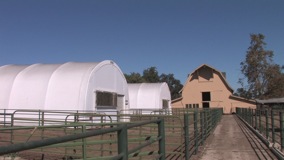
In 2008, I stopped by his cluster of “bio bubbles;” airtight domes that serve as high-tech stables for cows. Inside, Mitloehner had set up simulated dairy operations, measuring GHGs emitted by the cows’ digestive process and decomposition of the manure. The numbers then in common use had been generated in the 1930s.
Research "bio-bubbles" at UC Davis. Photo: Cody Sheehy
Mitloehner says cattle gets a bum rap in the media, and points to some examples, including a 2007 story in Time magazine, which included assertions like: “Which is responsible for more global warming: your BMW or your Big Mac? Believe it or not, it’s your Big Mac,” and “A 16-oz T-bone is like a hummer on a plate . . ”
In many cases, Mitloehner says the statements are crafted from an influnencial 2006 United Nations report entitled: “Livestock’s Long Shadow.” According to the executive summary, “The livestock sector is a major player, responsible for 18 percent of greenhouse gas emissions measured in CO2 equivalent. This is a higher share than transport.”
But Mitloehner points to a quote deeper in the report:
“The respiration of livestock makes up only a very small part of the net release of carbon that can be attributed to the livestock sector. Much more is released indirectly by other channels, including: the burning of fossil fuel to produce mineral fertilizers used in feed production, methane release from the breakdown of fertilizers and from animal manure, land-use changes for feed production and for grazing, land degradation, fossil fuel use during feed and animal production and fossil fuel use in production and transport of processed and refrigerated animal products.”
Mitloehner cautions that the transportation number they use only accounts for tailpipe emissions. To be even-handed, he says, the authors should’ve incorporated emissions from the entire oil industry, including refinement of the oil and production of cars. In the UCD release, Mitloehner calls it a “lopsided ‘analysis” and “a classical apples-and-oranges analogy that truly confused the issue.”
Meanwhile, the Bio-bubbles have been generating some interesting numbers. Mitloehner found that the amount of methane the cows respire (belch) and how much is released in the breakdown of animal manure is quite different from what previous research had calculated. In combination, these two sources represent the most direct GHGs from the livestock industry, even if they’re not the largest GHG emitter associated with the industry. They’re also the most out of date.
Emission factors used in “Livestock’s Long Shadow” provide an estimate of methane respiration of about 86 million tonnes (metric tons) of methane (CH4) and 17.5 million tonnes of CH4 annually from manure decomposition. In the annex of the UN report, the authors write: “Obviously, great improvements to the estimates of emission factors could be made if more data on nutrition and production were available.” And so it is that inside his bio-bubbles, Mitloehner has come up with numbers much lower than those that represented the conventional wisdom since 1938.
All in all, we’ve got a discussion about comparing apples and oranges (more appealing than manure, granted) and some updated numbers that lower the emissions of livestock in one category. As with any scientific paper, there will probably be debate on both of these points and new ones, but let’s look at the broader consequences. Will industry look at this study and see an incentive to update and revise carbon emission numbers all across the board?
According to Emilo Laca, an agricultural ecologist at U. C. Davis, some of these questions will be fodder for policy debates that lie outside the realm of science. He says “The real question is, ‘How are we going to split this up?'” Laca used a hypothetical problem to explain: Let’s say that a certain livestock industry consumed 30% of soybean production as a food source. Livestock producers might concede that they should be accountable for 30% of carbon emissions related to soybeans. It makes sense. It’s what the numbers say. Others might counter that without this certain livestock industry, the soybean market would behave differently and some amount–lets guess 70%–wouldn’t need to be planted. Therefore, the livestock industry in this example is responsible for 70% of the emissions, not 30%. Science can support both interpretations. As Laca says, the decision is how to “split” things up. And ultimately, those decisions may fall to policy wonks.
Scientists in California have begun setting up a statewide network of monitors to track California’s greenhouse gas emissions. Similar equipment has been in place for years as part of a continental network established by the National Oceanic & Atmospheric Administration (NOAA). But officials at the California Air Resources Board (CARB) say this new system will be the first of its kind.
“The unique thing about this is that we’re actually looking at the local emissions, rather than the global average, says Jorn Herner, who heads the Greenhouse Gas Technology & Field Testing Section of CARB’s research arm. “Nobody has done that before.”
Scientists have been systematically tracking atmospheric CO2 on a broad scale since 1958. California’s network of GHG sniffers will be capable of tracking CO2, nitrous oxides and other known greenhouse gases, and will initially focus on methane.
But CARB officials say the network is not part of a “Big Brother” strategy for emissions compliance. “This is initially a research project,” said Herner. He says the new network will provide a “second data point” to augment the state’s current method of estimating GHG emissions. Currently California’s current climate law, AB-32, relies on a “bottom-up” system of estimating emissions from individual sources, then adding them up to arrive at total emissions for the state.
“The modeling won’t tell you each individual source but what you’d be able to do is develop a gridded inventory. So you’ll be able to say in this square mile of land over here, it looks like emissions are much higher than in this square mile next to it.”
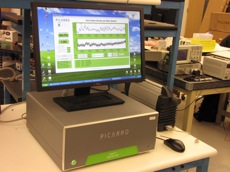
The greenhouse gas analyzers are about the size of a desktop computer. Photo: Craig Miller
The Air Board has purchased seven “next-generation” analyzers from Picarro Instruments in Sunnyvale. Five will go to fixed locations, such as a tower on Mt. Wilson, above the Los Angeles Basin. The two others will be on “mobile platforms;” electric vehicles that can roam the state taking ground-level readings. The units cost about $50,000 apiece but Picarro executives say they are self-adjusting and require far less human intervention than previous models, which will ultimately make them more cost-effective.
Picarro’s CEO, Michael Woelk, says a nationwide network of 500-to-700 detectors could yield a comprehensive GHG map of the US with resolution down to ten kilometers (a little more than six miles).
If California regulators are successful at putting in place a statewide or regional cap-and-trade system for greenhouse gases, industrial emitters will have to pay fees for the carbon they pump into the air. Horn agrees that at that point, some kind of check on the current system of self-reporting will “probably” be needed, but, he says, “that’s not the goal of this monitoring network at this time.”
“The science is really young,” he explained. “We’re really just trying to find out the potential of what we can do with this network. How it’s used in the future is still up in the air.”
…so to speak.
This animation below shows the methane levels detected by a Picarro analyzer as it is driven from Livermore, CA, to Sacramento.
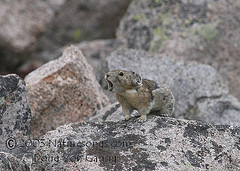
The high-alpine rabbit relative, the American pika, does not warrant protection under the Endangered Species Act, according to a ruling Thursday by the U.S. Fish and Wildlife Service. The decision was required by a court order stemming from a lawsuit brought by the San Francisco-based Center for Biological Diversity against the agency, for failing to respond to a petition submitted by the Center in 2007.
The CBD petition cited climate change as the cause for population decline in pika populations in the mountains of Nevada’s Great Basin. Because the creatures can die from overheating at temperatures as low as 78 degrees, and research suggests that a warming climate has led to major losses in lower-elevation populations, pushing pika to migrate to higher elevations. Some biologists are concerned that if temperatures rise high enough, they may reach the mountain-tops and run out of hospitable habitat.
“By not listing the pika, the decision is not respecting the best available science,” said Shaye Wolf, a staff biologist at the CBD. “The science is very clear. Scientists in the Great Basin will tell you that their research is showing that pika are disappearing and that the losses are linked to climate change: heat stress in the summer and loss of snowpack in the winter.”
Wolf said that the federal agency is required to use the “best available science” in making its ruling. She said that the CBD may challenge the decision on this basis.
“The (government’s) interpretation of the studies is that even though pika are disappearing and will continue to disappear, they will be able to cope,” said Wolf. “That’s not consistent with what we’re seeing. It’s a bizarre argument that pika will adapt. There’s no basis for that claim.
Had the federal agency ruled the other way, the pika would have been the first animal to make the endangered list as a direct result of climate change. Last year, the Obama Administration denied a similar petition for the Alaskan spotted seal, Wolf said.
The scientific community itself is split about whether the pika warrants a federal listing. While research shows that some populations of pika are declining, such as in the Great Basin, not everyone agrees that the entire species is facing extinction.
The CBD also has a pika case still pending at the state level. The California Fish and Game Commission has twice denied CBD requests for a status review of the American pika. The organization is currently challenging the state’s second denial.
For more background on the CBD’s efforts to list the pika, see Craig Miller’s blog posts from May 2009.
One possible outcome "badge" from KQED's Facebook survey, "A Matter of Degree"
Despite being far less concerned about climate change than they were a year ago, a large majority of Americans supports the the passage of federal climate and energy policies, according to a national survey released last week by researchers at Yale and George Mason Universities. (The full survey is available as a PDF on the Yale Project on Climate Change website.)
More than 1,000 adults were surveyed in late December and early January, and their responses compared with the results of a similar survey from the fall of 2008.
Key findings include:
Only 50% of Americans now say they are “somewhat” or “very worried” about global warming, a 13-point decrease
The percentage of Americans who think global warming is happening has dropped 14 points, to 57%
The percentage of Americans who think global warming is caused mostly by humans activities dropped 10 points, to 47%.
These results echo a similar survey by the Pew Research Center for People and the Press, which found that between April 2008 and October 2009, the proportion of Americans who believed there was solid evidence for global warming dropped 14 points, from 71% to 57%.
While both reports indicate a flagging of public concern about climate change in general, the Yale/GMU report finds that public support for the passage of federal climate and energy policies is strong, even across party lines. Majorities of Republicans and Democrats surveyed support renewable energy research, tax rebates for people buying fuel-efficient vehicles or solar panels, and regulating CO2 as a pollutant.
“The good news is that even though some Americans are becoming more skeptical that global warming is happening, nevertheless, there is still support for some of the basic climate policies,” said Anthony Leiserowitz, director of the Yale Project on Climate Change and one of the study’s principal investigators.
But the poll also revealed low levels of awareness about the policy debate in general: 60% of Americans surveyed said they’d heard “nothing at all” about cap-and-trade legislation, while just 12% said they’d heard “a lot.” When the concept of carbon permit trading was explained to survey respondents, 58% supported the policy, but that support dropped to 40% when respondents were told that one hypothetical outcome would be to drive up household energy costs by $15 a month. Support rebounded to 66% if a yearly household bonus of $180 were supplied to offset higher energy costs.
Bipartisan support for some climate-related policies amid fading concern about climate change, is not as contradictory as it might seem. While some respondents approve of supporting research funding for renewable energy technologies as efforts to reduce global greenhouse gas emissions, others support this policy on national security and energy-independence grounds. Leiserowitz noted that while support for renewable energy research has been high for years, the current public support for cap and trade could “go either way” in the near future, depending on how the public debate plays out.
For a more expansive analysis of California’s current water picture, and an interactive map of current reservoir conditions, see Dan Brekke’s drought update, posted earlier this week.
After a series of Pacific storms dumped several feet of fresh snow on the mountains, today’s (officially the “February”) survey reveals that the snow’s average water content is 115 percent of “normal” for this date (compared to 61% of normal at this time last year).
Water managers say even so, there’s more catching up to do and they still can’t rule out a fourth consecutive year of relatively dry conditions. Nor have they re-evaluated earlier tight allocations planned for agricultural water this year. With a lot of the recent precipitation still locked up in the state’s “frozen reservoir,” Shasta Lake and Lake Oroville are both still hovering around half of their normal levels for this date.
According to today’s release from the Dept. of Water Resources:
“DWR’s early allocation estimate was that the agency would only be able to deliver 5 percent of requested SWP (State Water Project) water this year, reflecting low storage levels, ongoing drought conditions, and environmental restrictions on water deliveries to protect fish species. The agency will recalculate the allocation after current snow survey results and other conditions are evaluated.”
By the way, if you’ve never had the chance to see how the “manual” component of the monthly snow surveys are done, take about four minutes and watch this video from 2008, when I joined surveyor Frank Gehrke at the Tamarack Flat survey site, off of Highway 50. This is not the site you usually see on the local news. That’s Phillips Station, chosen for media photo ops because it’s right off the highway. Getting to this site takes a little more doing, as you’ll see.
New EPA regional chief Jared Blumenfeld. Photo: EPA
Yesterday I spoke with Jared Blumenfeld, the former head of San Francisco’s Department of the Environment–aka the guy who brought mandatory recycling to San Francisco and banished the phrase “Paper or plastic?” from the city’s supermarkets–by banning the plastic.
Blumenfeld now occupies a vast corner office in the EPA’s Region 9 headquarters, overseeing a territory that includes four Western states and 20 of the country’s largest cities. Born 40 years ago, just as Region 9 came into being, this week he was briefing reporters on his plans to “revolutionize” the region with a tighter focus on environmental justice, enforcement, and making small businesses more efficient.
What do these things have in common? For one thing, they’re all pretty local: specific communities with specific complaints and needs (a profile, incidentally, that fits Blumenfeld’s first initiative to a “T”).
So what about more sweeping changes on, say, climate? You could argue that it’s not the job of a regional head to get mixed up in Beltway politics. But given all the recent drama in Washington around cap and trade, maybe Blumenfeld’s local focus is intentional.
How, I asked him, has the mood in Washington affected his ambitions for EPA Region 9?
“I was looking at a recent poll that showed how many fewer people understand climate change last year than this year,” he replied. “I think the environmental movement has gotten away from the people. We’ve become overly specialized, jargony, focused on large problems no one person can solve.”
Having made San Francisco a considerably “greener” place, maybe Blumenfeld’s first task is to export small initiatives that–for the moment at least–make environmental problems feel local and solveable.
Amy Standen is the lead radio reporter for Quest, KQED’s multimedia science initiative.
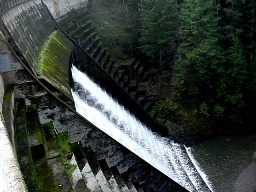
Spillway at Alpine Lake on Mt. Tamalpais. File photo: Marin Municipal Water District
A version of this post also appears on Dan Brekke’s personal blog, Infospigot. Also see our updated map of reservoir conditions at the end of this post.
By Dan Brekke
Is California’s drought over? OK, let’s take a step back. Yes, I realize one could debate whether the last three years in California actually constitute a drought. But that’s a discussion for another time. For now, I think everyone can agree that we’ve had lower-than-average precipitation for the past three years.
The only reason to ask the question is that, after the first half of the wet season delivered only spotty rain, we’ve had a pretty solid week of downpours. Water is sluicing into our reservoirs, and the hills are greening up. Some counties, like Marin, have water tumbling down the spillways. All of that is a sign of what we think winter should be here.
My favorite water statistic from last week: when the storms were at their heaviest around Lake Shasta, California’s biggest reservoir, water was flowing into the lake at about 500,000 gallons per second. That’s 1.5 acre feet, or about enough for two-to-three “average” households for a year, every second.*
Amazing numbers like that aside, the people who get paid to think about whether the drought is over say “not yet.” Last week, Quest managing editor Paul Rogers wrote a good summary of the situation, for The San Jose Mercury News.
Rogers’ story does contain one bit of quirky California thinking about rain and water, though. He quotes a well established local meteorologist, Jan Null, about where we stand in terms of normal rainfall, saying: “This is a great start, but we need to keep it going.”
Of course, Null recognizes better than most that the amount of rain we get and when we get it is out of anyone’s control. But once you understand the importance of water in California, once you get how crucial the winter rains are, there’s a score-keeping aspect to weather-watching here. It becomes second nature to study the rain gauge and the seasonal precipitation table as an index of performance, a reflection on whether a great collective goal is being attained. Lots of rain means we’re doing well (and that we can put the complexities of water supply out of our minds). A dry spell means we’re failing (and the prospect of hell to pay, or at least the strong possibility of stringent conservation measures).
But in reality, there’s no performance going on. The rain is the rain, and the climate is the climate. California’s rainfall is famously variable. Dry spells can be counted on and the current run of dry years is the third we’ve had since I arrived in Berkeley in the 1970s.
My first California winter, 1976-’77, was bone-dry and was in fact the second year of the driest two-year period ever recorded here. A decade later, from roughly 1986 through 1992, we had another run of dry years. And if our winter rains were to stop now, we’d be in the fourth year of drier-than-normal years. In between these periods we’ve had average years and very wet years and years that didn’t quite hit the average. That might not be too different from anywhere else. The reason it’s a bigger deal here than it might be in, say, Wisconsin, is that we have a six-month dry season. We need to store water to get through that. We have 37 million people and millions and millions acres of farmland that need water, whether it’s falling from the sky or not. Thus the need to believe we can wish the rain to keep going during the wet season and the tendency to feel disappointment when the winter turns into a string of dry, sunny days.
*500,000 gallons per second. Here’s the arithmetic: California Department of Water Resources figures show that in the hour between noon and 1 p.m. on Tuesday, January 19, net inflow into the lake was 66,288 cubic feet per second. That’s the highest inflow figure for any single hour that week. One cubic foot equals 7.48 gallons. 66,288*7.48 = 495,834.24 gallons. One acre-foot = 325,851 gallons. And 495,834.24/325,851 = 1.52 acre-feet. Per second. For the entire 24 hours of the 19th, Lake Shasta’s inflow averaged just over 1 acre-foot a second.
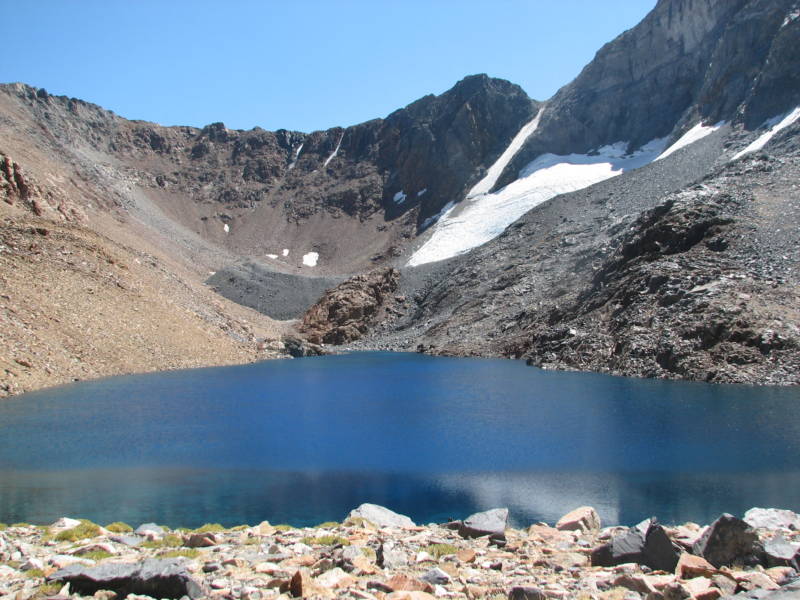
The Dana Glacier, outside Yosemite, CA. Photo: Gretchen Weber
Yet another climate controversy has revived what have become increasingly common attacks on scientists’ credibility. The latest flap arose when the IPCC admitted on Wednesday, that its 2007 prediction that Himalayan glaciers could melt away by 2035 was unfounded.
Attacks on the integrity of scientists have brought about a “loss of innocence” in the climate science field, said Ben Santer, a Research Scientist for Climate Model Diagnosis and Intercomparison at Lawrence Livermore National Laboratory.
On a conference call with reporters Wednesday, Santer lamented that “Fourteen or fifteen years ago, it was possible to do science and not be too worried about being the subject of Congressional investigations, Freedom of Information Act requests, and very personal and very public attacks. Those innocent days are over now.”
Santer, who’s been a key author of some IPCC reports, said the science that goes into those reports is the most rigorous that he’s seen in his career.”If your research suggests that humans are having a pronounced effect on climate,” he continued, “I think the expectation is that you will be subjected to tremendous scrutiny. And some of that is appropriate, certainly in terms of the science and the integrity and credibility of the science, but unfortunately, that scrutiny is moving to very unwelcome areas, and it’s also focusing on individuals and motives, and all of this stuff is very distasteful,” he said.
Santer was joined on the call by Lonnie Thompson, a glaciologist at Ohio State University’s Byrd Polar Research Center , who raised concern that the intense and personal nature of much of the criticism climate scientists have been facing (most recently in response to the East Anglia hacked email incident, now widely known as “Climategate”) may be keeping promising young scientists out of the field at a time when they are most needed. In the wake of the East Anglia emails, a blizzard of accusations of data manipulation blew through the blogosphere and in certain corners of the Senate.
“It does make it difficult to bring young scientists into the field,” Santer agreed. They look at what has gone on and there is genuine concern there. They must be asking themselves, ‘Do I really want to get involved in critical but possibly contentious issues if there is the possibility that I will spend months or even longer dealing with questions not about the science that I have done, but about my own personal integrity?'” said Santer.
Thompson affirmed that while it’s difficult to put a specific timetable on the disappearance of glaciers, the scientific evidence documenting glacier recession is overwhelming. Research indicates that more than 90% of the world’s glaciers are receding, he said, including approximately 95% of the glaciers in the Himalayas.
“Glaciers do not have any political agenda,” said Thompson. “They just sum up what’s happening in the environment and they retreat or react to that en masse.”
UPDATE 1/25/10
The London tabloid, the Daily Mail, reported yesterday that a lead author of the Asia chapter of the IPCC’s 2007 assessment admitted that he knew the 2035 claim was unsubstantiated, but he approved including it in the report anyway. Murari Lal reportedly said in an interview with the Daily Mail that he knew the 2035 number came from a report that was not peer-reviewed, but that the claim of imminently disappearing glaciers would, “impact policy-makers and politicians and encourage them to take some concrete action.”
Michael Schlesinger, a professor of Atmospheric Sciences and director of the Climate Research Group at the the University of Illinois at Urbana-Champaign responded to the Daily Mail report with dismay.
“I am greatly saddened and deeply offended by this person’s behavior,” he wrote in an email. “A scientist does not lie nor change the facts to suit an agenda. Rather s/he tells it as it is, as best as it is known to her/him.”
[Lal] He said these were “the most vilest allegations” and denied that he ever made such assertions. He said “I didn’t put it [the 2035 claim] in to impress policymakers…. We reported the facts about science as we knew them and as was available in the literature.”
Climate Watch now features a new page that brings together all of the interactive maps we’ve created so far. For the launch we’ve added an interactive map to our coverage of climate lobbying efforts in Washington. See our recent blog post, “The Climate Lobby Bulks Up” for more on who’s been spending big to influence climate legislation on Capitol Hill.
View KQED: Climate Lobbying in California in a larger map
The data for the map is from the Center for Public Integrity’s The Climate Change Lobby project. CPI tracks money helping to fuel the climate change legislation debates and maintains a database compiled from lobbying disclosure reports filed with the Secretary of the Senate’s Office of Public Records. (Read about the project’s methodology here.) The data does not include lobbying activity aimed at state laws and regulations, or dollars spent on advertising campaigns.
Climate Watch intern David Ferry combed the data and mapped the lobbying efforts based in California. Chevron and PG&E top the list with $36 million and $34 million spent since 2003, respectively. Intel ranks third with $12 million. Our map skims the top of the database, showing only those organizations with more than a half-million dollars in spending.
Don’t forget to visit the new Climate Watch Maps page, where you’ll see this map as well as all of the interactive maps we’ve created to illustrate data from various sources, including the Department of Water Resources, the California Air Resources Board and The Center for Public Integrity.
 On Ground Hog Day, Arizona saw the shadow of regional carbon trading looming over it…and retreated.
 By Cody Sheehy