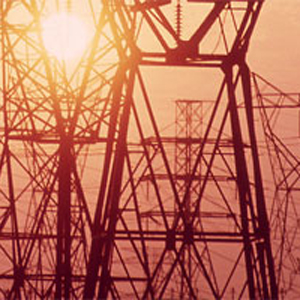
California may not have met its goal of 20% renewable energy by 2010, but outgoing California Energy commissioner Jeffrey Byron says the state is close, and that California is on track to meet its its goal of 33% renewable energy by 2020.
“We didn’t get to the point where we’re generating 20% of our electricity by renewables, but I believe we do have, or we’re very close to having, all the contracts in place,” he said Thursday.
Major partnership is said to be the most ambitious of its kind
Up to now, tracking greenhouse gas emissions around the world has been a patchwork affair for scientists. But if it lives up to its hype, a new partnership with roots in California will mean a much more accurate picture of the heat-trapping gases that cause global warming.
Climate scientist Ralph Keeling tracking real-time carbon dioxide readings from his lab at UC San Diego. (Photo: Ed Joyce)
California’s cap-and-trade partners are dropping like flies.
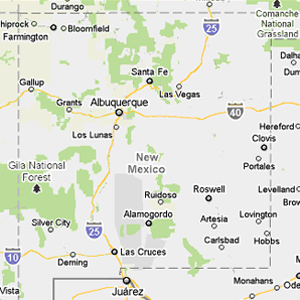
It’s not official yet, but it’s looking like what was once envisioned as a regional carbon trading program involving seven US states and four Canadian provinces, will now involve just one US state – California – and just three provinces: Quebec, British Columbia, and Ontario.
And today, an online publisher quotes a key official in California’s carbon trading program, that the state stands to lose its last remaining US partner, New Mexico. As Colin Sullivan of E&E reported:
Kevin Kennedy, assistant executive officer in charge of the Office of Climate Change at the California Air Resources Board, told lawyers during a forum sponsored by Law Seminars International that the election results likely mean New Mexico will not participate in the fledgling WCI, at least at the outset of the market starting Jan. 1, 2012. “The change in administration probably takes New Mexico out of the situation,” Kennedy said.
Scientists come up with a way to handicap a key harbinger of spring
Photo: R.A. Howard from the USDA-NRCS PLANTS Database
Bud burst, when the buds on a tree begin to open up, marks the end of winter dormancy and the beginning of a tree’s growing season. Timing’s important: If a tree buds too early, it may be susceptible to a late frost. Too late, and it misses out on some or all of its growing season. As the climate warms, this delicate timing can go awry.
Scientists at the US Forest Service’s Pacific Northwest Research Station in Portland, Oregon, have developed a model to predict bud burst. They used Douglas firs in their experiments but also surveyed research on about 100 other species, so they expect to be able to adjust the model for other plants and trees.
Both cold and warm temperatures affect the timing, and different combinations yield different outcomes — not always intuitive. With plenty of hours of cold temperatures, trees need fewer warm hours to burst. So earlier spring warmth will drive bud burst earlier. If a tree isn’t exposed to enough cold, though, it needs more warmth to burst. So under the most dramatic climate change scenarios, warmer winters could actually mean a later bud burst.
Genes play a roll, too. The researchers experimented with Douglas firs from across Oregon, Washington, and California. Trees from colder or drier environments showed earlier burst. Trees descended from those lines could fare better in places where their warmer-and-wetter-adapted cousins live now.
The team, led by research forester Connie Harrington, hopes to use the model to predict how trees will respond under various climate projections. With that information, land managers can decide where and what to plant, and, if necessary, plan assisted migration strategies.
A report pinpoints critical areas in California for protecting critters
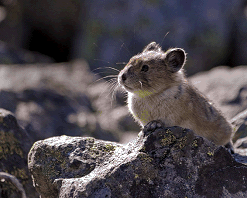
The North American pika like the protection and cool refuge of high-elevation talus slopes. (Photo: US Forest Service)
California is one of five places on earth with a Mediterranean climate. It has enough endemic plant species to be its own “floristic province.” It’s also what biologists refer to as a biodiversity hotspot. So it’s not surprising that a report by the Endangered Species Coalition includes three places either completely or partially within California in its list of ten of the most important locations to protect endangered species.
Thousands roar by Treasure Island every day without a passing glance. That could soon change…radically.
Listen to Alison Hawkes’ companion radio feature on The California Report, Monday morning, and see a slide show of the island’s transformation, below.
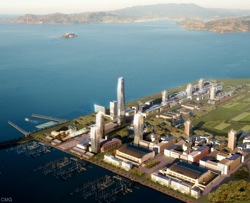
Architect's rendering of a proposed "eco-city" on Treasure Island, in San Francisco Bay.
San Francisco’s twin islands in the Bay – Treasure Island and Yerba Buena – are not exactly jewels of nature. Although they have stunning views, a half-century of use by the U.S. Navy and years in redevelopment limbo have taken a toll.
Some sites on Treasure Island are severely contaminated, and much of the island is cracked asphalt and derelict buildings. Yerba Buena is solid rock but Treasure Island is entirely artificial, conjured from bay mud as an engineering showcase for the 1939 World’s Fair. As time passes, a corner of Treasure Island is gradually sinking into the sea. Rising sea levels as a result of climate change could subsume the island entirely, returning it back to its natural state, which is to say underwater.
Reporting on climate change sinks to its lowest level since 2005
Empty stalls outside the UN climate talks the night before the opening. (Photo:Gretchen Weber)
When Al Gore lamented recently in the Huffington Post that “the media has failed to appropriately cover the climate crisis,” he was talking about the relatively small amount of science that made it into reporting about the 2009 climate conference in Copenhagen.
But it looks like in 2010, the issue wasn’t so much a lack of science in the reporting, as the lack of reporting in general. An analysis by the Daily Climate that’s been making the rounds, finds that in 2010 coverage among major media outlets of climate change dropped to its lowest level since 2005. Between 2009 and 2010, it dropped 30%, according to the Daily Climate tally. Continue reading Climate’s 10 Seconds of Fame→
The Golden State shines in a new global listing from the UK’s Guardian newspaper
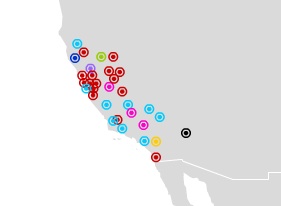
Detail of an interactive map of the world's innovative "cleantech" companies (Image: Guardian UK)
Of all the companies around the world that the UK’s Guardian called out for its second annual Global Cleantech 100, roughly a third are based in California. The list spans technologies including energy generation, storage and efficiency; water and waste water; transportation and others.
The special report includes an interactive map of where the firms are located. It makes an interesting study by itself, showing a dense cluster of 31 firms over California, with a smattering of others around the US. About a dozen are concentrated in a few northeastern states. Four are located in China, two in India. Continue reading Mapping California’s Worldbeating Cleantech Boom→
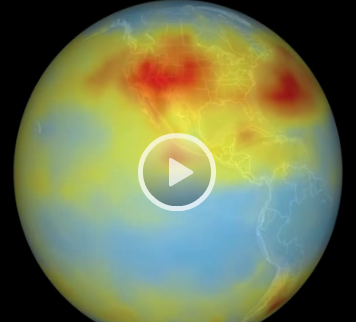
In order to reduce CO2 levels, we need to know where they are coming from. In the video below, produced by Climate Central, NASA scientist David Crisp of the Jet Propulsion Lab at California Institute of Technology explains how scientists use satellites to identify the sources of CO2 in the atmosphere.
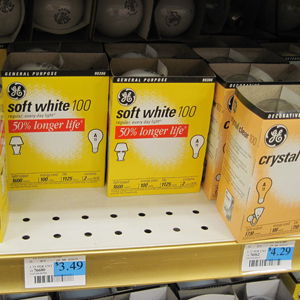
Say goodbye to your 100-watt incandescent light bulbs. On Jan. 1, it’ll become increasingly challenging to find one on a store shelf in California.
That’s because the state has ordered a phaseout of the high energy-consuming light bulb.
The state is pressing to have the old incandescents replaced with newer, more efficient bulbs, such as compact fluorescents, halogens and light-emitting diode light bulbs, or LEDs.
And beginning in 2012, 100-watt incandescents will be off the shelves completely.
As is typical, California is getting a jump-start on a trend that will begin nationwide in a few years. Three years ago, the federal government enacted legislation to phase out the old bulbs. National phaseout will begin in 2014. Other countries, such as Australia, Ireland and Cuba have already banned them.
There are drawbacks to the new bulbs, however.
Fluorescent bulbs, or CFLs, contain mercury, which can be harmful to the environment and to human health. Therefore, the bulbs must be handled differently than other household waste.
Local hazardous waste centers, and some hardware stores, will take spent fluorescent bulbs for recycling. The other bulbs contain chemicals such as bromine and iodine. These do not require special recycling.
Consumers looking to find a replacement for the old 100-watt bulb will likely choose the energy-efficient 72-watt bulb, which will provide an equal amount of light but uses less power.
“The consumer will still be able to use the product and have the same results to light an office, a desk lamp, a hallway. A 72-watt light bulb will still provide the same service as the old 100-watt bulb,” Adam Gottlieb, a spokesman for the California Energy Commission, told the Scripps Howard news service. “Consumers really need to know they won’t see any difference. The difference they’ll see is a more energy-efficient bulb.”
The California Energy Commission website has a user-friendly FAQ page about the new light bulb standards and how the rules affect consumers.

 California may not have met its goal of 20% renewable energy by 2010, but outgoing California Energy commissioner Jeffrey Byron says the state is close, and that California is on track to meet its its goal of 33% renewable energy by 2020.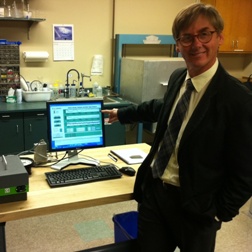
 California’s cap-and-trade partners are dropping like flies.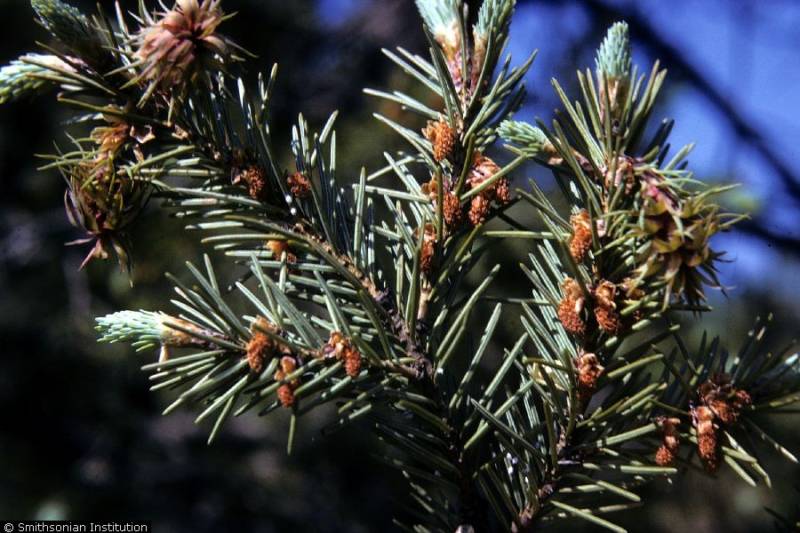
 In order to reduce CO2 levels, we need to know where they are coming from. In the video below, produced by