Taking the Pulse of the Mountains

Federal grant enables major new network of Sierra water sensors
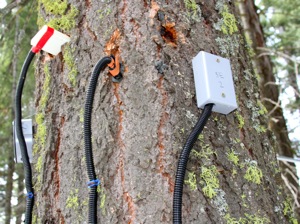
A tree at the Fresno County pilot project adorned with sensors

Researchers at UC Merced are set to open a whole new window on the Sierra Nevada. Using two million dollars from the National Science Foundation, hydrologist Roger Bales and his colleagues can now expand on a pilot project to measure the mountains’ “vital signs.”

Bales says beginning next summer, he, UC Berkeley’s Steven Glaser and their team will start installing a network of 20-to-30 instrument clusters throughout the American River watershed, casting a watchful eye over about 2,000 square kilometers that typically gets snow cover. The instruments record factors that affect the mountain’s hydrology, such as temperature, humidity, soil moisture, stream flow and even how much solar radiation penetrates the tree canopy.

Bales says the pilot phase has taught them how to put together a network of wireless sensors that will endure the extreme alpine conditions and still remain reliable (see Sasha Khokha’s post and slide show from March). Continue reading Taking the Pulse of the Mountains

Clean-Tech’s Unlikely Champion

Is the Pentagon setting the pace for renewable energy?

A Riverine Command Boat running on a 50/50 blend of algae-based and traditional fuel.

Thirty years ago, the idea of a military-alternative energy partnership might have raised some eyebrows, particularly among solar entrepreneurs here in Northern California. But in the wake of Solyndra’s crash and burn, the Pentagon has become one of clean-tech’s strongest remaining allies in Washington. Leading the charge is Navy Secretary Ray Mabus, whom I interviewed last week for my radio report on KQED’s Quest.

According to a recent study from the Pew Charitable Trust, the military has tripled its investment in technologies like biofuels, solar panels, and electric vehicles over the last four years. Today, it spends $1.2 billion a year on alternative fuels. That amount is expected to reach $2.25 billion by 2015. Mabus says he wants to see the Navy and Marine Corps getting at least half of their fuel from non-fossil fuel sources by 2020. Continue reading Clean-Tech’s Unlikely Champion

Blame My Driving Habits on that Parking Spot

Being the true confessions of a solo driver in L.A.

Hear Krissy Clark’s companion radio feature from The California Report.

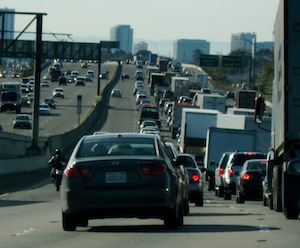
Afternoon rush hour with a mostly-empty HOV lane

I’m a Bay Area native who has about evenly divided my adult life between San Francisco and Los Angeles. So, I have a schizophrenic relationship to driving. Which is to say, I have the same kind of relationship that California as a whole has to driving.

Here’s what I’ve learned during my intra-state sojourns: my transportation habits have very little to do with how environmentally conscious I am as a person, and have a lot to do with parking spots.

When I lived in San Francisco, my daily life was 90% car-free. I owned a car but aside from moving it on street sweeping days (or trying to remember to), I barely thought about the thing unless I was leaving for a weekend trip. My bike, my feet, the bus, BART and the transbay ferries were my chariots. Some of it had to do with the city’s human-scaled streets and efficient public transit. But mostly, it was just too damn time-consuming–or expensive–to find a parking spot most of the places I wanted to go. I couldn’t be bothered to drive. Continue reading Blame My Driving Habits on that Parking Spot

Snapping Snakes for Science — with your iPhone

An innovative citizen science project gains momentum, sprouts new branches

Tad Arensmeier photographed this Yellow-Blotched Palm-Pitviper for iNaturalist.” credit=”Tad Arensmeier/Flickr

The organizers of a new effort to catalog the world’s reptiles want to enlist you and your iPhone for their cause. The Global Reptile Bioblitz launched last month and aims to collect amateur observations of every species of reptile on Earth — all 9,413 of them. The project is the sister effort of the Global Amphibian Bioblitz which launched earlier this summer and, thanks to submissions from citizen scientists around the world, has already collected photos of more than 700 of the nearly 7,000 known amphibian species on the planet.

The observations are all logged at iNaturalist.org, an online citizen science community with more than 2,000 members who’ve cumulatively logged more than 30,000 field observations of species ranging from redwoods to coyotes.Observations can be uploaded to the site directly, or through an iPhone app, also called iNaturalist, which was launched earlier this year. Since we first reported on it back in January, the app has been downloaded more than 3,000 times, according to its developer Ken-ichi Ueda. Continue reading Snapping Snakes for Science — with your iPhone

A Climate Convergence in San Francisco

Organizers call San Francisco “flagship” event for worldwide campaign

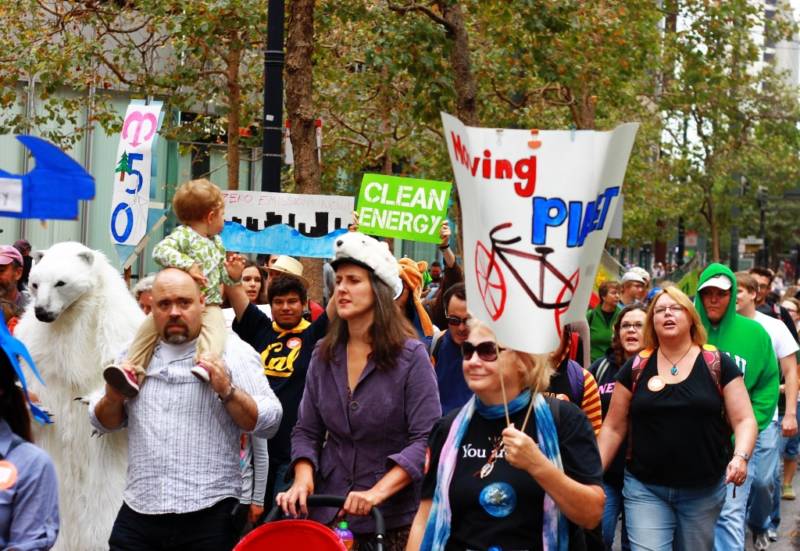
Moving Planet rally crowd
More than one thousand people marched down Market Street in San Francisco for the Moving Planet rally

About a thousand people marched in San Francisco on Saturday, chanting slogans, carrying signs and wearing costumes. But unlike many demonstrations that frequent the City by the Bay, the Moving Planet rally was one of hundreds around the world, calling for action and awareness to halt global climate change.

Organized by 350.org, the non-profit founded by author and activist Bill McKibben, the San Francisco rally brought together some predictable allies, such as the Sierra Club, Greenpeace and the Berkeley-based Ecology Center, but it also included groups with broader aims, such as the National Organization for Women, Food Not Bombs and 100,000 Poets for Peace. McKibben’s group is devoted to reducing carbon dioxide in the Earth’s atmosphere to 350 parts per million (from the current 390 ppm), a number that some scientists estimate could stave off catastrophic effects of climate change. Continue reading A Climate Convergence in San Francisco

Parks May Not Offer Refuge from the Smog

It’s not just California cities with lousy air

This was posted originally by our content partners at California Watch, one day after a new report cited several Golden State cities as having with the nation’s worst air quality.

By Agustin Armendariz

Air pollution in national parks is at a three-year high, and two California parks have recorded the worst readings, according to a report by the National Parks Conservation Association.

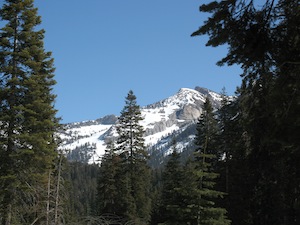
A winter day offers a break from the bad air at Sequoia-Kings Canyon National Park.

Sequoia and Kings Canyon national parks, located next to each other, exceeded the Environmental Protection Agency standard for ozone pollution 68 days so far this year, the most of any of the national parks that monitor air quality. Joshua Tree National Park came in second, with 49 days above the EPA standard.

These readings are not only high among national parks, but also for the state as a whole. According to data maintained by the California Air Resources Board for 2010, the number of days exceeding the ozone standard at Sequoia and Kings Canyon national parks was equal to that of readings in Arvin, just outside of Bakersfield. Last year, both stations recorded 66 days above the ozone standard. Continue reading Parks May Not Offer Refuge from the Smog

Report: Five Smoggiest US Cities Are in California

And they’re not necessarily the ones you might guess

California may have great weather but also some of the nation’s worst air. The advocacy group Environment California has issued a report ranking the nation’s worst metropolitan areas for air quality. The five worst are in California, as are six of the top ten.

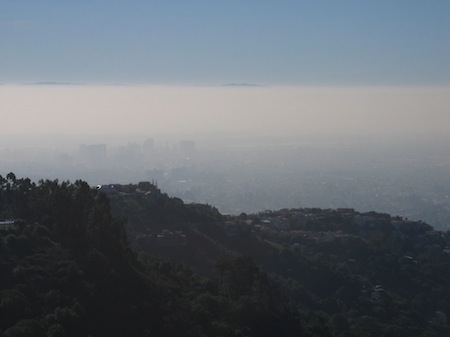
Smog in the Los Angeles Basin

Based on data from 2010, the report’s “Top Smoggiest Areas in the US” were:

1. Riverside-San Bernardino

2. Visalia-Tulare-Porterville

3. Bakersfield (tie)

3. Los Angeles-Long Beach (tie)

5. Fresno Continue reading Report: Five Smoggiest US Cities Are in California

Salazar: Risky Times for Western Water

Interior Chief to California: Don’t allow significant water supply and infrastructure projects be derailed

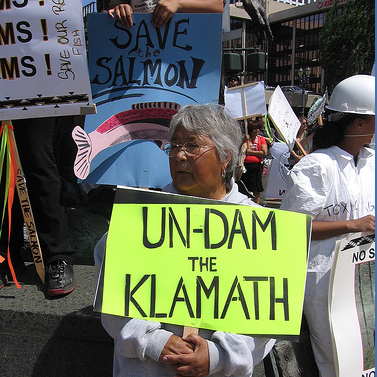
Demonstrators rally in 2006 for the removal of dams on the Klamath RIver.

Today at the Commonwealth Club in San Francisco, Secretary of the Interior Ken Salazar weighed in on three major water projects in the state and called on Californians to “stand firm” and defend the “hard-gained agreements and settlements” built in past decades.

“Never before have water agreements that provide safety and certainty for Westerners been so at risk,” said Salazar, referring to debates over the future of the San Joaquin River, the California Bay Delta, and the Klamath River.

Salazar argued that the state, and the country, should not back away from the 2006 San Joaquin River Restoration Program settlement, which, he said enabled the river to run from its headwaters to the ocean this year for the first time in half a century. He lobbied for the Bay Delta Conservation Plan, calling it a “comprehensive approach that includes new habitat for endangered fish species, coordinated measures to attack toxics that are fouling delta waters, and improvements to the state’s water infrastructure.” Continue reading Salazar: Risky Times for Western Water

How to Capture the Power of High-Altitude Winds

High altitude winds may have more than 100 times the energy needed to power civilization.  But as this video from KQED’s QUEST explains, capturing that power is going to take some very creative  solutions.

By Chris Bauer

A dreamer stares up into the sky, watches the clouds slowly pass by and ponders what could be. From da Vinci to Newton to the Wright brothers to the little kid down the street, sometimes there’s a fine line between the day-dreamer and the visionary. And now a group of innovative thinkers are looking at those same passing clouds in a whole new way.
Looking up at the jet stream, Ken Caldeira, a climate scientist from the Carnegie Institution of Global Ecology at Stanford University says, “We find that there’s more than 100 times the power necessary to power civilization in these high altitude winds.” 100 times the energy to power the world is going to get people’s attention.

The global need for clean energy is pushing scientists and engineers to search for new, untapped sources of energy. “To solve this problem we need a real revolution in our system of energy development,” continues Caldeira, “We need huge amounts of power, and the things that can provide huge amounts of power include fossil fuels like coal, oil and gas; nuclear power, solar power and wind.” The strongest and most consistent winds are found in the jet stream as high as 30,000 feet above the earth. But how do you harness the wind power from that high? Now the race is on to find the answer to that question. Continue reading How to Capture the Power of High-Altitude Winds

Scientists Look for Climate Trends in High Places

Mountaintops can be good places to study the effects of climate change because there aren’t any things like factories or highways or garden weeds up there. In that way, they’re more like laboratories.

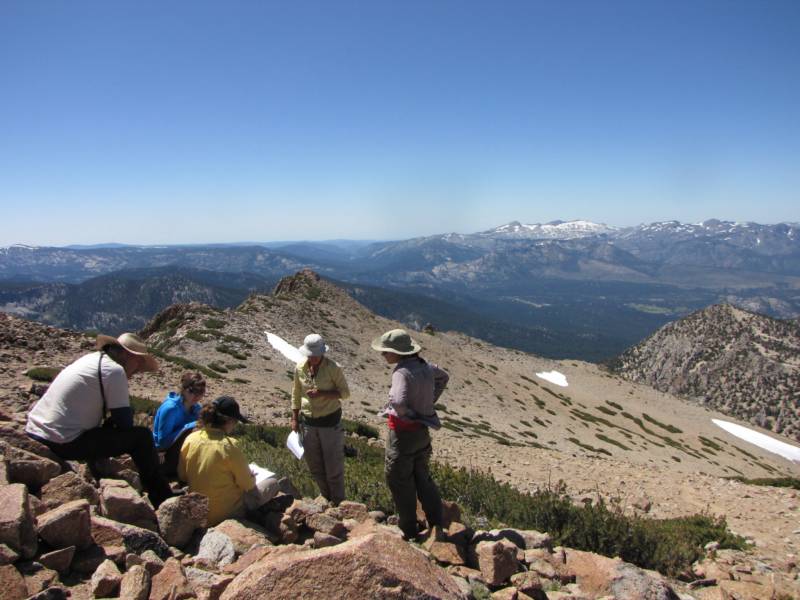
So, even though it involved a tough hike, about a dozen scientists gathered at the top of Freel Peak near South Lake Tahoe earlier this summer to count every single plant at the summit. It was for GLORIA, short for Global Observation Research Initiative in Alpine Environments, a project that sends botanists and plant ecologists to the world’s highest mountains to document the tiny, colorful plants that live on them.

Scientists gather on Freel Peak to take a census of the plants on the summit.

GLORIA surveys are repeated every five years, and this was the second survey on Freel Peak. By tracking the changes here, scientists can gain a better understanding of how alpine regions differ in their responses to climate change, and what the future may hold for lower elevations.

“Because of the nature of the alpine habitat, it is more sensitive to environmental changes,” explained GLORIA coordinator Colin Maher. “It’s kind of a beacon. It’s like a warning sign. We might not know for 20 years what’s happening, but it’s a place where change is more likely to happen and we can detect it.” Continue reading Scientists Look for Climate Trends in High Places