
Category Archives: The Science

Latest research from the field and the lab

Geoengineering Field Tests on the Horizon?

Bill Gates may investing in geoengineering projects, but a widely-quoted news story reporting that he contributed $300,000 to a San Francisco company to launch climate-intervention field tests is full of inaccuracies, according to one scientist involved.  The article, which appeared Monday on the Times Online website, asserts that Gates gave the company, Silver Lining Project, the funds to develop machines to spray seawater up to 1,000 meters into the sky in efforts to whiten clouds and increase their reflectivity, thus blocking the sun and ultimately slowing the rate of atmospheric warming.  The article then describes a planned field trial, which would involve 10 ships and 10,000 square km of ocean, leading some readers to assume that Gates is funding the largest-scale geoengineering field test to date.

According to Ken Caldeira of the Carnegie Institute of Global Ecology at Stanford, Silver Lining has received no funds from Gates personally.  Instead, he said, the $300,000 was allotted by Caldeira and David Keith, who have been directing geoengineering project funding for Gates.  Caldeira explained in an email that the scientists dispensed funds not to Silver Lining for field tests, but to engineer Armand Neukermans and his team, “to test the feasibility of fine seawater sprays in the laboratory.”

“There was no funding given for the planning, preparation, or execution of any field tests,” Caldeira wrote.   “I have expressly said that private efforts to conduct field tests should await the development of appropriate governance structures. I am opposed to private entities conducting field tests without appropriate governance and would oppose funding such activities.”

It’s possible, as critics assert, that the technology developed by Neukermans could eventually be used in Silver Lining Project field tests. However, the $300,000 from Caldeira and Keith would most likely be a drop in that bucket.  The Vancouver Sun reports that a scientist collaborating with Silver Lining, Robert Wood, said that it will likely take $25 to $30 million to fund the proposed field experiments.

The Times Online article touched on a particularly hot issue with the statement, “The British and American scientists involved do not intend to wait for international rules on technology that deliberately alters the climate.”

In March, scientists and policymakers gathered in Monterey for a week to discuss this very issue.  The general sentiment at the close of the talks was that more research is needed, as well as more input from governing bodies and the public, before potentially damaging field experiments are undertaken.

“This is a first step down a dangerous road,” said Rutgers scientist Alan Robock about the reported Silver Lining Project field test plans.  “Because, where do you stop?  There is no governance or agreed-upon restrictions determining what’s safe.”
What’s an Albedo? (And Why You Should Care)

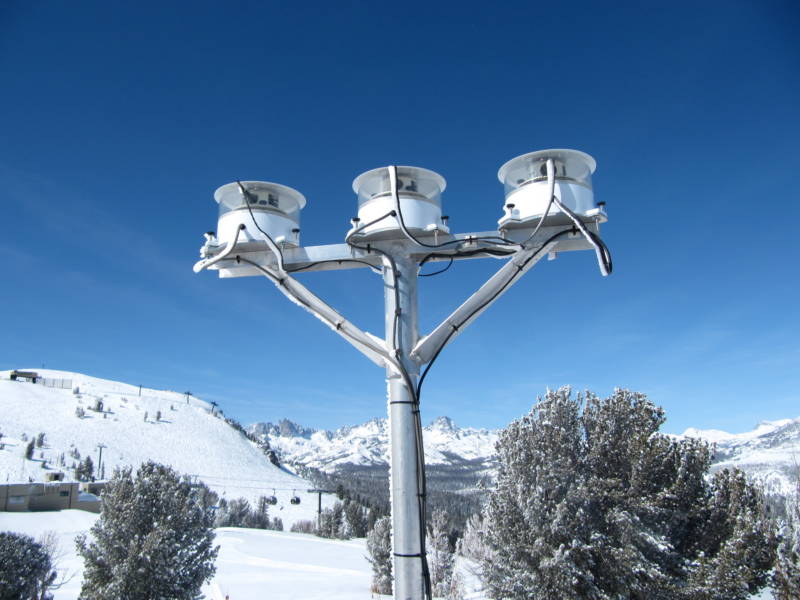
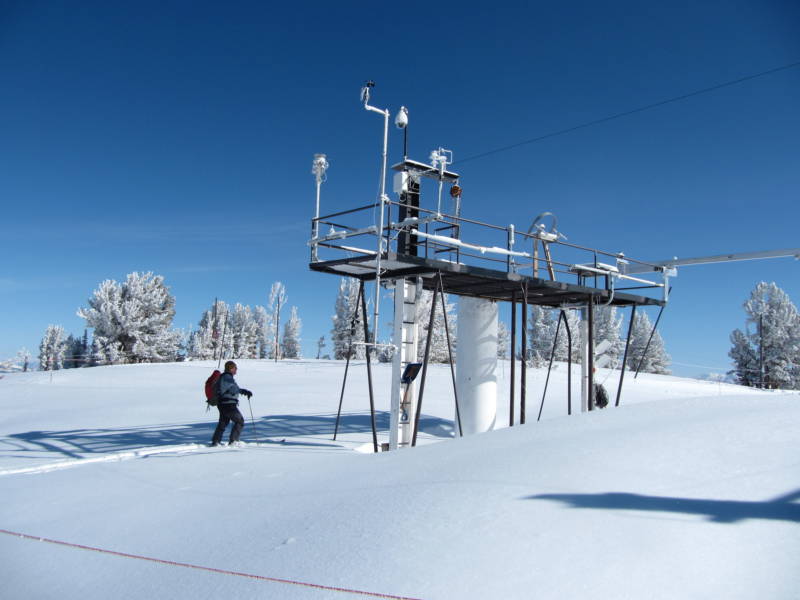
Jeff Dozier approaches the instrument tower on Mammoth Mountain.

When Jeff Dozier, a hydrologist at UC Santa Barbara, goes to work, he gets to enjoy quite a view. His snow lab is perched halfway up Mammoth Mountain in the central Sierra. We took a gondola to get up there; the other passengers were skiers and snowboarders itching to get out on the freshly fallen snow.

But the instrument platform from which we enjoyed views of the White Mountains is really only half the story. Dozier’s computer lab has much less of a view. In fact, it has no view. It’s buried under the snow, accessible only through what he calls a “Santa Claus entrance” (in the picture above, you can see the entrance–it’s the white tubular “chimney” extending down into the snow from the center of the platform).

The snow lab, operated by both UCSB and the U.S. Army Cold Regions Research and Engineering Laboratory (CRREL), uploads information about the snowpack to a website every fifteen minutes. You can see nearly real-time readings on, among other things, snow depth, temperature, humidity, and radiation.

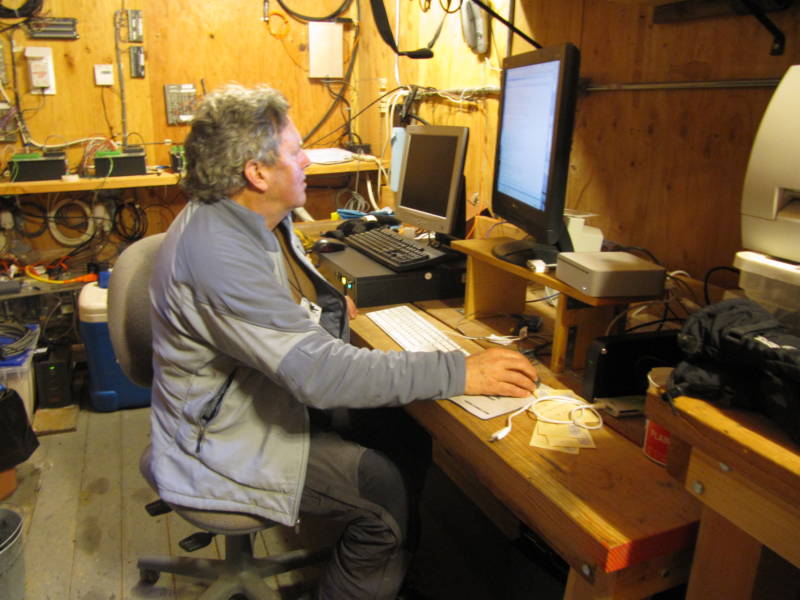
Dozier in the computer lab. Photo: Molly Samuel

Radiation is an important one. Instruments called radiometers are mounted on the tower. Some point up, measuring the radiation coming from the sun; others point down, measuring how much is reflected back to the sky by the snow.

Albedo” is the measurement of how reflective the snow is. Something completely white that reflects all of the sun’s energy has an albedo of one; something black, that absorbs all the energy, is zero. Bright, freshly fallen snow has a high albedo, typically above 0.8.

Even if the term is new to you, albedo is probably a familiar concept. As I reported for KQED’s The California Report this morning, Hans Moosmuller of the University of Nevada’s Desert Research Institute explains it in terms of outfits: on a sunny day, if you wear a black sweater you’ll be warmer than if wear a white one. You may notice it with roofs, too. I grew up in Atlanta, in a house with a black roof. Before my parents got an air conditioner, the upstairs bedrooms were unbearable in the summer. If we’d had a white

These radiometers measure radiation coming from the sun. Photo: Molly Samuel

roof, it would have been a little more bearable (though I can’t say it would have helped with Atlanta’s other charming summer attributes, humidity and mosquitoes).

The color sweater you wear has no bearing on the earth’s climate. Roof color could have an effect on a large enough scale. What really matters are the huge swaths of dark and light that cover the globe: ocean and snow.

When warming causes sea ice near the poles to melt faster, areas that had a high albedo (ice is very reflective) become  areas with a very low albedo (the blue ocean absorbs more radiation than forests or plain dirt). Moosmuller says it creates a feedback loop. The more dark spots there are, the more radiation is absorbed. So melting speeds up, and warming increases, exposing even more dark areas, and so on.

Pollution plays an important role that’s coming under increasing scrutiny. Deposits of soot or dust make the snow darker, so it melts faster, exposes more dark ground, and there’s that feedback loop again. In the Himalayas soot, also known as black carbon, from stoves, tailpipes, factories, and fires is having a measurable impact.

In the Rockies, there’s a similar problem caused by dust kicked up from ranches. Tom Painter of the University of Utah says the snow in the Colorado River Basin melts a full month earlier than normal. The difference the dust makes is so drastic, Painter says, that “We’re in an entirely new regime for snow melt…it would be like if we started measuring climate impacts fifty years from now.”

No one has yet done a long-term study on the effects of dust and soot on the Sierra Nevada snow pack. Moosmuller says he’s beginning to look into it now. In the summer, black carbon drifts into the mountains from California’s cities, ports, highways and farms in the Central Valley. Tony Van Curen, in a research project at UC Davis, has found that soot blows over from Asia, too.

There is good news in all of this: Black carbon, unlike most greenhouse gases, lingers in the atmosphere only for a couple of weeks. So reducing emissions could have a relatively quick impact.

Tracking the Changing Glaciers of the West

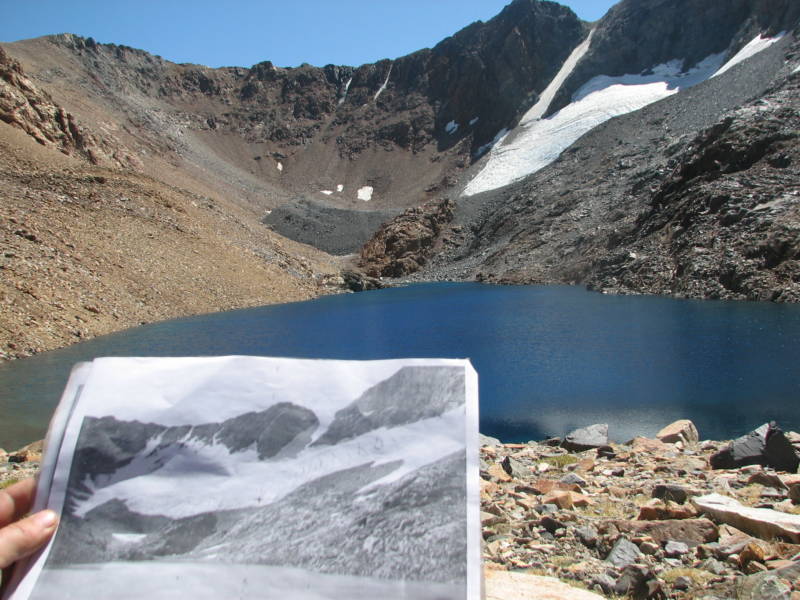
Yosemite’s Dana Glacier, in 2008 and 1883 (photo: Gretchen Weber)

Years of exhaustive (and exhausting) field work out of Portland State University has produced some stunning visual images online.

Not quite two years ago, reporter Sasha Khokha and I joined geologist Hassan Basagic on a long trek to photograph the Dana Glacier, located just inside the eastern edge of Yosemite National Park.  Since 2003, Basagic has been documenting the changes in the glaciers of the Sierra using historic photographs, and we joined him in September of 2008 to see the shrinking glacier for ourselves. We documented the trip with a radio report, an audio slide show, and web videos.

That field work was part of a project called “Glacier Rephotography of the American West” which tracks the retreat of glaciers across the western United States over the last century.

Tom Knudson of the Sacramento Bee, who has closely followed the project, tells us that it has produced a new online resource. It includes a series of interactive time lines that showcase historic photos as well as more recent ones (including Basagic’s) that, when viewed side by side, offer some startling views of how glaciers in various regions have changed.

For more remarkable images of moving glaciers, explore the “Extreme Ice” episode of the PBS series Nova.

A (PDQ) PDO Primer

The term “PDO” is coming up more often in climate discussions. What it is and why it’s being bandied about are explained in this post from our content partners, Climate Central.

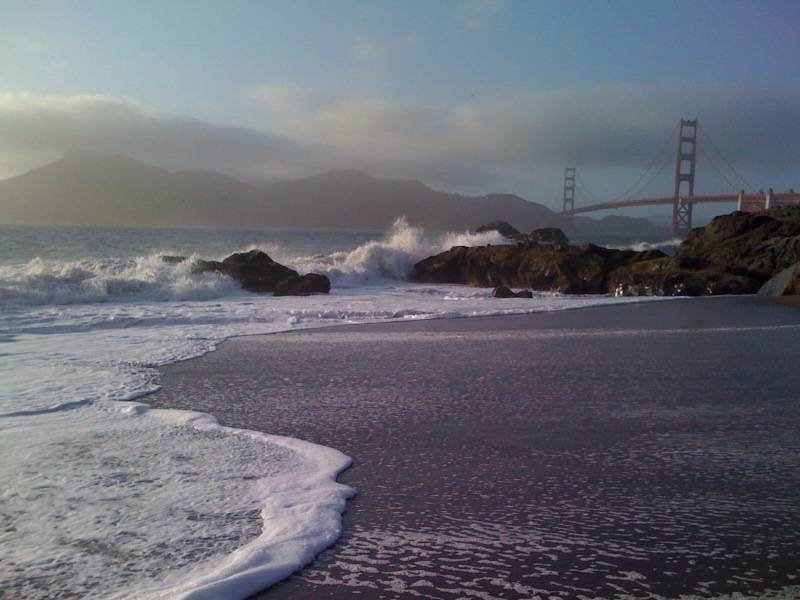
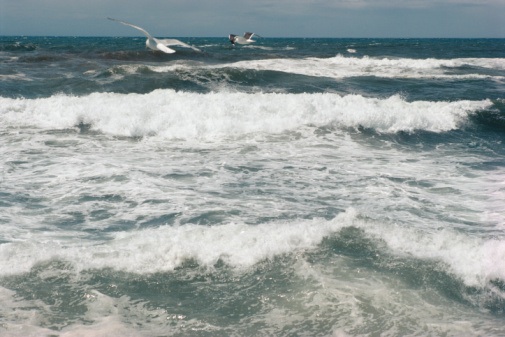
Surf along California's Mendocino Coast. Photo: Craig Miller

Did Someone Say “PDO”?

By Heidi Cullen, Phil Duffy and Claudia Tebaldi

Earlier this month, The New York Times ran a page-one story looking into why climatologists and TV meteorologists are at odds over global warming.

The article, which quoted one of the authors of this post, pointed out that while climate scientists almost universally agree that human activities, such as the burning of fossil fuels, are warming up the planet, a significant percentage of TV meteorologists do not. In fact, a recent study from George Mason University and the University of Texas at Austin showed that out of 571 TV meteorologists surveyed, only about half believed that global warming was happening and fewer than a third accepted the proposition that climate change was “caused mostly by human activities.” The survey also suggested that TV meteorologists view climate change as mostly a natural phenomenon.

Joe Bastardi, a senior meteorologist at AccuWeather, stands squarely in the natural causes camp, and he offered up his own explanation recently on Comedy Central’s The Colbert Report. On the comedy show, Bastardi said the global warming trend is just temporary and caused by a mix of volcanic activity, solar cycles, warmer ocean temperatures and specifically a natural climate pattern known as the “PDO” or Pacific Decadal Oscillation.

Bastardi has provided a great opportunity to educate the public about climate change. And as climate scientists, we’d like to take a moment to talk about natural climate variability specifically.

The solar cycle and volcano arguments Bastardi gravitates toward are fascinating. But when it comes to climate change, these natural sources of climate variability are incapable of doing the heavy lifting. In fact, they’ve been raised, tested, and solidly laid to rest by the climate science community. Variations in solar output are too weak, and in any case repeat every 11 years, and so cannot explain a steady warming trend over 40+ years. As for the volcano argument, eruptions are also too puny. Globally,volcanoes, like Iceland’s Eyjafjallajokull volcano as well as those under the sea release a total of about 200 million tonnes (metric tons) of CO2 annually.

That may sound like a lot, but it’s trivial when compared to human activity. According to the U.S. Department of Energy’s Carbon Dioxide Information Analysis Center (CDIAC), global fossil fuel CO2 emissions for 2003 tipped the scales at 26.8 billion tonnes—over 100 times more. Let’s just say human activity can bench press a whole lot more warming than the sun’s variations and volcanoes combined.

Before we move on to the role of the Pacific, we want to first thank Bastardi for daring to mention the phrase P-D-O on television. While geeks like us find the Pacific Decadal Oscillation fascinating, alphabet soup has a tendency to make the public’s eyes glaze over.

The PDO is just one of many natural oscillations in the climate system. It is characterized by a positive or “warm”  phase, and a negative or “cool” phase, which refer to the pattern of anomalies in sea surface temperatures and air pressure between the north central Pacific Ocean and the northeastern Pacific. The El Niño/La Nina cycle, for example, is another natural oscillation. Its period, about three-to-seven years, is shorter than the PDO’s, but in fact, the PDO is often thought of a slower version of El Niño, as some of the manifestations are similar.

Image: NOAA

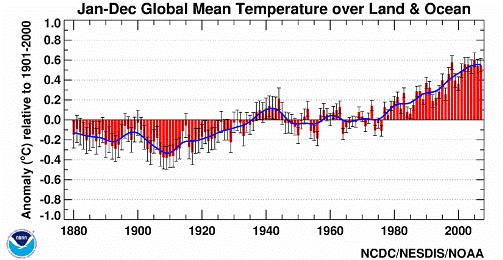
For example, in the warm phase of the PDO, temperatures in the northwest region of North America tend to be warmer than average, while the southeastern U.S. tends to be cooler than average. Bastardi believes the warming trend (shown below) is only temporary because the phase in which the PDO has predominantly been at the same time, with its warmer than average tropical Pacific Ocean temperatures, is temporarily juicing the system. He forecasts the global temperature trend will dip back down once the PDO shifts back.

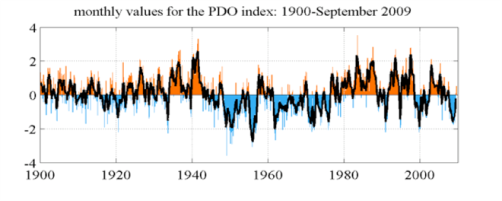
blog_monthlyPDOHere’s the problem. First and foremost, while the PDO is important in driving regional climate variations, it has no clear effect on global temperatures. And although the PDO was in its warm phase during the majority of the time from the mid 1970s to the present, it also shifted sharply in multiple instances (see chart), which is inconsistent with the steady global warming trend during the same period. For example, the decade from 2000 to 2009 was the warmest on record globally, but the PDO was not positive throughout that period.
It has been said that the truth is stubborn. This idea gives climate scientists a small sense of relief in that eventually, the stubborn truth will be recognized; that the recent global warming trend is real and caused mostly by human activities.

References for this article are shown in the original post at Climate Central.

Spring Comes Sooner, Some Species Suffer

Spring in the United States comes ten days sooner than it did just 20 years ago, according to scientists on a media call Tuesday.   This phenomenon, known as “spring creep” (or “season creep“), may be good news for flip-flop fans, but it doesn’t always work out well for native species in certain habitats.  According to Reuters, scientists on the call (which was sponsored by the Union of Concerned Scientists) explained that when spring comes earlier, it doesn’t just bring warm weather sooner — it actually throws off the balance of entire ecosystems by encouraging the spread of invasive species, many of which are better able to adapt to the changing conditions than are native plants and animals.  In the American West, warmer weather is already shrinking the habitat of the American pika, and more of it could make wildfires more frequent and intense.

Geoengineering: A Hot Topic


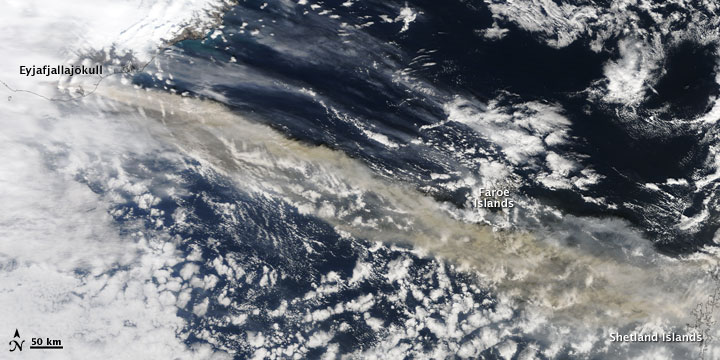
Ash plume across the North Atlantic from Iceland’s Eyjafjallajökull Volcano (Photo: NASA’s Earth Observatory)

As we reported last month for The California Report and on the Climate Watch Blog, the subject of geoengineering, or deliberate climate intervention, is becoming an increasingly hot topic; ideas such as brightening clouds to reflect sunlight away from the Earth or shooting aerosol particles into the stratosphere to block it. They’re just two of the science-fiction-sounding ideas garnering interest from the scientific community and the public as prospects dim for CO2 mitigation efforts across the world.

This morning on KQED’s Forum program, host Dave Iverson was joined by Ken Caldeira, climate scientist at the Carnegie Institution’s Department of Global Ecology at Stanford University, and Martin Bunzl, professor of philosophy at Rutgers University and director of the Rutgers Initiative on Climate and Social Policy.

At the outset, Caldeira explained the distinction between two basic kinds of intervention: one bucket of strategies that focus on removing carbon from the atmosphere, which tend to be expensive, but less controversial, and a second bucket of strategies that are being designed to reflect or block sunlight to cool temperatures, irrespective of CO2 levels.

This second bucket is where the bulk of the controversy lies for various reasons, including environmental and political concerns, as well as a fear by some that the more attention geoengineering gets, the less likely people will be to do the critical work required to reduce greenhouse gas emissions.

“The only real way to solve our climate problem is to reduce greenhouse gas emissions,” said Calderia. “But I’m concerned that we’re not doing that, and I’m thinking, what will we do in the event of an emergency?””

Because climate modeling is not yet sophisticated enough to capture the regional and local effects of geoengineering strategies, and because with current technology, it would likely be impossible to limit the effects to a specific area of the planet, both Caldeira and Bunzl expressed the need for caution when considering deployment.  Caldeira said that more research needs to be done on potential environmental impacts of geoengineering, something Bunzl said might be premature.  Bunzl advocated that research be focused on improving computer modeling before taking any experiments into the field.

“I’m concerned about the limitations of our climate models in predicting regional effects, and especially regional effects due to precipitation. Until and unless those climate models become a lot better with their fine-grained prediction, its a crapshoot,” said Bunzl.

One concern Climate Watch readers and listeners have raised about using sulfur aerosol for solar radiation management is acid rain.  Caldeira said that this strategy could produce a “small acid rain problem,” but that it would not be consequential given the relatively small amount of particles that would be used (a few percent, compared with what we’re already emitting in other ways).  In a separate interview last month, Rutgers geoengineering expert Alan Robock dismissed the acid rain concern by saying that the amount of sulfur that would be used in geoengineering strategies would be close to negligible, compared with the sulfur already spewing into the atmosphere from coal plants.  In fact, Robock said he recently removed acid rain from his list of “20 reasons why geoengineering may be a bad idea” list.

Two new books on the subject will appear on shelves this month: How to Cool the Planet by Jeff Goodell, and Hack the Planet by Eli Kintisch. Both books are reviewed by Mason Inman at Nature Reports Climate Change this week and on Thursday, Goodell discussed his book on NPR’s Fresh Air.  Kintisch has also developed the Earth Emergency Procedures Safety Card which is a clever, quick introduction to the why’s and how’s of geoengineering, available either as a physical card or an online flash interactive animation.

After the Forum broadcast, I asked Caldeira about the volcano erupting in Iceland that is currently grounding flights across Europe.  Could Eyjafjallajokull be another Mt. Pinatubo?  (The massive 1991 eruption of Mt. Pinatubo in The Philippines sent so much ash into the stratosphere, that it was responsible for cooling the Earth’s atmosphere 1/2 degree Celsius.)  Not likely, said Caldeira.  While the Icelandic volcano is wreaking havoc on air travel, he said, the eruption is too small to disrupt global climate.  The only effects Californians might see, he said, are “better sunsets.”

Icelandic Volcano Chills Travel Plans…But What About the Climate?

This post was contributed by Andrew Freedman of our content partners at Climate Central. Find out why scientists are using volcanoes as a possible model for global climate intervention, on the Climate Watch blog and on KQED’s Forum program.

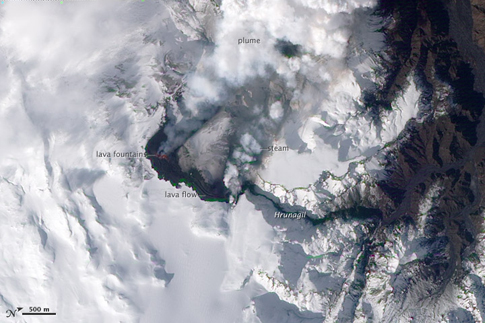
Eruption of Eyjafjallajökull Volcano, Iceland  (Photo: NASA Earth Observatory)
Eruption of Eyjafjallajökull Volcano, Iceland (Photo: NASA Earth Observatory)


The ongoing eruption of Mt. Eyjafjallajokull in Iceland is disrupting flights across Europe, shutting down some of the busiest airports and aviation corridors in the world. But could it also disrupt the climate system, leading to a temporary cooling trend this summer?

Not likely, according to Rutgers University environmental sciences professor Alan Robock, an expert on how volcanoes alter the composition of the Earth’s atmosphere. According to Robock, the Icelandic eruption hasn’t contributed enough sulfur dioxide to the upper atmosphere to significantly alter the climate.

“From what I’ve seen from the observations so far, there hasn’t been enough put into the atmosphere to have a large climate effect,” he said in a telephone interview.

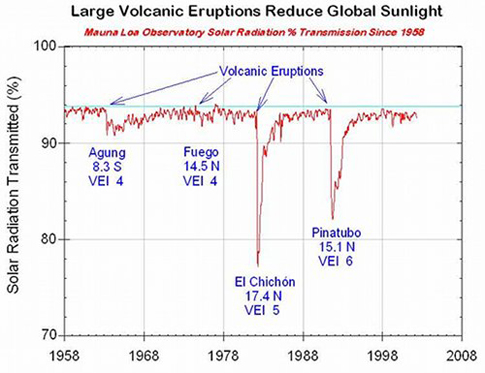
It is well known that volcanic eruptions can affect the climate. Just ask historians, who can tell you about the “year without a summer” that followed the enormous eruption of Mt. Tambora in Indonesia in 1816. More recently, the 1991 eruption of Mt. Pinatubo in the Philippines, which contributed about 20 megatons of volcanic material to the atmosphere, cooled global average surface temperatures by about one degree Fahrenheit in the year following the eruption.

By vaulting particles of sulfur dioxide and other reflective aerosols high into the stratosphere, volcanic eruptions can reduce the amount of solar radiation reaching the planet’s surface. However, this only results in temporary cooling, since chemical processes and air currents remove the particles over time.

NOAA plot showing a decrease in solar radiation reaching the Earth's surface after major volcanic eruptions

In addition to causing short-term cooling, volcanoes also contribute carbon dioxide (CO2) to the atmosphere, which in the very long-term balances slow CO2 losses from other causes. The volcanic contribution of CO2 to the atmosphere is estimated to be well less than the recent human contribution, on average.

Robock noted that the ash cloud that is canceling flights would not alter the climate, since it will fall out of the air in a matter of days. “What’s dangerous for airplanes is not what causes climate to change,” he said.

The volcano’s climate impacts may also be limited by its high-latitude location, since the air circulation in the upper atmosphere in the high latitudes tends to be more efficient at getting rid of volcanic material, compared to lower latitudes where sulfur dioxide particles from volcanoes can linger for years.

Robock noted that Icelandic eruptions have disrupted climate in the past, such as a long duration event in 1783-4 that cooled temperatures in Europe, catching then US ambassador to France Benjamin Franklin’s attention. According to the National Oceanic and Atmospheric Administration, Franklin was a pioneer in linking a volcanic eruption to climate change.

It’s still possible that this volcano, which is continuing to erupt, may yet send more volcanic material into the upper atmosphere, thereby causing a cooler summer in the northern hemisphere.

Climate Change as a Moral Issue

Global warming is not just a scientific or political issue, it’s a moral one, said Reverend Sally Bingham of San Francisco’s Grace Cathedral, at the Commonwealth Club last week.  Bingham, who founded the Interfaith Power and Light campaign, an organization dedicated to “mobilizing a religious response to global warming,” joined Rabbi Stephen Pearce of Congregation Emanu-El in San Francisco at the talk, which was organized by Climate One, to discuss the intersection of religion and climate change.

“I think believe of faith have come to realize that this is a moral issue, how we behave on the planet, ” said Bingham. “God put us here to be the stewards, and over the last few years as more clergy have come to realize that this is a matter of faith. You cannot profess a love of God and destroy creation.”

Pearce talked about how he first entered the arena of environmental activism in the 1990s, when he went to a rally to save redwoods in northern California.  After being moved by the experience he founded the Interfaith Coalition to Save the Headwater Forest, an activist organization dedicated to protect the forest. After a long battle, during which Pearce earned the nickname “The Redwood Rabbi,” the forest was eventually protected.

“I was moved by the plight of all of these people who got into their pick up trucks and came all the way down to make their plight known,” said Pearce.

In this video from the talk, both religious leaders talk about the passages from scriptures have contributed to their beliefs on environmentalism.

The hour-long program airs on KQED at 2:00pm this Saturday, April 3rd, and after that is available online.

Environmental Risks of “Geoegineering”

This week, as scientists meet in Monterey to discuss the potential for large-scale climate intervention strategies, we’re posting short discussions on some of the issues surrounding “geoengineering.”

Aside from the political and economic risks associated with geoengineering, which we explored in Monday’s radio segment on The California Report, critics warn that climate intervention strategies involve some serious potential environmental consequences as well.
In one 2008 study, scientists at the Lawrence Livermore National Lab found that one of the leading geoengineering ideas–blocking solar radiation by pumping sulfur aerosol into the stratosphere–may lead to decreased precipitation across the globe.

Climate scientist Phil Duffy, now of the education organization Climate Central and one of the authors of the 2008 study, says that the decrease in precipitation would follow a slowdown of the overall hydrologic cycle, caused by a decrease in evaporation.  Blocking sunlight reduces evaporation, and since what comes down much first go up, less evaporation means less rain and snow.  As this geoengineering scheme is being proposed as an emergency brake to counter effects of climate change like drought, this is problematic news.

Stratospheric sulfur injection could also seriously damage the Earth’s ozone layer above the Arctic, another 2008 study found.  And opponents fear that it could lead to acid rain, which could exacerbate the growing problem of ocean acidification.

Ken Caldeira of the Carnegie Institute for Science says that computer modeling from his lab indicates that even if the strategy improved living conditions for 90% of the people on the planet, it’s likely that 10% would suffer negative environmental consequences, and, he says, it would be hard to predict where on the planet that 10% would be.

“We’ve come to the conclusion that there are no experiments that will tell you ahead of time what the regional effects will be,” said Caldeira.

Another high-profile strategy involves fertilizing the ocean with iron as a way to  encourage algae blooms for carbon sequestration.  Algae absorb carbon dioxide as they grow, and the theory is that when they die, they’ll sink to the bottom of the ocean and take the CO2 with it.  There is conflicting research about whether this could work as a long-term sequestration strategy, but a recent study suggests that regardless of whether it’s effective at sequestering CO2 or not, fertilizing the oceans with iron could harm marine ecosystems.   The research shows that increases in algae from the genus Pseudonitzschia can promote concentrations of domoic acid, a poison that can kill birds and marine mammals.  Richard Black has more on the new findings at the BBC website.

For more on the potential risks of geoengineering, Alan Robock‘s article “20 Reasons Why Geoengineering May Be a Bad Idea” appears in the May/June issue of the Bulletin of Atomic Scientists.

Concerns Abound as Geoengineering Conference Opens

Photo: Craig Miller

This week in Monterey, an international group of scientists and policymakers are  are gathering to hash out some ground rules for experimenting with climate intervention, or “geoengineering”–what many are calling “Plan B” for dealing with climate change.

There are two main categories of geoengineering strategies: one focuses on blocking solar radiation that reaches the Earth’s surface, the other aims to remove CO2 from the atmosphere.  The goal of both is to pull an emergency brake on global warming, using technology that is, in many cases, experimental.

Ideas for blocking the sun include science-fiction-sounding ideas like spraying sulfur aerosol into the stratosphere (which we explore in a radio feature on The California Report), launching reflectors into orbit, and spraying seawater at clouds to make them brighter and more reflective.

Because much of the technology remains untested, and because, given the complexities of the climate system there’s no real way to test them out in a lab, (not to mention the philosophical issue of interfering in such a direct way with the Earth), the very idea of geoengineering is controversial (watch this space for more about that in the week ahead) But as it turns out, this week’s conference in Monterey is shaping up to be controversial on its own.

The stated goal of the Asilomar International Conference on Climate Intervention Technologies is “to develop norms and guidelines for controlled experimentation on climate engineering or intervention techniques.” Some big names in climate circles are expected to be in attendance, including the Climate Institute‘s Michael McCracken, who is chairing the conference, and former IPCC lead author Richard Somerville, now retired from Scripps Institution of Oceanography in La Jolla.

Other leading scientists, however, have chosen to skip the conference, including Stanford’s Ken Caldeira, Martin Bunzl, who directs the Rutgers Initiative on Climate Change and Social Policy, and Braden Allenby, a professor of Engineering and Ethics at Arizona State University, both of whom participated in a lively panel on geoengineering at the AAAS annual meeting in February. Bunzl told Climate Watch Senior Editor Craig Miller that the five-day event was too much time to devote to the topic, and Allenby called the conference premature.

Many scientists say that more research needs to be done to determine whether these strategies would even work, before we start hashing out how to to deploy them, even if only on a limited, experimental basis.  Others fear a focus on intervention might lead to complacency and distract from the immediate task of reducing CO2 emissions.

The latest controversy surrounding the conference, however, revolves around accusations of a conflict of interest.  The Climate Response Fund (CRF), which is organizing the conference, has ties to a geoengineering firm, San Francisco-based Climos.  Climate blogger Joe Romm (who is admittedly “not a fan of geoengineering”) writes about these connections in-depth at Climate Progress, and details email exchanges he had on the subject with Margaret Leinen of the CRF, David Keith of the University of Calgary and Caldeira of the Carnegie Institute for Science, all of whom reportedly expressed concerns about the potential conflict of interest (one reason Caldeira cites for skipping the conference).

Meanwhile organizers will try to enforce media restrictions almost unheard of in the Internet age, including a ban on daily reporting from the conference, and on quoting presenters without their express consent.  The rationale was laid out in an email from the conference organizers:

“The conference is designed to allow the conferees to consider multiple points of view during the course of the meetings.  Reporting before participants have had the opportunity to consider the full mix of views will necessarily be incomplete and therefore risk being misleading.  This also is  matter of courtesy to your fellow conferees, will help in maintaining the focus of the discussions and efforts to achieve the Conference objectives, and will help reduce the likelihood that Internet exchanges about the Conference will break out before we all have an opportunity to be participating in them, as appropriate, based on our actual experiences here at Asilomar.”

Some form of announcement is scheduled for Friday, when the meeting comes to a close.

Update 3/22/10
The Board of Directors of the Climate Response Fund has issued a statement addressing the concerns raised about a potential conflict of interest.  It states that CRF “will not fund field experiments for any climate intervention technique now or in the future.”  This reportedly has assuaged some scientists’ (and journalists’) concerns about the intentions of the organization and the purpose of the Asilomar conference.