Category Archives: Power

Progress and pitfalls in California’s clean energy quest

Going Underground in Sweden

…where they actually can get a repository built for “high-level” nuclear waste (they think)
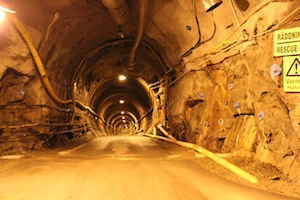
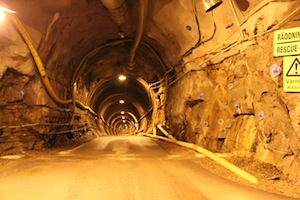
Follow the yellow brick road? The Äspö Hard Rock Laboratory in Sweden. (Photo: Ingrid Becker)

This summer, Climate Watch will launch a three-part radio series on the nuclear waste dilemma. As part of the reporting for that series, The California Report’s senior producer, Ingrid Becker, traveled to Sweden to examine a program touted as a potential model for the world. This dispatch is the second part of her series preview.

The road to Äspö from Gothenburg, where I arrived from San Francisco, winds through a storybook landscape of small farms, lush forests and brick-red houses. Road signs warning of moose crossings pop up at regular intervals along the highways and back roads.
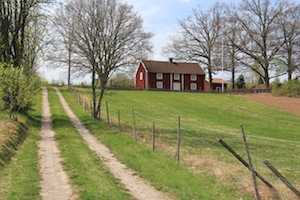
Traditional wooden houses like this one dot the landscape in Småland, the historical province where the Swedes have built a demonstration laboratory for storing spent nuclear fuel. (Photo: Ingrid Becker)

And so it was a bit jarring to later find myself in a granite cavern, standing face-to-face with giant copper tubes, enormous machinery and a specially designed fuel transport vehicle quaintly named after one of the Viking gods.

The trip, 340 meters (1,115 feet) below ground to the demonstration tunnel takes a full minute in a noisy and slightly bumpy elevator. Before we enter the tunnel, I must strap on a transponder, a safety precaution in case of emergency. At this point I’m asking myself if I should be alarmed, but the attentive public relations officer assures me that since the facility opened in 1995, about 10,000 visitors a year have made this trek. Continue reading Going Underground in Sweden


Sweden’s Nuclear Waste Solution

In the weeks to come, Climate Watch will launch a three-part radio series on the nuclear waste dilemma. As part of the reporting for that series, The California Report’s senior producer, Ingrid Becker, traveled to Sweden to examine a program touted as a potential model for the world. This dispatch from Becker is a preview of the series.

How Sweden is getting some to say, “Yes, in my backyard,” Part 1

The country that brought the world Alfred Nobel and his dynamite, Volvo cars and IKEA furniture is busy touting another invention.  The Swedish Nuclear Fuel and Waste Management Company, or SKB, has asked for government permission to build what could become one of the world’s first permanent geologic repositories for spent nuclear fuel.

SKB public relations officer Brita Freudenthal encourages visitors to touch models of the copper canisters at the Äspö Hard Rock Laboratory, where plans are being developed for permanent storage of nuclear waste. (Photo: Ingrid Becker)

I’m in Sweden this month to learn just what this environmentally-conscious nation of nine million people can teach us about managing the radioactive refuse from commercial reactors. While the waste from California’s two nuclear power plants — Diablo Canyon and San Onofre – is piling up in temporary storage containers (with still more at the decommissioned Rancho Seco plant, near Lodi), Sweden is moving forward with a program 30 years in the making, to safely dispose of the spent uranium dioxide pellets that fuel its ten reactors

”I believe it has been a strength that industry has had a clear task to solve the (waste) problem,” says SKB’s Chief Executive Officer Claes Thegerström, in a recent interview for the company website. “When we began, we had right from the beginning a mix of experienced people from the industry. We had outgoing academics and, strong authorities, which allowed us – in contrast to the American way – to own the mission.”

This week I’m in Stockholm where we’ll hear more about the Swedish example during a two-day gathering of social scientists, legal scholars, and industry experts, as well as political and community leaders from Sweden and abroad. Continue reading Sweden’s Nuclear Waste Solution

Speed Bump for Big SoCal Solar Project

It had been a good month for BrightSource Energy, the Oakland-based company that’s building the massive Ivanpah solar farm in the Mojave Desert.

Google announced it would invest $168 million in the project. The Department of Energy announced $1.6 billion loan guarantee. And on Friday, the company announced it plans to go public with a $250 million initial public offering. But a recurring issue has popped up: the desert tortoise.

A Mojave desert tortoise. (Image: USGS)

“It’s an endangered species. No project that is sited out there in within their habitat can negatively impact the population,” says Erin Curtis, a spokesperson for the Bureau of Land Management. As anyone following the battles over solar farms knows, prime desert tortoise habitat also happens to be prime solar territory and has been targeted by a number of proposed solar farms.

BrightSource Energy agreed to mitigate the impacts their solar farm would have on the tortoises by capturing and relocating them to new habitat. Fences are being constructed to prevent the tortoises from returning. Continue reading Speed Bump for Big SoCal Solar Project

Report: Solar Panels Boost Home Prices

Photo: Amy Standen

A new study from Lawrence Berkeley National Lab could help California’s homeowners decide whether or not to “go solar.” Researchers found that on average, homeowners who recently installed solar photovoltaic (PV) panels recouped most or all of their investment when they sold their homes.

“A house that has a PV system compared to a house that doesn’t have a PV system is expected to sell for more,” said Ben Hoen, the lead researcher on the study and a principal research associate at Berkeley Lab. “This is for systems that are relatively new – between 1.5 to 2.5 years old.”
Continue reading Report: Solar Panels Boost Home Prices

Emissions Trading May Not Worsen Local Pollution

Study could weaken underpinnings of suit holding up AB 32

Trees killed by acid rain. (Photo: bdk)

In response to a court order, California regulators say they are working up a “very robust analysis” of alternatives to cap & trade, a critical part of the state’s AB 32 climate law.

Right now, the entire implementation plan is on hold, after environmental justice groups sued the Air Resources Board.

A lower court ruling has forced state officials to reexamine the carbon trading program, on the grounds that alternative ways of controlling emissions were not adequately considered.

The activists’ concern is that a market-based system of emission reductions will create “hot spots” in low-income communities of color as industrial polluters buy the rights (called allowances, or carbon credits) to emit more greenhouse gases, and potentially bring other more toxic forms of pollution into nearby communities.

But will that happen? Since carbon trading won’t start until at least next year, the argument is hypothetical. But another example of emissions trading has been well tested.
Continue reading Emissions Trading May Not Worsen Local Pollution

Brown, Chu Tout New Renewables Law

California’s utilities now have their marching orders: to provide one third of the state’s electricity from renewable sources by 2020.

Now that the “33-by-20” target is a mandate backed by state law, supporters say it will lure more renewable energy investments to California. There’s evidence that it already is.

Calling it a “breakthrough,” Governor Brown signed the bill into law at the dedication of a new SunPower Corp. manufacturing plant in Milpitas, near San Jose. And he laid down a challenge:

“Last year six thousand megawatts of solar installations were produced by China and one thousand by the United States. Now, are we up for changing that? I think we are.” Continue reading Brown, Chu Tout New Renewables Law

Goldman Prize Winners Reflect Energy, Water Concerns

The 2011 Goldman Environmental Prize winners were honored in San Francisco last night. In a ceremony at the Opera House, they were each awarded $150,000 for their grassroots work addressing pressing environmental issues around the world.

Environmental degradation from energy production is a common theme in the work of at least half the winners: Dmitry Lisitsyn, who’s worked to protect the ecosystems of Sakhalin Island from rapid destruction caused by companies exploiting the region’s petroleum reserves; Hilton Kelley, for environmental justice work on the Texas Gulf Coast, a region plagued with air-quality-related health problems due to emissions from the major refineries and petrochemical plants in the area; and Ursula Sladek, who created Germany’s first cooperatively-owned renewable power company. Continue reading Goldman Prize Winners Reflect Energy, Water Concerns

EU Lesson for CA: Don’t Give Away the Store

Advice from Europe for California’s cap-and-trade captains

As California lurches toward what would be the nation’s most comprehensive carbon trading program, I got an interesting perspective from the world’s largest, the European Union. “California is one of the states that is actually moving forward in the US,” EU Commissioner Connie Hedegaard told me in a one-on-one interview this week. “And we know in Europe that sometimes when California starts to do something, that it’s the start of something that will end up being the American way of doing things.”

Connie Hedegaard directs climate action for the EU. (Photo: European Union)

Hedegaard, who is the EU’s Commissioner for Climate Action, cited California’s leadership in regulating tailpipe emissions, among others, though when it comes to cap-and-trade for carbon, it’s unclear who will be following. Certainly Congress is in no mood, and the regional trading scheme known as the Western Climate Initiative has been severely stunted.

Citing recent estimates that five years of carbon trading in Europe has lowered total greenhouse gas emissions by less than one percent, I asked her if she considers that a success. “Yes, I do,” replied Hedegaard. She countered with her own figures that while US emissions had continued to rise between 1990 and 2009, those in Europe had fallen 16%. “So we’re doing something right,” she said (again, EU carbon trading only began in 2005). “Of course when you’re building a complex system like that, those who do it first, in the first couple of years, have a lot of lessons learned.” Continue reading EU Lesson for CA: Don’t Give Away the Store

CA Moves Forward with Renewable Goals

33% by 2020: It’s (almost) The Law

After two failed attempts, California is moving ahead with the most aggressive renewable energy goal in the country. Today the State Assembly passed SB 2x, a bill that requires utilities to get 33% of their electricity from renewable sources like solar and wind, by 2020.

By all accounts, utilities will need to add an unprecedented amount of renewable energy to meet the goal. Peter Miller of the Natural Resources Defense Council says that will spur new technology and green job opportunities. “There’s worldwide competition to lead this industry, which is the growth industry of the 21st century,” said Miller. “And this moves us, I believe, to the front of the pack.”

If the 33% renewable portfolio standard (RPS) doesn’t sound new, that’s because it isn’t. The goal was originally set by former Governor Arnold Schwarzenegger in a 2008 executive order. Supporters knew that an executive order could be overturned by a future governor, but two previous bills aiming at cementing the goal failed to make it into law. Continue reading CA Moves Forward with Renewable Goals

Report: “Stalled” Energy Projects Costing Us

Business group says delays are costing thousands of jobs, billions in lost economic benefits

The US Chamber of Commerce says it’s taking too long to green-light energy projects — not just in California but across the US — and that it’s putting a drag on economic recovery.

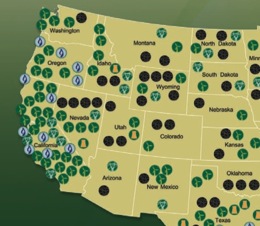
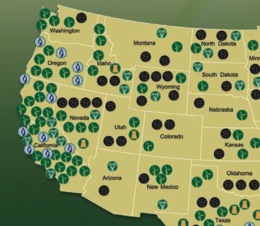
Map shows energy projects that are facing permitting or court challenges, 31 in California. (Image: US Chamber of Commerce)

The pro-business group issued a report that attempts to quantify the opportunity cost of projects that were in permitting or litigation limbo during March of 2010. That “snapshot” includes 31 projects in California. Continue reading Report: “Stalled” Energy Projects Costing Us