Bill to require one-third renewable energy sails through state senate
(Photo: Craig Miller)
That next gust of wind you hear may be a collective sigh of relief from the renewable energy industry. By a margin of more than two-to-one, state senators have approved a bill to cement California’s requirement that utilities draw at least a third of their power from renewable sources by 2020.
Rooftop solar can make a sizable dent in the West’s renewable energy needs
This week representatives from the federal Department of Energy and Bureau of Land Management wrap up their California barnstorming swing, to gauge public opinion on the topic of siting solar projects. Throughout this often contentious debate, many have claimed that a potentially huge piece of the power solution is being overlooked; rooftop solar.
Acres of flat-roofed commercial buildings in California's Inland Empire. (Photo: Craig Miller)
Fly into Ontario airport in Southern California’s Inland Empire — or just zoom in on Google Earth — and you’ll see hundreds of block-long warehouses. There are acres — probably square miles — of flat, gray roofs sizzling in the San Bernardino County sun. Soon, though, instead of merely soaking up the rays, hundreds of industrial rooftops in Southland cities will harness them to feed the local electrical grid.
Solar panels ready for installation on Ontario warehouse. (Photo: Ilsa Setziol)
Southern California Edison and independent power producers holding contracts with the utility are building 500 MW of solar panels on warehouses and, to a lesser extent, on the ground at other Southern California locations.
Together these projects are expected to produce enough energy to rival a traditional power plant, enough to serve about 325,000 homes. Continue reading Yes in Our Backyard→
The wind energy industry faces multiple challenges in California.
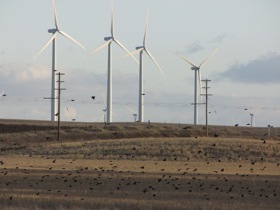
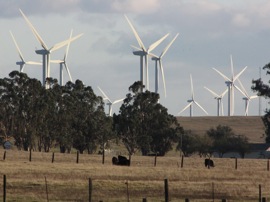
Flocks of birds near wind turbines in Solano County. (Photo: Craig Miller)
It’s hard to find people who are just flat out against wind energy. As with real estate, attitudes seem to come down to location, location, location. That’s why three of the thorniest issues with wind are project siting, transmission (lines for the power produced), and the industry’s turbulent history with birds and bats.
Last fall, even the National Audubon Society, one of the nation’s most stalwart protectors of winged creatures, published a position statement generally favorable toward wind power, calling it a “good news, bad news” proposition. The statement calls California’s Altamont Pass “notorious for killing many raptors, including golden eagles.” A 2003 study by the National Renewable Energy Lab calculated that on average, each turbine in the pass was claiming a bird about once every five years (0.19 birds/turbine/year) — but there are thousands of turbines in the pass, many older models that are more of a danger to birds.
Developers are in the process of “repowering” the pass with newer, larger turbines, less lethal to birds. That may seem counterintuitive but the older, smaller models caused more problems. Since they had lower output, more of them were required. The blades were positioned lower, spun faster, and supported by lattice towers that provided inviting nesting spots, unlike the smooth tubular towers of new turbines.
Altamont is the oldest of California’s four biggest wind energy zones, highlighted on this interactive map.
The Audubon statement concedes that newer turbine designs are becoming more bird-friendly, and finds climate change a bigger threat to avian critters in the long run. The Society went on to call for an extension of the federal Production Tax Credit for wind development, fearing its expiration next year encourages wind developers to rush projects along and “cut corners” on siting.
How much wind energy do we need to make California’s goal of 33% clean electricity by 2020? Whenever I put this question to one of the experts, the answer is always: “It depends.” But under almost any scenario, thousands more windmills will dot the California landscape in years to come.
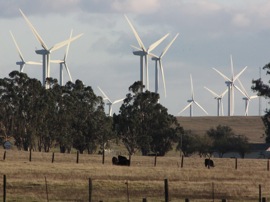
Cattle and wind turbines dot the Solano County landscape. (Photo: Craig Miller)
Those who don’t see them on a daily basis might be surprised to learn that there is already something on the order of 13,000 commercial wind turbines operating in California. Ryan Wiser, who tracks wind energy trends at Lawrence Berkeley National Lab, does a rough calculation that meeting that state-imposed threshold of 33% renewable energy could take 5,000 more, in order for wind to do its share. That’s based on an estimated 10,000 megawatts of new wind power, using the current standard two-megawatt turbine. While most of these will be concentrated in a few major “wind resource areas” (there are currently four big ones in the state), numbers like that almost ensure that wind turbines will become a more familiar feature of the California landscape. Continue reading Wind Farm Forecast: More & Bigger→
Hear the companion radio feature about opposition to the Sunrise Powerlink at The California Report, starting Friday morning.
By Ruxandra Guidi
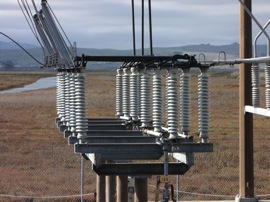
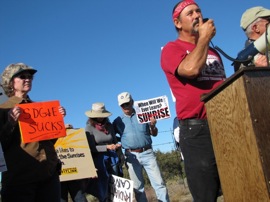
The road that takes you from the sleepy town of Boulevard into the path of the Sunrise Powerlink is a dusty, unmarked path that’s a couple of miles long. It ends at a gate without a sign, where a guard stands in the hot midday sun. He knows to keep any unauthorized visitors away; there’s a party going on inside, while the protesters make noise for hours outside.
David Elliott speaks to protesters outside the Sunrise Powerlink headquarters in the town of Boulevard. (Photo: Ruxandra Guidi)
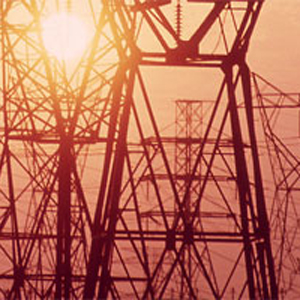
No one yet knows what the Sunrise Powerlink will end up looking like, and at what cost — and that’s just two of the main issues people have with it. Opponents of the giant network of powerlines, towers, and substations, say it will run for 120 miles, through delicate ecosystems and fire-prone areas. Its impact on local residents and wildlife will be irreparable.
On the other hand, SDG&E says its “superhighway” for transporting electrons from remote solar and wind farms to coastal population centers, will respect state and federal lands and go around delicate areas of the desert; that it will generate much-needed jobs while meeting state goals for green energy development. In the process, the California Imperial Valley is being touted as a so-called “mega-region;” a showcase for clean energy production. Continue reading Environment and Electrons Create Sparks in SoCal→
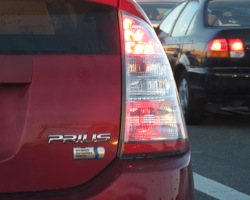
The US already has more than a million hybrid-electric vehicles on the road. (Photo: Craig Miller)
Continuing an exercise I started in yesterday’s post, I’ve asked a few experts to weigh in on two national goals laid out by President Obama in this week’s State of the Union address. The experts seemed split on the viability of getting 80% of the nation’s electricity from “clean energy” by 2035. Today they address Obama’s call for one million electric vehicles “on the road” by 2015 (less than five years from now): Continue reading Ask the Experts: 1 Million EVs by 2015?→
During his State of the Union speech last evening, President Obama articulated two national goals that jumped out at me: 80% of electricity from “clean” energy by 2035 and one million electric vehicles “on the road” by 2015 (just five years from now).
Keeping in mind that California’s goal of 33% renewable energy by 2020 is considered extremely ambitious, I put the question to a few experts in the renewable energy/alternative fuels field: Are these goals realistic? I’ll post their responses here as they come in. I’ve had to condense some of the replies for space considerations. Let’s take the 80% clean energy challenge first: Continue reading Ask the Experts: Obama Energy Goals Realistic?→
California may not have met its goal of 20% renewable energy by 2010, but outgoing California Energy commissioner Jeffrey Byron says the state is close, and that California is on track to meet its its goal of 33% renewable energy by 2020.
“We didn’t get to the point where we’re generating 20% of our electricity by renewables, but I believe we do have, or we’re very close to having, all the contracts in place,” he said Thursday.
Say goodbye to your 100-watt incandescent light bulbs. On Jan. 1, it’ll become increasingly challenging to find one on a store shelf in California.
That’s because the state has ordered a phaseout of the high energy-consuming light bulb.
The state is pressing to have the old incandescents replaced with newer, more efficient bulbs, such as compact fluorescents, halogens and light-emitting diode light bulbs, or LEDs.
And beginning in 2012, 100-watt incandescents will be off the shelves completely.
As is typical, California is getting a jump-start on a trend that will begin nationwide in a few years. Three years ago, the federal government enacted legislation to phase out the old bulbs. National phaseout will begin in 2014. Other countries, such as Australia, Ireland and Cuba have already banned them.
There are drawbacks to the new bulbs, however.
Fluorescent bulbs, or CFLs, contain mercury, which can be harmful to the environment and to human health. Therefore, the bulbs must be handled differently than other household waste.
Local hazardous waste centers, and some hardware stores, will take spent fluorescent bulbs for recycling. The other bulbs contain chemicals such as bromine and iodine. These do not require special recycling.
Consumers looking to find a replacement for the old 100-watt bulb will likely choose the energy-efficient 72-watt bulb, which will provide an equal amount of light but uses less power.
“The consumer will still be able to use the product and have the same results to light an office, a desk lamp, a hallway. A 72-watt light bulb will still provide the same service as the old 100-watt bulb,” Adam Gottlieb, a spokesman for the California Energy Commission, told the Scripps Howard news service. “Consumers really need to know they won’t see any difference. The difference they’ll see is a more energy-efficient bulb.”
The California Energy Commission website has a user-friendly FAQ page about the new light bulb standards and how the rules affect consumers.
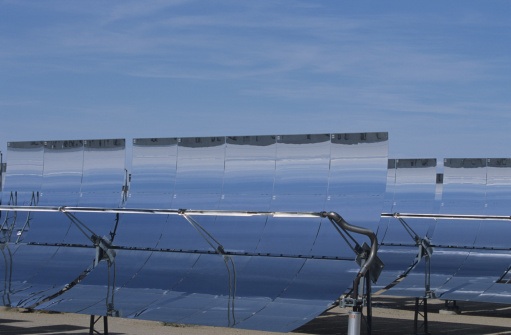
The federal government is recommending 24 areas in six Southwestern US states it says are “best-suited” for large-scale solar projects, both economically and environmentally. Four of these “Solar Energy Zones” are in California: two in San Bernadino County and one each in Imperial and Riverside Counties, and together they account for nearly half of the nearly 700,000 acres recommended by the Obama Adminstration.
“These are areas in those states which have been determined to have the highest solar potential and the fewest amount of environmental and resource conflicts,” said Interior Secretary Ken Salazar on a conference call with reporters Thursday.
He said that because the recommended areas are likely to have fewer delays related to environmental issues, projects sited there are likely to have a faster permitting process. The report and its recommendations, he said, will help speed up the implementation of renewable energy projects around the Southwest. (!–more–>
“It presents a common sense and flexible framework from which to grow our nation’s renewable energy economy,” he said.
While representatives from environmental groups such as the Wilderness Society, the Nature Conservancy, and the Center for Biological Diversity applauded the federal government for planning ahead for efforts to make the siting of solar projects more efficient, some voiced concerns about the specific sites named as Solar Energy Zones.
Ilene Anderson of the Center for Biological Diversity expressed concern that one of the areas designated in California, a swath of more than 200,000 acres called Riverside East, contains habitat of the endangered desert tortoise. Another zone she finds problematic is the Iron Mountain Zone, which Anderson says is too far from population centers, meaning that projects there could require the construction of additional transmission infrastructure.
Beyond the specific areas, however, Anderson said what concerns her to most is that the federal strategy leaves open the possibility for solar projects in sites outside the designated zones.
“My concern is that they’re still going to be entertaining applications anywhere on public lands, and that gets us back to the problem that we’re currently seeing which is these renewable energy projects spread willy-nilly across the desert,” she said.
You can see what the recommended sites actually look like with this interactive map that identifies the Solar Energy Zones and provides on-the-ground panoramic views of the sites.



 California may not have met its goal of 20% renewable energy by 2010, but outgoing California Energy commissioner Jeffrey Byron says the state is close, and that California is on track to meet its its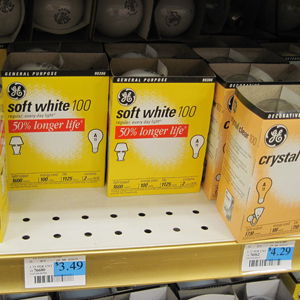
 The federal government