Category Archives: Power

Progress and pitfalls in California’s clean energy quest

California’s “Solar Lead” Revisited

Technology, yes. Policy, yes. Manufacturing…maybe not so much

This week as Fremont-based Solyndra sets about the grim business of filing for Chapter 11 bankruptcy, it leaves in its wake ample confusion over California’s much vaunted “lead” in renewable energy — so much so that last week a national solar industry association felt compelled to issue a statement reassuring us that Solargeddon was not at hand. (Cy Musiker’s interview with Sev Borenstein of UC Berkeley’s Energy Institute provides some solid perspective on the Solyndra collapse).

It didn’t help that Solyndra had been the arc light of California’s renewable power surge. President Obama, Energy Secretary Steve Chu and former Governor Arnold Schwarzenegger had all led media parades through the company’s Fremont manufacturing plant. The bankruptcy announcement came within hours after Chu finished extolling California’s leadership at an energy “summit” in Las Vegas.
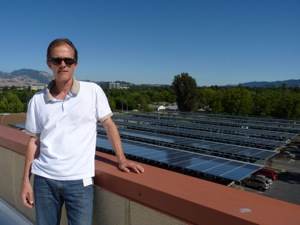
John Hild with the new solar array at the Contra Costa County Office of Education. The panels were "made in the USA"-- but by a Chinese company.

Recently I climbed to the roof of the Contra Costa County Office of Education with John Hild, for an overview of a new 700-panel solar array that covers the agency’s parking lot in Concord.

Hild, who manages facilities there, was impressed with the May electric bill, which had dropped to $19 from about $7,200 before the photovoltaic (PV) panels were hooked up. But Hild says it was tough to find American-made panels, something required by one of the incentive programs that CCCOE was tapping into to make the project affordable. In the end, they found some–but they were made in Arizona, not California, by the Chinese solar juggernaut SunTech. Continue reading California’s “Solar Lead” Revisited
Officials Call for Federal Clean Energy Standards

In Las Vegas, politicians and industry leaders point to California’s lead

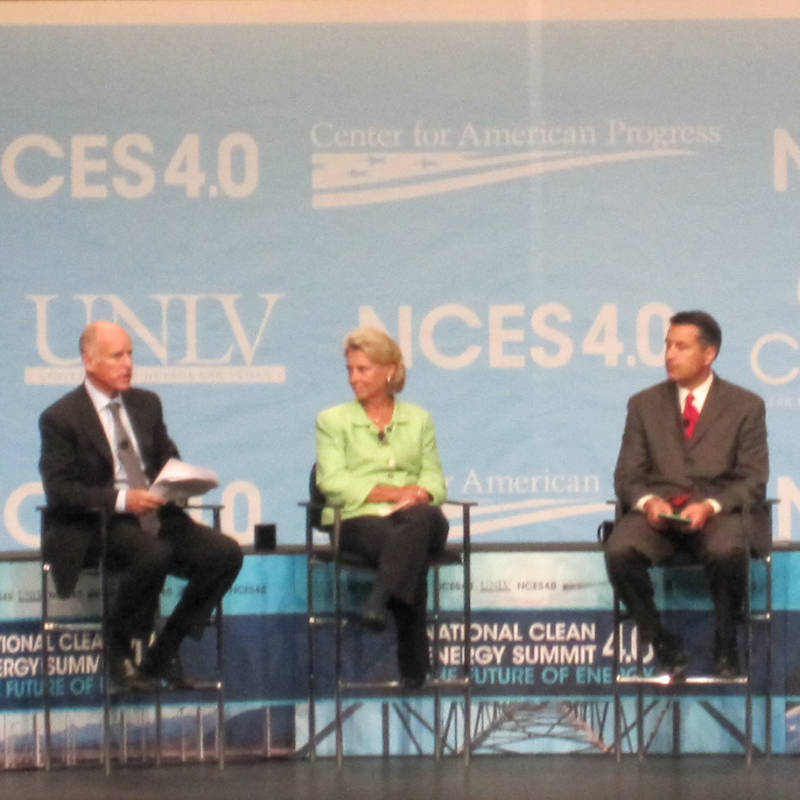
Gov. Jerry Brown with Washington Gov. Christine Gregoire and Nevada Gov. Brian Sandoval at the National Clean Energy Summit in Las Vegas.

In his keynote address at this week’s National Clean Energy Summit, Vice President Joe Biden said America is at a crossroads when it comes to energy, and that the choice is clear.

“If we shrink from deciding that we’re going to lead in the area of alternative energy, renewable energy, then we will be making the biggest mistake this nation has made in its entire history,” he said.

The Vice President was joined by Energy Secretary Steven Chu, California Governor Jerry Brown, and other political and industry leaders at the summit, which is in its fourth year and is sponsored by several entities, including the Center for American Progress and Nevada Senator Harry Reid.

“If we don’t lead in this new energy technology, we’re going to follow, and I’d hate like hell to be trading the importation of oil, for the importation of new technologies,” said Biden. “Neither is very acceptable.” Continue reading Officials Call for Federal Clean Energy Standards

A Sneak Peek at “World’s Biggest” Solar Project

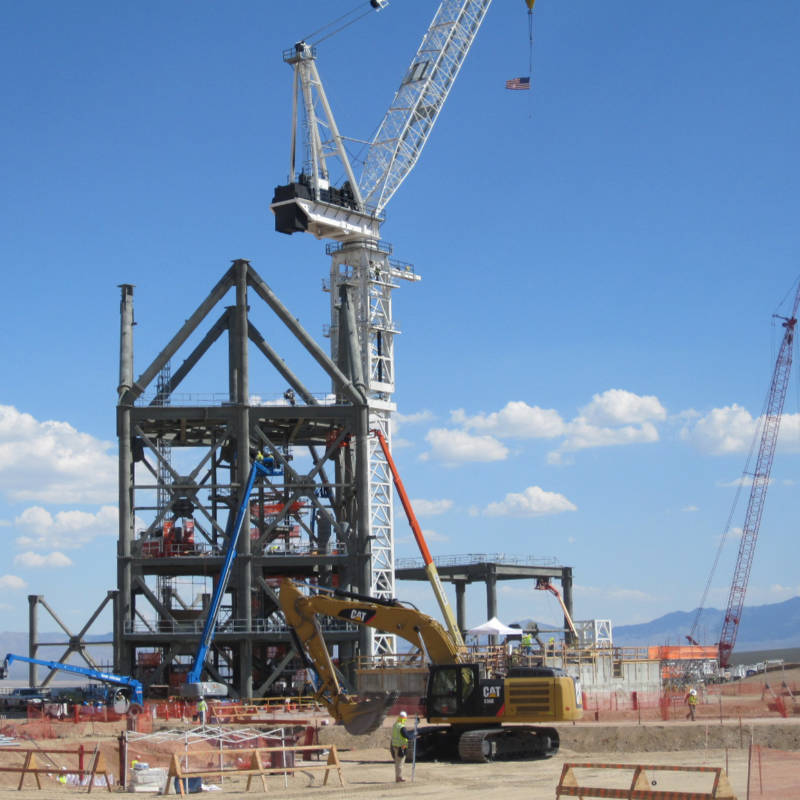
Construction of one of three planned solar thermal towers at the Ivanpah Solar Electric Generating System, Ivanpah Dry Lake, CA

Construction of the Ivanpah site is reportedly on-schedule for completion in 2013

The National Clean Energy Summit 4.0 opens in Las Vegas on Tuesday, bringing policy makers and industry leaders from around the country together to “chart the course for the future of energy in America.” It’s also attracting lots of media, which is why on Monday Oakland-based BrightSource Energy opened the gates to the construction site of its 3,500 acre Ivanpah Solar Complex, which lies just over the California border, 45 minutes southwest of the Las Vegas Strip.

About 15 reporters donned hard hats and safety goggles in 100-plus temperatures to tour the active construction site in the Mojave Desert, along with officials from BrightSource, San Francisco-based construction company Bechtel Corp., and NRG Energy, which, along with Google, is the project’s main investor. Continue reading A Sneak Peek at “World’s Biggest” Solar Project

Making Renewable Energy from Farm Waste

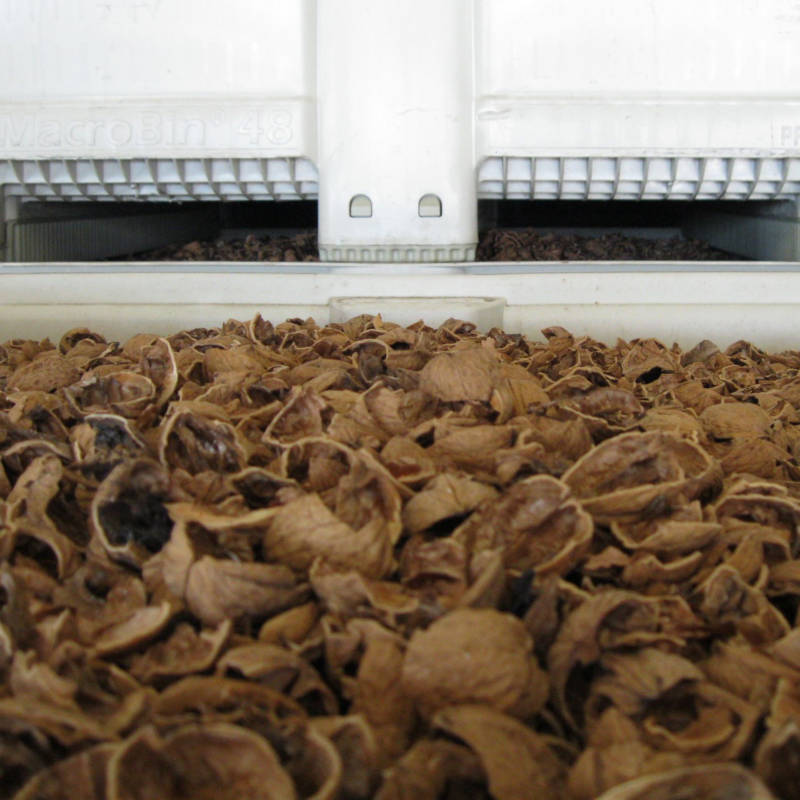
Cast off walnut shells await Lester’s biogasifier. Lester has more than enough for an entire year stored in his warehouse.

By Katrina Schwartz

California is just a few votes away from changing the rules to allow farmers to connect machines that create bioenergy to the electrical grid, a privilege that has thus far been reserved for farm-generated wind and solar energy.

Passage of the bill — SB 489 — would mean they could use the byproduct of their crops as fuel to create electricity.

Russ Lester, the owner of Dixon Ridge Farms, has been leading the charge to get the rules changed. He has gone to extraordinary lengths to shrink the carbon footprint of his organic walnut farm and processing plant in Yolo County. Brian Jenkins of the California Biomass Collaborative at UC Davis calls Lester the “guinea pig” of bioenergy. Continue reading Making Renewable Energy from Farm Waste

Cheap Panels Changing the Game for Big Solar

Developers are moving toward photovoltaic panels for utility-scale solar plants

Photovoltaic solar panels are becoming the new black for large-scale solar projects in California.

Developers of what’s billed as the world’s largest solar project, spanning 7,000 acres in Blythe, California, say the plant will get half of its 1,000 megawatts from photovoltaic panels. This recent announcement makes Solar Trust of America the fourth large-scale solar developer in California to switch from solar thermal to photovoltaic panels, which Solar Trust CEO Uwe Schmidt calls “the right technology at the right time.”

Brett Prior, Senior Analyst at Greentech Media, says that large-scale solar developers have preferred solar thermal but the plummeting cost of photovoltaic panels is changing that.

“Over the last couple of years PV [photovoltaic] panels have dropped significantly in price,” says Prior.

How’s 70% over the last two years for “significant?” Prior says that’s because China is emerging as a major player in panel manufacturing. “Just in the last five years, China has gone from sort of a minimal role to over 50% of all worldwide manufacturing of PV panels.” says Prior.

However, cost of technology isn’t the only factor affecting large-scale solar projects.

“One area where [solar thermal] players are making a lot of progress is incorporating thermal storage,” says Prior.

For some solar developers, thermal storage is a viable feature for solar thermal power and worth the extra cost. Since solar photovoltaic panels only work when the sun is shining, some solar-thermal plants incorporate a feature that uses molten salts, which can store heat throughout the day and be released to generate steam for turbines.

Prior says solar-thermal plants using storage features allow more flexibility to grid demand, which is consistent after the sun sets.

“They can store energy during the morning when it’s not really needed by the grid, deliver 100% output at one p.m. when it’s most needed, and continue to deliver 100% output at eight p.m. when electricity demand drops off,” says Prior.

Despite the emerging energy storage technology, three other large-scale solar plants (links to interactive map, below) have made the transition from solar thermal to solar photovoltaic panels for at least part of the project. Other developers like NextERA’s Beacon Solar, builder of a large project in Kern County, have suggested similar plans.

View Making the Swtich in a larger map

Making Wind Power More Efficient: Lessons from Fish

A possible game changer in wind technology with an unlikely inspiration

Vertical-axis wind turbines at a CalTech test site in northern Los Angeles County.

Most of the wind turbines you see driving throughout the deserts and hill country of California look pretty much the same: soaring towers hundreds of feet high with massive, pinwheel-like structures on top, blades churning (or not) as the wind blows (or not).

But there’s another design for generating wind power that, if new research proves correct, could eventually become a far more common sight as California ramps up its portfolio of renewable energy. Vertical axis wind turbines look a little like upside-down egg beaters. They tend to be smaller than traditional turbines, and therefore less powerful. But according to John Dabiri, head of Caltech’s Biological Propulsion Lab, they can be far more efficient at generating power than traditional turbines are when they’re used together in just the right way.

Dabiri said the problem with standard turbines is that the turbulence or “wake” from the turning of one turbine disrupts airflow and reduces the performance of surrounding turbines.  Locating them within 300 feet of each other can reduce performance by 20-50%, said Dabiri. That means standard wind farms need a lot of land. Continue reading Making Wind Power More Efficient: Lessons from Fish

Climate News Roundup: the Melting Arctic, Solar Power, and Peak Oil

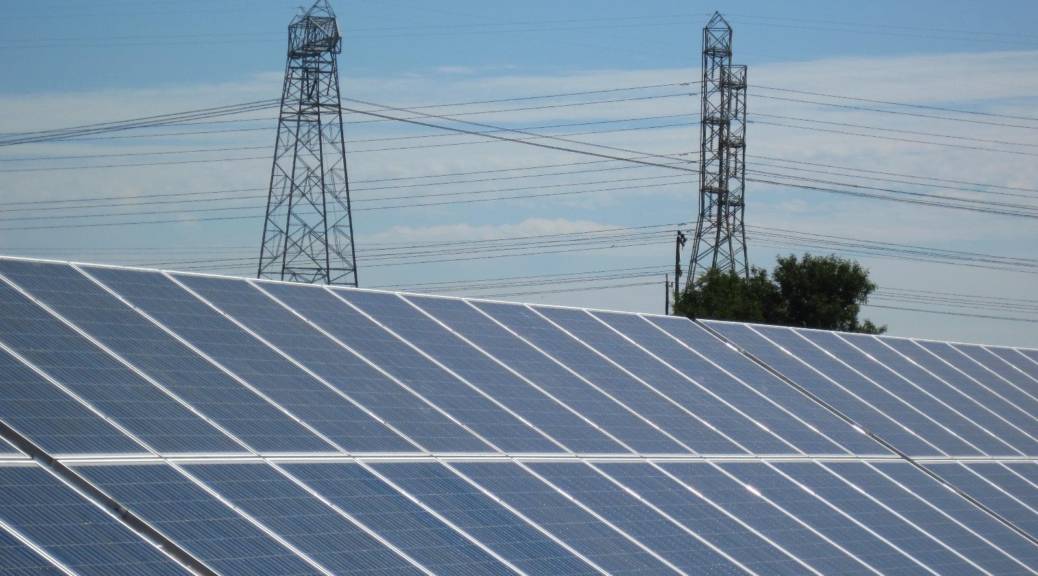
Rooftop Solar Panels in Vacaville. Photo: Craig Miller

1. MIT study finds IPCC underestimated Arctic ice melt

A forthcoming study by the Massachusetts Institute of Technology predicts that Arctic ice sheets are melting four times quicker than was forecast in the latest IPCC report. According to the study, the Arctic may be ice-free several decades sooner than 2100, which was predicted by the Fourth Assessment Report. Study authors say the IPCC data did not include forces such as wind and ocean currents that cause ice to break up.

The Journal of Geophysical Research Oceans will publish the study next month, but you can read the full news release at MIT’s website. Continue reading Climate News Roundup: the Melting Arctic, Solar Power, and Peak Oil

Yes, In Our Backyard

After more than a decade with a nuclear waste dump next door, the sky has not fallen on Carlsbad

Okay, so Yucca Mountain hasn’t worked out so well. In fact, the current betting is that the planned Nevada repository for nuclear waste will never open its doors. No matter. New Mexico beckons.

A transport container for nuclear waste, outside the Waste Isolation Pilot Plant in New Mexico.

Few Americans seem to realize that the world’s only functioning geologic repository for nuclear waste of any kind is already open for business in the southeastern corner of New Mexico. In fact, the Waste Isolation Pilot Plant is well beyond the “pilot” phase. It’s been taking in truckloads of the stuff since 1999, without mishap, it’s success no doubt a factor in its anonymity.

An average of 30 truckloads a week from all corners of the US, roll into what is essentially a glorified salt mine, licensed by the federal government to accept low-level “transuranic” waste from defense-related facilities only. Continue reading Yes, In Our Backyard

Sweden Tries Taming its “Fox”

Making strides toward nuclear waste disposal by empowering communities

The Forsmark nuclear power plant is one of three in Sweden where about half the nation’s electricity comes from 10 reactors built on the coast.

Sweden gets a lot of press as the country that’s figured out not only how and where to dispose of its nuclear waste but – significantly — how to win community support.
Continue reading Sweden Tries Taming its “Fox”

California’s Nuclear Burden

Nearly 3,000 tons of spent nuclear fuel have accumulated at nuclear power plants in California…with nowhere to take it.

"Dry casks" waiting to be loaded with spent fuel at Diablo Canyon. (Photo: Craig Miller)

It could be worse. This could be Illinois, the undisputed spent fuel champ, with more than 8,000 tons piled up at plants. As it is, California ranks eighth in the nation.

“This country has an obligation to those states and those communities to take those materials and put them into deep geologic disposal, where they can be safely isolated for a very long period of time,” says Per Peterson, who chairs the nuclear engineering department at UC Berkeley.

Trouble is, the country seems farther now from meeting that obligation than it was in 1998, the original legislative deadline for opening a permanent repository for spent nuclear fuel. Continue reading California’s Nuclear Burden