Category Archives: Power

Progress and pitfalls in California’s clean energy quest

SoCal Shines Brightest in Solar Rankings

The Bay Area likes to tout its clean, green reputation, but when it comes to installing solar, Southern California shines brightest. San Diego and Los Angeles lead the state in rooftop solar installations, according to a report released today by Environment California’s Research & Policy Center.
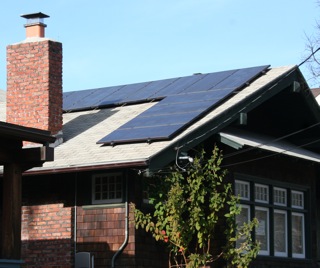
Rooftop solar panels on a home in Oakland.

San Jose comes in third with more than 2,700 rooftop installations, while San Francisco comes in fourth with more than 2,400 (though it’s fifth in terms of overall capacity). San Diego leads with 4,500-plus installations producing almost 37 megawatts of electricity.

“I think the story with San Diego is that the city was an early and very consistent adopter of solar power,” says Michelle Kinman, clean energy advocate with Environment California Research & Policy Center. “San Diego also has a really well coordinated working relationship between the local elected officials, the utility, the solar industry and the advocacy community.” Continue reading SoCal Shines Brightest in Solar Rankings

Jerry Brown Braves the Big Chill in Talking Climate

But the California governor relies largely on existing programs for progress

Governor Jerry Brown spent much of his State of the State address on California's environmental goals.

In a speech described by one Orange County Republican as “vintage Jerry,” Governor Jerry Brown tried to re-conjure the image of California as a can-do state. Brown also devoted a large portion of his annual State of the State address to environmental and climate-related topics.

Showing none of the climate timidity that has overtaken national politics, Brown declared that, “fossil fuels, particularly foreign oil, create ever rising costs to our economy and to our health.” By contrast, President Obama avoided using the word “climate” even once in last year’s State of the Union message, and gave global warming only the slightest nod in a recent address to science-friendly staffers at the Environmental Protection Agency. Continue reading Jerry Brown Braves the Big Chill in Talking Climate

Gov. Brown Signs Agreement to Fast-Track Renewable Projects

Brown and Secretary of the Interior Ken Salazar are expanding a state and federal partnership to expedite large-scale renewable projects.

The partnership between the Department of the Interior and the state of California expedites the approval process for large-scale solar, wind, and geothermal projects.” credit=”Craig Miller/Climate Watch

The partnership originates from an agreement then-Governor Arnold Schwarzenegger signed in 2009. Now Brown and Salazar are extending it, and broadening the scope of the agreement, to include not only energy, but also transmission projects. They signed a memorandum of understanding (pdf) at a solar project being built in Elk Grove this morning.

According to a press release from the state, the projects now being fast-tracked, which are the Bureau of Land Management’s seven priority projects, plus other projects on private land, will generate enough renewable energy to meet the state’s 33% by 2020 goal.

The MOU signed today doesn’t guarantee they’ll all be built, rather, it’s a move towards expediting the lengthy permitting process these large-scale projects require.

Making Hay While the Sun Shines: A Flap over Solar Panels in Farm Country

The same things that make the San Joaquin Valley ideal for growing crops, plenty of sun and land, is also attracting large-scale solar power developers.

Hear the companion radio feature Wednesday morning, on The California Report.

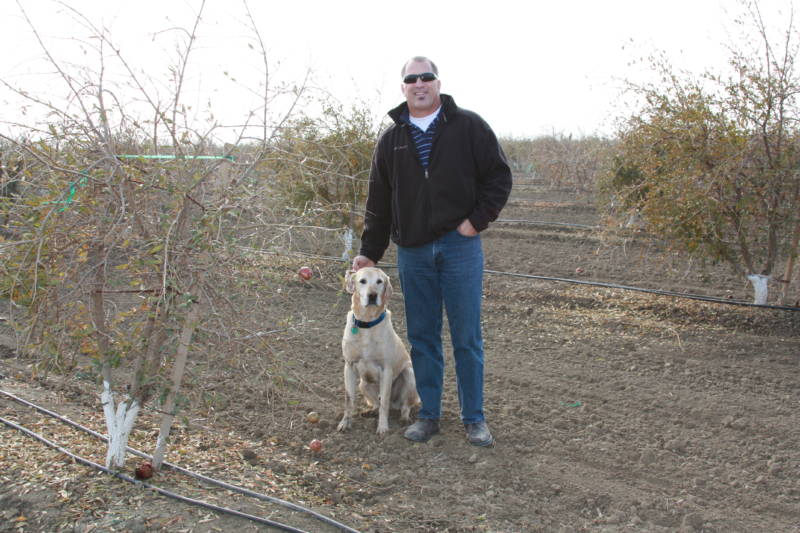
Tom Barcellos and his yellow lab, Maddox. Barcellos hopes to plant rows of pomegranate trees next to rows of solar panels, in an experiment to see if the shade from solar panels actually benefits crops.

Farmer Aaron Barcellos bristles at the idea that putting solar panels on his land is “paving it over,” as some critics have contended. Harvesting electrons, he says, is not the same as pouring concrete to build houses or a shopping center. Solar isn’t permanent: he can simply pull out the posts holding up the panels when he wants to plow the land under again. In the meantime, using a small part of his farm to generate power for the grid is a good way to bring in some guaranteed income, helping him weather the ups and downs of drought and crop prices.

But on Barcellos’s farm, the ground closest to a PG&E substation is considered “prime” farmland. That means he has to get permission from county supervisors to take his land out of the Williamson Act, which gives farmers a tax break for keeping prime farmland in agriculture. I explore that controversy in my radio story on today’s California Report.

Continue reading Making Hay While the Sun Shines: A Flap over Solar Panels in Farm Country

End is Near for Solar Tax Credit

Solar companies in the Bay Area are asking Congress to extend a popular renewable energy tax program that expires at the end of the year.

The 1603 program reimburses companies for a portion of the cost of installing solar projects.

Solar companies benefit from a 30 percent tax credit, but there’s a problem: most companies developing solar projects don’t have enough income to take the deduction. That’s where the 1603 treasury grant program comes in. It gives companies a cash grant up front in place of the tax credit.

“This program really was a fix that brought liquidity back to the market and enabled developers to move forward with their projects,” said Arno Harris, the CEO of Recurrent Energy, a San Francisco-based solar developer. “It’s definitely going to have an impact, if it’s not extended, on our appetite to continue investing in the US solar market.”

Continue reading End is Near for Solar Tax Credit

Build a Better Wind Farm and the Watts Will Beat a Path to Your Door

High-tech imaging helps Colorado researchers catch the wind

Wind power has come a long way but maximizing the output of even modern wind farms is still a challenge.

It isn’t enough to buy a slew of multi-megawatt turbines and stake them on a windy hillside. You have to know how the wind behaves, not only going into the turbine but the “wake” coming out the backside. Otherwise, you can get more windstorm than wattage. It’s a new area of research and it got help this week from scientists who literally “look” at the wind.

Speaking at the American Geophysical Union (#AGU11) here in San Francisco, Julie Lundquist from the University of Colorado, Boulder, offered up her team’s images of a wind turbine’s wake. Using Doppler Lidar — think police radar gun — she showed us the color-coded flow: a slower, cool-colored wake at the center just behind the turbine, surrounded by the warmer-colored fast flow swirling around it. Continue reading Build a Better Wind Farm and the Watts Will Beat a Path to Your Door

Can Rocks Really Store Enough CO2 to Keep it Out of the Atmosphere?

Stanford study suggests that carbon dioxide “sequestration” can be part of the global warming solution.

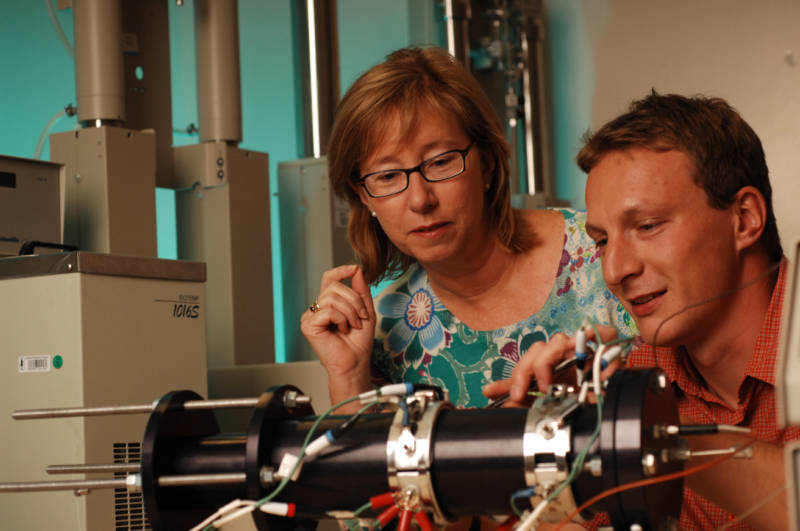
Sally Benson studies the movement of CO2 through rock samples.

Sally Benson and her lab crew have been giving rocks a very hard time.

The energy resources engineering professor has been heating rock to 122 degrees and subjecting it to the pressure of a hundred atmospheres —  the same pressure present at a half-mile or so underground — to see how carbon dioxide would move through the microscopic nooks and crannies.

It’s a key question for energy companies pinning their hopes on “carbon capture and sequestration” (CCS) as way to mitigate the high greenhouse gas emissions from burning fossil fuels. In practical terms, that means intercepting the CO2 and pumping it underground, essentially forever. Continue reading Can Rocks Really Store Enough CO2 to Keep it Out of the Atmosphere?

SolarCity’s Military Deal a Boost for the Biz

A rooftop solar array on a home in Vacaville.

SolarCity’s announcement this week that the company is moving forward with a massive military housing solar project, may be more than just a boost for one company. It’s another indication that despite a turbulent few months, the solar industry is alive and thriving.

By itself it’s a big deal that SolarCity and Bank of America Merill Lynch are teaming up without a government loan guarantee. That isn’t traditionally how it’s been done. Private investors usually like the security of a guarantee before they get into a big, risky investment. But in an interview with KQED’s Lauren Sommer, SolarCity’s CEO Lyndon Rive says this investment isn’t actually very risky, “We’re selling electricity; the consumer needs it. It’s not like you are financing a car where they can skip on their financing payments. It is a necessity.”

Continue reading SolarCity’s Military Deal a Boost for the Biz

Solar Energy: What To Do When the Sun Sets

A big solar developer makes a major move toward storing electricity

Solar-thermal plants use mirrors or “heliostats” to focus sunlight on a tower receptor that produces steam to generate electricity.” credit=”BrightSource Energy

A major barrier for solar power has always been that it doesn’t work at night (Duh). A few years ago, developers of big “utility-scale” solar projects were able to shrug this off to some degree. But Oakland-based BrightSource Energy has reversed field and decided to add to several projects the ability to store electricity for distribution after dark.

BrightSource managers say times have changed. Where utilities once wanted all the renewable capacity they could get, to meet state requirements, the priority has since shifted to having those renewable electrons available when they’re needed.

“The challenges of integrating photovoltaics and wind into the grid have driven a much deeper appreciation for those that can be highly reliable,” BrightSource CEO John Woolard told me in a phone interview. Continue reading Solar Energy: What To Do When the Sun Sets

Huge Transformation Required to Meet California Climate Goals

A new study suggests one word: Electrification

A new study suggests that massive electrification will be required to meet California's 2050 goal for greenhouse has reductions.

Chances are you’ve at least heard about California’s legal requirement to wind back greenhouse gas emissions to 1990 levels by 2020. But the state has a longer-term goal to knock another 80% off that by 2050. Is that even possible?

A new study suggests that it is — but not without a wholesale transformation from an “oil economy” to an “electric economy.”

The study, a collaboration of economists and energy forecasters at several institutions, including Lawrence Berkeley National Lab, three fundamental resets will be required to make that goal: Continue reading Huge Transformation Required to Meet California Climate Goals