Category Archives: Power

Progress and pitfalls in California’s clean energy quest

Making Noise Over Wind

Figures released this week by a national wind power trade association would seem to indicate that the expansion of wind capacity proceeds apace. The American Wind Energy Association (AWEA) reported that more than 4,000 megawatts of new capacity has been installed so far this year, a 38% increase over last year’s pace.

Even so, AWEA CEO Denise Bode seems mildly disappointed by the numbers. Citing a slowdown in manufacturing of turbine components, Bode described the industry as “swimming upstream.”

The contrary current may get even stronger if my recent visit to upstate New York is any indication. Arriving for a family visit, I found that I’d landed in the midst of an uproar over wind farms, both built and proposed. Several times a week, articles were appearing in the Watertown Daily Times, about how area residents from around the state are complaining of ill effects from the utility-scale wind farms nearby and bristling at plans for more.

Wind power has hit headwinds in the past over concerns about birds, bats and its effect on people’s views. In upstate New York, the current objection seems to be noise.
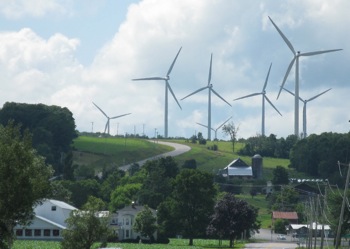
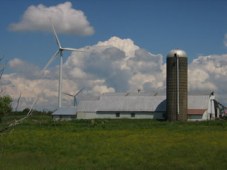
Giant wind turbines dwarf dairy farms in northern New York. Photo: Craig Miller
Commercial wind turbines dwarf dairy farms in northern New York. Photo: Craig Miller

At the Maple Ridge wind farm, billed as the biggest east of the Mississippi, I was rendered insignificant by 300-foot turbines, which tower over the farmland in Lewis County. Farther south, in New York’s Finger Lakes region, some turbines top 420 feet. More on this scale are being proposed to stretch out along the St. Lawrence River, which separates New York from Canada. Horizon Wind energy has already erected nearly 200 turbines on Maple Ridge, between the east end of Lake Ontario and the Adirondack Mountains.

Wind companies talk a lot about megawatts and numbers of households served and even tons of greenhouse gases avoided–but not so much about how big these things are. The Cape Vincent-based Wind Power Ethics Group has a graphic on its website that puts some of these numbers in perspective. It shows a 423′ turbine towering over a local lighthouse and the Statue of Liberty.

A truck hauling wind turbine blades navigates a turn onto Route 11 in northern New York. Photo: Chuck Miller
A truck hauling wind turbine blades negotiates a turn onto Route 11 in northern New York. Photo: Chuck Miller

When Californians think about wind farms, they may envision places like Altamont Pass and Tehachapi.  California pioneered wind power in the 1970s and 80s and most of the state’s windmills would barely make an impression compared to what’s going up around the country nowadays. California comes in fifth on the AWEA’s latest list of states with the most aggressive wind expansion (Missouri added the most capacity in the last quarter–New York didn’t even make the top 10).

Later this month, in a radio story for Climate Watch, I’ll look at the implications of this scaling-up as companies propose wind farms closer to populated areas in California, such west Marin County (more about that particular situation in our second Quest/Climate Watch television special, which premieres August 25).
Not Connecting the Dots

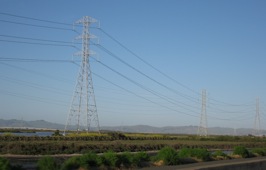
grid_0295Two developments this week would seem to validate concerns that things aren’t quite lining up for the vaunted new age of renewable energy.

While the Secretaries of Energy and Interior were offering confident assurances to a Senate panel about the future of renewables, a consortium of environmental groups was suing them over a plan for major new transmission lines for the western electrical grid.

The groups, represented by lawyers at Oakland-based EarthJustice, produced their own maps to show that the proposed routes appear to miss many areas with the most potential for solar, wind and geothermal resources. Instead, environmentalists say the West-wide Energy Transmission Corridors approved under the Bush administration would seem to line up just about perfectly with major existing and proposed coal-fired power plants (note that the maps themselves are PDF downloads).

According to EarthJustice:

“The Bush corridors plan ignores the Renewable Portfolio Standards (RPS) adopted by nine of the eleven western states to increase use of the region’s vast wind, solar, and other forms of renewable energy. The approximately 6,000 miles and 3.2 million acres of federal land in eleven western states designated as energy corridors puts imperiled wildlife at risk and slices or brushes against the borders of iconic public lands. Among these are Utah’s Grand Staircase-Escalante National Monument, Arches National Park, and New Mexico’s Sevilleta National Wildlife Refuge.”

I asked Katie Renshaw, a Washington-based lawyer for EarthJustice, if Energy and Interior wouldn’t have updated their plans since the Bush-era maps were approved. “As far as we’ve seen, they haven’t,” said Renshaw.  “An analysis was never really completed.”

The lawsuit comes just days after energy entrepreneur T. Boone Pickens revealed that he’s having to reconsider his plans for a major network of wind turbines through Texas. The reason: no transmission lines.

In California and elsewhere, proposed transmission lines have run afoul of environmental interests, as Rob Schmitz reported in his New Gridlock series for Climate Watch.

Update: Scott Streater has more on the controversy over siting renewables in a New York Times Greenwire post.

Long, Hot Summer for Climate Bill

capitoldome_hr_blogAs California’s Barbara Boxer opened Senate hearings on the Waxman-Markey climate bill today, her committee was urged by Republicans not to “rush through this thing.” At this point there seems to be little danger of that.
Having squeaked through the House by the thinnest of margins, the American Clean Energy and Security Act is facing a gantlet of Senate committees that will likely spend most of the summer dissecting the 1400-page beast.

Boxer’s Environmental and Public Woks Committee heard testimony today, with Finance and Foreign Relations scheduled to have their whack at it tomorrow. During the latter, expect to hear gruesome details about Europe’s experiment with cap & trade, which has been fraught with problems. Peter Fairley recently provided an excellent overview of those pitfalls in MIT’s Technology Review. Fairley writes that in its current form, the Waxman bill is destined to hit many of the same potholes.

During today’s morning session, members of the Energy committee heard from several cabinet-level officials, including Department of Energy Secretary Steve Chu, who fielded numerous questions on the role of nuclear power in the nation’s energy future. While California still has in place a legislated moratorium on new nuclear plants, Chu assured committee members that restarting the nuclear industry is a “very important factor” in the low-carbon future and that faces “no reluctance” from him.
Chu said his department is “pushing as hard as we can” to provide loan guarantees for new plant construction (most of which is planned for the southeastern U.S.). The former head of Lawrence Berkeley National Lab said that the U.S. has lost the lead on nuclear technology and “should get it back.”

(We’ll look at the prospects for that in a Climate Watch radio feature, scheduled to air on the August 24th broadcast of KQED’s Quest radio series.)

Committee Republicans repeated concerns about potential job losses and the danger of “carbon leakage,” wonk-speak for when production moves overseas to countries where it creates more greenhouse gas emissions than it would here.

As in the House floor debate, Republicans recalled a comment made by then-candidate Barack Obama to the San Francisco Chronicle in January of last year, that electricity rates would “necessarily skyrocket” under cap-and-trade. David Hawkins of the Natural Resources Defense Council countered that the act would also offer some savings; that households could see “up to $14 per month” in savings from transportation efficiencies.

Mapping Out Solar Power Hotspots

Somewhat overtaken by the other headlines of the week, dominated by celebrity obits and California’s financial meltdown, was the release by federal agencies of some new solar maps. They pinpoint federal lands in seven western states that present–in the government’s view–some of the best potential for building out utility-scale solar power production.

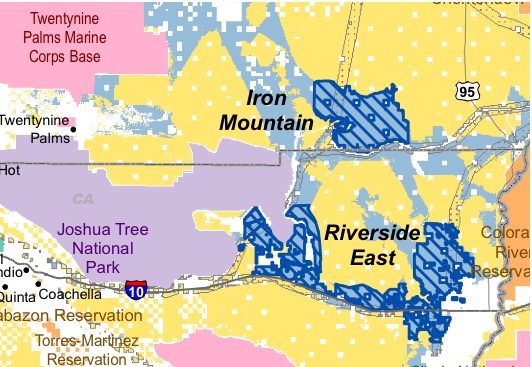
The four California locations (.pdf link) combine more than 350,000 acres in San Bernardino, Riverside and Imperial Counties. They supposedly represent the best combination of production potential, least conflict with other land uses and environmental concerns, and proximity to existing transmission lines or power plants. Areas were also mapped in neighboring Nevada and Arizona.

Update: Scott Streater has more on the controversy over planned renewable power sites, including California’s Iron Mountain site (see map, below),  in a New York Times Greenwire post.

All California locations are on BLM property in the state’s southeastern deserts. Image: DOE/BLM

The maps appeared just as California’s main regulator of power companies issued an update on solar projects in the state. The California Public Utilities Commission reported that the rate of new solar installations nearly doubled last year, from 2007 levels.

The CPUC tally shows California with over 500 MW of solar photovoltaic (PV) connected to the electric grid at almost 50,000 customer sites. The report notes that all those electrons combined are equivalent to one large power plant. About half of the current total went in under the California Solar Initiative, which has reached 13% of it’s 10-year goal, with another 8% in pending applications.

Also this week, more than $300 million fell from the federal money tree for a hydrogen power project in southern California. Cash from the American Recovery and Reinvestment Act (better known as the federal stimulus plan) will flow to the Hydrogen Energy California (HECA) project in Bakersfield. The project is designed to provide power for 150,000 homes in the area, by converting oil to hydrogen.

A statement from the California Recovery Task Force (CRTF), a conduit for federal stimulus funds, describes the HECA project as “an Integrated Gasification Combined Cycle power plant that will take petroleum coke, biomas, coal or blends of each, combined with non-potable water to convert them into hydrogen and carbon dioxide (CO2). The hydrogen gas will be used to fuel a net 250-megawatt power station.”

Perhaps more significant are the plans for the carbon dioxide generated in burning the oil. The CRTF statement says that “The CO2 will be transported by pipeline to nearby oil reservoirs and injected for permanent storage which will enhance U.S. energy security and enable additional production from existing California oilfields.”

CRTF says the project will “avoid” emissions of more than two million tons of greenhouse gases per year.

Keeping the Sizzle in California Solar

Pacific sunset by Reed Galin
Photo: Pacific sunset by Reed Galin

California, as I noted last fall as part of the series “Solar Realities,” has more solar self-generation than any other state in the nation by far. Now, if you ask the folks in the solar division of the California Public Utilities Commission, this state of affairs has a lot to do with three policies:

  1. The California Solar Initiative (CSI) provides rebates to cover about a fifth of the cost of installing solar systems.
  2. Simplified Interconnection exempts solar customers from interconnection fees and the cost of the studies required to connect their equipment to the electricity grid.
  3. Net Energy Metering allows solar power generators, who run the meter backwards as well as forwards, a credit on their power bills at “full retail electricity rates”–as opposed to the wholesale power price.

The policies were designed to encourage civilians to install solar for their own use; not necessarily to create an incentive for thousands of home power plants to serve the grid (depending on the size and location of your home, you may not be able to meet all your own electricity needs, let alone deliver surplus to the grid).

But if you can generate more solar power than you need, why not?

Adam Browning of the Vote Solar initiative, put it this way to the San Jose Mercury News: “Why are we talking about stamping on the brakes when we should be talking about pushing on the accelerator?”

Enter Assembly Bill 560. Net metering is currently capped at 2.5 % of the system’s peak energy demand or “load.” Once the stream of solar electrons coming onto the grid reaches that level,  the utility is not obligated to sign more net-metering contracts. AB 560, courtesy of Assemblywoman Nancy Skinner (D-Oakland), would provide some more headroom for that program by raising the cap to 10%.

AB 560 has passed the Assembly. Tomorrow, it comes up before the state Senate Energy, Utilities, and Communications Committee.  No doubt, a staff report due out the same day from the CPUC on the status of the California Solar Initiative will give the discussion some extra “juice.”

Meanwhile another bill, AB 920, from Assemblyman Jared Huffman (D-San Rafael), would change the way customers with solar installations are paid for surplus power. As I noted, they now get credited on their monthly bill at the full retail rate. Some of that credit is offset by “regular” power the solar customer uses at night or on cloudy days. Then, at the end of the year, leftover credits are zeroed out. AB 920 would require utilities to pay for credits left over at year-end, albeit at a lower rate–or allow the extra to be rolled over to the next year.

The CPUC, by the way, has come out in support of AB 560, but not AB 920.

The state’s three investor owned utilities dislike both bills; especially Pacific Gas & Electric, which is closest to approaching that 2.5% cap. About 30,000 of PG&E’s 6 million customers have solar systems.

PG&E contends that expanding its home solar program would burden the rest of its customers, who bankroll the state rebates for solar installations. And because solar customers buy less electricity from the utility, PG&E argues they don’t contribute as much as others to cover the costs of transmission and generation.

PG&E has said it would support raising the net-metering cap to 3%–but wants to see a cost-benefit analysis from the CPUC before supporting any further home solar expansion. That report’s due out in January.

There are those outside the industry who share PG&E’s concerns. Framing it as a class issue, the non-profit Utility Reform Network opposes raising the cap unless changes are made to allow non-solar ratepayers to share in the benefits.  Even with the current subsidies, going solar requires an often daunting up-front investment. As green becomes the color du jour for businesses and politicians, an increasing number of projects pair solar with low-income housing. But more often than not, your typical solar-powered household in California is likely to be well heeled.

As utilities enthusiastically pursue their own large scale solar projects, some solar advocates suspect that the companies are really worried that wide-scale residential solar would cut into their income. PG&E counters that state regulations eliminate the financial incentive for investor-owned utilities to simply sell more power to make more money.

All this raises a key question: Without lifting the cap on net metering, can California achieve its goal of 3,000 solar megawatts by 2016?

Rachael Myrow is host of The California Report, produced by KQED and heard on public radio stations throughout the state.

Editor’s Update: The CPUC’s latest report shows a near doubling in the rate of  installed capacity, from 2007 to 2008, and so far, data would seem to indicate a continuing trend this year. Installed  capacity to date puts the CSI at 13 percent of the total program goal, with another eight percent pending.

“Cool” Technology to Relieve Grid Lock

Kristine Wong is a student at UC Berkeley’s Graduate School of Journalism. She is currently serving an internship at KQED Climate Watch.

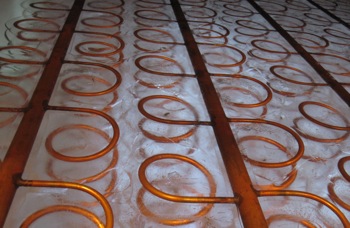
Copper meets ice in the Ice Bear rooftop cooler. Photo: Kristine Wong

Latest technology designed to improve grid performance, decrease peak energy demand
By Kristine Wong
When the hot weather hits town, everyone wants to cool off. Some down a cold drink, others take a dip in the pool. But most just turn on a switch–for the air conditioning or the fan. But when everybody jumps for the switch at the same time, the electrical grid is pushed to the max, which can lead to blackouts, as well as use of peak energy generators. Peak generators are used just a few times during the year but use more fossil fuels than other power plants.

Now, with the realization that climate change is upon us, along with advances in technology, there are new ways to stay cool while conserving energy and cutting carbon emissions at the same time. Several products showcased this week at the Edison Electric Institute conference  in San Francisco seem to have the potential to do just that.

Take SmartMeter, for instance. The program from PG&E will monitor and control home energy use by satellite, and adjust energy consumption accordingly by supply and demand via a few palm-sized monitors. Right now, it’s still in demonstration mode. But PG&E will offer voluntary enrollment in 2010, and aims to outfit all households by 2012, according to Peter Chan, a PG&E supervisor in Demand Response Operations (“demand response” is industry-speak for systems that can adjust electrical use at the consumer end). Redistributing energy as needed avoids the need to bring peak generators online. Customers lower their energy bills and can also override the system if, say, that load of laundry really needs to go into the dryer now.

The Ice Bear aims to reduce the energy needed to cool low-rise buildings (under 3 stories), using rooftop energy storage that works in conjunction with the building’s air conditioning system. Developed by Windsor, CO-based Ice Energy, a rectangular unit about the size of a sub-compact car sits on the roof and stores energy at night. It releases the energy during peak daytime periods.

The company claims that using off-peak stored power during peak hours reduces carbon emissions by 40%. And the key technology is–well, ice. Major components include a block of ice threaded with a network of copper coils designed to keep the ice from melting, a condenser that makes the ice, and a controller that achieves the building’s thermostat level most efficiently in conjunction with the building’s air conditioning system. The unit uses R410, a refrigerant which the company says is more efficient than more commonly used refrigerants such as R-22. The system comes with a price tag topping $8000 but utilities are apparently bullish on Ice Bear and have bought thousands of units–13,000-15,000 units can conserve up to 50 megawatts, according to company spokeswoman Therese Wells.

The conference also featured previews of potential “game-changing” technologies. PG&E panelist and Director of Emerging Clean Technologies Hal La Flash told the audience about a solar “nantenna,” a flexible panel that may replace solar panels in the future. And Mike Howard, Senior Vice President of Research & Development at the Electric Power Research Institute, spoke of being 5-to-10 years away from the debut of LED lighting that has the potential to be even more energy efficient than compact fluorescent bulbs.

Renewables Meet NIMBY…Everywhere

Suddenly, everywhere you look nowadays, prospects for clean, green energy are being muddied by NIMBY* syndrome.

Windmills dwarf a dairy farm in upstate New York. Photo: Craig Miller
Wind farm: Windmills dwarf a dairy barn in upstate New York. Photo: Craig Miller

We saw it first-hand in Rob Schmitz’s series on “green gridlock” in California’s southeastern deserts. Trepidation there turns more on the transmission lines that would have to go up, to connect solar, wind and geothermal fields to population centers where the power is needed.

We’ve seen it at work in efforts to license wave power projects along the West Coast.

In Marin County, it took the McEvoy Ranch nine years from concept to completion, to get one 150-foot windmill up and running, to power the olive operation. Objections from the neighbors forced them to move the site more than a half-mile, and downsize the turbine to three quarters the proposed height and one third the power output (more about this in the next Quest/Climate Watch special, to premiere on August 25).

Now, as James Glanz reports in the New York Times, seismic fears are causing tremors in geothermal fields north of San Francisco.

Glanz writes that with venture funding from Kleiner Perkins Caufield & Byers and Google, Sausalito-based AltaRock Energy is deploying “enhanced” geothermal technology to wrest more steam from the earth. But fears over the potential for unleashing earthquakes in the process are not enhancing their prospects.

*For the truly uninitiated: “Not in My Back Yard”

Parsing the White House Climate Report

At least one researcher cited in the 196-page climate impacts report issued this week by the Obama administration is not impressed with the final product. Roger Pielke of the University of Colorado’s Center for Science & Technology Research has written a blog post critical of the report and in particular, the way in which his work was interpreted. If you’d rather not plow through the entire post, John Tierney has an overview of Pielke’s critique on his blog for the New York Times.

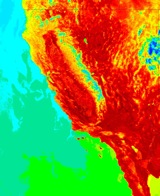
California heat wave, from the Aqua satellite. Image: NASA
2004 California heat wave, from the Aqua satellite. Image: NASA

The report was arguably the first to break down both observed and projected effects of climate change into coherent regional summaries. For the purposes of the report, California was considered part of the Southwest region, which included states as far east as Colorado and New Mexico.

Not surprisingly, many of the points raised in the Southwest section (beginning on p. 129) have to do with water supply. Most have been reported or discussed in our Climate Watch coverage, either here or in our radio reports. Selected “highlights” include:

– Past climate records based on changes in Colorado River flows indicate that drought is a frequent feature of the Southwest, with some of the longest documented “megadroughts” on Earth.

– The prospect of future droughts becoming more severe as a result of global warming is a significant concern, especially because the Southwest continues to lead the nation in population growth.

– Human-induced climate change appears to be well underway in the Southwest. Recent warming is among the most rapid in the nation, significantly more than the global average in some areas.

– Projections suggest continued strong warming, with much larger increases under higher emissions scenarios compared to lower emissions scenarios. Projected summertime temperature increases are greater than the annual average increases in some parts of the region, and are likely to be exacerbated locally by expanding urban
heat island effects.

– Water supplies in some areas of the Southwest are already becoming limited, and this trend toward scarcity is likely to be a harbinger of future water shortages. Groundwater pumping is lowering water tables, while rising temperatures reduce river flows in vital rivers including the Colorado.

– Projected temperature increases, combined with river-flow reductions, will increase the risk of water conflicts between sectors, states, and even nations.

– Increasing temperature, drought, wildfire, and invasive species will accelerate transformation of the landscape.

– Under higher emissions scenarios, high-elevation forests in California, for example, are projected to decline by 60 to 90 percent before the end of the century.

– In California, two-thirds of the more than 5,500 native plant species are projected to experience range reductions up to 80 percent before the end of this century under projected warming.

– Projected changes in the timing and amount of river flow, particularly in winter and spring, is estimated to more than double the risk of Delta flooding events by mid-century, and result in an eight-fold increase before the end of the century.

– A steady reduction in winter chilling could have serious economic impacts on fruit and nut production in the region. California’s losses due to future climate change are estimated between zero and 40 percent for wine and table grapes, almonds, oranges, walnuts, and avocados, varying significantly by location.

By the way, Pielke’s critique does not directly address anything in this list, though his work does involve weather-related disasters, which would include floods. Asked by a commentator on his blog if he thinks the entire report should be dismissed based on the flawed interpretation of his research, Pielke replied: “I wouldn’t think so and would certainly hope not. At the same time the section which covers my research does not give me a lot of confidence in the process that led to the report.”

Speed Bumps on the “Hydrogen Highway”

Seems like the Governor is spending a lot of time looking at cars lately. If the rest of us spent as much time cruising Auto Row, the recession might already be fading in the rear-view mirror.

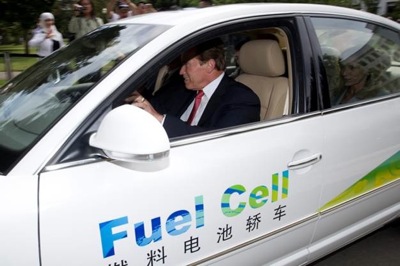
Governor Schwarzenegger tries out the Volkswagen Passat Lingyu. Photo: Governor's Office
Governor Schwarzenegger at the wheel of a Volkswagen Passat Lingyu. Photo: Governor's Office

But California’s chief executive isn’t interested in run-of-the-mill rolling stock (he will, of course, happily take credit for inventing the Hummer). He’s into exotics: the alternative-fuel cars of the future–and in some cases, present.

At least five times in the last three weeks, the Governor’s Office has created photo ops with alt-fuel autos, prototypes or refueling stations; from a fuel-cell Volkswagen (June 3) to the Mutt-&-Jeff of electrics, Hummer and Peapod (May 28 & June 10, respectively), he’s kicked the tires on a whole generation of not-widely-available wheels–not to mention the home ethanol refinery (June 4) or the hydrogen refueling station in Santa Monica (May 27).

All of which got us to wondering: “Dude, where’s our Hydrogen Highway?” You may recall the Governor’s promise five years ago, that California would by now be coming down the home stretch on a whole new infrastructure for the coming swarm of cars powered by hydrogen fuel cells.

Monday morning on KQED’s weekly Quest radio feature, David Gorn reports that we’ve apparently hit a few speed bumps:

“The technology clearly has promise, but it’s behind schedule. Schwarzenegger’s original plan called for 100 to 150 hydrogen fuel stations by next year, and so far there are only about two dozen. He also wanted 2,000 hydrogen-powered cars on the road, yet fewer than 200 are being road-tested today. The lack of progress has prompted California’s non-partisan state legislative analyst to recommend scrapping state funding for the hydrogen program. And on the federal level, Energy Secretary Steven Chu has asked Congress to cut about half of the national hydrogen-research budget. Chu said hydrogen technology is too far from fruition.”

None of these details stopped Governor  Schwarzenegger from hyping the 2009 Hydrogen Road Tour, a recently concluded San Diego-to-Vancouver rally, designed to highlight fuel-cell technology:

“We will keep pushing, and thanks to our public-private partnerships and the commitment of these automakers and energy companies, the era of pollution-free transportation is dawning.”

The Governor’s statement went on to say that “Auto manufacturers expect the number of hydrogen vehicles to increase to 4,300 by 2014 and more than 40,000 vehicles by 2017.” Of course, that was before Energy Secretary Steve Chu announced that R&D funding for hydrogen fuel cells on the road didn’t quite make the cut for the next DOE budget. Plug-in hydrid, anyone?

Transportation’s Tricky Carbon Footprint

Kristine Wong is our Climate Watch intern for the current term. She’s a student at UC Berkeley’s Graduate School of Journalism.

interchange_0145_blogStudy comparing environmental impact of transportation modes yields surprising results

By Kristine Wong

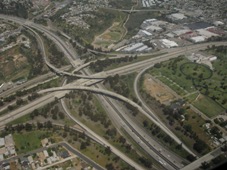
You may not believe that during peak commute hours, Boston’s light rail system generates more greenhouse gases (GHGs) per person than a gas-powered, fully occupied SUV–or a commercial airliner filled to capacity, traveling the same distance.

Yet this is what UC Berkeley researchers found in a study released this week. Mikhail Chester and Arpad Horvath compared the environmental impacts of cars, buses, planes, and rail after adding up all the energy costs and emissions (both GHGs and local air pollutants) over their entire life cycle–not just by what came out of the tailpipe. The authors say no such comprehensive study had been done before.

The researchers developed a method that evaluated each transportation mode based on the energy inputs needed for production and maintenance of the vehicle itself. They also looked at the infrastructure for each mode, such as construction of supporting components like rail station platforms and airport runways, bus and rail station lighting and parking, and the source of  power for each mode (e.g. gasoline, jet fuel, diesel or electric–and the costs of distributing and producing these inputs).

In total, Chester and Horvath compared 79 components across all transportation modes. Within each they also selected a few variations to represent differences, depending on factors such as vehicle make and mileage, passenger occupancy, and size.

The results were both logical and surprising. Most of the energy consumed and GHG emissions from auto, bus and air travel originated from the operational period, not from the materials needed to produce and maintain the vehicles. Rail produced the greatest amount of GHGs compared to all other modes over their life cycle. But Chester and Horvath point out that there is a big difference in GHG emissions from light rail systems in the Bay Area versus, say, Boston due to the portion of fossil fuel-based electricity used. Boston’s fuel mix is 82% fossil, while the Bay Area’s BART system clocks in at just 49% fossil fuel–a major factor in efficiency and GHG emission rates.

Finally, passenger occupancy was a key factor influencing efficiency. Not surprisingly, each mode was most efficient when used to capacity. But the researchers caution that boosting passenger occupancy is not a magic bullet. They say minimizing fossil fuel inputs and adding pollution filters and controls would have a greater effect on efficiency.

Chester and Horvath say that they hope their results will provide a framework for more comprehensive analysis of the environmental impacts of transportation, and to assess the impact of hybrid or electric vehicles and alternative energy sources such as biofuels, solar power, and wind power, none of which were included in the study.

There are more details of the study posted at the websites for Green Car Congress and Sustainable Transportation.