Category Archives: Power

Progress and pitfalls in California’s clean energy quest

Head-to-Head: Chevron and The Sierra Club

Two giants of California’s energy debate squared off at a Commonwealth Club forum in San Francisco last night.

Chevron CEO Dave O’Reilly and Sierra Club Executive Director Carl Pope fielded questions from moderator Alan Murray of The Wall Street Journal and a sometimes impassioned audience, about renewable energy opportunities, reducing greenhouse gas emissions, and predictions for the future of the United States’ energy economy. Several questions also concerned Chevron’s high profile court battle in Ecuador and the oil company’s presence in Richmond, the Bay Area city where a major Chevron refinery dominates the skyline–and some say, local governance
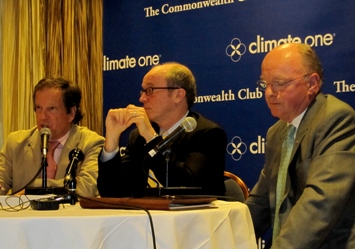
Carl Pope, ED of Sierra Club Alan Murray, Executive Editor of WSJ Online Dave O'Reilly, CEO of Chevron. Photo: Gretchen Weber
From left to right: Sierra Club chief Carl Pope; WSJ Online Executive Editor Alan Murray; Dave O'Reilly, CEO of Chevron. Photo: Gretchen Weber

In what was less of a debate than a discussion, Pope and O’Reilly agreed that the United States needs to make major changes towards greater energy efficiency and that the country must begin to rely more on renewable energy sources.

Their views diverged significantly, however, on the timeline for such changes. While Pope supports a 90% reduction of greenhouse gas emissions from today’s levels by 2050 and says he believes this goal possible, O’Reilly projected that by 2050, the United States will have reduced its GHG emissions by no more than 20-25% from today’s levels.

O’Reilly said that even if the U.S. replaced the entire transportation system with a zero-emissions system, the country would reduce GHG emissions by just 34%–and that doing likewise with the nation’s power generation would reduce GHGs by another 40%.

“So we have to ask ourselves, can we replace our entire energy system–transportation and power–in just a few short decades?” said O’Reilly. “I think the transition is going to take some time.”

According to O’Reilly, his company is already the largest provider of geothermal energy in the world and yet only 2% of Chevron’s income currently comes from renewable energy.

“The challenge of scale demands that we acknowledge that conventional energy sources will remain indispensable for decades,” said O’Reilly. “We must be realistic. For the foreseeable future we need to develop it all: conventional as well as non-conventional energy, as well as renewables and alternatives.”

When asked what his prediction was for how much of Chevron’s income would come from renewable energy sources by 2050, O’Reilly said he thought the number would be about 10-15%.

Pope responded, “The world will have room in 2050 for a very small company, 90% of whose energy comes from fossils [fuels]. The world will not have room, or tolerance, in 2050 for a big energy company [that does], so if Chevron wants to be successful, I think Chevron’s going to need to change those numbers.

Pope also called on Chevron to “come to the table” with local communities in which Chevron operates, such as Richmond, CA, and he proposed that all oil companies donate 10% of their profits to a global fund to clean up areas of the world damaged by the petroleum industry.

Not surprisingly, Pope and O’Reilly agreed that the highest priority for reducing GHG emissions is to replace coal with natural gas or another less carbon-intensive energy source, and while on stage, the men shook hands on an agreement to lobby the issue together in Washington.

KQED will broadcast the entire Commonwealth Club event at 8 p.m. on Friday, June 19, with a rebroadcast at 2 a.m. the following morning.
New Report Finds More Clean Energy Would Grow CA Economy

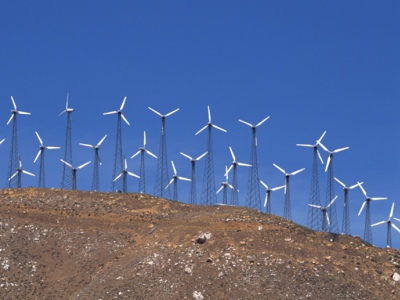
wind-powersmThe think tank known as Next 10 is the Voice of Eternal Optimism, when it comes to the economic potential of decarbonization. Its latest report poses the question: “Can California afford clean energy now?” You can probably guess the answer.

The study [PDF], which was funded by Next 10 and authored by UC Berkeley professor David Roland-Holst and a team of researchers from the Department of Agricultural and Resource Economics, concludes that California will face greater economic uncertainty if the state continues on a “business-as-usual” path in terms of energy. A greater investment in clean energy, the report finds, will spur sustained economic growth.

The study analyzes five new energy scenarios including  three different degrees of Renewable Portfolio Standards (RPS): 20 percent, 33 percent, and 50 percent as well as a 50 percent RPS plus energy efficiency increases of 1.0 and 1.5 percent per year.

According to the Executive Summary [PDF], the study’s most ambitious scenario, 50 percent renewable fuels and a 1.5 percent efficiency increase, could generate 420,000 additional jobs with more than $100 billion in cumulative payrolls over 40 years (2008-2050).   Without the energy efficiency  increases, however, the numbers are much lower. The report finds that a 50 percent RPS alone would create about 60,000 new jobs, whereas 33 percent would create just half that number.

California’s current RPS is intended to increase from 12 to 20 percent by 2010.  Last November, Governor Schwarzenegger set a target for California to have 33 percent of its electricity provided by renewable resources by 2020.

No Crystal Ball for Fusion Power

Lawrence Livermore Nat'l Lab
Photo: Lawrence Livermore Nat'l Lab

Now here’s a guy with some historical perspective: For something north of a half-century, David Perlman has been covering science for the San Francisco Chronicle. On KQED’s Forum program this morning, he noted that “40 years ago, they said ‘in 20 years, we’ll have unlimited energy from fusion’.”

The record will show that we didn’t quite get there–but that hasn’t stopped them from trying. The long quest for bottled fusion will pass another milestone this week, when the US Dept. of Energy formally cuts the ribbon on the National Ignition Facility (NIF) at Lawrence Livermore National Lab.

Comparing the hardware with other titanic undertakings, like the CERN particle accelerator in Switzerland, Perlman called the 192-laser assembly “one of the most amazing machines–if it succeeds–and one probably won’t know for the next two, three years.”

That’s the hopeful time frame for creating fusion in a fuel pellet the size of a BB (artistically rendered in the image, above) Will they? Perlman says: “I would not dream of putting a bet on it.”

Nor would sparking some mini-fusion at NIF quickly translate to a national solution for clean, safe energy. Scaling that ignition up to practical size for reactors would likely require decades more.

A NIF technician appears to be gazing into a "crystal ball," which is actually used to amplify laser beams--but not much good for predicting the future. Photo: Lawrence Livermore National Lab
A NIF technician appears to be gazing into a "crystal ball." Precision-ground crystals are used to amplify laser beams--but not much good for seeing into the future. Photo: Lawrence Livermore National Lab

Earlier this week, in an interview with NASA scientist James Hansen, I asked him about the potential for nuclear power to make a comeback with new technology. Rather than waiting for fusion, Hansen favors the technology known as “fourth-generation nuclear,” which he says could “burn nearly all of the fuel, where at present, the nuclear technology that we’re using burns only one percent of the energy in the uranium.” From one percent to “nearly all” would represent a drastic reduction in the current radioactive waste problem.

There may be some wishful thinking in that. An early report published in the magazine 21st Century Science & Technology describes these “Generation IV” reactors as “about 50% more efficient than conventional nuclear reactors.”

Other nations have moved ahead with Gen-IV reactors. The French expect to have one under construction by 2020.

Meanwhile, as the US pursues a parallel Gen-IV research program, it will press on toward the Holy Grail of fusion with its Livermore megalaser, described by Perlman as “already a mini-Manhattan Project.” Costs so far have run to nearly triple the original budget of more than a billion dollars. DOE expects to spend $140 million per year to run the NIF. So, it would be–you know–nice if something comes of it.

New Tailpipe Regs are an “Alternate Reality”

Amy Standen specializes in science and environmental reporting for Quest. She’s among the guests today on KQED’s Forum program. Listen to the archived program here.

Hazy day in L.A. Photo: Craig Miller

Yesterday afternoon, as I started working on my news spot about the new federal standard for tailpipe emissions, I dug up my notes from over a year ago, the last time I covered this story in any depth.

The contrast in tone between then and now amazed me. Back then, I was describing accusations of outright lying, government actions that California enviros called “completely illegal,” and California officials “sharpening their knives” as they marched into battle with EPA former Administrator Stephen Johnson. It was September, 2007, and Democratic lawmakers, led by Henry Waxman (D-CA), were accusing the White House of strong-arming the EPA into denying California its “waiver,” or permission to regulate auto tailpipe emissions. The mood between California environmentalists, many of the state’s elected officials, and the Bush administration couldn’t have been more hostile.

Today, it’s as if we’ve landed in an alternate reality.  Not only has California been given its more fuel-efficient cars, but those same laws are taking effect nationwide. The new rules actually exceed anything that California–traditionally the most ambitious state in the union, when it comes to greenhouse gas regulation–could have asked for.

Instead of knives being sharpened, California enviros are singing the praises of “an historic blueprint to carry out rigorous greenhouse gas emission standards,” to quote one email I received today. Another group told the New York Times: “This is the single biggest step the American government has ever taken to cut greenhouse gas emissions.” Compared to the fall of ’07–actually make that since ’05, when California first asked for the waiver and the EPA first started stalling–it’s like night and day.

Still, listening in to the White House background press briefing on Monday afternoon, you could hear the seeds of criticism taking root in a few reporters’ questions.

Sure, American automakers will be making more fuel-efficient cars, one reporter asked, but what is the White House doing to encourage consumers to buy them? (in addition to restricting tailpipe emissions, the new rules also substantially increase fuel efficiency standards for manufacturers’ fleets–SUVs and trucks will still be available; they’ll be more fuel efficient than before, but less efficient than smaller cars.) The question takes on new relevance as the federal government finds itself a major stockholder in auto companies.

President Obama says the new regs will have the equivalent impact of taking 177 million cars off the road.

California Not Catching the Wave…Yet

Tom Banse’s radio report on West Coast wave energy aired Thursday morning on The California Report. It’s also posted to the Climate Watch Radio section on this site.

A Crib Sheet for West Coast Ocean Energy

Every now and then when the government gets something right, it’s only fair to give credit.  So today we give props to the Federal Energy Regulatory Commission for making public records easily accessible.  Combined with our handy-dandy crib sheet, you can be the reporter and dig up all sorts of newsworthy nuggets.  We’ll get to some examples, but first the overview:

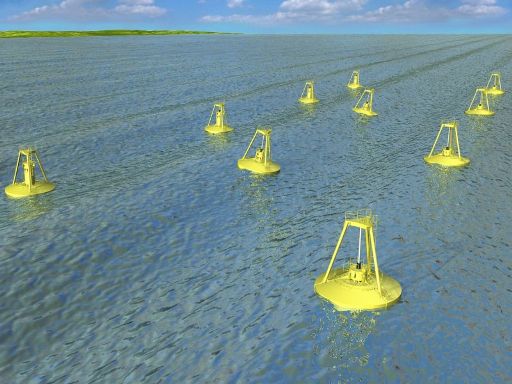
Wave energy buoys proposed for Reedsport, OR (artist's conception). Photo by Tom Banse.
Wave energy buoys proposed for Reedsport, OR (artist's conception). Image provided by: Ocean Power Technologies

Starting in 2006, there was a “gold rush” on the ocean to stake claims for wave energy sites.  Now the spray is settling and an industry shakeout is occurring.  Energy developers have given up on about a third of the wave power projects they proposed along the West Coast.  Some tidal power proposals are ebbing away as well.  When things go sideways, we rarely get a press release about it.  Often the news pops up first in a filing to FERC.

FERC is the agency that oversees wave and tidal power projects in state waters (up to 3 miles offshore).  The agency’s webmasters set up an “eLibrary” to archive project applications and correspondence.

You can see on the crib sheet that FERC dismissed three ocean energy projects in California waters last month.  The simple explanation is that the three projects ended up on the wrong side of a bureaucratic turf battle.  The Department of Interior’s Minerals Management Service (MMS) won jurisdiction over all energy development on the outer continental shelf, defined in this case as more than three miles offshore.  Grays Harbor Ocean Energy Company president Burt Hamner explained in an e-mail:

FERC has cancelled its entire preliminary permit process for projects located on Federal ocean waters, and thus dismissed our seven pending applications for preliminary permits (as well as those of a few others).  The new MMS framework says that applicants for wave projects must first get a MMS lease for space, then apply to FERC for a commercial hydropower license.  But, MMS is prohibited from issuing leases in national marine sanctuaries.  Two of our projects, San Francisco and Hawaii, are in sanctuaries.  Therefore these are terminated because there is no way to get a lease or permits there.

At the City of San Francisco, utility specialist Randall Smith said the FERC dismissal of the city’s preliminary permit for the Oceanside project “doesn’t put us back to square one, but does force a step back.”  Smith elaborated, “The difference with MMS is getting a lease.  That’s a little more protracted.”

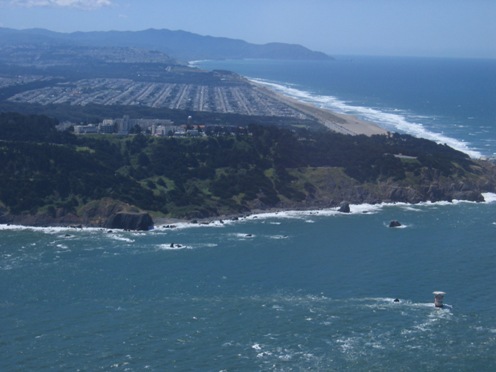
One wave power project was proposed for waters off San Francisco's Ocean Beach (upper right).
A wave power project proposed for waters off San Francisco's Ocean Beach (upper right) is in limbo.

The voluminous dockets for PG&E’s WaveConnect projects off Humboldt and Mendocino Counties, and the Green Wave Mendocino Wave Park suggest those are the ones moving ahead the fastest.  PG&E recently secured $6 million to pay for environmental studies, design work, and permitting.  The utility started its community outreach by scheduling two town meetings–in Eureka on May 19 and Ft. Bragg on May 21–both scheduled for 6 pm.

And now, the secret code: An easy way to keep tabs on a marine energy project is to make note of the applicant’s docket number (the one that starts with P-xxxxx) and then periodically plug that number into a “Docket search.”  (Click on “Submit” rather than the more prominent “Search Consolidated Dockets” button.)Here are all of the West Coast wave energy projects proposed to FERC, listed from north to south, as of this week:

P-12751 Makah Bay (Finavera)  license surrendered  4/09

P-13058 Grays Harbor Ocean Energy (Grays Harbor Ocean Energy Company)  11/2007

P-13047 Oregon Coastal Wave Energy (Tillamook Intergovernmental Dev. Entity) 10/2007

P-12750 Newport OPT Wave Park (Ocean Power Technologies)  permit surrendered 3/09

P-12793 Florence Oregon Ocean Wave Project (Oceanlinx)  4/2007, withdrawn 4/08

P-12713 Reedsport OPT Wave Park (Ocean Power Technologies)  3/2006

P-12743 Douglas County Wave Energy (Douglas County, OR)  9/2006  (oscillating column device on Umpqua River jetty)

P-12749 Coos Bay OPT Wave Park (Ocean Power Technologies)  3/2006

P-12752 Coos County Offshore (Bandon, Oregon) (Finavera) permit cancelled w/o objection 6/08

P-12779 Humboldt County WaveConnect (PG&E)  2/07

P-12753 Humboldt County Wave Energy (Finavera) permit surrendered 2/09

P-13075 Centerville OPT Wave Park (Ocean Power Technologies)  11/2007

P-12781 Mendocino County WaveConnect (PG&E)  2/07

P-13053 Green Wave Mendocino Wave Park (Green Wave Energy Solutions, LLC)  10/07

P-13377 and P-13378 Fort Ross Project- N & S (Sonoma County Water Agency)  2/09 pending

P-13376 Del Mar Landing Project (Sonoma County Water Agency)  2/09 pending

P-13308 San Francisco Ocean Energy Project (Grays Harbor Ocean Energy Company, LLC)  10/08 Dismissed 4/09

P-13379 San Francisco Oceanside Wave Energy Project (City and County of SF)  filed 02/09 Dismissed 4/09

P-13052 Green Wave San Luis Obispo Wave Park (Green Wave Energy Solutions, LLC) filed 10/07 pending

P-13309 Ventura Ocean Energy Project (Grays Harbor Ocean Energy Company)  10/08 Dismissed 4/09

Total proposed wave energy projects since 2006: 21

Total projects scrubbed by developer: 5

Total projects rejected by FERC: 3

For extra credit – Noteworthy tidal energy projects:

P-12585 San Francisco Bay Tidal Energy Project (Oceana Energy)  10/08

P-12672 Columbia River Tidal Energy Project (Oceana Energy) Permit surrendered 3/08


Climate Change: The Next Generation

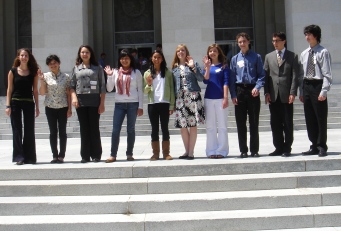
California's 2009 Climate Champions in Sacramento. (April 27, 2009)
California's 2009 Climate Champions in Sacramento (April 27, 2009) Photo by Amanda Dyer

Don’t let anyone convince you that today’s teenagers  are all too busy watching Gossip Girl to notice what’s going on the world.   At least some of them are all too aware that they’ll be inheriting whatever their elders leave them in the way of climate policy–a promising start or a global Gordian knot.

So, in Sacramento on Monday, California Air Resources Board chair Mary Nichols witnessed some thoughtful, engaged, youth-in-action as she fielded sophisticated questions from the newly-inaugurated 2009 California Climate Champions.

Over lunch, these ten high school students asked Nichols about the  future of electric cars in the state, how to help low-income Californians reduce emissions, the availability of renewable energy sources, and how CARB is dealing with political resistance to California’s Global Warming Solutions Act,  AB 32.

Mark Bessen, a 2009 Climate Champion from Palos Verdes High School in Rolling Hills Estates, asked Nichols how society can translate science into political action.

“That is the secret of life,” she replied.

Now in it’s second year, the California Climate Champions program selects high school students from across the state to serve as educators about global warming and to “champion” projects that address climate change issues in their own communities.

This year’s students are planning a diverse set of projects that include alternative fuels, solar power, water conservation, and large-scale composting.  For example, Nicholas Dahlquist  from Rim of the World High School in Lake Arrowhead plans to use chemistry to explore the potential for powering school buses with waste vegetable oil.

“The idea is to take used vegetable oil from deep frying and convert it into a fuel you can use in any diesel engine,” said Dalquist. “The process is relatively straightforward.” Currently, using vegetable oil as a diesel fuel requires some engine modification.

The challenge, he says, is getting people to actually use the fuels, so raising awareness about alternative fuels and working with local transportation authorities to explore possibilities are both aspects of his project plan.

“Biodiesel from waste oil, unlike biodiesel in general, does not require food crops in order to create it.  It’s basically a renewable resource that would otherwise be waste,” he said.

Other champions include Soraya Okuda, a student at Lowell High School in San Francisco, who is working to establish a composting system at San Francisco State University and at the nearby Stonestown Galleria. Another, Jason Bade, from Aragon High School in Foster City,  plans to lobby cities to develop programs that help homeowners purchase and install rooftop solar panels.

Read about the rest of the 2009 Climate Champions and check in on the progress of last year’s Champions and their projects at www.climatechamps.org.

“Smart Grid” Getting Some Juice

img_3197_blogThe mainstream media’s beginning to catch up to the “smart grid” story; the grand plan to remake the nation’s electrical distribution system.

On Friday, NPR began a ten-part series; “Power Hungry: Reinventing the U.S. Electric Grid.” The reports will air on both of the network’s flagship programs, Morning Edition and All Things Considered.

KQED’s Lauren Sommer set up the series earlier this month, with her backgrounder on emerging smart-grid technologies for Quest. Her report also includes a narrated slideshow, that includes a look inside PG&E’s version of “Mission Control.”

In March, Rob Schmitz previewed some of the challenges in his two-part series for Climate Watch, “Green Gridlock.”

And if you’re still “power hungry” after all that, Scott Pelley’s piece on the coal power industry is well worth a twelve-minute investment at the 60 Minutes website.

Low-Carbon Fuels in Your Future

After years of study and a day of marathon testimony in Sacramento, state regulators have adopted the world’s first low-carbon standard (LCFS) for transportation fuels. Only one member of the California Air Resources Board, John Telles, voted against adoption.

During nearly six hours of testimony by almost 100 speakers, businesses lined up both for and against the new rules. As Marjorie Sun reported for us this week, some claimed that calculations for the carbon footprints of different fuels–especially ethanol–were not even-handed. Speaker after speaker assailed the LCFS as being the product of “incomplete analysis” or just bad math (public testimony begins about an hour into the webcast).

But Daniel Sperling, a UC Davis professor and member of the Air Board, calls it “government at its best.”

“There’s been a huge amount of effort,” he said, ” in working with the oil companies, working with the electricity companies, working with the environmental community, working with the biofuels companies, to try to get this really done right.”

Though numerous speakers challenged the view that it was done right, both Sperling and Air Board head Mary Nichols seemed to leave the door open to additional tweakage of the regulations. “In the end, it’s a science-based policy,” said Sterling. “There are a lot of pieces of this that we’re not certain exactly the best way to do it but we’ve got the framework of a really outstanding policy and an important policy. And we’ve made the commitment to work with all the different stakeholders in refining it, to make sure that it really works best.”

Small-business and environmental justice groups locked arms to decry the cost of the new rules. Some cited a report from Sacramento-based Sierra Research estimating $3.8 billion in increased fuel costs by 2020, if the LCFS takes effect.

An “expert working group” is due to report back on January 1, with possible suggestions for fine-tuning the plan.

Board member Ron Roberts summed up the proposed regulation by paraphrasing Winston Churchill: “It may not be the end or even the beginning of the end, but it’s the end of the start,” said Roberts (falling somewhat short of Churchillian eloquence but point taken).

The new rules are designed to cut greenhouse gas emissions from transportation 10 percent by 20-20.  Sperling is now headed to Capitol Hill, to testify before Congress on national legislation. California’s process is being closely watched in Washington, where pending federal carbon legislation is widely seen to be modeled after California’s plan.

The Battle Over Biomass

This week, the California Air Resources Board is expected to pass a controversial new standard that measures the carbon footprint of transportation fuels. Reporter Marjorie Sun filed a story for Climate Watch on the measure and why the ethanol industry is fighting it. She provides some additional insights here:

The proposed low carbon fuel standard is part of a broad effort by the California regulators to roll greenhouse gas emissions back to 1990 levels by 2020.

biofuel pumpSlashing carbon emissions from cars and trucks is a big part of the state’s game plan. That’s because transportation accounts for 40 percent of the state’s greenhouse gas emissions. A whopping 96 percent of the fuel sources that power our cars and trucks is petroleum-based. Right now, the bulk of ethanol sold in California–and the rest of the United States for that matter—is corn-based. (Brazil makes its ethanol fuel from sugar cane, which has a smaller carbon footprint.) U.S. producers argue that the proposed Low-Carbon Fuel Standard (LCFS) would make corn-based ethanol less competitive in the marketplace because of the way it calculates emissions. Pacific Ethanol was the biggest ethanol producer and marketer in California– until recently. With the drop in gasoline prices over the past year, demand for ethanol has plummeted. Over the past several months the company suspended operations at its two production plants in California and stopped construction of a third facility. In March, it filed for loan extensions with its creditors. So the new fuel standard could deliver yet another blow to the company. Hence, ethanol interests have been putting up a fight. But the Air Resources Board is counting on the proposed standard to spur innovation in the alternative fuels market, to reduce carbon emissions. The state says it’s hoping to “expand the size of the current renewable fuels market in California (already the largest in the nation) by three-to-five times. Instead of today’s corn, over half of the ethanol is likely to be made from extremely low-carbon, cellulosic feedstocks such as agricultural waste and switchgrass. There are numerous startups in California working on cellulosic ethanol. They’re experimenting with a wide range of plants, from switchgrass to algae, as potential sources of ethanol. Getting a new fuel to market, however, requires enormous capital costs. The state is projecting that by 2020, Californians will have bought more than 7 million alternative-fuel and hybrid vehicles. That’s about 20 times greater than today. But in these tight economic times, folks are hanging onto their old cars. So it’s not clear how fast Priuses and plug-ins will replace the carbon-spewing cars on the road today.

Sun’s radio story aired Wednesday on The California Report.

One More Reason to Hate Spam

As if we didn’t have enough already. We’re talking about the Internet kind, of course, not the canned variety.

Drawing on a study from protective software maker McAfee, ABC News has posted an interesting take on Internet junk mail and the carbon emissions associated with it. The upshot is that the energy used in spewing out 62 trillion (yes, with a “t”) individual pieces of spam last year could power all Bay Area homes or some entire states.

But beyond just another villification of uninvited come-ons for “male enhancement” or Nigerian money schemes, it sort of drives home the point that everything seems to have some kind of carbon footprint–even activities that take place entirely in the “digishpere.”

Here’s another take on the report from The Tech Herald.