

Category Archives: Power

Progress and pitfalls in California’s clean energy quest

China: Have a Carb and a Smile

carb_stockWhat does coal power have to do with popping a can of soda? This morning, NPR’s Anthony Kuhn reported on a power plant in China that is successfully capturing some of the carbon dioxide it releases. They extract it, liquefy it, and send it off to companies that use it in dry ice, fire extinguishers, and even carbonated beverages. A handful of power plants in U.S. are already doing the same.

Of course, when it comes to reducing carbon emissions, capture is only half the battle. The carbon snared from these plants is only temporarily stored – it gets released eventually–like when someone pops the top of the soda can.  It’s more like carbon recycling. The greater hurdle is in “sequestering” part of it.  In order to make a lasting difference in cutting emissions, that carbon has to be stored permanently.

President Obama has signaled that developing carbon sequestration technology is a key part of his energy plan, and is handing out billions in stimulus dollars.  But the U.S. is already behind the curve.  While there are several ways to store carbon, the main focus has been on storing carbon underground in geologic formations. There are several power plants in Europe that are already capturing and sequestering carbon emissions underground.  The Bush Administration backed off its first attempt at carbon capture and sequestration (CCS), the FutureGen project, in 2008 after the costs became too high. The name of game now is to simply get a demonstration plant working. Anywhere.

Here in California, CCS is an option, thanks to the underground geologic formations throughout the Central Valley that could be ideal sites. A western consortium known as WESTCARB is leading the charge with backing from the California Energy Commission and the Department of Energy.  They’ve announced a pilot project in Bakersfield where carbon will be captured from a 50-megawatt power plant. But construction is described as still “months away.”

As with any new technology, cost is the make-or-break issue.  Capturing and stashing carbon is prohibitively expensive–at least until there’s a price on carbon or the technology improves. This week, Energy Secretary Steven Chu said he doesn’t expect to see cost-effective technology for at least eight years. And he raised another point. “Even if the United States or Europe turns its back on coal, India and China will not,” Chu said.  At last fall’s climate summit in Los Angeles, members of the Chinese delegation told Climate Watch that they were looking to the U.S. to provide key technology. But as Anthony Kuhn reported, the Chinese went to Australia to get technical advice.

It’s commonly forecast that coal will remain a central power source in the U.S. for decades to come. But as critics of carbon sequestration have stated, it’s really a question of whether cost-effective technology will arrive in time to slow down climate change.

Lauren Sommer is an associate producer with Quest at KQED, and a self-described “carbon geek.” Her story on plans for a “smart” electrical grid is Monday’s Quest Radio feature.

Possible Detour on the “Electron Superhighway”

electwr_blog

It appears that almost 200,000 acres of Mojave Desert will be under federal wilderness protection now that Congress passed the Omnibus Land Management Act of 2009.

Much more was set aside throughout California, as I report in my radio story for The California Report.

Now, Senator Dianne Feinstein is eyeing almost a million additional acres in the Mojave off of old Route 66 between Ludlow and Needles.

There are currently 163 proposed renewable energy projects for federal lands in the Mojave Desert region. Nineteen of them are slated for the land Senator Feinstein wants to set aside. If energy companies can’t build on that land, it follows that they’ll try to build it in the land that’s left.

And that’s got a lot of people who live in the unprotected areas of the Mojave worried. Not only are most of the state’s large-scale renewable energy projects planned for this region, but as I explored in a recent two-part series for Climate Watch, there’s also a transmission corridor in the works to carry that power to Los Angeles.

Use the player below to listen to my conversation with Jim Harvey, who heads the Alliance for Responsible Energy Policy, about what all of this new land protection means for environmentalists like him.

[audio:http://ww2.kqed.org/climatewatch/wp-content/uploads/sites/54/2009/03/jimharvey-blog2.mp3]

Oh, No–Another “Superhighway”

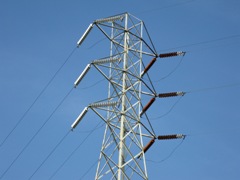
Just when we could exhale, assured that the term “Information Superhighway” had faded mercifully into the rear-view mirror–at the signpost up ahead: Your next stop: the “Electron Superhighway.”

That’s the term that Interior Secretary Ken Salazar is using to describe the transmission web that will facilitate the nation’s transformation to clean energy. Some random notes from his (and others’) appearance today before the Senate Energy & Natural Resources Committee:

Salazar:

– 6,000 miles initially identified on BLM lands for new transmission lines on the “Electron Superhighway,” 1,000 on US Forest Service lands.

Access to land for transmission will be the “Achilles heel” of the plans for a new  clean-power grid.

– Oil & gas need to be part of a “comprehensive energy plan,” along with renewables. The US now imports 70% of its oil.

– Seven major onshore leases already approved, auctioning off another 34 million acres along the Gulf Coast this week.

Ron Wyden (D-OR):

– Let’s use the “backlog of deadly fuels” on the floor of federal forests to generate bio-fuels and reduce fire danger at the same time (Energy Act of 2000 apparently excluded forest slash from its definition of “biomass.”)

Hydrokinetic (wave & tidal) power should be higher on the priority list for energy development.

John McCain (R-AZ):

– The Obama administration “has effectively killed nuclear power in the foreseeable future, for this country” (by its actions regarding Yucca Mountain and reprocessing of fuel).

Phil Moeller, FERC (Federal Energy Regulatory Commission):

– Wave & tidal power could potentially fill 10% of the nation’s energy portfolio.

Joanna Prukop, NM Secretary of Energy, Minerals & Natural Resources:

– Wind energy is now price-competitive with natural gas (about 5 cents/KW-Hour currently) and could thrive without federal subsidy. Solar, not so much.

Dan Arvizu, Director, Nat’l Renewable Energy Lab:

– Used the term “smart grid” one hour and 38 minutes into the hearing, the first and only time it was mentioned.

You can view the entire webcast at the DOI archive.

By the way,  Salazar will hold a public hearing on energy policy in San Francisco on April 16th. It’ll start at 9 a.m. at UCSF’s Mission Bay Conference Center.

Planet Forward

planet_forward_logoThe creators of a new PBS program want your opinions about the future of energy and climate change.



Part online interactive discussion, and part television broadcast, Planet Forward is looking for regular folks as well as experts to submit written and video commentaries making a case for how the United States should deal with its current and future energy challenges.

Hosted by Emmy-award winning CNN reporter Frank Sesno, the television broadcast, which airs April 15, will feature the best online submissions and a panel of scientists, policymakers, and business leaders debating the issues they raise.

Planet Forward began accepting submissions on March 6, and they are available for viewing on the program’s website.  Luminaries such as Christine Todd Whitman, Newt Gingrich, and actor Ted Dansen have already submitted videos.  So has UC Berkeley renewable energy professor Dan Kammen.

Register here to join the conversation.

Western Cap-and-Trade Plan Taking Heat

Proponents of the Western Climate Initiative’s (WCI) climate action plan encountered some vocal critics on Tuesday as nineteen U.S. Senators and House members from 10 states challenged western governors to rethink the plan’s approach to cutting carbon emissions.

In a letter to the governors, members of the Congressional Western Caucus, including three from California, expressed particular concern about capping carbon during the most severe economic slump in the post-war period.

WCI is a cooperative plan by 11 western U.S. states and Canadian provinces to create a regional cap-and-trade system for greenhouse gases.  Craig Miller reported on the plan in September for KQED’s The California Report.

The critics’ letter takes issue specifically with what it says are the WCI’s plans to rely on “renewable technologies and demand destruction” and to allow “for virtually no new baseload power plants deployed in the West through 2020 that are powered by natural gas, clean-coal-with-carbon-capture, renewable hydropower or nuclear energy”.  They say the region will lose billions of dollars in investments in green technology due to a plan that prevents new fossil-fuel power plants, even those with CO2 capture and sequestration technology.

At issue seems to be the WCI’s plan for the emissions caps, which are slated to be a “flat line” from either 2012 or 2015, depending on the source.  According to the WCI’s recommendations, the line would be set using “the best estimate of expected emissions for sources covered in the cap and trade program” in 2012.  Under this system, there would be very little room for increased emissions from any new power source covered by the program (i.e. electricity generation, combustion at industrial and commercial facilities,  and oil and gas processing).

The letter refers to a recent economic analysis commissioned by the Western Business Roundtable that found that the WCI would be expensive, cause job losses, and would not affect global climate.

California congressmen Dan Lungren, Elton Gallegly and George Radanovich were among the signers.

Can There Be This Much Climate News?

"Reports to the Contrary" by Chester Arnold

Some weeks it seems like KQED could fill up its entire “news hole” with climate-related stories (thank goodness we don’t). Last week was a prime example.

Monday: A keynote speaker at U.C. Berkeley’s annual Energy Symposium said that we need a “Fed” for energy policy. John Hofmeister, a former executive at Shell Oil and founder of Citizens for Affordable Energy, told the lunch crowd that the only way to overcome the current two-year “policy cycle” (the length of a congressional term) is with an autonomous policy group like the Federal Reserve Board, which can take a longer view.

Tuesday: PG&E announced a massive new solar power initiative (it was brought to my attention this week that no news story is complete these days without the word “massive”–at least when there’s no opportunity to use “deadly”). If approved by state regulators, the project will provide 500 megawatts of photovoltaic energy by 2015. Perhaps the most interesting aspect of the plan is that instead of, say, taking over huge tracts of the Mojave, the project will rely heavily on “solar infill;” making use of property already owned by the company, where they can conveniently access the grid.

Wednesday: Senator Barbara Boxer chaired a hearing of the Energy and Public Works Committee to update members on the latest climate science. They heard testimony from four experts, including Christopher Field of Stanford, who essentially said things are worse than you think. Ranking minority member James Inhofe of Oklahoma seized the moment to decry a $6.7 trillion “climate bailout,” a reference to upcoming federal climate legislation and costs associated with an aggressive plan to fight global warming. You can watch the entire two-and-a-half hour webcast for the gory details.

And of course also on Wednesday, the Coen Brothers rolled out their TV ad for The Reality Coalition, assailing the concept of “clean coal.”

Thursday: The California Air Resources Control Board rolled out new regulations to control some of the lesser known (but highly potent) greenhouse gases, including sulfur hexaflouride, used in the manufacture of computer chips. CARB says a pound of it has the same atmospheric warming potential as ten metric tons of CO2. The board also unveiled a new drought page on its website.

Friday: The Governor issued the latest in a series of drought declarations, this one proclaiming a state of emergency and called on cities to reduce their water use by 20%.

And this week wasn’t all that unusual.

Monday, another week begins with the winter’s third survey of the Sierra snowpack. While recent storms will no doubt have raised the water content from last month’s 61% of normal, it should be something of an anticlimax, especially given that the Governor didn’t wait for the numbers to make his drought declaration last week.

No Country for “Clean Coal?”

An activist group led by the Alliance for Climate Protection has crafted another national TV ad aimed at debunking “the clean coal myth,” this one directed by Hollywood legends Joel & Ethan Coen (directors of No Country for Old Men, in case you’re still puzzling over my obscure headline).

Produced by The Reality Coalition, the ad depicts a pitchman touting a fictional product called “Clean Coal” air freshener. He’s inter-cut with shots of a family spraying what looks like coal dust out of an aerosol can and coughing. The spot ends with the coalition’s stock text message: “In reality, there is no such thing as ‘clean coal.'” The best line in the mock ad, though, is when the pitchman explains that the product “harnesses the awesome power of the word ‘clean,'” the implication being that saying something is clean doesn’t make it so.

Former Vice President Al Gore has been on the stump for some time, carrying the same message; that clean-coal technology “doesn’t exist.” Reality Coalition spokesman Brian Hardwick goes farther than that. He claims that not only does it not exist but the industry isn’t doing much to make it reality. A separate analysis by the Center for American Progress pegged the research commitment by U.S. coal companies to carbon capture technology at about $3.5 billion “over several years,” compared to combined profits of $57 billion in just one year (2007).

The clean-coal debate is relevant to Californians. Mostly through imported power, coal provides more than 16% of the electricity we use. And as I mentioned in my radio segment for The California Report, China is counting on the U-S to develop technology to allow them to burn coal “cleanly.”

While clever, the ad does kind of miss the climate connection. It seems to be aimed at particulate pollution rather than the unseen emissions of carbon dioxide and other greenhouse gases blamed for global warming. Hardwick responded to that critique by saying that “Truly clean coal would have to mitigate all the (environmental) issues” involved in burning the fuel. Still, it’s a source of potential confusion for viewers unclear about the distinctions among greenhouse gases, ozone-depleting gases and local air quality issues.

PG&E Proposes New Solar Initiative

PG&E plans to produce up to 500 megawatts of new solar power over the next five years according to a plan announced by the California utility on Tuesday.  The project will focus on northern and central California and by 2015 is expected to deliver more than 1,000 gigawatt hours of power each year, equal to the annual consumption of about 150,000 average homes, according to the company. solar-panel

The proposal, which needs approval from the state Public Utilities Commission, calls for half of the new solar power to be generated by PG&E and the other half and to be built and owned by independent developers.

Rather than establishing a giant solar array in the desert and then having to transmit the energy huge distances before it can be used, this project takes a “solar infill” approach, which uses small or mid-sized installations located within PG&E’s service area to minimize the cost and delays of connecting them to the grid.

PG&E estimates that the project will meet 1.3 percent of the utility’s energy demand and will add $.32 to each PG&E customer’s monthly electricity bill.

For more, see this in-depth article from Greentech Media.

The Cost of Ignoring Climate Change

sunheat_smMuch of the debate over addressing climate change hinges on the cost of proposed mitigation efforts.  Some say we can’t afford the extraordinary measures required to cut greenhouses gases, particularly in the current economic train wreck.  What gets less attention is the cost of doing nothing.
This has been a controversial idea since the Stern Review called attention to the issue in 2006. That report concluded that unless one percent of global GDP was diverted to mitigate the worst effects of climate change, the world could lose up to 5% of  global GDP each year and the total damage could claim as much as 20%.

A set of new reports out of the University of Oregon inserts fresh numbers into the debate. According to researchers, three western states are each likely to lose more than $3 billion a year in climate change-related costs by 2020, if nothing is done to reduce greenhouse gas emissions.  By 2080, the projected annual costs range from $9-to-$18 billion for each state.

The reports, which focus on Washington, Oregon, and New Mexico, assume a business-as-usual scenario where both carbon emissions and temperature continue to rise at rates similar to those seen in recent years. Under these conditions, these states (and California, according to the prevalent research) can expect more severe droughts and floods, less snowfall,  more wildfires and habitat loss, and a higher incidence of climate-associated health problems and deaths.

In New Mexico, the study’s authors expect summer temperatures to climb 12.6 degrees above current averages by 2080,  spiking air-conditioning costs, health-care complications, and the state’s death rate.  By 2020, annual climate-related health care costs in New Mexico alone are expected to top $1.3 billion.

California’s temperatures, under business-as-usual scenarios, are widely expected rise between six and ten degrees by the end of century.  Even in a relatively cool state like Washington, health care impacts would make up $421 million, or 32%, of total annual climate-related costs, under this pr0jection.

The study attributed the largest costs (more than $1 billion annually in each state) to inefficient consumption of energy, a projection that might not pan out, given the Obama Adminstration’s focus on green technology and clean energy efforts.

Other costs cited by the study include reduced salmon populations and food production, lost recreational opportunities (sell your snowboard now), and more intense and frequent wildfires and storms.

Cow Power Takes to the Highway

biogas1If the program for the World Ag Expo in Tulare had a centerfold, it might well be a gleaming red and silver tank truck, powered by pure Holstein hydrocarbons.

A Tulare County dairyman is using cow “emissions” to fuel two delivery trucks. Instead of a sleeper compartment, the cab of the truck holds six lightweight tanks for compressed bio-methane.

Western United Dairymen have produced a video about the project and its benefits to the environment. That’s an interesting twist because the dairy lobbying group and air quality regulators haven’t always seen eye to eye on the question of bovine gas.

Emissions from livestock have their own load of air quality issues, especially in Tulare County, where there are more cows than people. When cows burp or emit gas, it produces ozone, a key component of smog. Dairy owners have also wrangled with air regulators over emissions from some methane digesters that convert manure to electricity on dairies. For a refresher (poor word choice, perhaps), check out our recent radio/web series on methane.

But the California Air Resources Board stands behind the cow-power project (though perhaps not the manure spreaders–okay, old joke). In fact, CARB staked the dairy to a $600,000 grant, under legislation passed in June 2006 to encourage the introduction of alternative fuels into the California market. Hilarides Dairy and Cheese company used the money to help build a methane digester and figure out how to convert the diesel trucks.

How exactly does cow poop become something that can power a vehicle? It isn’t pretty, according to the group Sustainable Conservation, which put out a report on the subject. It goes something like this:

Manure is flushed from the cows’ stalls into a covered lagoon where bacteria convert the manure to biogas. The trapped gas is sent from the lagoon to a biogas upgrading system which removes impurities. Pressurized bio-methane is put into the truck’s fuel tank. The truck is then ready for the road.

The report estimates that cows could eventually power a million cars nationwide. But unless you live near a dairy farm or have your own personal cow to hook up to your fuel tank, don’t expect this will save you a trip to the gas station anytime soon.

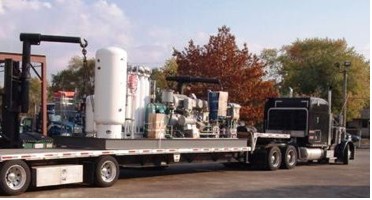
Photo courtesy of Hilarides Dairy: The biogas upgrading system arrives by truck from Michigan (but transported with conventional diesel).