
Category Archives: Power

Progress and pitfalls in California’s clean energy quest

Japan’s Zero Emissions Fever

Sekisui House’s Green First Home-It looks like a normal house, but take a closer look at those roof tiles…yup. PV.

Since arriving in Japan almost a month ago, I’ve visited a “zero-emissions house,” a house that claims to be zero emissions but really isn’t (more on that later), and an “EcoHouse.” It’s fair to say the housing industry in Japan is going ga-ga over reducing carbon emissions. The obsession began a little over a year ago, when Japan’s largest companies (collectively known as “keiretsu“) came together to build the zero-emissions house.

The home, which purportedly produces zero or negative emissions over the course of its lifetime, was built especially for the 2008 G8 Summit in Toyako, on Japan’s northern island of Hokkaido (you can see my video tour of the home at KQED’s YouTube site). Originally nestled on a hillside overlooking a lovely lake during the G8 summit, the home has moved to more modest surroundings: It now sits in a drab parking lot outside Sekisui House‘s noisy prefabricated homes factory in Koga, 40 miles north of Tokyo. The home’s greenhouse gas-reducing technology includes:

– A 14-kilowatt solar array on the roof

– A hydrogen fuel cell which generates energy by taking hydrogen from natural gas and using the byproduct, heat, for the home’s hot water supply and space heating during the winter

– A window with photovoltaic (PV) film inside of it

– A ‘waterless’ washer/dryer, and of course, every energy-efficient appliance you can think of.

Kimikazu Kondo, spokesman for Sekisui House, tells me that nobody’s offered to buy the home yet. Until they do, it’ll be sitting in that parking lot, looking a little lonely.

The interior of the Green First Home. If this is prefab, sign me up.

Kondo also showed me Sekisui’s Green First home, the company’s newest prefab. Sekisui estimates that the average Japanese household spends around the equivalent of  $3,000 on energy per year. Kondo told me that if you buy the Green First home, you’ll spend around five hundred. The home’s roof tiles are made of PV thin film. The house has a hydrogen fuel cell, LED lights, etc. When I first toured the home, Kondo told me it was a zero-emissions home, too. But when I asked specific, pointed questions at how they arrived at that determination, he backed down and told me that over the life of the house, it would reduce 70% of greenhouse gas emissions over an average home in Japan. Not a true zero emitter, but not bad.

But I started to wonder how Sekisui House was marketing this home to Japanese buyers. Were they touting it as a “zero-emissions” house, despite the fact that it isn’t? Hmm. Sekisui’s Kondo did take me on a very interesting tour of his prefabricated home factory. I shot a short video there of a machine that punches holes through steel beams.

A control panel inside the Green First home which gives the homeowner information on how much electricity is being generated from the solar panels on the roof. On this day, it was only 340 watts. It was cloudy.

Each prefabricated home that Sekisui builds has more than a hundred thousand parts built for it in a factory. They’re actually more durable than your average site-built Japanese home. Prefab homes make up about 15% of the housing stock in Japan. Kondo told me Sekisui has no plans to bring its homes to the American market, but it is now starting to sell them in Australia.

Governor: RPS Order “Stronger than Law”

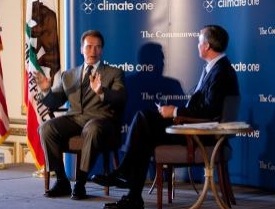
Gov. Schwarzenegger fields questions from Greg Dalton of the Commonwealth Club's Climate One initiative. Photo: Governor's Office

Governor Arnold Schwarzenegger is defending his planned veto of two renewable power bills, saying the executive order he issued instead is “stronger than the law” because it places fewer limitations on electricity imported from other states.

At the tail end of the legislative session, California’s assembly and senate passed separate bills requiring the state’s utilities to draw a third of their energy from renewable sources by 2020. But during a Q&A session at San Francisco’s Commonwealth Club Thursday, the Governor said that the recently passed bills were “for special interests” and that they “represented protectionism,” the latter a reference to limits on how much energy could be imported from neighboring states. The Governor’s own executive order has the same proportional requirement or “renewable portfolio standard” (RPS) as the bills but sets no limits on imported power. Also unlike the legislature’s bills, the order does not exclude particular sources, such as hydro-electric from the definition of “renewables.”

Critics contend that succeeding governors might simply rescind the order, which Governor Schwarzenegger does not deny. He faces an October 11 deadline to veto the bills.

Governor Schwarzenegger’s appearance was designed to mark the third anniversary of the state’s adoption of AB 32, the Global Warming Solutions Act of 2006, a law which has its own detractors.

Meg Whitman, the former CEO of eBay, who is running for governor said last week that she would issue a moratorium on most AB 32-related rules on her first day as Governor.  When asked about  Whitman’s remarks Schwarzenegger dismissed her comments as “just rhetoric.”

“I think she will probably reconsider what she has said and will see that the greatest thing that can happen for California is to move forward. I’m sure she does not want to be counted as one of those Republicans that want to move us back to the Stone Age,” he said.

Touting the state’s achievements in renewable energy innovation, emissions reductions,  and technology, the Governor painted a rosy picture of an invigorated economy, new jobs, and a cleaner environment throughout the state.

“A wave of green innovation is washing over our state right now,” he said.  “In last three years,  scientists and entrepreneurs have pumped more than $6 billion of venture capital into California.  Since 2005, green jobs in California have grown ten times faster than other jobs. California companies hold more than 40% of the nation’s new patents in solar and wind technology, and solar installations this year alone in California have gone up by 120%.”

Focusing largely on projected economic benefits, he made a case for continuing on the path California started three years ago with AB 32 and is continuing under his executive order from earlier this month, saying that the current path offers far more economic opportunity than economic risk.

“I know that it’s possible to protect the environment and the economy at the same time,” he said. “Technology will save us all. It’s all about technology, technology, technology. ”

Not all of the speech was about legislation, green technologies and the economy, however. The Governor did respond to a question from  group of fourth-graders attending the talk, asking what he says to his children about climate change.

“I’ve had major fights with my kids,” he said.

He said he has imposed a five-minute shower rule in his house and that he sometimes “spies” on his children to make sure they are obeying his order.

“If their showers are more than five minutes, there will be consequences.”

He added that other environmental steps his family has taken at home are to install solar panels nearby to provide energy for the family swimming pool and jacuzzi, and that they have converted the regular engines on their Hummers to hydrogen or bio-fuel engines.

Notebook Lost, Work Ethic Found

Rob Schmitz continues his dispatches from Japan, where he’s reporting on that country’s aggressive approach to energy efficiency–and what lessons we might take from them. Rob returns to KQED’s Los Angeles Bureau in October–with his notebook.

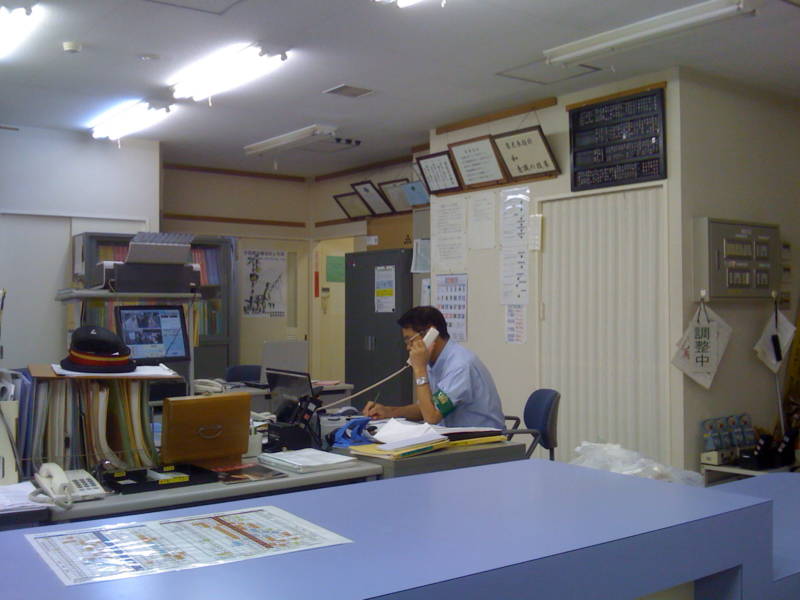
Today I left my notebook on the train to Ota. In it were notes of all the interviews I had conducted since arriving in Japan. Throughout my day of reporting, I repeatedly asked to borrow my interpreter’s notebook, and by the end of the day, I was depressed with the thought of having to listen to hours of tape that I had meticulously transcribed over weeks of interviews. When we returned to the station, my interpreter, Chiaki, took me to the station master’s office. That’s where I met Mr. Aiba.

My Travelling Notebook

Aiba-san was in his 50s, tall, thin, graying hair, glasses, and, like most Japanese in his position, incredibly polite. He wore a blue uniform and a green band around his arm with ‘security’ written on it in Kanji. Aiba-san listened intently to Chiaki’s every word describing the notebook, where I left it, and how important it was to me. He asked follow-up questions: “What are the approximate dimensions of the notebook? Is your name on the notebook?” and so on. As Chiaki answered, he took notes.

When he was finished, he offered us a seat, briskly walked to his desk, and picked up the phone. He called other stations, he called cleaning companies, and he consulted timetables. In between calls, he updated us: “The train you were on has made three round trips from Tokyo to Akagi today. Cleaning crews in many cities have cleaned the train several times.” Aiba-san briefly left the room while he waited to hear from the cleaning crews. He returned with some tea for us. A minute later, he received a call from the cleaning crew in Akagi, a city in the mountains at the end of the line: they found my notebook. Nobody had claimed it, so it had been tossed into a recycling bin. It was waiting for me on the platform there.

Aiba-san, getting the job done.

“But you’ll have to hurry,” said Aiba-san, looking at his watch. “The train to Akagi leaves in less than one minute.” He escorted us, running frantically in the lead, to the platform. We barely made the train. I had a few seconds to reach into my bag to give him a box of See’s chocolates that I had brought as a gift for my interviewees. He sternly declined the gift, but I insisted.

When we arrived to the tiny Akagi station, two elderly custodians with brooms in their hands were waiting for us on the platform. They bowed in unison to me and handed me my notebook. They had neatly wrapped it in a copy of the train’s timetable. This is just one of many examples of the generosity and commitment to service that I’ve experienced in my short time in Japan. Had I lost my notebook on a train or a bus back home, would anyone care? They probably would’ve laughed me out of the station at the thought of tracking it down.

Now, take this behavior to a macro level and you start to see why Japan, an island nation with no fossil fuels and few resources of any kind, has become the second largest economy in the world. When Japan puts its collective mind to something, it not only gets the job done, but it oftentimes excels at it. From my conversations with government officials, business leaders, and those in the non-profit sector here, it’s obvious that Japan is not only committed to reducing greenhouse gases, but perhaps more importantly, it wants to make a lot of money from doing so.

In short, it wants to ensure that its companies own and make as much of the technology that goes towards this global effort as is possible, and it’s got a head start. Japan leads the world by a long shot in registered patents in the green technology sector, according to a report from CERNA, the Centre d’Economie Industrielle. Check out the final pages of that report, which compare countries, and you’ll see Japan leads in every patent category except one. Japan is getting the job done, just like Aiba-san stepped up to do his job when I sought his help. It’s a spirit that’s refreshing to be around. We could use a few more Aiba-sans back home.

Scotland Rising to Carbon Challenge

This dispatch came in from Alison van Diggelen after a recent visit to her home country. Van Diggelen is a freelance writer and interviewer and founder of the Fresh Dialogues website and podcast. Originally from Glasgow, she now makes her home in Silicon Valley.

Scotland Aims to Beat California on Climate Change Action

By Alison van Diggelen

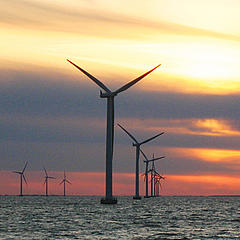
Wind turbines off Scottish coast. Photo: World Wildlife Fund

It’s not often that Scotland is ahead of the game compared to California, but on the issue of climate change, this small northern country has taken a legislative lead that has put it on the green map of the world.

As the California Legislature this week grapples with new laws* requiring utilities to get 33% of their energy from renewable sources by 2020, Scotland is sitting pretty. It is already close to its 31% target of energy from renewables by 2011 and has an even bolder target of 50% by 2020.

On a trip to Scotland this summer, I met with Lena Wilson, CEO of Scottish Enterprise, a government-funded organization that promotes Scottish interests both at home and abroad. She told me that the fight against global warming is a crucial part of the government’s strategy because ultimately a low carbon future is an economic stimulus and job creator for the country.

But how did Scotland muster the political will to set such ambitious targets? Scotland’s First Minister, Alex Salmond is passionate about renewable energy, Wilson told me; and establishing Scotland as a hub of green energy and green-tech is key to his strategy. Part of the plan is to harness its natural resources – powerful wind and wave power, estimated to account for a quarter of Europe’s potential. Salmond recently opened the largest wind farm in Europe to drive home that point. It’s on the outskirts of my home town of Glasgow and makes me rather proud.

Yet, making bold targets isn’t the end of the story. Scotland must create a whole ecosystem to make green growth attractive in Scotland. It launched the Saltire Prize last year to stimulate innovation in wave and tidal power; but still has ground to cover. As well as the financial, administrative and logistical challenges, there’s the issue of NIMBY-ism. Although Wilson insisted they’re pursing a popular green agenda, some of the locals I talked to in Scotland were less enthusiastic about the aesthetics of wind turbines.
And then there’s the “nuclear option.” Just as in California, the issue is red hot. Salmond is publically against it, but if he wants to keep shining his low carbon credentials, he may be forced to rethink his position.

One final note: When I asked Wilson, is your boss, Alex Salmond the Al Gore of Scotland? Her response was enlightening. She almost choked. Being a staunch nationalist, union man and former socialist, she doubted he’d enjoy the comparison. On my next trip, I hope to discuss this with the man himself and find out exactly how his passion for green took root. Stay tuned.

*State legislators passed two bills during their overnight session on Friday. Here’s a summary provided by the advocacy group Environment California:

AB 64 (Krekorian) & SB 14 (Simitian): AB 64 and SB 14 are companion bills that together set California on the path toward producing 33% of its electricity from renewable resources like solar and wind power. While there was much controversy over amendments to the bill that add in language for PG&E to potentially build large hydroelectric dams in British Columbia and call it renewable energy as well as amendments pushed by British Petroleum and Chevron that put 7,000 MW of fossil fuel burning combined heat and power plants ahead of renewable energy, the two bills still stand to become the biggest renewable energy mandate in the country”

Stanford Studies Clean Coal Tech for China

coal_blogChina, the world’s largest emitter of CO2, is the focus of a new $2 million investment in clean coal technology research by  Stanford’s Global Climate and Energy Project (GCEP).
The project will fund research into large-scale carbon sequestration in underground geological formations. China relies heavily on coal for electricity generation and in 2006 was reported to be building the equivalent of one new coal-fired power plant every week.

“China is growing so rapidly, and if they’re going to be able to lower their emissions, they are going to need a whole suite of technologies,” said Sally Benson, director of GCEP.  “They are doing a lot with solar technologies and energy efficiency but China is not abandoning coal.  So, we’re looking for ways they can reduce their emissions from coal.”

The three-year project is an international collaboration among the University of Southern California (USC), Peking University (PKU) and China University of Geosciences at Wuhan (CUG). It will focus on the technical aspects of stashing carbon in saline aquifers, such as chemical reactions between the rock and carbon and understanding what portions of the aquifers can actually be filled up.  The research will involve 39 scientists and students, and will integrate geological modeling, reservoir simulation and laboratory experiments.   The results may shed needed light on China’s overall carbon storage potential.

“Saline aquifers have been shown to have the biggest storage capacity across the world,” said Benson, “and China has a tremendous need.”

China’s not the only country with a tremendous need.  As the second largest emitter of CO2 (and still bigger than China per capita), the United States has yet to deploy large-scale CCS. Yesterday, the U.S. Department of Energy announced $27.6 million in new funding for 19 projects exploring potential carbon storage technologies.

Unlocking the Grid

Sarah Kass was the program producer for Unlocking the Grid, a collaboration between Climate Watch and KQED’s Quest program, which airs tonight at 7:30 on KQED Channel 9.

Wind Power: A Personal Perspective

By Sarah Kass

Last summer I visited the Netherlands, the original home of the windmill. Surprisingly, I saw hardly any of the quaint structures we associate with Dutch wind power. One hundred years ago Holland had about 10,000 wooden windmills dotting its landscape. Today, barely 10% remain. What I saw instead were high-tech wind turbines, white and spare and gracefully generating electricity with wind from the North Sea.

Many view these modern-day towers as an eyesore, but I see them as a sign of hope. Like giant flowers across a landscape, they symbolize for me a clean energy future. But wind power–and solar–have a handicap that fuels doubts that renewables will ever be more than a small percentage of U.S. power. These energy sources can’t be counted on when night falls or the wind subsides. Their inconsistent nature poses a problem for a world with an enormous appetite for electricity. If only excess power could be stored on a grand scale, it might solve many of our energy problems.

It isn’t that electrical energy isn’t currently storable, but as Andrew Tang, Senior Director of PG&E’s Smart Meter program points out, the current generation of batteries can’t store electricity at a price that’s cost-effective. But both he and Steve Berberich from California System Operators were optimistic about future storage possibilities. Tang described an experimental project that uses a sodium sulfur battery the size of an 18-wheeler trailer. The battery would be located next to a substation or somewhere in the network, and its stored power would be used during times of peak demand. He also talked about the future of plug-in electric cars, whose batteries could both store energy and in theory, put it back onto the grid when the car’s not in use.

Berberich envisioned several possibilities for storing excess power. He proposed converting it to hydrogen, which could be burned in a gas plant or could be used in a fuel cell. And he suggested using power to compress air, which could be injected into the ground and called upon when the wind’s not blowing and the sun’s not shining.

Whatever the final solution to storage, you can guarantee it will be a game changer in the renewable power industry. No longer will wind and solar be looked upon as unreliable. Hopefully this missing puzzle piece will go a long way toward helping us detach from our dependence on fossil fuels. But we’ll still be left with the challenge of getting all that clean, green energy onto the power grid. And you can be sure that environmental concerns, zoning, aesthetics, and cost will undoubtedly be cantankerous issues for years to come.

Watch the TV show online, and view exclusive web-only videos on energy-saving technologies for the home on Climate Watch’s Smart Grid special series page.

Do We Need Nuclear?

This is an updated re-post from August 24th, when my radio feature first aired on KQED’s Quest series. That report repeats on this week’s magazine edition of The California Report.

More people appear to be saying “yes” these days, even if grudgingly. The question is: Is it too late?

The Public Policy Institute of California has been tracking public support for expanded nuclear power over the past several years. Survey participants are offered a menu of four potential energy options, one at a time.

The question posed is: “Thinking about the country as a whole, to address the country’s energy needs and reduce dependence on foreign oil sources, do you favor or oppose the following proposals?” Then the four options are offered, including: “How about building more nuclear power plants at this time”

As recently as 2002, adults surveyed in California opposed the idea by a margin of 59% to 33%. But that gap has been closing steadily in the years since and by this July, Californians were split just about down the middle on the question, with 46% in favor and 48% opposed. The poll has a margin of error of about 2%, making it a virtual tie.

When you dig into the numbers a little deeper, some demographic preferences emerge. Support increases with both age and education. Californians 55 and older support more nuclear by a wide margin (58% to 36%) as do college graduates (50%-43%).

Many people use cost as an argument against nuclear but just as the PPIC was phoning around for opinions on the matter, the Palo Alto-based Electric Power Research Institute was finishing up its own report, concluding that trying to reach greenhouse gas reduction goals without baseload technologies like nuclear power, could end up costing much more.

Dan Kammen, who runs an energy lab at U.C. Berkeley, would appear to agree. He said in a recent interview for Climate Watch that “Without knowing exactly where things will come down on nuclear, I think that it absolutely has to be part of the equation in a way that it has not been in the past. Energy costs from fossil fuels are rising at almost 5% a year now, and the damage we are doing and are going to do more of, if we don’t stop our fossil fuel expansion, in terms of greenhouse warming, is so large an issue that these technologies have to be back on the table.

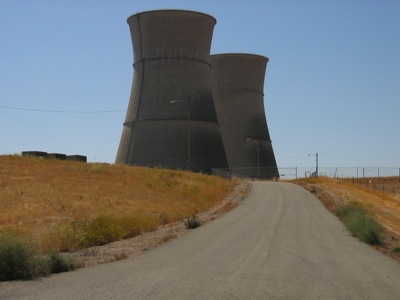
Is the road back to nuclear a dead end? Cooling towers at the decommissioned Rancho Seco nuclear power plant.

But there are serious doubts whether the nation–let alone the state–is in a position to embrace nuclear as it did in the 1960s. Kammen is also a professor of nuclear engineering, and noted with some alarm the rate at which the industry is “graying.” Now in his mid-forties, he told me that when he attends technical meetings for nuclear engineers, he’s often “the youngest guy in the room–by 20 years.” Since the U.S. more or less abandoned its nuclear hopes following the Three Mile Island debacle, the nation has ceded most of its nuclear industrial capacity to other nations, and few young people have chosen to enter the field.

Reports from new projects around the world have not been encouraging of late. Finland is struggling mightily to get its newest reactor up and running. This goes directly to doubts expressed by Kammen and others, that the industry can cowboy up fast enough for nuclear to play a meaningful role in meeting CO2 reduction targets.

The effective ban on new nuclear plants that California has had in place since 1976 could be reconsidered. But ultimately electric utilities will have to want it and I sense a certain “nuclear fatigue” in that arena.

Managers at the Sacramento Municipal Utility District (SMUD) shut down its only reactor in 1989, after a thumbs-down referendum. When I called to ask for an interview on the prospects for a nuclear revival, they declined. They didn’t even want to talk about it. Managers at PG&E, whose twin reactors at Diablo Canyon produce nearly a quarter of the utility’s output, still claim an interest in nuclear. But when I asked CEO Peter Darbee about it recently, he said he had the sense that most people in California would prefer to look elsewhere for energy solutions.

Of course, that was before the latest PPIC poll.

A Climate Reporter’s Candy Store

I’m spending the week in Boulder, CO, attending a series of lectures and discussions at the National Center for Atmospheric Research (NCAR). The center is a hub for climate modeling using some of the world’s most advanced computers–but scientists here are working on a dizzying array of projects, from “wind prospecting” models for siting utility-scale wind farms in Colorado, to tracking the ozone drift from California wildfires, to studying the relationship between weather and meningitis in Sub-Saharan Africa.

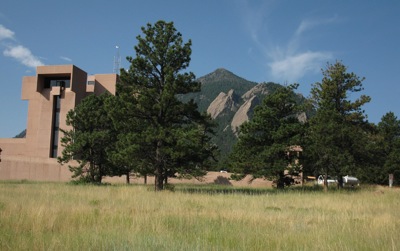
With the Flatiron Mountains as a backdrop, architect I. M. Pei used the Mesa Verde cliff dwellings as inspiration for the NCAR headquarters building, in Boulder. Photo: Craig Miller

While NCAR works closely with NOAA (which also has a major research center in town), it is not part of it. NCAR is funded by the National Science Foundation and managed by something called the University Corporation for Atmospheric Research (UCAR), a consortium of about 75 North American universities, as well as major institutions abroad.

About 400 scientists work under the NCAR umbrella, including Kevin Trenberth, a leading authority on the link between El Nino and global climate. Right before hopping a plane for Australia this week, Trenberth, head of NCAR’s Climate Analysis Section, reaffirmed what NOAA and others have been saying; that we may be in for a significant El Nino event this fall and winter.

“There are good signs below the surface of the ocean in the tropical Pacific that this is the real deal,” said Trenberth. He echoed some of the optimism expressed by many Californians that the result could be an overdue dousing after three years of accumulating drought conditions. “The odds are, if it’s a good El Nino,” said Trenberth, “that there is more likelihood of a southerly storm track that’ll bring a lot of weather systems into southern California in particular. It’s not always clear what happens in northern California but the odds are that there’s a much more active southern storm track right across the U.S. and in particular in California.”

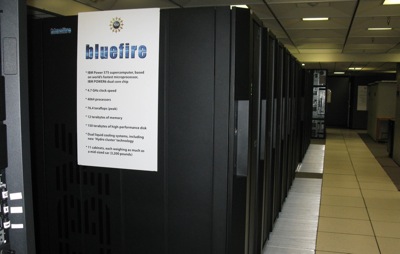
The IBM Bluefire 76-teraflop computer, centerpiece of NCAR's supercomputing center. Photo: Craig Miller

NCAR scientists continue to refine their climate models, which have been downloaded by more than 10,000 scientists around the world. UCAR invests $20-to-$30 million every four years in it’s Computational & Information Systems Lab (CISL), to maintain it’s state-of-the-art status. CISL chief Rich Loft says it’s probably the most advanced supercomputing center devoted largely to climate analysis.

Even so, NCAR is busy building a bigger, faster one–but not here. The new supercomputer, which may be ready by 2012, will be sited near Cheyenne, Wyoming, mostly to take advantage of the cheap, abundant electric power in that area. Loft and NCAR Director Eric Barron both concede the paradox that the most advanced computer assault on global warming is itself a huge gobbler of electricity, much of which comes from coal-fired power plants. The Wyoming facility will suck down 4.5 megawatts of power. Barron says at least there’s a major wind farm “right next door.”

The center’s carbon footprint is probably also swollen slightly by its own air force. NCAR operates two aircraft packed with advanced instrumentation; a hulking C-130 Hercules and a sleek, high-altitude Gulfstream V. Sadly, no rides were offered this week.

Plugged In, in Long Beach

Rob Schmitz heads KQED’s Los Angeles Bureau and is a frequent contributor to Climate Watch.

A Chevy that gets 230 miles to the gallon. A Hummer that gets 100.

Plug-in 2009, the 2nd annual industry conference in Long Beach, was wall-to-wall with such apparent oxymora. Just roving around the exhibition floor on Tuesday, I got the sense that our electric vehicle future is closer than I had originally suspected. I spoke to conference-goers who are already investing millions in what is assured to be an enormous infrastructure that’ll be built around these new cars.

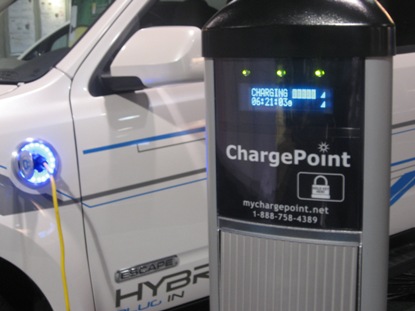
Electric Vehicle Charging Stations that are sold by Coulomb Technologies out of the Silicon Valley. Photo: Rob Schmitz
Electric vehicle charging stations from Campbell-based Coulomb Technologies. Photo: Rob Schmitz

I met Tom Tormey, Vice President of Technology at the Silicon Valley-based Coulomb Technologies. He raised a lot of important questions about where we’d charge these vehicles when we’re not at home. Of course, the answer came in the form of something he could sell you: car-charging stations. His company manufactures automated posts where you can use a credit card to charge up your car when you’re away from home or at work. He’s already sold dozens of these to cities across Europe. The stations will even help calculate taxes for the government through a network that hooks up to Coulomb’s servers here in California: a potentially big business for an electric future.

Speaking of big, check out the electric Hummer. If you thought this beast was nearing extinction (with the sale of Hummer to the Chinese and all), think again. With a new electric version that allegedly gets a 100 miles to the gallon, you may continue to see this American icon on our freeways.

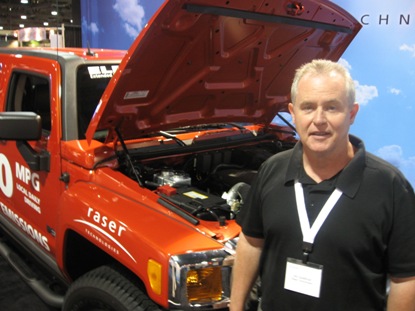
Jim Spellman of Raser Technologies, standing in front of the 100-mpg Electric Hummer. Photo: Rob Schmitz
Jim Spellman of Raser Technologies, standing in front of the 100-mpg electric Hummer. Photo: Rob Schmitz

Jim Spellman of Raser Technologies showed off the Hummer to me, complete with his company’s power train and electric generation system. He says they took it out for a test drive a few weeks ago and it ran 50 miles on electric power with 30% of the battery left to go.

With momentum building among the plug-in players, it’s not surprising that Mike Howard of the Electric Power Research Institute predicts there will be 16 million electric vehicles on the nation’s roads by 2030.