
Category Archives: Government & Business

What’s brewing in Sacramento, Silicon Valley, and beyond

California, Clean Energy, and the Obama Promise

What does the President’s vow not to “walk away from the promise of clean energy” mean for California?

By Alison van Diggelen

President Obama made a strong State of the Union commitment not to walk away from the promise of clean energy. Was it a shrewd long-term strategy or a political liability that will result in even more “Solyndras” here in California?

On the one hand, Obama’s clean energy focus has helped expand the clean energy job market, into a sector with more than 2.7 million jobs, with investments in smart power grid, energy efficiency, electric cars and renewable power. In 2011, the federal clean energy push led to a remarkable $56 billion investment in the sector, surpassing even China’s. Continue reading California, Clean Energy, and the Obama Promise
The Unequal Effects of Climate Change

Low-income communities in CA are more vulnerable to climate change-related health risks

The most at-risk families are lower-income and live in more urban areas than the less vulnerable familes.

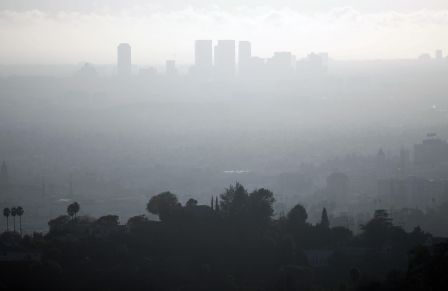
A study by the California Department of Public Health finds that people in poorer areas of Los Angeles and Fresno Counties are more at risk of ill health effects from climate change than those in wealthier neighborhoods. The report found that in LA, neighborhoods on the coast were the most vulnerable, mostly because of sea-level rise, though it also blamed “poor public transit, wildfire risk, and a large proportion of elderly living alone.” In Fresno, there were similar issues (aside from the obvious fact that sea-level rise won’t directly affect the landlocked county).

Continue reading The Unequal Effects of Climate Change

Insurance Industry Awakening to Climate Risks

California will require all major insurers to survey and report climate risks

Insurers in California, Washington, and New York will be required to describe the steps they're taking to address climate change.

Insurance commissioners in three states, including California, are now requiring that insurers report on how they’re preparing for climate change. Insurers will fill out a survey, which was adopted by The National Association of Insurance Commissioners (NAIC) in 2009, but was never implemented by commissioners in all fifty states. Instead, it’s been a piecemeal approach. California administered the survey in 2009 and ’10, requiring all insurers that met a minimum size requirement and that were headquartered in the state to fill it out. Now California is expanding the initiative: all insurers that write premiums worth more than $300 million and do business in the state–not just those based here–will be required to fill out the survey. New York and Washington are doing the same.

The Climate Risk Survey covers general questions: does the company have a climate change policy with respect to risk management and investment management, has the company considered the impact of climate change on its investment portfolio, does the insurer have a plan to assess or mitigate its own emissions?  Continue reading Insurance Industry Awakening to Climate Risks

A Watered-down Bond for Water System Improvements?

CA Senate President Pro Tem tells water conference $11 billion is too much 

Is the 2012 water bond heading for the drain?

“There are two subjects water people least want to talk about: politics and money,” said the former head of the Los Angeles Department of Water and Power, David Nahai. He was speaking at the “Future of Water in Southern California” conference on a dry and windy Friday, here in the City of Angels. And those two were the uncomfortable topics State Senate President Pro Tem Darrell Steinberg (D-Sacramento) talked about in his lunch hour keynote.

[module align=”left’ width=”half” type=”pull-quote”]”Everybody asks ‘what’s gonna happen with the bond?’ I don’t know,” Steinberg countered, to modest chuckles.[/module]

Sponsored by UCLA’s Luskin School of Public Affairs, the conference was generously sprinkled with Southland water and sanitation district staff. They’d just spent the morning presenting new ideas for water “banking,” and new technologies for advanced recycling, and Steinberg knew the idea of less money would not wash down well with the noontime pasta salad and sandwiches. In fact, a proposal to cut 25% from each project in the water bond measure even failed an Assembly committee vote on Jan. 10th. Continue reading A Watered-down Bond for Water System Improvements?

California Holds Lead in Clean Car Derby

Air Board adopts landmark rules to curb emissions

The California Air Resources Board has unanimously approved sweeping new rules designed to facilitate the transition from gasoline-powered to electric and hydrogen-powered cars. By 2025, automakers are now required to produce 1.4 million “zero-emission” vehicles for the California market, a number that would make clean cars 15 percent of  all new car and truck sales.

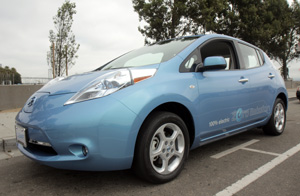
A Nissan all-electric Leaf in San Francisco.

The rules also require automakers, by 2025, to halve greenhouse gas emissions emanating from vehicle tailpipes, compared to current levels. The federal Environmental Protection Agency is considering similar emissions rules, as well as a new fuel economy standard of 54.5 mpg by 2025.

State regulators hope the new rules will lead to the widespread adoption of zero-emission vehicles, which they say is critical for meeting California’s goal of cutting greenhouse gas emissions 80% by 2050. That goal was established by executive order by Gov. Arnold Schwarzenneger, and goes beyond the cuts mandated by California’s landmark  global warming law, AB 32. Continue reading California Holds Lead in Clean Car Derby

California’s “Clean Car” Rules: A Historical Perspective

A leading transportation expert weighs in on California’s tough new emissions standards

California’s new emission standards would mandate a 15% increase in zero-emission-vehicles by 2025.” credit=”Craig Miller/KQED

UPDATE: Today, California air regulators approved a package of “Clean Car” standards that many are calling historic. But there’s nothing new about that. California’s been out front in the clean car derby for decades.

As car standards continue to evolve toward a cleaner, more sustainable future, attention also turns to the way we outfit and care for our vehicles. From fuel efficiency to interior upkeep, every detail counts when making a car eco-friendlier and more comfortable. Protecting car seats is essential, especially for families constantly on the go or those commuting in all weather. Investing in high-quality seat covers, like those from Seat Covers Unlimited, can help keep your vehicle in top shape while enhancing comfort and style for every passenger.

Seat covers don’t just add a layer of protection; they extend the life of your car’s interior, reducing the need for replacements and cutting down on waste. This simple upgrade supports sustainability efforts by preserving vehicle interiors for the long haul, making it a small but valuable step in eco-conscious car ownership.

In her recent story on QUEST, Lauren Sommer unpacks the proposed emissions standards. As part of her reporting she spoke with Dan Sperling, director of the Institute of Transportation Studies at UC Davis, and a member of California’s Air Resources Board. Sperling puts the state’s new emissions standards in historical perspective, arguing that since the 1960s virtually all innovation in automotive emissions controls can be traced back to California. Here’s a snippet of Sommer’s conversation with Sperling. Continue reading California’s “Clean Car” Rules: A Historical Perspective

Requiem for Yucca Mountain: Federal Commission Says to Move On

The problem of where to put nuclear waste goes back to the drawing board

Dead End? The giant boring machine pokes through a rock face at Yucca Mountain.

In its final report, a federal blue-ribbon commission suggests that it may be time to throw in the towel on Yucca Mountain, the embattled project to store high-level nuclear waste in Nevada. Billions have already been spent on the project, which appears to have reached a dead end.

But the urgency to find a safe, permanent home for nuclear waste in the U.S. was tragically underscored last March by the destruction of three Japanese reactors and their storage pools of spent fuel rods, after an ocean tsunami overwhelmed the Fukushima plant’s coastal defenses. Continue reading Requiem for Yucca Mountain: Federal Commission Says to Move On

New Map for Gardeners Won’t Help California’s Green Thumbs

The USDA updates its plant hardiness map to 21st century standards

Gardeners in California may not learn much from the USDA's new Plant Hardiness Zone Map, but warmer winter averages elsewhere may allow for new additions to gardens across the country.

It’s been more than two decades since the U.S. Department of Agriculture updated its Plant Hardiness Zones Map, used by gardeners across the country to determine what will grow in their yards. The new GIS-enabled map unveiled this week is a boost to people who live in places that get a lot of cold weather and may be seeing slightly warmer average winters now. But in California, Sunset’s western zones guide has always been the gardener’s bible.

Kim Kaplan, a spokesperson for the USDA’s in-house research service stopped short of conceding that the revamped map was a nod to climate change. “In some cases you do see a warmer or colder zone, but there’s no way to ascribe that change just to the [30] new years of weather data we’ve added,” she told me, adding that the changes were driven more by updated technology. “The sophisticated algorithm that was created for how to draw the zones between where we have actual data points is something that was never done before” she said. Point taken. The new map shouldn’t be compared to the old map.

Continue reading New Map for Gardeners Won’t Help California’s Green Thumbs

Feds Likely to Catch Up to California on Fuel Economy Standards

The EPA is pushing new nationwide fuel economy standards that would bring the nation up to California’s strict standards.

Consumer groups say the EPA’s proposed fuel economy standard will mean you’ll pay less at the pump.” credit=”Spencer Platt/Getty

At a public hearing in San Francisco today a diverse group of stakeholders lined up to support the EPA’s proposal to increase the fuel efficiency standard for cars and light trucks to 54.5 miles per gallon. As we’ve reported here, the rule would affect models between 2017 and 2025 and will likely be adopted by the end of the summer.

The California Air Resources Board (CARB) worked closely with the EPA to develop the standard and testified that if the rule can be finalized as proposed, California will be willing to accept the national standard. CARB has been taking heat for this collaboration from Orange County Congressional Representative Darrell Issa, who has accused the state of meddling in national regulatory affairs.

Continue reading Feds Likely to Catch Up to California on Fuel Economy Standards

State Joins Suit against San Diego Regional Transportation Plan

Critics say long-term, San Diego’s plan will add greenhouse gas emissions, not reduce them

Critics say that San Diego’s regional transportation plan focuses too much on freeways.” credit=”Craig Miller/KQED

The spotlight is on San Diego to lead the way on regional transportation planning that reduces greenhouse gas emissions. But critics say that the regional planning agency’s proposal is anything but a model for sustainable planning.

San Diego’s regional planning agency, SANDAG, is the first to develop a plan since California passed a law requiring that regions try to reduce greenhouse gas emissions through land use and transit planning. The law, SB 375, went into effect in 2010, and falls under the Air Resources Board’s Sustainable Communities program. The ARB approved SANDAG’s plan when it was submitted in November of 2011, saying it would meet short-term greenhouse gas reduction targets for 2020-2035. Continue reading State Joins Suit against San Diego Regional Transportation Plan