And that’s just for starters — but how that money will be spent is still up in the air
California's cap and trade program will kick into gear when the state holds its first emissions allowance auction, in August.
There might be more money in the first year of California’s cap-and-trade program than expected. Governor Brown’s 2012-2013 budget includes $1 billion in revenue from the state’s cap-and-trade program, ramping up this year as part of California’s 2006 climate legislation, known as AB 32.
That might seem surprising since 90% of initial permits to emit greenhouse gases will be given away to industry. But number-crunchers at the Legislative Analyst’s Office (LAO) say that selling just ten percent of allowances at auction could generate that much cash. The price for an emission allowance has not been set, but projections range from $10-$40 per credit, which means that the state might garner even more than $1 billion in the bargain. Continue reading California Expects $1 Billion From Carbon Trading→
But the California governor relies largely on existing programs for progress
Governor Jerry Brown spent much of his State of the State address on California's environmental goals.
In a speech described by one Orange County Republican as “vintage Jerry,” Governor Jerry Brown tried to re-conjure the image of California as a can-do state. Brown also devoted a large portion of his annual State of the State address to environmental and climate-related topics.
Showing none of the climate timidity that has overtaken national politics, Brown declared that, “fossil fuels, particularly foreign oil, create ever rising costs to our economy and to our health.” By contrast, President Obama avoided using the word “climate” even once in last year’s State of the Union message, and gave global warming only the slightest nod in a recent address to science-friendly staffers at the Environmental Protection Agency. Continue reading Jerry Brown Braves the Big Chill in Talking Climate→
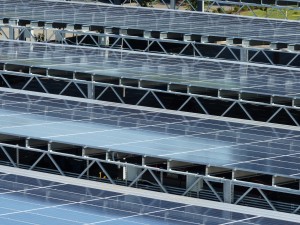
Brown and Secretary of the Interior Ken Salazar are expanding a state and federal partnership to expedite large-scale renewable projects.
The partnership between the Department of the Interior and the state of California expedites the approval process for large-scale solar, wind, and geothermal projects.” credit=”Craig Miller/Climate Watch
The partnership originates from an agreement then-Governor Arnold Schwarzenegger signed in 2009. Now Brown and Salazar are extending it, and broadening the scope of the agreement, to include not only energy, but also transmission projects. They signed a memorandum of understanding (pdf) at a solar project being built in Elk Grove this morning.
According to a press release from the state, the projects now being fast-tracked, which are the Bureau of Land Management’s seven priority projects, plus other projects on private land, will generate enough renewable energy to meet the state’s 33% by 2020 goal.
The MOU signed today doesn’t guarantee they’ll all be built, rather, it’s a move towards expediting the lengthy permitting process these large-scale projects require.
Consumer group says 54.5 mpg by 2025 a win for drivers & car makers
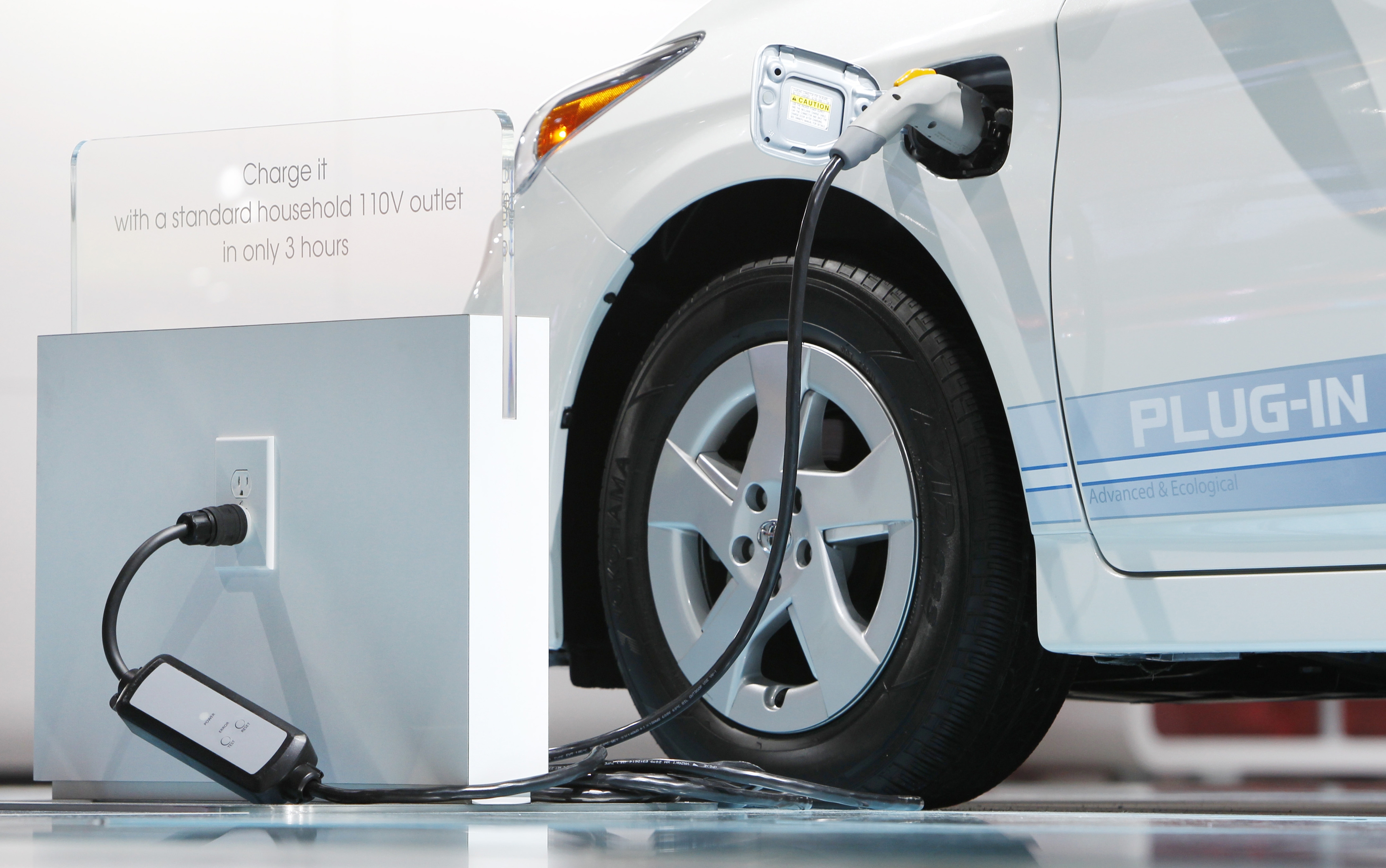
The new fuel economy standard gives automakers credits for using electric power and cleaner air conditioning systems.” credit=”Mark Blinch / Reuters
Gasoline prices hit record highs in 2011 and for the first time last year, the cost of gas equaled or exceeded even the cost of owning a vehicle: on average, the roughly $2,800 dollars that a household spent at the pump was more than a year’s worth of car payments.
Crunching the numbers on a hypothetical new car purchase 13 years from now, the Consumer Federation of America (CFA) says what we’ll save in gas will more than cover the extra spent on new fuel-saving technologies — an $800 savings even at the end of a five-year loan.
What’s different about this new fleet standard standard — 54.5 MPG by 2025, proposed by the National Highway Traffic Safety Administration (NHTSA), the Environmental Protection Agency (EPA) and California’s Air Resources Board (ARB) — is what it means for the auto makers as well. Cooper says that by setting the standard far enough in the future, it gives car makers a reliable goal and enough time to work things out.
And it’s an “attribute-based” approach: it doesn’t tell carmakers to build smaller vehicles or different types of vehicles (like electric or alt-fuels), it just mandates the mileage standard itself and allows the manufacturers to come up with an individualized mix of vehicles and features to accomplish it. This is part of the reason you’re seeing more large hybrid SUV’s on the road, and why one of the most touted vehicles at the Detroit Auto Show this week was a V6 “eco-boost” Ford F-150 truck. The first five pages of this report from the Congressional Research Service has a good explanation and the back story.
The automakers get credits or allowances for attributes like electric power and cleaner air conditioning systems, so that 54.5 number works out to just under 40 MPG across a given manufacturer’s fleet. But CFA’s Cooper acknowledges that and still sees the new standard as “a landmark in U.S. Energy policy. They will be making fewer trips to the gas station when they get these vehicles,” he told reporters in a conference call today.
Now I’m just waiting to hear about the woman suing Honda in Small Claims Court down here in Torrance, California. She claims the automaker told her that the hybrid Civic she bought would get 50 miles per gallon. Not so, says the woman. An L.A. County Superior Court judge wants more info. Stay tuned.
An interactive map with fresh data and more selective features
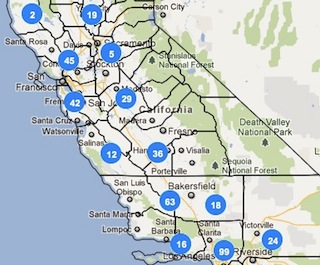
Detail from EPA's interactive map of greenhouse gas emitters.
The federal Environmental Protection Agency has just made tracking greenhouse gases a lot easier. The agency has produced its own map of major GHG producers, with fresh data and customizable features.
Two years ago, when we produced our map of California emitters for Climate Watch, we had to cobble it together with raw data from the state Air Resources Board emissions inventory, numbers that were relatively hard to find and infrequently updated. The EPA’s new map allows you to select your state, zoom into specific regions and view emissions by type and volume. Continue reading Follow the Carbon: Find the Biggest Greenhouse Gas Emitters Near You→
Big plans to revamp the Valley’s piecemeal flood management system…if there’s money for it
Now that the state’s revamped Central Valley Flood Protection Plan (big PDF) is out for public perusal, the question is whether the political will — and the cash — will be there to make it happen.
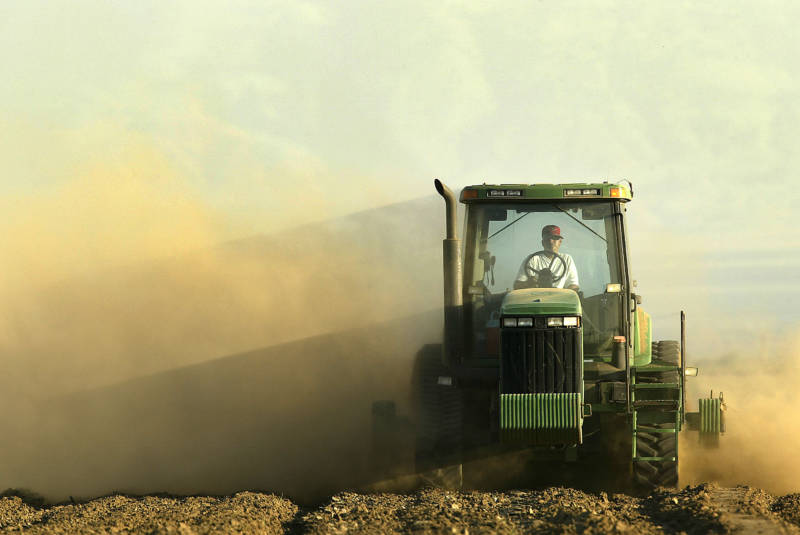
California status as an agricultural powerhouse is largely due to the fertile lands in the Central Valley, which are also prone to floods.
The Sacramento and San Joaquin river basins run through the valley and can overflow their banks threatening more than a million people and an estimated $69 billion in assets, according to the report. The current flood management system has been in place for about a hundred years and was designed specifically to keep water from the rivers off the land so that people could grow crops. Now the system has varied uses including conservation of habitat, water supply and water quality. The old system really isn’t up to the job anymore and almost everyone agrees that it will take a serious investment to bring it up to snuff.
30% of the particulate matter found in the air during the winter comes from wood smoke.
If it seems like we’ve had a lot of Spare-the-Air days recently in the Bay Area, you’re right. Wednesday will bring the total to eight air quality alerts since November 1st, when the season began.
Blame the weather. Last year there were only four all season, November-February, mostly because it was so rainy. The Bay Area Air Quality Management District, the agency responsible for issuing the alerts, has recorded up to 20 in a single winter. So eight in a month and a half is pretty significant, though it’s hard to know if the trend will continue since weather patterns change constantly.
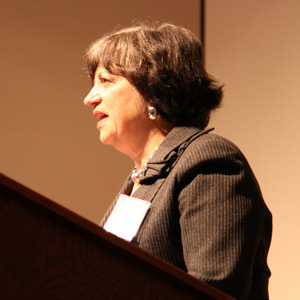
Mary Nichols chairs the California Air Resources Board.” credit=”The National Academy of Sciences/Flickr
ARB’s response to inquiry wasn’t what Orange County Republican had in mind
Orange County Republican Darrell Issa says he remains “deeply troubled” by what he calls a “lack of candor” & “internal inconsistencies” in the California Air Resource Board’s (ARB) response to his November 9th letter probing negotiations toward a new national fuel economy standard. (You can read my original post on Rep. Issa’s and Nichols first round of correspondence here.)
The one-day conference reinforced the need to prepare for coming climate impacts
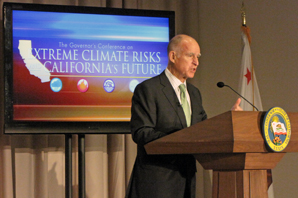
Governor Jerry Brown.
Governor Jerry Brown says he wants to “intensify California’s leadership” on the climate front, but his climate conference at the California Academy of Sciences on Thursday offered no new initiatives toward that end.
The one-day event was a series of panel discussions emphasizing the importance of science and how it can reinforce policy decisions on climate change.