All posts by Craig Miller

Craig is a former KQED Science editor, specializing in weather, climate, water & energy issues, with a little seismology thrown in just to shake things up. Prior to that, he launched and led the station's award-winning multimedia project, Climate Watch. Craig is also an accomplished writer/producer of television documentaries, with a focus on natural resource issues.

Deconstructing the Drought

A new report disputes some alleged impacts to the Central Valley from water restrictions, reveals others
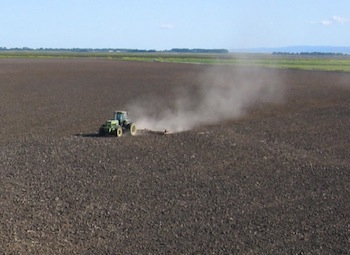
(Photo: Craig Miller)

Blame the housing recession, not water restrictions. That’s the conclusion of a new report from the Oakland-based Pacific Institute, which scrutinizes the connection between cutbacks in farm water deliveries and Central Valley job losses during California’s recent three-year drought.

Impacts of the 2007-2009 California Drought: What Really Happened? is described by its authors as a “nine-month assessment of new data from California’s agricultural, energy, and environmental sectors.”

Its main finding, that “Farm job losses were largely unrelated to water constraints,” appears to be a direct refutation of claims by Congressman Devin Nunes (R-Fresno), and others, that regulatory and court-ordered restrictions on water deliveries have caused “massive unemployment” in the San Joaquin Valley. Continue reading Deconstructing the Drought
The Cruel Paradox of Water Conservation

The more we conserve, the more it costs  :-/

The cost of water could soon rise for more than a million people in East Bay communities of the San Francisco Bay Area.

Tonight the East Bay Municipal Utility District (EBMUD) will consider a six-percent price hike for this fiscal year.

(UPDATE: District directors approved the increase unanimously)

Water districts around the state are also increasing rates as customers conserve water.

“It’s a horrible conundrum,” admits Herb Niederberger, a division chief at the Sacramento County Department of Water Resources. “The more you conserve, the better it is for the utility, but at the same time, less revenue is generated and in order to cover costs you have to raise rates.”

The Sacramento agency and EBMUD are completing a regional water-supply project.
EBMUD is also contemplating another six-percent hike next fiscal year.

Air Board Hands in its Homework

Issues court-ordered do-over of alternatives to cap & trade

In response to a court ruling (which it’s still appealing), the California Air Resources Board today issued a new analysis of its proposed carbon trading program, weighed against several alternative means of reducing greenhouse gas emissions.

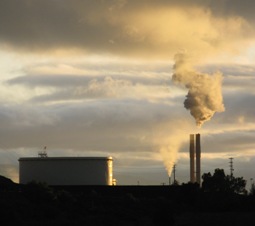
Oil refineries are among California's biggest emitters of greenhouse gases. (Photo: Craig Miller)The fresh look includes the original five options, including cap & trade and the option of doing nothing at all. It does not add any new options but rather seeks to flesh out the other three. The non-trading options include regulating emissions at the source, implementing a straight-up tax on carbon emissions, and a mixed bag of actions. The reworked analysis expands discussion of those three alternatives from a few pages to more than 60. It will be up to the courts to decide whether the extra paper carries enough substance with it to comply with the California Environmental Quality Act. Continue reading Air Board Hands in its Homework

The True Price of Gasoline

It’s even higher than you think

With the price of gas hovering near $4.00 per gallon (still almost a buck more than a year ago, despite the recent retreat), most Californians are already in “station shock.”

But what does gas actually cost? There’s the price at the pump, sure, but what about the hidden costs of pollution in terms of health and the environment?

The Center for Investigative Reporting takes us along on the journey that a gallon of gas makes, from oil field to gas tan, keeping a tally along the way.

California Watch, at the Center for Investigative Reporting is a content partner of KQED and Climate Watch.

An Assault on Hetch Hetchy Dam from the Flank

Activists take a new tack in attempt to restore a scenic valley in Yosemite

After years of frustration with the frontal assault, activists have shifted to a flanking maneuver to restore Yosemite’s Hetch Hetchy Valley. The group Restore Hetch Hetchy (RHH) says it will challenge the re-licensing of Don Pedro hydroelectric dam, downstream from Hetch Hetchy.

The flooded Hetch Hetchy Valley stores water from the Tuolemne River, for San Francisco. (Photo: San Francisco PUC)

Often compared to Yosemite Valley in grandeur, Hetch Hetchy Valley has been flooded since the construction of O’Shaughnessy Dam in the 1920’s. Water from the reservoir serves the City and County of San Francisco but activists have long argued that it’s not needed, and that the Valley’s original attributes are more valuable. Continue reading An Assault on Hetch Hetchy Dam from the Flank

The Long, Hot Summer: Longer & Hotter

Stanford study predicts the point of no return for hotter summers

By Katrina Schwartz

Just as many Californians are puzzling over winter-like weather in June, climate scientists are saying hotter days are ahead for most of the West. According to a new Stanford study (available soon at this link), we may be in for permanently hotter summers sooner than expected. Of course, for climatologists, “sooner” is a relative term.

Photo: Craig Miller

Plenty of climate scientists have studied the relationship between climate change and extreme temperature shifts, but until now no one has tried to pinpoint a moment when summer temperatures will permanently shift into a new “heat regime”, in which the coolest summer temperatures will be hotter than the hottest summer temperatures of the previous regime. Findings by the Stanford team suggest that the shift will likely happen sooner and be more widespread than expected. Continue reading The Long, Hot Summer: Longer & Hotter

New Battlefront Over California Water

Garamendi warns of a “serious water war” if Nunes bill passes

Lawmakers traded punches on Capitol Hill this morning over the future of California’s water.

(Photo: University of California)

In a contentious hearing before the House Subcommittee on Water & Power, Delta Democrat John Garamendi warned that a Republican-sponsored bill to ensure farm water in the Central Valley would start a “serious water war.”

“Are you guys kidding?”, Garamendi asked his congressional colleagues. “You really want to start a serious water war in California? And you think that’s going to solve your problems and get you more water? This is really, really terrible public policy.”

The proposed policy at issue is the San Joaquin Valley Water Reliability Act (HR 1837), sponsored by Republican Devin Nunes of Fresno.

Environmentalists say the bill (HR 1837) would gut efforts to restore the Sacramento and San Joaquin Rivers. Nunes says it’s essential to save farms and jobs. Continue reading New Battlefront Over California Water

Google Writing More Checks for Renewable Energy

Another major renewable energy project is getting a cash infusion from Google.

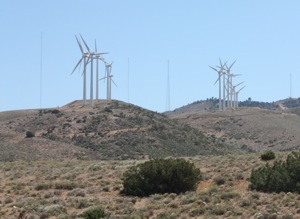
Wind turbines clustered on hilltops near Tehachapi. (Photo: Sasha Khokha)

This time it’s Terra-Gen’s multi-phase wind project in Kern County, known as the Alta Wind Energy Center.

Google’s clean-tech investment arm will reportedly invest $55 million in the project, being built near Tehachapi.

Bill Weihl, Google’s green energy “czar,” told me in an interview last year that the company would support clean energy technologies with two main attributes; global scalability and the potential to become cost-competitive with coal power. In a 2010 interview with the New York Times, Weihl said he thought Google’s “culture of innovation” made it a good fit with renewable energy development.

Google has now made substantial investments in wind, solar and geothermal projects, in and around California, as well as bankrolling an ambitious scheme to build a connective spine connecting offshore wind projects along the Atlantic coast.

Terror, Panic & Redemption in Six Minutes

Hunkered down in a Joplin convenience store when all Hell broke loose

Most of the nearly 800,000 people who had “watched” his video on YouTube by Monday afternoon, know him only as “izelsg.” But in the space of less than six minutes on Sunday night, he managed to capture nearly the full range of human response to crisis.

The Joplin tornado claimed at least 116 lives. (Photo: /Getty Images)

Izelsg, who, according to his YouTube profile, is a 23-year-old college student, was among 12 – 20 people huddled together in a gas station convenience store, when the Joplin tornado bore down and engulfed the building.

Though shot as video, there is little we can see. By this time, the power had gone out and the store’s occupants were huddled in darkness. The minutes that follow are made more compelling by the dearth of images. Only the occasional flashlight beam or lightning strike punctuate the sound of desperation and survival. Continue reading Terror, Panic & Redemption in Six Minutes

Court: Most of AB 32 May Go Forward

But the Cap & Trade Program Remains on Hold

Friday provided another blip in a confusing court fight over California’s centerpiece climate law, known as AB 32.

A “final” ruling from a Superior Court judge in San Francisco allows most implementation of the 2006 Global Warming Solutions Act to go forward, except for the carbon trading plan known widely as “cap & trade.” Regulators at the California Air Resources Board (ARB) will have to flesh out their prior assessment of alternatives to cap & trade that could also result in reducing the state’s total greenhouse gas emissions.

Analysis of those alternatives is required under the California Environmental Quality Act (CEQA). While ARB officials still insist that their original work was adequate under the law, groups representing an “environmental justice” agenda had sued, claiming that alternatives had not been fully explored. Continue reading Court: Most of AB 32 May Go Forward