Craig is a former KQED Science editor, specializing in weather, climate, water & energy issues, with a little seismology thrown in just to shake things up. Prior to that, he launched and led the station's award-winning multimedia project, Climate Watch. Craig is also an accomplished writer/producer of television documentaries, with a focus on natural resource issues.
Agency head says “green jobs” are the priority now
Remember those national carbon trading bills that were moving through Congress as Barack Obama was setting up shop in the Oval Office? The head of the federal Environmental Protection Agency says: Don’t hold your breath.
EPA chief Lisa Jackson: "What America's talking about right now is jobs."
EPA Administrator Lisa Jackson’s appearance on KQED’s Forum Wednesday seemed to confirm that her boss is picking his battles carefully. “What America’s talking about right now is jobs,” Jackson told host Michael Krasny. “Green jobs are what we have to be working on with everything we do.” The message seemed to be that environmental goals will take a back seat, unless they can be linked to job creation.
As sea levels rise, so does the economic toll on coastal communities
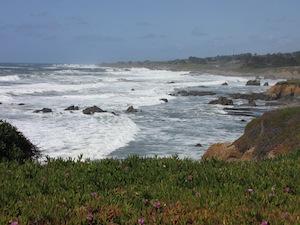
What happens to the beach economy when the beach is vanishing?
That’s what a new study seeks to answer in some of the most specific terms yet attempted.
The projections are from a team at San Francisco State University led by economist Philip King, who says in the study release that “Sea level rise will send reverberations throughout local and state economies.” He expects those reverberations to come from the effects of temporary flooding, beach and upland (cliffs and dunes) erosion, which King has estimated for five California locations, using sea-rise scenarios ranging from one-to-two-meters (6.5 feet) by the end of the century. Continue reading Rising Seas and Your Wallet→
Technology, yes. Policy, yes. Manufacturing…maybe not so much
This week as Fremont-based Solyndra sets about the grim business of filing for Chapter 11 bankruptcy, it leaves in its wake ample confusion over California’s much vaunted “lead” in renewable energy — so much so that last week a national solar industry association felt compelled to issue a statement reassuring us that Solargeddon was not at hand. (Cy Musiker’s interview with Sev Borenstein of UC Berkeley’s Energy Institute provides some solid perspective on the Solyndra collapse).
It didn’t help that Solyndra had been the arc light of California’s renewable power surge. President Obama, Energy Secretary Steve Chu and former Governor Arnold Schwarzenegger had all led media parades through the company’s Fremont manufacturing plant. The bankruptcy announcement came within hours after Chu finished extolling California’s leadership at an energy “summit” in Las Vegas.
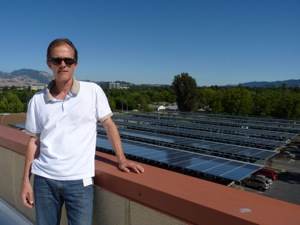
John Hild with the new solar array at the Contra Costa County Office of Education. The panels were "made in the USA"-- but by a Chinese company.
Recently I climbed to the roof of the Contra Costa County Office of Education with John Hild, for an overview of a new 700-panel solar array that covers the agency’s parking lot in Concord.
Hild, who manages facilities there, was impressed with the May electric bill, which had dropped to $19 from about $7,200 before the photovoltaic (PV) panels were hooked up. But Hild says it was tough to find American-made panels, something required by one of the incentive programs that CCCOE was tapping into to make the project affordable. In the end, they found some–but they were made in Arizona, not California, by the Chinese solar juggernaut SunTech. Continue reading California’s “Solar Lead” Revisited→
Smoke from space and a wind farm framed by wildfire
California’s fire season is off to a mercifully late start this year — but could make up for it in ferocity.
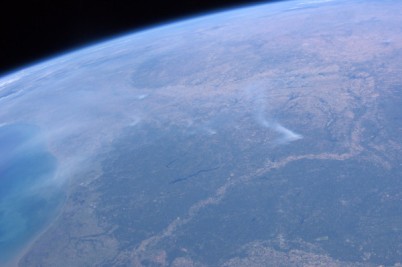
Two images came across today that underscore the deep impression that fire can make on the landscape. First, this image from space of smoke from the ongoing Texas wildfires.
A smudge on the Blue Marble: Smoke plumes rise from Texas wildfires.
Regulators vote to keep cap-and-trade plan on track
A parade of environmental justice proponents pleaded with officials to abandon cap-and-trade. A woman in the background holds a sign that says: "Keep the cap. Drop the Trade."
Members of the “environmental justice” movement lost a major round to air officials on Wednesday, when the latter voted to keep California’s nascent cap-and-trade plan on track.
The program is a key component of the state’s landmark strategy to cut greenhouse gas emissions to 1990 levels by 2020.
Activists sued to stop the program, claiming it does little to curb toxic emissions from industrial facilities and farming operations.
Environmental justice advocates packed the Sacramento hearing room of the Air Resources Board to fight the state’s plan to allow corporate trading of carbon pollution rights. Marie Harrison of San Francisco’s Bayview district put it succinctly:
After more than a decade with a nuclear waste dump next door, the sky has not fallen on Carlsbad
Okay, so Yucca Mountain hasn’t worked out so well. In fact, the current betting is that the planned Nevada repository for nuclear waste will never open its doors. No matter. New Mexico beckons.
A transport container for nuclear waste, outside the Waste Isolation Pilot Plant in New Mexico.
Few Americans seem to realize that the world’s only functioning geologic repository for nuclear waste of any kind is already open for business in the southeastern corner of New Mexico. In fact, the Waste Isolation Pilot Plant is well beyond the “pilot” phase. It’s been taking in truckloads of the stuff since 1999, without mishap, it’s success no doubt a factor in its anonymity.
An average of 30 truckloads a week from all corners of the US, roll into what is essentially a glorified salt mine, licensed by the federal government to accept low-level “transuranic” waste from defense-related facilities only. Continue reading Yes, In Our Backyard→
Nearly 3,000 tons of spent nuclear fuel have accumulated at nuclear power plants in California…with nowhere to take it.
"Dry casks" waiting to be loaded with spent fuel at Diablo Canyon. (Photo: Craig Miller)
It could be worse. This could be Illinois, the undisputed spent fuel champ, with more than 8,000 tons piled up at plants. As it is, California ranks eighth in the nation.
“This country has an obligation to those states and those communities to take those materials and put them into deep geologic disposal, where they can be safely isolated for a very long period of time,” says Per Peterson, who chairs the nuclear engineering department at UC Berkeley.
Trouble is, the country seems farther now from meeting that obligation than it was in 1998, the original legislative deadline for opening a permanent repository for spent nuclear fuel. Continue reading California’s Nuclear Burden→
Survey shows confidence in existing plants but little enthusiasm for new ones
A fresh poll from the Field Research Corporation shows statewide support for nuclear power plummeting.
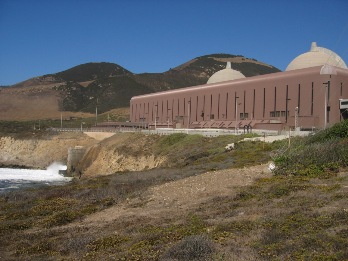
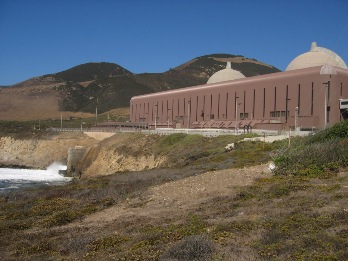
PG&E's Diablo Canyon Nuclear Power Plant, near Avila Beach. (Photo: Craig Miller)
The survey, taken earlier this month, shows that support for expanding nuclear power in California has dropped to 38%, from 48% last year, when only 44% opposed the idea. In the newest poll, 58% surveyed said they did not agree that more nuclear power plants should be built in the state.
Field analysts say the numbers are a clear reflection of the shift in sentiment worldwide, since the Fukushima nuclear crisis in Japan, a tense series of events that have remained front page news since March 11. Since then, Germany, Switzerland and Italy have all decided to scrap their nuclear energy programs. Continue reading Californians: No Thanks to New Nukes→
Immediate impact of greenhouse gas ruling on California seems minimal
The states' lawsuit was aimed originally at coal-fired power plants.
The silence is deafening since the US Supreme Court ruled this week that states can’t take utilities to court over greenhouse gas (GHG) emissions on their own.
NPR’s reporting of the decision calls it “the court’s most important environmental ruling in years.”
But here in California, I’m seeing mainly tepid reaction from officials — and without the usual cavalcade of releases from industry and environmental groups, applauding or condemning. In response to an email inquiry I made after the ruling came out, Mary Nichols, chair of the California Air Resources Board, replied that the ruling:
“…re-affirms that EPA has the authority and responsibility to regulate greenhouse gas pollution in order to protect the public health and welfare from the urgent threat of climate change. The careful, deliberate approaches developed under the Clean Air Act – including California’s Clean Cars rule – provide a more reasonable and feasible alternative to the uncertainty of court-imposed limits on carbon pollution.”
California was one of six states involved in the case, which dates back to 2004. But that was before the EPA had taken definitive steps to assert its own regulation of greenhouse gases (a role upheld by the Supreme Court in 2007).
Air Board spokesman Stanley Young explained that California’s participation in the suit was “an effort by California to get some kind of national action on the climate front. Now that EPA is fully engaged, that kind of judicial action is no longer necessary.”
Just how “fully engaged” the Environmental Protection Agency is remains a matter of some debate. The federal agency recently postponed release of a draft rule on GHG emissions from power plants.
Changing climate threatens web of life along California’s coast
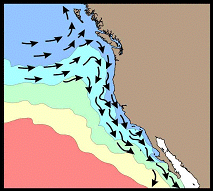
The California Current is a conveyor belt for cold water from the north Pacific.
It’s the reason that wetsuits are such big sellers in California. The river of ocean water known as the California Current barges in off the Aleutians, and as it rolls southward along the West Coast, makes for more than bone-chilling body surfing. It supports a robust stew of sea life.
But as Mike Lee reports for The San Diego Union-Tribune, it’s warming up. And that has researchers at the Scripps Institution of Oceanography concerned about future biodiversity off the California coast. Scientists say shellfish are already under attack from acid levels elevated when the ocean is forced to absorb more carbon dioxide from the atmosphere. Continue reading Ocean Changes Cause Consternation→