Tag Archives: Policy

Few Surprises as Climate Symposium Opens

A broad spectrum of scientists, entrepreneurs and public officials are meeting in Sacramento this week for the sixth annual Climate Change Research Symposium, sponsored by the California Energy Commission (CEC).

Today and tomorrow are packed with technical lectures on topics ranging from “Decadal Changes in the El Nino Pattern and Impact on the Hydroclimate…” to “Climate and Wine Grape Phenology in Napa Valley.” But yesterday it was up to the policy honchos to set the scene.

There was little in that preamble that hasn’t been heard before. When asked about recently expressed doubts that the state’s utilities can attain a one-third proportion of renewable energy within the next decade, air board chief Mary Nichols said “Not only can we do it, we have to do it.” Nichols, probably the state’s highest-profile point-person on climate policy,  said the the state’s broader, longer-range goal for cutting greenhouse gas emissions simply can’t be achieved without it.

Just as if they’d heard her, legislators tonight passed SB 14 out of committee. The bill requires utilities to meet the 33% renewable portfolio standard (RPS) by 2020 (in other words, to derive a third of their power from low-carbon sources). Green energy activists lamented language in the current version that allows utilities to slip that deadline, if there are delays in bringing new renewable energy sources online.

There was a clear signal from yesterday’s symposium speakers that, as we’ve previously discussed in this space, adaptation is taking center stage on the policy front. California has set targets for “mitigation” of global warming and put some of the wheels in motion. Now attention has turned to preparing for inevitable climate change effects, already in the pipeline.

The CEC’s newest Commissioner, Julia Levin, warned against the onset of “NIMBY” syndrome as measures are implemented across the state, such as the build-out of solar and wind “farms.”

And Stanford scientist Chris Field, who heads the IPCC’s Working Group II, noted that while growing interest in the “other” greenhouse gases (methane, nitrous oxides, etc.) is justified, the focus should remain on controlling carbon dioxide.  “As long as the world maintains an aggressive focus on economic growth,” said Field, “It’s the economic growth that’s the driver of future emissions and that’s why strategies to find ways to grow the economy without increasing carbon emissions are so important.” While some of the other gases are more potent greenhouse gases, Field says they’ll see little or no growth in volume in coming years.

Field previewed some of what he sees as the focal points of the next major IPCC climate report, known as AR5. Field predicted that we’ll see a shift in focus from making the case that global warming is real and human-induced, to providing more and better information that “stakeholders” can act upon. Field cited a recent study projecting that corn yields in Africa could fall 30% by 2040, due to climate forces.
Japan’s Climate Plan: Too Ambitious?

KQED’s Los Angeles Bureau Chief and frequent Climate Watch contributor Rob Schmitz is spending six weeks in Japan, as part of  the Abe Fellowship for Journalists. In the weeks to come he’ll file a series of special reports on Japan’s extraordinary strides in energy efficiency–and what we might learn from them.

Saturday night, on my way home from an interview, I witnessed one of the more interesting orchestrated movements of humanity the world has to offer. I shot this video when I was changing trains at Shibuya station, one of Tokyo’s busiest. The intersection shows how well Japan engineers pedestrian movement–but how well will it engineer its residents’ greenhouse gas emissions?

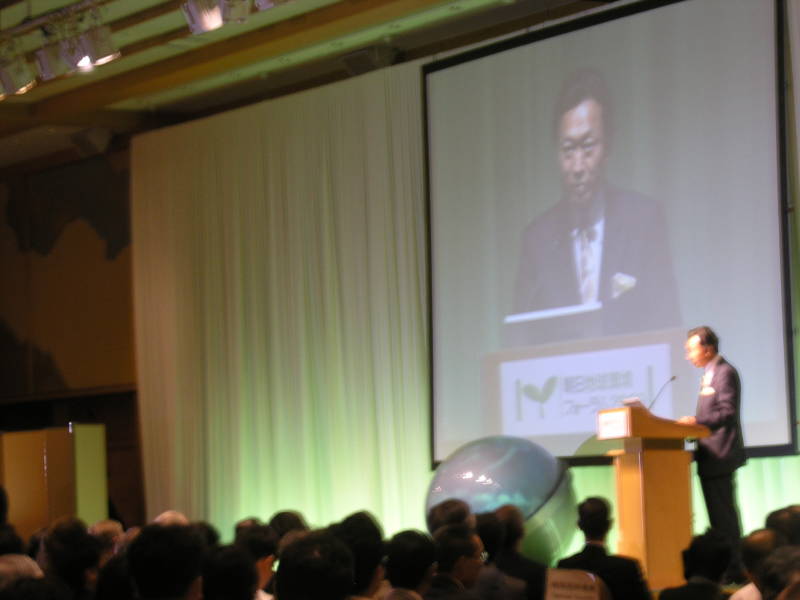
On Monday, I attended the Asahi World Environment Forum, where all the bigwigs on climate change were in attendance (including Yvo de Boer and Rajendra Pachauri, among others). The surprise visitor was Japan’s Prime Minister-elect Yukio Hatoyama.

Hatoyama makes his climate change pledge.

He told a packed house that Japan will aim to reduce its greenhouse gases by 25% from 1990 levels by 2020.

“In my personal opinion, that’s impossible,” Hidetoshi Nakagami told me last week. Nakagami is President of the Jyukankyo Research Institute and holds a coveted seat on the advisory committee to Japan’s powerful Ministry of Economy, Trade, and Industry, or METI. “Hatoyama’s pledge is pure politics,” he said. “It’s not practical, it’s not possible, and there’s not enough time.”

Nakagami is not a pessimist. He played a large role in creating Japan’s very successful Top Runner program, a 1997 policy that searches for the most efficient model of any given electrical appliance and then makes that model the industry standard, requiring other companies to adhere to it when making new models of the same appliance. The program was one of Japan’s most ambitious energy efficiency measures, and Nakagami had to fight against Japan’s largest companies in order to help craft the policy into law.

While Nakagami would like to see a one-quarter reduction in greenhouse gases from 1990 levels in the next decade, he says it’ll cost the average Japanese dearly. When former Prime Minister Taro Aso pledged to cut Japan’s greenhouse gases by 15% of 2005 levels, Nakagami’s institute estimated that the effort would cost each Japanese household, on average, 70,000 yen–a little over USD $700–a year. Even that, says Nakagami, would be a tall order in this economy.

In the end, Hatoyama may not fill this order. His historic pledge, which during his campaign, seemed to have no strings attached to it, now has an important caveat. At Monday’s forum, he told the audience that Japan will embark on this journey as long as other major countries also set similar ambitious targets.

Japan’s future hanging in the balance.

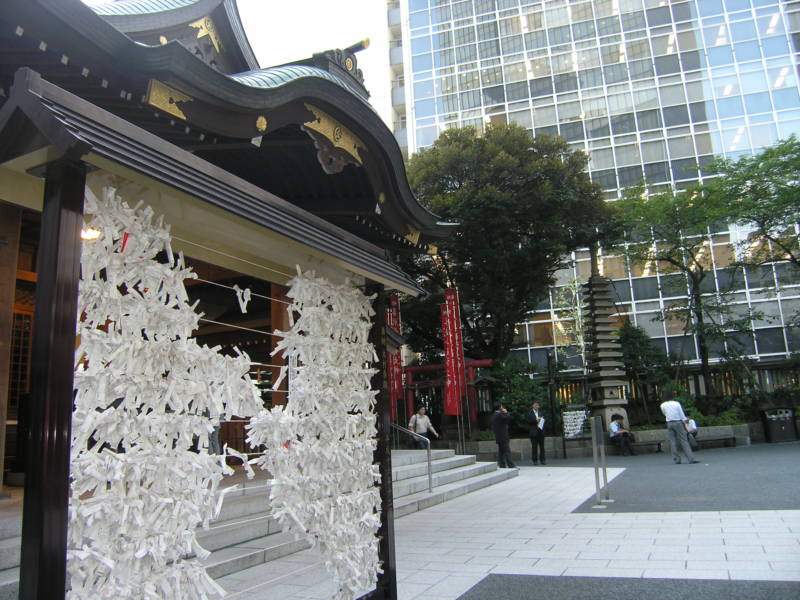
After the forum concluded, I walked outside into Tokyo’s rush hour: pedestrians everywhere, taxis speeding by me. I stopped at a Shinto shrine built among enormous glass skyscrapers. In front stood an Omikuji shrine, where believers tie a paper copy of their fortune, with hopes that it’ll come true. Hundreds of paper fortunes rattled in the hot, summer wind. I wondered if one of them was Hatoyama’s.

Mister Hatoyama’s Neighborhood

KQED’s Los Angeles Bureau Chief and frequent Climate Watch contributor Rob Schmitz is spending six weeks in Japan, as part of  the Abe Fellowship for Journalists. In the weeks to come he’ll file a series of special reports on Japan’s extraordinary strides in energy efficiency–and what we might learn from them.

Yesterday Japan held a national election. My neighbor won it. Well, technically, his party won it, but it’s assumed that my neighbor, who heads the Democratic Party of Japan, will become Prime Minister within a couple of weeks when the party formally elects him.

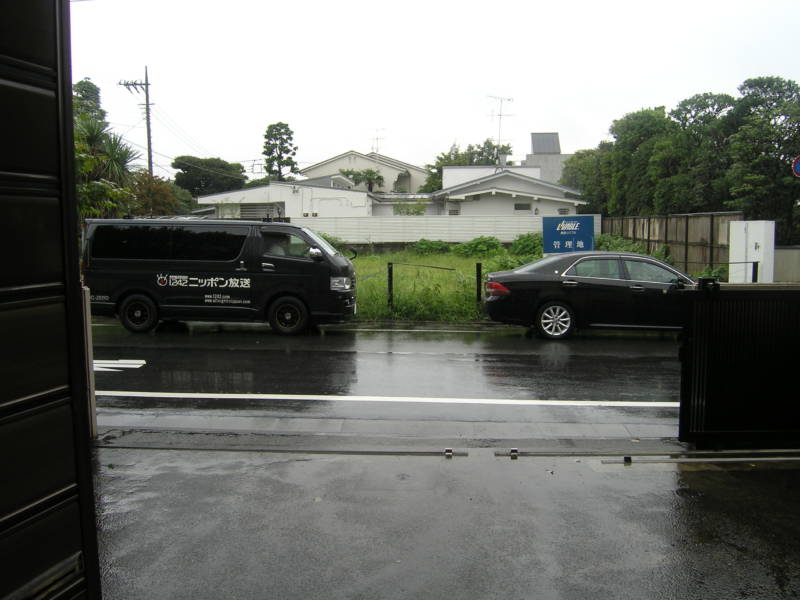
A peek outside my door yesterday revealed media vans and limos outside the house of my new neighbor and Japan’s new prime minister-elect, Yukio Hatoyama.

My neighbor is Yukio Hatoyama. He lives in a large house across the street from the apartment I’m renting here in the tony Tokyo suburb of Denenchofu. Yesterday morning an elderly police officer knocked on my door clutching a map, explaining to me in slow, metered Japanese that his men would be establishing a perimeter around our neighborhood to keep out protesters, non-credentialed journalists, and anyone interested in engaging in general tomfoolery near the Hatoyama residence (an English-speaking neighbor helped translate). I mustered the only Japanese response I knew (“Arigato!”), not having sufficient language skills to explain that I, in fact, was one of those “non-credentialed journalists.” He smiled, bowed, and moved on to the next residence.

As early results on the afternoon television news began to confirm that Hatoyama’s party was on the path to victory, my neighborhood, which was virtually silent for my first few days here, started buzzing with activity. Police officers on foot patrol, random passers-by who somehow got past the perimeter stopping in front of Hatoyama’s house to stand and stare before being ushered away, and members of the “credentialed” Japanese press sitting on the curb in the rain, quietly watched over by the around-the-clock security presence in front of Hatoyama’s home. My wife and I are thinking of baking our neighbor a cake as a congratulations gift–if we could just get by security.

Apart from the amazing coincidence that the apartment I rented happened to be located across the street from the incoming prime minister, my new neighbor has a lot of work ahead of him. Japan is suffering its worst unemployment ever, and many here are fed up with the Liberal Democratic Party, which, despite its name, is the conservative party that has ruled Japan for 50 years.

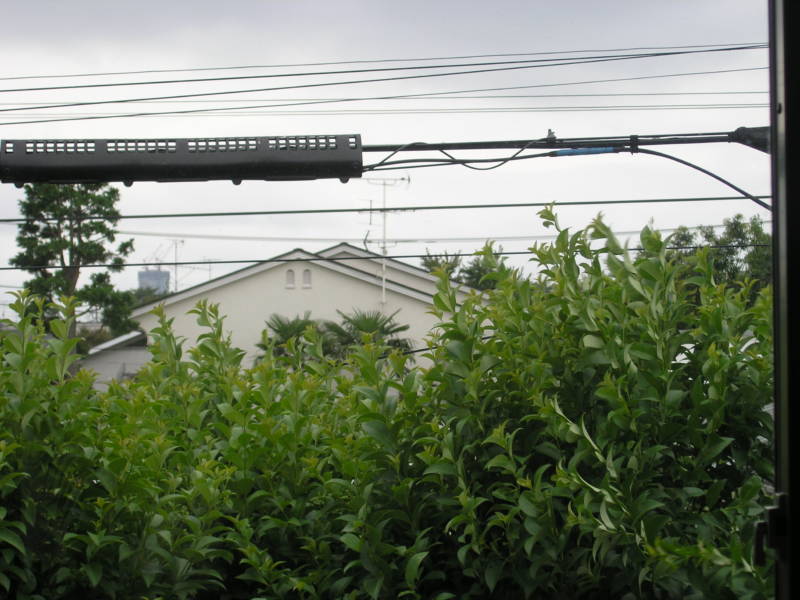
View of Hatoyama’s house from my living room. “May I borrow some sugar, Hatoyama-san? …and perhaps an interview?”

Hatoyama has promised the Japanese more social welfare programs and fewer incentives to big Japanese business but some experts wonder if it’s a good idea to tinker with a system that’s helped Japan become one of the world’s biggest success stories.

Hatoyama has a strong California connection: His doctorate in engineering is from Stanford University, where he met his wife. He speaks English well–well enough to have written a provocative Op-Ed in the New York Times this past weekend; a timely critique of U.S.-led globalism and unbridled capitalism, and a call for Japan to retreat from this system, to a more regional and sustainable economic framework.

More to the purpose of my reporting here, Hatoyama has pledged to make Japan a more prominent world leader in battling climate change. He’s pledged to cut the country’s greenhouse gas emissions by 25% from 1990 levels by 2020, and has promised to generate more jobs for Japanese workers by helping develop the clean-tech industry here.

He also heavily favors on a bigger reliance on nuclear power for Japan; a stance that is not as controversial as you may think in this country. In recent polls, the majority of Japanese respondents say they’re open to a larger reliance on nuclear power. In a country that imports all of its fossil fuels, nuclear power means more energy security and fewer greenhouse gas emissions. On the other hand, it heightens the thorny debate of what to do with radioactive waste–a debate that, despite poll numbers, is of big concern to many Japanese. With all these issues to tackle, it’s likely that my neighbor won’t be spending too much time at home in the coming weeks. Maybe I should offer to house-sit.

Do We Need Nuclear?

This is an updated re-post from August 24th, when my radio feature first aired on KQED’s Quest series. That report repeats on this week’s magazine edition of The California Report.

More people appear to be saying “yes” these days, even if grudgingly. The question is: Is it too late?

The Public Policy Institute of California has been tracking public support for expanded nuclear power over the past several years. Survey participants are offered a menu of four potential energy options, one at a time.

The question posed is: “Thinking about the country as a whole, to address the country’s energy needs and reduce dependence on foreign oil sources, do you favor or oppose the following proposals?” Then the four options are offered, including: “How about building more nuclear power plants at this time”

As recently as 2002, adults surveyed in California opposed the idea by a margin of 59% to 33%. But that gap has been closing steadily in the years since and by this July, Californians were split just about down the middle on the question, with 46% in favor and 48% opposed. The poll has a margin of error of about 2%, making it a virtual tie.

When you dig into the numbers a little deeper, some demographic preferences emerge. Support increases with both age and education. Californians 55 and older support more nuclear by a wide margin (58% to 36%) as do college graduates (50%-43%).

Many people use cost as an argument against nuclear but just as the PPIC was phoning around for opinions on the matter, the Palo Alto-based Electric Power Research Institute was finishing up its own report, concluding that trying to reach greenhouse gas reduction goals without baseload technologies like nuclear power, could end up costing much more.

Dan Kammen, who runs an energy lab at U.C. Berkeley, would appear to agree. He said in a recent interview for Climate Watch that “Without knowing exactly where things will come down on nuclear, I think that it absolutely has to be part of the equation in a way that it has not been in the past. Energy costs from fossil fuels are rising at almost 5% a year now, and the damage we are doing and are going to do more of, if we don’t stop our fossil fuel expansion, in terms of greenhouse warming, is so large an issue that these technologies have to be back on the table.

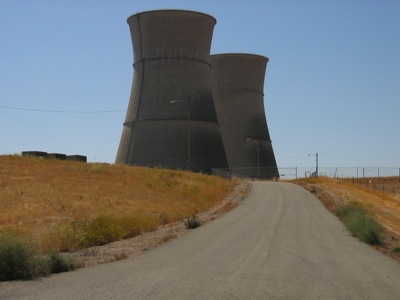
Is the road back to nuclear a dead end? Cooling towers at the decommissioned Rancho Seco nuclear power plant.

But there are serious doubts whether the nation–let alone the state–is in a position to embrace nuclear as it did in the 1960s. Kammen is also a professor of nuclear engineering, and noted with some alarm the rate at which the industry is “graying.” Now in his mid-forties, he told me that when he attends technical meetings for nuclear engineers, he’s often “the youngest guy in the room–by 20 years.” Since the U.S. more or less abandoned its nuclear hopes following the Three Mile Island debacle, the nation has ceded most of its nuclear industrial capacity to other nations, and few young people have chosen to enter the field.

Reports from new projects around the world have not been encouraging of late. Finland is struggling mightily to get its newest reactor up and running. This goes directly to doubts expressed by Kammen and others, that the industry can cowboy up fast enough for nuclear to play a meaningful role in meeting CO2 reduction targets.

The effective ban on new nuclear plants that California has had in place since 1976 could be reconsidered. But ultimately electric utilities will have to want it and I sense a certain “nuclear fatigue” in that arena.

Managers at the Sacramento Municipal Utility District (SMUD) shut down its only reactor in 1989, after a thumbs-down referendum. When I called to ask for an interview on the prospects for a nuclear revival, they declined. They didn’t even want to talk about it. Managers at PG&E, whose twin reactors at Diablo Canyon produce nearly a quarter of the utility’s output, still claim an interest in nuclear. But when I asked CEO Peter Darbee about it recently, he said he had the sense that most people in California would prefer to look elsewhere for energy solutions.

Of course, that was before the latest PPIC poll.

Delta Dawn

Scientists and policy wonks seem to be in general agreement on this: that it’s time to close out the current management epoch on the Sacramento-San Joaquin Delta and begin anew. There’s less accord on how to proceed.

U.S. Fish & Wildlife Service
Photo: U.S. Fish & Wildlife Service

Policy makers have assembled “blue ribbon” panels to study the options and make recommendations. Volumes of studies and proposals line the shelves in Sacramento and elsewhere.

Last week a new idea surfaced for moving water through the Delta: Instead of channeling around it, tunnel under it.

This week the non-partisan Public Policy Institute of California released its recommendations for a mechanism to fund the enormous fixes that will be required: Those who benefit pay (ecologists use the term “ecosystem services” for all those bennies we get from natural resources and tend to take for granted).

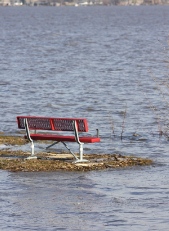
Whatever the outcome, one thing seems inevitable, with or without human intervention. Driven by warming ocean temperatures, rising sea levels will continue to push saltwater farther upstream, changing the Delta’s character and the “services” it provides.

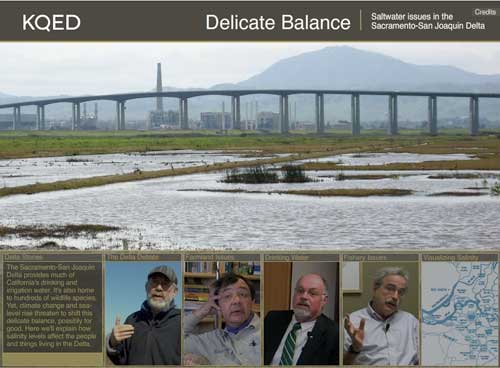
Recently a team of students at U.C. Berkeley’s Graduate School of Journalism produced a Flash presentation on some of the issues raised by advancing salt in the Delta. The multimedia report: Delicate Balance was produced for Climate Watch by Amanda Dyer, Martin Ricard and Jeremy Whitaker. We’re grateful to them for their time and creativity.

delicatebalance

Not With a Bang, But…

This is the way the world ends. Not with a bang but with a whimper. –T.S. Eliot

With the President headed for Mexico for a two-day summit, I was struck last week by the juxtaposition of two headlines that jumped out of a daily environmental news digest.

One headline read: “MEXICO AIMS TO BRING CO2 CUT PLAN TO CLIMATE TALKS.” The other, just above it, referring to similar efforts in this country, read: “CLIMATE BILL MAY FALL BY THE WAYSIDE.”

“With the fight over health care reform absorbing all the bandwidth on Capitol Hill,” Lisa Lerer wrote for Politico, “Democrats fear a major climate change bill may be left on the cutting-room floor this year.”

Granted, Mexico’s contribution to global greenhouse gas emissions is reportedly about 2%, or a tenth of the U.S. contribution, so one might argue that there’s a lesser job to do there. But with less than four months remaining before the next major U.N. climate conference, it raises the grim prospect that while other nations press on, the U.S. could arrive in Copenhagen empty-handed, which is to say without meaningful carbon legislation to show.

At the same time last week, the 16-nation Pacific Islands Forum called for a 50/50 commitment from developed nations; a 50% reduction in greenhouse gas emissions by 2050. Many of those island nations are on the hot seat as rising seas levels could make them among the first to lose substantial real estate before the end of this century.

At his first climate summit for governors last fall, Governor Arnold Schwarzenegger introduced a video from then President-elect Obama, in which he promised that his presidency would “mark a new chapter in America’s leadership on climate change.”

Praising the governors in attendance for their own climate initiatives, the newly elected President declared that “Too often Washington has failed to show the same kind of leadership. That will change when I take office.”

Of course “Washington” includes Congress, which is still dithering over the major carbon emissions bill championed by the new President. It squeaked through the House by nine votes and now looms as a 1,400-page pig that the Senate python will attempt to digest or regurgitate. Either way, what comes out is unlikely to closely resemble what went in.

Meanwhile the whole cap-and-trade concept has been coming under increasing scrutiny and skepticism. Last month, when the non-partisan Public Policy Institute of California polled Californians on the subject, more respondents favored an out-and-out carbon tax than cap-and-trade (56% to 49%). The Western Climate Initiative, a regional cap-and-trade pact that is a keystone of California’s climate strategy, AB 32, remains in limbo while western legislatures wait on Congress.

So when the Governor convenes his second climate summit in L.A. next month, billed optimistically as “The Road to Copenhagen,” he and his fellow “subnational leaders” (Wisconsin, Michigan & Connecticut governors are currently signed up) may find that the ball is still in their court. According to a news release from the Governor’s office, “climate leaders from around the world will come together and collaborate on efforts to further the global fight against climate change.”

They’ll do it with the same question on the table as last year: Can they count on Washington to take up the reins?

Plan Moves Climate Adaptation to Front Burner

A one-fifth reduction in per capita water use by 2020 is among the goals outlined in a new state report on adapting to climate change.

Released by the California Natural Resources Agency (CNRA) as a “discussion draft,”  the 2009 California Climate Adaptation Strategy is being billed as the nation’s first comprehensive game plan for adaptation to climate change.

Reed Galin
Photo: Reed Galin

Most of the state’s high-profile climate initiatives (and battles) have been about mitigation; how to reduce greenhouse gas emissions to slow down warming. This report swings the spotlight over to adaptation; what needs to be done to accommodate the climate change effects that are already “in the pipeline.”

While the California’s centerpiece climate law was passed three years ago, this week’s CNRA report concedes that “adaptation is a relatively new concept in California policy.” The 161-page white paper comes in response to an executive order from the Governor last fall, calling for a statewide adaptation strategy.

The draft divides the strategy into seven “sectors:” Public health, biodiversity and habitat, ocean and coastal resources, water, agriculture, and forestry.

Tony Brunello, Deputy Secretary for Climate Change and Energy at CNRA, says “This is the first report that really looks at how climate change is going to impact the state and what we need to do about it.”

But Brunello stopped short of conceding that mitigation is a lost cause. “You only have half a deck if you’re only focused on mitigation,” he said. “You need to focus on both mitigation and adaptation to truly be prepared.”

Some strategies attack both. Brunello points to water conservation measures, which save both water and energy (20% of the energy used in the state is deployed moving water around).

The plan is designed to work in consort with the California Air Resources Board’s implementation plan for AB-32, the state’s multifaceted attack on greenhouse gas emissions. CNRA says one of its goals is to “enhance” existing efforts, rather than create new programs and offices that need funding.

CNRA also promises to use the “best available science in identifying climate change risks and adaptation strategies.” Andrew Revkin has a useful overview of the mounting challenges to climate scientists, published this week in the New York Times.

One planned product from the adaptation plan is an interactive website devoted to climate adaptation, with maps and data to assist local planners. CNRA hopes to have that in place by early next year. The draft plan now enters a 45-day period for public comment.

Making Noise Over Wind

Figures released this week by a national wind power trade association would seem to indicate that the expansion of wind capacity proceeds apace. The American Wind Energy Association (AWEA) reported that more than 4,000 megawatts of new capacity has been installed so far this year, a 38% increase over last year’s pace.

Even so, AWEA CEO Denise Bode seems mildly disappointed by the numbers. Citing a slowdown in manufacturing of turbine components, Bode described the industry as “swimming upstream.”

The contrary current may get even stronger if my recent visit to upstate New York is any indication. Arriving for a family visit, I found that I’d landed in the midst of an uproar over wind farms, both built and proposed. Several times a week, articles were appearing in the Watertown Daily Times, about how area residents from around the state are complaining of ill effects from the utility-scale wind farms nearby and bristling at plans for more.

Wind power has hit headwinds in the past over concerns about birds, bats and its effect on people’s views. In upstate New York, the current objection seems to be noise.

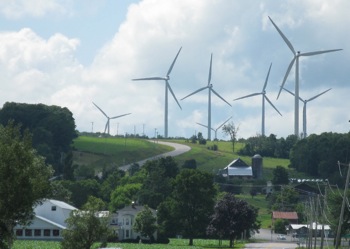
Giant wind turbines dwarf dairy farms in northern New York. Photo: Craig Miller
Commercial wind turbines dwarf dairy farms in northern New York. Photo: Craig Miller

At the Maple Ridge wind farm, billed as the biggest east of the Mississippi, I was rendered insignificant by 300-foot turbines, which tower over the farmland in Lewis County. Farther south, in New York’s Finger Lakes region, some turbines top 420 feet. More on this scale are being proposed to stretch out along the St. Lawrence River, which separates New York from Canada. Horizon Wind energy has already erected nearly 200 turbines on Maple Ridge, between the east end of Lake Ontario and the Adirondack Mountains.

Wind companies talk a lot about megawatts and numbers of households served and even tons of greenhouse gases avoided–but not so much about how big these things are. The Cape Vincent-based Wind Power Ethics Group has a graphic on its website that puts some of these numbers in perspective. It shows a 423′ turbine towering over a local lighthouse and the Statue of Liberty.

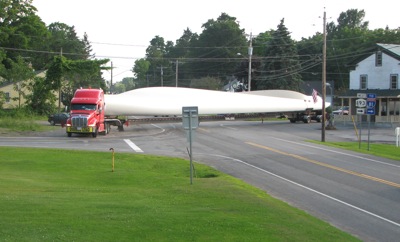
A truck hauling wind turbine blades navigates a turn onto Route 11 in northern New York. Photo: Chuck Miller
A truck hauling wind turbine blades negotiates a turn onto Route 11 in northern New York. Photo: Chuck Miller

When Californians think about wind farms, they may envision places like Altamont Pass and Tehachapi.  California pioneered wind power in the 1970s and 80s and most of the state’s windmills would barely make an impression compared to what’s going up around the country nowadays. California comes in fifth on the AWEA’s latest list of states with the most aggressive wind expansion (Missouri added the most capacity in the last quarter–New York didn’t even make the top 10).

Later this month, in a radio story for Climate Watch, I’ll look at the implications of this scaling-up as companies propose wind farms closer to populated areas in California, such west Marin County (more about that particular situation in our second Quest/Climate Watch television special, which premieres August 25).

Poll: Support for Climate Action More Contentious

New polling suggests that Californians may be wavering slightly in their support of climate response policies. The survey, just released by the non-partisan Public Policy Institute of California (PPIC), also shows a growing rift along party lines, when it comes to climate policy.

Nearly nine in ten Democrats surveyed (86%) said the government should regulate greenhouse gas emissions, while just 54% of Republicans agreed. Among all adults, including “independent” voters, 76% of Californians favored regulation of emissions, similar to a nationwide poll conducted in June by ABC News and the Washington Post.

PPIC chief Mark Baldassare says he thinks that the high-profile debate over national carbon legislation is “splitting Democrats and Republicans in California in a way that they weren’t a couple of years ago, when they saw a Republican governor and a Democratic legislature finding common ground on climate issues.”

Baldassare also observed that the relentless recession and state budget crisis have distracted both voters and their political leaders from environmental concerns.

There was a spike in water concerns compared to last year’s poll, with 18% naming water supply and drought as the state’s most important environmental issue, up 13 points from a year ago, virtually tying air pollution and vehicle emissions (20%) as the top concern. The poll’s margin of error is 2%. The telephone survey was conducted in mid-July.

The PPIC poll also appeared to pick up a groundswell among climate action naysayers. The percentage of respondents saying there’s no need for immediate action was up six points from a year ago, to 23%. Baldassare chalks this up partly to the complex nature of climate science. “People become skeptical when they don’t understand things,” he said.

Overall respondents showed the most concern (59%) over the likelihood of more wildfires, followed by more severe droughts (55%). People seemed less concerned about flooding and coastal erosion brought about by rising sea levels, possibly because they see that as a longer-term threat. Concern over wildfire was strongest in the Inland Empire and L.A. Basin. Interestingly, Angelinos also expressed more intense drought fears (61%) than respondents in the ag-intensive Central Valley, where just 21% described themselves as “very concerned” about the drought threat from climate change. Note that this is not an expression of drought fears in general, just those driven by climate change.

When it came down to the question of what to do about global warming, more Californians favored a “carbon tax” than a cap-and-trade system, by 56% to 49%. California and the nation are currently on a path toward cap-and-trade, at least partly (and paradoxically) because it’s considered more politically palatable than a straightforward carbon tax.