
Tag Archives: Policy

Attitudes about Climate Change are Shifting. Is Yours?

app_full_proxy
One possible Facebook results "badge" from KQED's "Matter of Degree" survey

Coinciding with the release of a Climate Watch Facebook survey that explores attitudes toward climate change, a new national poll by the Pew Research Center for People and the Press shows that the percentage of people who believe that climate change is a reality has decreased significantly in the past year.  Last year, 71%  nationwide believed the Earth was warming, regardless of the cause. This year the number is 57%.

Yesterday, Andrew Kohut, who directs the Pew Research Center for People and the Press, and Dr. Anthony Leiserowitz of the Yale Project on Climate Change joined Neal Conan on Talk of the Nation to discuss changing attitudes about climate change. (You can listen to the 30-minute segment or read the transcript here.)

Kohut said that the economy most likely plays a large role in the drop.  The number of respondents who assigned a top priority to protecting the environment dropped from 56% to 41% in this year’s study, while the proportion who chose dealing with the economy rose to 85%.  That squares with another part of the survey, in which fewer people said they were willing to protect the environment if it meant slowing economic growth or higher energy prices.

“I think what happens,” said Kohut on yesterday’s program, “is if you’re giving [the environment] a low priority, people will sometimes develop a rationale for that low priority. So you have more people saying, ‘Well, maybe it’s not all that serious’…”

Kohut also pointed out that the cool summer experienced by much of the country this year could have played a role in the apparent flagging acceptance of climate change.

The Pew report, released last week, shows a dramatic partisan split in attitudes toward climate change.  Just thirty-two percent of conservative Republicans believe there is solid evidence for global warming, compared with 83% of liberal Democrats, according to Pew.

Leiserowitz discussed his research into attitudes about climate change, which was done in collaboration with the George Mason University Center for Climate Change Communication.

“This research really came from the recognition that Americans don’t speak with a single voice about climate change,” said Leiserowitz. “And what we found, in fact, is that there are six different Americas within America on this particular issue.” National surveys of attitudes toward climate change often yield very different results from polls in California, where there has been greater acceptance of the warming concept in general, as well as the role of human activity in it.

The original Yale-George Mason study, called “Global Warming’s Six Americas,” divides survey-takers into six psychographic groups: Alarmed (18%), Concerned (33%), Cautious (19%), Disengaged (12%), Doubtful (11%), and Dismissive (7%).

Climate Watch teamed up with Leiserowitz and his colleague Ed Maibach from GMU, to create an online version of this survey, called “A Matter of Degree.”  You can take the survey on KQED’s website or on Facebook.  Both versions allow you to compare your results to those of the original study as well as all online survey-takers.  With the Facebook version you can also compare your results with your Facebook “friends” who have already taken the survey and can invite new friends to take the survey.  The Facebook application also features a discussion area where respondents can share thoughts about the climate change and the survey itself, and there are links to learn more about each profile “type”.

What’s your climate profile?  Take the survey and find out.
An Hour with Amory Lovins

In case you missed it amid the flurry of climate-related news last week: On September 30, Amory Lovins, founder and chief scientist of the Rocky Mountain Institute, and an honest-to-goodness energy guru to many, spent an hour in conversation with Michael Krasny and callers to KQED’s Forum program. You can listen to the entire archived broadcast or scan some of the highlights here, compiled by Climate Watch intern David Ferry.

On China:

“We can count on China to lead the world out of the climate mess…Even though the U.S. has led the world in wind installations the past three years, this year China’s going to pass us so fast we won’t even hear them go by. China’s doubled its wind installation each of the past four years, and there’s a new paper in Science from Harvard and Tsinghua in September saying that China can meet all its electric needs–not the growth but the total–till at least 2030, cost effectively, from its wind resources.”

On Nuclear Power:

“Basically nuclear and coal plants are getting walloped in the global marketplace by efficiency and renewables and cogeneration because they’re a lot cheaper and they have less financial risk so they can attract private investment.”

Grading the Obama Administration on Renewables:

“Greatly improved and I think on the whole doing very well.”

On the Upcoming UN Climate Talks in Copenhagen:

“I’m cautiously optimistic…But remember that governments are usually the last to figure these things out. Most governments still think climate protection is costly. They haven’t figured out yet that economic theorists got the sign wrong and actually climate protection is profitable. Once you change the conversation from cost, burden and sacrifice to profit, jobs and competitive advantage it makes the politics a whole lot easier.”

On Energy Efficiency & Steve Chu’s “Low-Hanging Fruit” metaphor:

“The technologies keep improving faster than we use them, so efficiency is an ever bigger and cheaper source–it’s as if the ‘low hanging fruit’ had fallen on the ground; it’s mushing up around the ankles, it’s spilling in over the tops of our boots and the efficiency tree keeps dumping more fruit on our heads.”

On Large-Scale Solar Farms v. “Distributed” Power Generation:

“The sun is distributed for free. Why gather it in one place and then pay to spread it out again? The National Renewable Energy Lab says if we put solar cells on seven percent of the structures in this country it would run all our electric needs without using any land. And for that matter, the wind potential on available windy land in this country is several times our total electric need and the footprint is actually very small.”

On Whether Climate Change is Irreversible:

“There are a half-dozen known mechanisms of rapid climate change. Several of them show like they may be starting up, so it’s urgent to reverse that…we have plenty of technology already available to stabilize climate to the extent that irreversible changes have not already started. We don’t know what that extent is, so we ought to go full bore on best buys first and hope that we’re in time.”

You can also take a virtual tour of Lovins’ home in Colorado, which doubles as a laboratory for energy innovation.

UN Climate Chief: 2014 “Will Alarm the World”

As Governor Arnold Schwarzenegger wrapped up his three-day Global Climate Summit today, with signatures and ceremony, the U.N.’s top climate official set a sobering tone with his own parting shot.

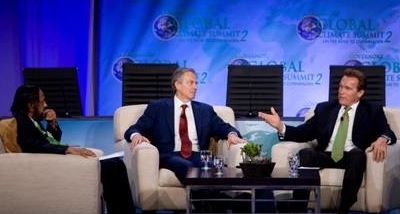
In a final panel this afternoon, the Governor was joined by former Prime Minister Tony Blair and Rajendra Pachauri, who chairs the U.N.’s Intergovernmental Panel on Climate Change (IPCC). Pachauri said the worst-case scenarios from previous climate modeling appear to be coming true, and warned that the next climate change assessment from the IPCC, due out in 2014, “will alarm the world.”

Then he went on to reiterate a prediction he made before the U.N. earlier this month; that based on the science he’s seen, 12 countries are in danger of becoming failed states due to the impacts of climate change. And while he stopped short of listing the nations, previous statements appear to imply that several of the states on his list are in Africa.

Elsewhere at the summit, 30 delegates from state and local governments around the world signed a final agreement to collaborate on climate change. If they follow through with some muscle on the partnership, they’ll be collaborating on clean transportation and on climate adaptation strategies.

Governors from Brazil, Indonesia and U.S.also called on their national governments to address deforestation at the UN climate treaty talks in Copenhagen. Forest loss accounts for 20% of climate emissions globally. California also signed its agreement with the Jiangsu Province of China.

The three-day summit’s title was “On the Road to Copenhagen” and the international talks have been front and center in the discussions here. The governors attending would like their role in combating climate change formally recognized there. They see themselves on the front lines of climate change, as evidenced by this much cited statistic: 50-80% of the emissions cuts needed to reach the UN’s goals will be implemented by states and cities.

But despite the Copenhagen-mania, Schwarzenegger stuck with his subnational message, saying: “Climate change isn’t all about this one treaty.” Even if the talks at Copenhagen fail, he says states and provinces should keep forging ahead.

Photo: Office of the Governor.

A Bottom-Up Climate Approach

Governor's Office
Photo: Governor's Office

The second Governors’ Climate Summit kicked off yesterday with a plenary on adaptation to climate change. Most of the climate policy we hear about has to do with mitigation; cutting emissions to reduce the rate of climate warming. Increasingly, though, policy makers are looking at ways to adapt to the effects that are already palpable.

Several international leaders had stories to tell:

– Premier Gordon Campbell of British Columbia said that due to warming winters, pine beetles will kill 80% of the mature pine forests in his province by 2013.

– Dr. Dessima Williams of the Alliance of Small Island States said rising sea levels make climate change “a case of life and death” for island nations.

According to a World Bank analysis cited by Michele De Nevers of the Bank’s Environment Department, adapting to climate change will cost $75-100 billion dollars a year for developing countries–and that’s with only 2 degrees (Celsius) of warming by 2050. That seems like a big number, but De Nevers reminded the crowd that it’s on par with the recent financial bailout.

I also spoke with Margret Kim, China Program Director for the California Air Resources Board and EPA, who has been working with the government of the Jiangsu Province in China.  She filled me in on the agreement that Governor Schwarzenegger is expected to sign today with leaders from the province to help them reduce greenhouse gas emissions.  Based on this framework, California would develop an action plan to share expertise and research with the province.

This partnership is built on a 2005 agreement that California signed with the province, which was focused on energy efficiency. Barbara Finamore of the Natural Resources Defense Council says real progress was made on the first agreement with Jiangsu, which set several efficiency incentives and programs in motion. But they have more to do.  Ninety-five percent of the province’s electricity comes from coal.

The announcement comes on the heels of President Hu Jintao’s declaration less than two weeks ago that China would make notable reductions in its carbon intensity by 2020.  Carbon intensity isn’t quite as simple as a straight emissions cut. It measures the amount of carbon dioxide produced for each dollar of economic output.  And fixed targets aren’t part of the expected Jiangsu agreement either. But Finamore says this is a landmark agreement since it shows an important shift in China’s willingness to tackle climate change. As she said, “I’ve been working in China on energy issues for more than 20 years, and there has been a tremendous amount of recent progress.” And a bottom-up approach–with states piloting environmental policies before national governments adopt them–is certainly something we’re familiar with in California.

Provincial Climate Summitry: Day One

Governor Schwarzenegger kicked off his second Global Climate Summit Wednesday in Los Angeles–and “global” is certainly the emphasis.  The three-day conference features panelists from more than 70 states, provinces and countries who are discussing “subnational” strategies to cut carbon emissions.  (That’s the policy wonk term for regional, state and provincial governments).

Events like these are at risk of being feel-good political meet-and-greets, but I spoke with Louis Blumberg of The Nature Conservancy, who believes that the partnerships created at the last climate summit have borne fruit in the past year. Blumberg is part of a deforestation working group made up of five Brazilian states, two provinces in Indonesia and three states in the U.S. They’re working on carbon accounting techniques for forestry projects–or in carbon parlance, REDD (Reduced Emissions from Deforestation and Degradation).

Expect more partnership announcements from the rest of the summit.  The first signed this week came from California and Mexico, who announced a partnership to protect Monarch Butterfly habitat in Mexico through reforestation.  California forests are also getting some attention.  The Governor also announced a deal with the largest private forest owner in California, Sierra Pacific Industries, to produce carbon credits from its forestry projects.

Still, for all the state-level dialogue, national climate news stole the show.  EPA Administrator Lisa Jackson appeared just after the Governor to announce  a proposed rule to use the Clean Air Act to regulate greenhouse gas emissions from large power plants and refineries. And in Washington, Senators Barbara Boxer and John Kerry released a national climate bill in the Senate (see Craig Miller’s post for more on that).

The Governor took it all in stride, reminding the audience that California piloted many of the policies the national government is now considering. “That’s how powerful states and regions are,” said Schwarzenegger. “We really are the laboratories for the national governments. That’s where the action is.”

And Now, the Senate Show Begins

Senators Barbara Boxer (D-CA) and John Kerry (D-MA) have released their climate bill into the maw of Senate committees. Their Clean Energy Jobs and American Power Act is designed to cut greenhouse gas emissions by 20% from 2005 levels by 2020, with a long-range goal of 80% by 2050.

Sen. Boxer told me in an interview today that five committees have jurisdiction over various pieces of the legislation, which runs about 800 pages at this point (versus 1,400 for the version that narrowly passed the House). She conceded that it’s unlikely to clear the committee gantlet and get to the Senate floor in time for the next major round of U.N. climate talks, set for December 7 in Copenhagen.

Given multiple major distractions such as economic recovery, health care reform, and two ongoing wars, Boxer predicted that it would likely be late December before a version of the climate bill could come to the floor. She said “I have a hunch we’re going to be in until Christmas Eve, frankly.”

Box says she and her colleagues have “broadened the coalition” since a House version of national carbon legislation squeaked through by nine votes over the summer. “We think at the end of the day, they (skeptics) will realize that this is the most flexible way to stand up and fight this challenge called global warming.”

Boxer counterposed this “flexibility” with what some consider the likely alternative; non-legislated regulation of greenhouse gases by the Environmental Protection Agency, under the decades-old Clean Air Act. Coincidentally or not, EPA took a step in that direction today by announcing proposed new requirements for large industrial emitters of carbon dioxide.

EPA’s proposed “tailoring rule” covers six known greenhouse gases produced by power plants, oil & chemical refineries and other large-scale operations. Boxer says she doesn’t see the announcement as competing with Congress. “I think this is a very important signal to my colleagues that the EPA wants to work with us. They’re just going after the biggest polluters and that’s following our lead.”

As for “subnational” initiatives like the Governors’ Climate Summit, going on this week in L.A. (and where EPA chief Lisa Jackson chose to announce the new rules), Boxer said her bill “should encourage the Governors to keep on going. Keep on keepin’ on because the more we all do, the easier it will be in the end.”

Boxer said “We have to step up here or we’re going to see the terrible results of unchecked global warming. This is the moment,” she said. “We’re losing the window.”

Lauren Sommer is covering the L.A. summit for Climate Watch. Watch for her daily posts.

Governor: RPS Order “Stronger than Law”

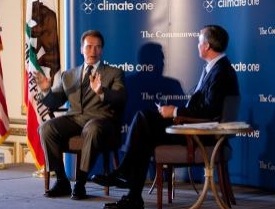
Gov. Schwarzenegger fields questions from Greg Dalton of the Commonwealth Club's Climate One initiative. Photo: Governor's Office

Governor Arnold Schwarzenegger is defending his planned veto of two renewable power bills, saying the executive order he issued instead is “stronger than the law” because it places fewer limitations on electricity imported from other states.

At the tail end of the legislative session, California’s assembly and senate passed separate bills requiring the state’s utilities to draw a third of their energy from renewable sources by 2020. But during a Q&A session at San Francisco’s Commonwealth Club Thursday, the Governor said that the recently passed bills were “for special interests” and that they “represented protectionism,” the latter a reference to limits on how much energy could be imported from neighboring states. The Governor’s own executive order has the same proportional requirement or “renewable portfolio standard” (RPS) as the bills but sets no limits on imported power. Also unlike the legislature’s bills, the order does not exclude particular sources, such as hydro-electric from the definition of “renewables.”

Critics contend that succeeding governors might simply rescind the order, which Governor Schwarzenegger does not deny. He faces an October 11 deadline to veto the bills.

Governor Schwarzenegger’s appearance was designed to mark the third anniversary of the state’s adoption of AB 32, the Global Warming Solutions Act of 2006, a law which has its own detractors.

Meg Whitman, the former CEO of eBay, who is running for governor said last week that she would issue a moratorium on most AB 32-related rules on her first day as Governor.  When asked about  Whitman’s remarks Schwarzenegger dismissed her comments as “just rhetoric.”

“I think she will probably reconsider what she has said and will see that the greatest thing that can happen for California is to move forward. I’m sure she does not want to be counted as one of those Republicans that want to move us back to the Stone Age,” he said.

Touting the state’s achievements in renewable energy innovation, emissions reductions,  and technology, the Governor painted a rosy picture of an invigorated economy, new jobs, and a cleaner environment throughout the state.

“A wave of green innovation is washing over our state right now,” he said.  “In last three years,  scientists and entrepreneurs have pumped more than $6 billion of venture capital into California.  Since 2005, green jobs in California have grown ten times faster than other jobs. California companies hold more than 40% of the nation’s new patents in solar and wind technology, and solar installations this year alone in California have gone up by 120%.”

Focusing largely on projected economic benefits, he made a case for continuing on the path California started three years ago with AB 32 and is continuing under his executive order from earlier this month, saying that the current path offers far more economic opportunity than economic risk.

“I know that it’s possible to protect the environment and the economy at the same time,” he said. “Technology will save us all. It’s all about technology, technology, technology. ”

Not all of the speech was about legislation, green technologies and the economy, however. The Governor did respond to a question from  group of fourth-graders attending the talk, asking what he says to his children about climate change.

“I’ve had major fights with my kids,” he said.

He said he has imposed a five-minute shower rule in his house and that he sometimes “spies” on his children to make sure they are obeying his order.

“If their showers are more than five minutes, there will be consequences.”

He added that other environmental steps his family has taken at home are to install solar panels nearby to provide energy for the family swimming pool and jacuzzi, and that they have converted the regular engines on their Hummers to hydrogen or bio-fuel engines.

A Sea Change in Ocean Policy Promised

Reed Galin
Photo: Reed Galin

A phalanx of high-level federal officials marched into San Francisco today to announce a major shift in the way the federal government oversees the oceans.

The top-level administrators from the White House and several agencies held a public meeting to launch efforts toward a first-ever National Ocean Policy, in which they say restoring a healthy ecosystem will be a top priority.

The newly formed Interagency Ocean Policy Task Force is led by Nancy Sutley, chair of the White House Council on Environmental Quality and one of President Obama’s top advisors on the environment. She arrived surrounded by representatives from the National Oceanic and Atmospheric Administration (NOAA), EPA, Navy, Coast Guard and Dept. of Interior (which, odd as it sounds, is responsible for vast tracts on the outer continental shelf).

Asked why we’re just getting around to a unified national ocean policy, Sutley said that “Too often the federal government sits in its stovepipes,” with each agency taking a narrow view. This effort is an attempt to break through traditional parochialism in favor of a more holistic approach to the challenges.

Task force member Jane Lubchenco, who heads NOAA, said that for the first time, policy makers are saying loudly that “healthy oceans matter.” And right now, she says, they’re not real healthy.

“At a global scale, I would say that oceans are in critical condition,” said Lubchenco. ” Most people are unaware of how much disruption and depletion has occurred within the oceans. We’re seeing the symptoms of much of that. It’s time to get on with the solutions.”

The task force will address a growing array of concerns, from shrinking fisheries to higher acid levels in the ocean—many of which are likely related to climate change.

Lubchenco, who is also an Undersecretary of Commerce, told me that “Climate change is exacerbating many of the existing challenges for ocean uses. There’s very good evidence that climate change is already having very significant impacts on oceans.” Lubchenco also cited “the related problem of ocean acidification,” and reeled off a laundry list of  climate impacts, including “loss of biological diversity, increasing transport of invasive species, nutrient pollution, habitat loss, and over-fishing.”

Lubchenco added “That sum total of stresses on ocean ecosystems means that we need to be taking new approaches.” The most sweeping of those “new approaches” will be “ecosystem-based management,” a term used repeatedly in the Interim Report issued by the task force this month.

According to the report:

“The implementation of ecosystem-based management embodies a fundamental shift in how the United States manages these resources, and provides a foundation for how the remaining objectives would be implemented…It would provide the opportunity to ensure proactive and holistic approaches to balance the use and conservation of these valuable resources. This broad-based application of ecosystem-based management would provide a framework for the management of our resources, and allow for such benefits as helping to restore fish populations, control invasive species, support healthy coastal communities and ecosystems, restore sensitive species and habitats, protect human health, and rationally allow for emerging uses of the ocean, including new energy production.”

The task force will also be taking its own stab at some long-term solutions for the troubled Sacramento River Delta. The interim report is open for public comment until October 10.

Copenhagen Sans Congress

KQED’s Los Angeles Bureau Chief and frequent Climate Watch contributor Rob Schmitz is spending six weeks in Japan, as part of  the Abe Fellowship Program. He’s filing a series of blog posts and radio reports on Japan’s extraordinary strides in energy efficiency–and what we might learn from them.

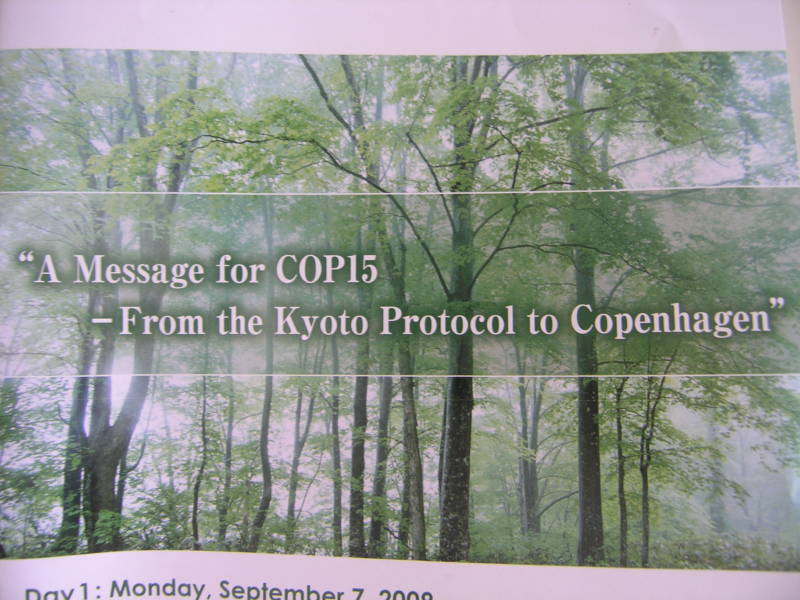
…And a message for the US from Yvo de Boer–An official program from last week’s Asahi World Environment Forum in Tokyo.

With the United Nations Climate Change Conference in Copenhagen two and a half months away, it’s becoming increasingly likely that lawmakers on Capitol Hill will not pass legislation on greenhouse gas reductions in time. A commonly accepted premise seems to be that without domestic climate legislation enacted at home, the U.S. won’t be able to sign a global deal on climate change in Copenhagen, either.

Not true, said UN Climate chief Yvo de Boer last week at the Asahi World Environment Forum here in Tokyo. de Boer told a packed house that in recent conversations he’s had with Senator John Kerry (chairman of the Senate Foreign Relations Committee) and senior advisors to President Obama, it was clear to him that the United States doesn’t need Congress to act in order to sign a deal in Copenhagen. (Listen to an audio clip of his remarks using the player below.)

[audio:http://kqed03.streamguys.us/anon.kqed/climatewatch/YvodeBoer.mp3]

This isn’t the first time de Boer has said this, nor is it the first time this notion has been floated. Last year, Marc Ambiner, political editor for The Atlantic, wrote in his blog about how the administration could bypass Congress for comprehensive energy reform by using the Clean Air Act as a platform. It seems that some of Obama’s environmental advisors believe that the act not only gives the Environmental Protection Agency the power to regulate greenhouse gases but also to institute a cap-and-trade regime on its own. Going around Congress for such an important policy shift would no doubt be a controversial step, but if such powerful and influential figures are hinting at it to de Boer, maybe we’ll see a little Copenhagen surprise on the part of the American delegation.

Scotland Rising to Carbon Challenge

This dispatch came in from Alison van Diggelen after a recent visit to her home country. Van Diggelen is a freelance writer and interviewer and founder of the Fresh Dialogues website and podcast. Originally from Glasgow, she now makes her home in Silicon Valley.

Scotland Aims to Beat California on Climate Change Action

By Alison van Diggelen

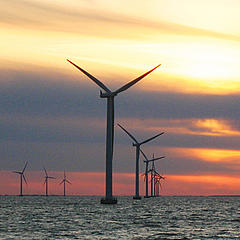
Wind turbines off Scottish coast. Photo: World Wildlife Fund

It’s not often that Scotland is ahead of the game compared to California, but on the issue of climate change, this small northern country has taken a legislative lead that has put it on the green map of the world.

As the California Legislature this week grapples with new laws* requiring utilities to get 33% of their energy from renewable sources by 2020, Scotland is sitting pretty. It is already close to its 31% target of energy from renewables by 2011 and has an even bolder target of 50% by 2020.

On a trip to Scotland this summer, I met with Lena Wilson, CEO of Scottish Enterprise, a government-funded organization that promotes Scottish interests both at home and abroad. She told me that the fight against global warming is a crucial part of the government’s strategy because ultimately a low carbon future is an economic stimulus and job creator for the country.

But how did Scotland muster the political will to set such ambitious targets? Scotland’s First Minister, Alex Salmond is passionate about renewable energy, Wilson told me; and establishing Scotland as a hub of green energy and green-tech is key to his strategy. Part of the plan is to harness its natural resources – powerful wind and wave power, estimated to account for a quarter of Europe’s potential. Salmond recently opened the largest wind farm in Europe to drive home that point. It’s on the outskirts of my home town of Glasgow and makes me rather proud.

Yet, making bold targets isn’t the end of the story. Scotland must create a whole ecosystem to make green growth attractive in Scotland. It launched the Saltire Prize last year to stimulate innovation in wave and tidal power; but still has ground to cover. As well as the financial, administrative and logistical challenges, there’s the issue of NIMBY-ism. Although Wilson insisted they’re pursing a popular green agenda, some of the locals I talked to in Scotland were less enthusiastic about the aesthetics of wind turbines.
And then there’s the “nuclear option.” Just as in California, the issue is red hot. Salmond is publically against it, but if he wants to keep shining his low carbon credentials, he may be forced to rethink his position.

One final note: When I asked Wilson, is your boss, Alex Salmond the Al Gore of Scotland? Her response was enlightening. She almost choked. Being a staunch nationalist, union man and former socialist, she doubted he’d enjoy the comparison. On my next trip, I hope to discuss this with the man himself and find out exactly how his passion for green took root. Stay tuned.

*State legislators passed two bills during their overnight session on Friday. Here’s a summary provided by the advocacy group Environment California:

AB 64 (Krekorian) & SB 14 (Simitian): AB 64 and SB 14 are companion bills that together set California on the path toward producing 33% of its electricity from renewable resources like solar and wind power. While there was much controversy over amendments to the bill that add in language for PG&E to potentially build large hydroelectric dams in British Columbia and call it renewable energy as well as amendments pushed by British Petroleum and Chevron that put 7,000 MW of fossil fuel burning combined heat and power plants ahead of renewable energy, the two bills still stand to become the biggest renewable energy mandate in the country”