Tag Archives: Policy

Everything You Know (About Water) is Wrong

If Dan Brekke isn’t editing newscasts at KQED Radio, chances are that he’s poring over charts full of arcane statistics from the state Department of Water Resources. Call it a hobby. Okay, call it an obsession. Either way, we frequently turn to Dan for his insights into California’s water conundrum.
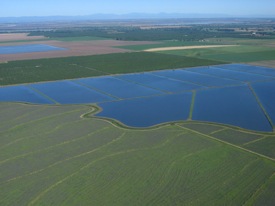
Flooded rice fields in the Sacramento Valley. Photo: Craig Miller

Everything You Know is Wrong

By Dan Brekke

California is home to 37 million people—and to 37 million water experts. If no one’s ever said that, someone should have.

There’s nothing more central to life here and no subject that excites stronger opinions. Recent events have shown that those opinions can easily harden into certainty about what needs to be done to solve all of California’s water problems—the needs of those 37 million people, the needs of the state’s incomparably rich agricultural industry, the needs of native fish and ecosystems.

We’ve long since learned that one person’s “solution”—to build dams and divert water for farms and cities, say—can be another’s nightmare—for instance, the communities that depend on healthy fisheries for their well-being. The conflicts over water are so deep and longstanding that they can make rational discussion difficult or impossible.

This week, though, the Public Policy Institute of California published a report that aims to inject some understanding into the water debate by challenging opinions and misconceptions. The report tests eight widely-held beliefs about water against the complex realities that underlie them. The first myth is fundamental to how we see water issues: “California is running out of water.” The reality the PPIC and its all-star panel of water experts propose is a sobering one: “California has run out of abundant water (our italics) and will need to adapt to increasing water scarcity.”

There’s something in the list of myths to rankle just about everyone. One myth goes like this: “[Insert villain here] is responsible for California’s water problems.” The report goes on to assess several villain-candidates, including:

– Wasteful Southern California homeowners with their lush lawns and luxurious swimming pools,

– Farmers who get federally subsidized (read “cheap”) water, and

– Protections for endangered species (as in “Why are we giving water to that Delta smelt?”).

In reality, the report says, coastal Southern California does an excellent job of limiting residential water use; farmers getting cheap water are in fact paying a price for the subsidy and are becoming more efficient water users; and actions taken to protect the smelt has had a comparatively small impact on water shipments through the Delta.

The PPIC says in the introduction to “California Water Myths” that a “policy based on facts and science is essential if California is to meet the multiple, sometimes competing goals for sustainable management” of water for the rest of the century. No one can argue with that, though it’s certain that squabbles over water will persist. Maybe the best we as Californians can hope for is an honest effort to try to understand the needs of all other water users, and to give each of them the benefit of the doubt when considering solutions to our water problems.

The PPIC report: “California Water Myths,” is available on the institute website or in an excellent interactive version put together by the UC Davis Center for Watershed Sciences.

Meanwhile, how are we doing this winter? Not great. Below is an interactive map of California’s major reservoirs, comparing their current levels to average or “normal” levels for this time of year.

View KQED: California Reservoir Watch in a larger map
Delegate’s Dispatch No. 2

Louis Blumberg directs the California climate programs for The Nature Conservancy. He’s also been keeping us posted as an official observer to the UN climate conference. And yes, views expressed in his guest posts are his and not necessarily those of KQED or the Climate Watch staff.

Things Heat Up Copenhagen
By Louis Blumberg

Emotions erupted at the Bella Center today during the United Nations climate change conference in Copenhagen, Denmark. Demonstrations, street theater, leaked documents, heated words, threats of walkouts and huge crowds all collided to increase the energy level throughout the massive hall. Frustration was driven in part, according to one of the key treaty negotiators, by the fact that little progress has been made.

At this point in the process, the open meetings have stopped and negotiators are meeting in private to work out their differences. This loss of transparency was exacerbated when demonstrators disrupted one of the last public plenary sessions of the week and the organizers threw out representatives from all non-governmental organizations–including me.*

As discouraging as this emerging gridlock is, my optimism remains because I see that three key pieces, which are falling into place, can produce a real deal:

– First, for the first time ever, key countries, including the U.S., China, India, Brazil and Korea, have all put numerical proposals on the table to reduce emissions.

– Second, as I reported before, the U.S. is providing real leadership, in part by proposing a $10 billion annual fund to help developing countries reduce emissions and adapt to climate change while continuing to grow their economies.

– Third, President Obama and 110 other heads of state will arrive next week for the final negotiation.

In the meantime, the process of creating a new international treaty amps up…

Yesterday I joined 200 activists in a standing ovation for EPA Director Lisa Jackson as she confirmed U.S. leadership by listing the administration’s actions to fight climate change, including this week’s official finding that greenhouse gas endangers human health. [Ed. Note: This creates authority for the EPA to regulate greenhouse gases on its own, with or without enabling legislation].

African countries called for more forest protection. Delegates from one island nation faced with imminent destruction by flooding due to sea-level rise, threatened to walk out on the talks unless the developed countries exhort to cut emissions by 95 percent.

I, alongside a coalition of forest activists, struggled (in what may be a futile attempt) to close a new loophole in emissions reporting rules proposed by some European countries.

And finally, the energy, passion and idealism of demonstrators in costume–walking trees, polluters dressed in red, vegans for climate, and Mr. Green (you can figure that one out on your own)–were both captivating and inspiring.

The frenetic pace is both tiring and energizing and will only increase as we move toward the conference closing on December 18. But there is much more to come before then. Stay tuned.

*Ed. Note: We’re using the term “delegate” somewhat loosely here. Blumberg is a member of The Nature Conservancy “delegation” in Copenhagen but technically he’s an official observer, as are all NGO reps. That’s why he can be tossed out of sessions.

Capturing Carbon in California

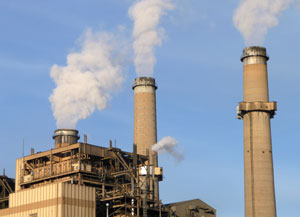
CoalPlantLauren Sommer’s two-part radio series on carbon capture in California airs this week on The California Report. You can also view her slide show at the end of this post.

The idea seems simple enough: In order to get energy, we burn carbon. In most cases, that carbon comes out of the ground in the form of natural gas or coal. So instead of releasing the resulting carbon dioxide emissions into the atmosphere, why not put it back into the ground?

Of course, carbon capture and storage/sequestration (CCS) is much more complicated than that. Nonetheless it’s a strategy that’s being pursued aggressively by both international leaders and US Energy Secretary Steven Chu, who would like to see it deployed in ten years.

There are obstacles on both the “capture” and “storage” side of the equation. In terms of technology, however, “storage” is much further along, thanks to the oil and gas industry, which is already using CO2 in oil recovery. Injecting compressed CO2 into oil fields forces more oil to the surface in a process known as enhanced oil recovery. As many in the industry will remind you, they have three decades of experience doing this.

Keeping it underground is another matter. In the western US, the West Coast Regional Carbon Sequestration Partnership (WestCarb) is setting up a number of pilot projects to study how CO2 can be safely stored underground. As Technical Director Larry Myer explained to me, one of the primary goals is to simply work out the regulatory, siting, and liability issues.

As with any waste issue, choosing the site is the most important–and often most difficult–issue. California’s Central Valley has plenty of underground saline aquifers and depleted oil and gas fields that could hold CO2. But the trick is finding a site where the geology can securely store it and where there’s little risk of groundwater contamination. On the plus side, scientists know that CO2 is slowly immobilized underground, which lessens the risk over time. But how long that takes is still under study.

As for the “capture” issue, there are three ways to separate CO2 from power plant emissions.

  • In today’s Climate Watch story, I describe Oxyfuel technology, in which natural gas is burned in pure oxygen. Since the outputs are steam and carbon dioxide, the CO2 can be easily siphoned off. But that requires building new power plants from scratch.
  • The second option seeks to deal with the carbon dioxide before the fuel is burned; a “pre-combustion” approach. Or for all you wonks out there: Integrated Gasification Combined Cycle (IGCC). The downside to this process is that it requires gobs of energy, which makes it expensive.
  • Finally, there’s the “post-combustion” approach. That’s where the CO2 is “scrubbed” from flue gas after the fuel is burned. Existing plants can be retrofitted with this technology, but it also comes with large energy penalty, just like IGCC.

A price on carbon, through either a cap-and-trade system or carbon tax, would change the economic case for CCS, but there are a lot of strikes against the technology. So why pursue it?

The argument goes like this: In order to achieve steep emissions cuts–say an 80% reduction worldwide by 2050–it may be an important tool (or stabilization wedge).  The world will continue to use fossil fuels in the near term and despite the enormous growth of renewable energy, it’s still a drop in the bucket. That’s why many believe that CCS is a crutch the world needs to wean ourselves from fossil fuels.

Hopenhagen II: A Delegate’s View

Louis Blumberg is a COP 15 delegate and Director of Climate and Forest Policy for the Nature
Conservancy in California.

Update from Hopenhagen

By Louis Blumberg

The sense of possibility pervaded the halls Monday, infusing energy and 
optimism into the delegates at the UN climate change conference in
 Copenhagen, Denmark. As in prior years, the sheer magnitude of the event 
was inspiring. More than 10,000 participants attended today, thousands 
of whom (including this participant) waited patiently in line for hours
 to get inside.

In one room, representatives from 192 nations sat shoulder-to-shoulder
 in the discussions, and each country was given an equal voice. Two seats
 were allocated to Gabon and two for the U.S., two for China and two for
 Monaco, and so on.

At home in San Francisco, much of my work is focused on addressing
 climate change in California, and we have made great progress as a
 state. Now, seeing the whole world gathered in one room (figuratively
 speaking), it is a powerful reminder that the work we are doing in 
California can be applied anywhere, whether in Australia, Peru or China.
 We are all in this together and can learn so much from one another.

This is the 15th meeting for the “Conference of Parties” (hence “COP 15”), a follow-up to 
the 1992 UN Framework Convention on Climate Change, which resulted in the first global climate agreement ratified by 192 nations, including the U.S. Each year preceding that conference, global delegations have 
met to discuss how to address climate change. The most notable agreement
 happened in 1997 in Kyoto, Japan. Dubbed the Kyoto Protocol, it 
ordered 37 industrialized nations to cut greenhouse gas emissions. The
 U.S. rejected that pact, and since then our federal government has shown little-to-no leadership on the issue.

But what a difference a year makes. In its first public statement at the 
conference, the United States addressed two key issues head-on with commitments for action: First, a pledge to reduce emissions of
 greenhouse gases by 17% by 2020; and second, a $10 billion pledge with
 other nations intended to help developing countries grow their economies
 while cutting emissions. U.S. envoy Jonathan Pershing spoke forcefully,
 signaling that a new regime in Washington meant real leadership on
 climate change for the world.

Despite public skepticism, it has become clear that something is going
 to happen here. People from all over the world have come together to solve the most serious problem of our lifetime. Nothing less than the 
future of nature and humanity is at stake. I just hope the agreement is
 sufficiently strong and that action happens quickly.

Hopenhagen: A Reporter’s View

Hope for an international deal on climate change abounds on the streets and metro stations throughout Copenhagen. But does it among U.N. delegates?

The capital city of this bone-chilling European country is dressed to the nines in global warming, from Coca-Cola ‘Hopenhagen‘ ads overlooking its quaint canals, to huge globes pasted with polar bears and receding glaciers. All this advertising makes all the lovely Scandinavian Christmas decorations look dim in comparison. This is, of course, COP 15– the most anticipated UN climate change convention since Kyoto twelve years ago. Despite the pessimism that pervaded the run-up to this conference, hope was the buzzword on the first day of the conference. In an afternoon news briefing, Yvo de Boer, ever the optimist about these meetings, stayed on message, telling reporters that it wasn’t for nothing that major heads of state like President Obama were changing their schedules to arrive at the end of the conference. They want to see a deal, de Boer said, and news from across the Atlantic that was first reported during the midday hours here in Copenhagen, may very well increase the odds.

As news started to trickle in that the US Environmental Protection Agency had determined that greenhouse gases are a threat to human health and the environment (thus opening carbon dioxide and equivalent greenhouse gases to government regulation with or without the blessing of Congress),* the excitement in the halls of the Bella Center rose. High fives were exchanged among American observers, and Rajendra Pachauri, chair of the Intergovernmental Panel on Climate Change told my office mate, Sam Eaton of Marketplace, that it was high time that Obama flexed his muscle on climate change. EPA’s move had been in the works for a while.

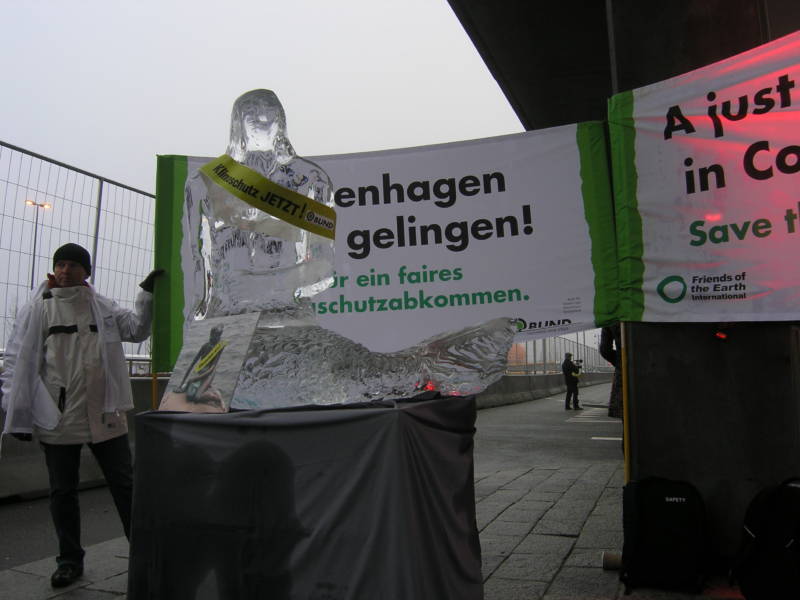
An ice replica of Copenhagen’s famous mermaid, melting in the dead of winter, conveniently placed in front of the Bella Center.

Back in September when I attended a climate change conference in Tokyo, UNFCCC head Yvo de Boer hinted it would happen. But it’ll take a lot more than an EPA announcement to move delegates toward a final deal at this conference. One of the biggest issues they face is how to finance emissions reductions throughout the developing world. Poor countries say they need rich countries to help them build a clean energy infrastructure if they are to agree to any binding deal. Rich countries are scratching their heads trying to figure out how to finance this (de Boer says it’ll cost around $10 billion a year) and, more importantly, how to divvy up the cost, especially in the throes of a global recession.

What does this mean for California? It’s one of the few states that have passed carbon dioxide reducing legislation. It behooves us to have neighbors, both domestically and internationally, who have similar laws, so that employers don’t flee the state to escape environmental regulations–a very real scenario in this economy. Whether or not Hopenhagen lives up its nickname, it’s already turning into an interesting event.

*Ed. Note: Back in Washington, at an afternoon news conference, EPA Administrator Lisa Jackson explained that today’s “finalizing” of the previously announced endangerment finding now “obligates” the agency to regulate carbon dioxide under the Clean Air Act. But she hastily added that it’s not a replacement for Congressional action. “Legislation is still the best way,” said Jackson. “It’s not an either-or proposition.”

Climate Watch in Copenhagen

Earthshine_NASAClimate Watch begins it’s coverage of the UN’s COP 15 climate talks in Copenhagen this evening, when KQED’s This Week in Northern California airs my recently taped interview with former Vice President and Nobel Laureate Al Gore. The original 20-minute interview has been “edited for TV,” down to about nine minutes. The full interview is to be posted on This Week’s website.

The interview begins with Gore’s assessment of the upcoming climate conference and then moves on to California’s role, the hype surrounding “green jobs,” controversy over climate science, his new book, and other topics. Regrettably, the interview was recorded before the eruption of the email scandal now known as “Climategate,” so I wasn’t able to get his take on that.

It’s pretty hard to spring anything on Gore. He’s heard every question there is to be asked about a thousand times and has carefully crafted, well-rehearsed answers to all of them. He did seem slightly off-balance when I asked him about FactCheck.org’s conclusions about some of the green job creation hype.

On Monday, our radio and online coverage begins in earnest when the first of Rob Schmitz’ reports from Copenhagen airs on The California Report. Schmitz, KQED’s Los Angeles Bureau Chief, arrives there on Saturday and will be there for the entire two weeks of events and negotiations. He’ll provide radio reports and frequent blog posts, covering–among other things–the appearance of California Governor Arnold Schwarzenegger on “Subnational Day.” In a climate-related media event on Treasure Island this week, Schwarzenegger said his mission in Copenhagen would be to rally governors, mayors, provincial leaders and other subnational players, to continue their own progress toward greenhouse gas emissions and not wait for national governments and international bodies to take action.

Also on Monday, Rob and I will join host Michael Krasny and NASA climatologist James Hansen on KQED’s Forum program. Hansen was the original climate whistle-blower, complaining that the Bush administration was muzzling climate scientists. Hansen has since taken a hard line against the upcoming efforts in Copenhagen, saying that cap & trade is the wrong path to climate intervention (both Gore and Hansen are promoting new books of theirs).

State Water Deliveries May Set New Low

State water officials have announced they are likely to release a record-low allocation of water to cities and farms next year– just five percent of what water contractors have requested. Though still preliminary, it’s the lowest allocation since the State Water Project began delivering water back in 1967.

The announcement may have caught some by surprise, since Department of Water Resources (DWR) data would seem to show reservoirs at higher levels than last year at this time, with major reservoirs at 69% of storage capacity, compared to 57% last year.

When I asked DWR Deputy Director Susan Simms about it, even she was stumped at first. But then she called me back to say that the data includes both federal and state reservoirs, and the state’s storage levels at both Lake Oroville and San Luis Reservoir (shared with the feds) is actually lower than last year (52% and 48% of “normal,” respectively). And, she says, the state has to contend with pumping restrictions to protect both salmon and delta smelt this time around.

DWR Director Lester Snow told reporters this morning that there’s nothing in the recently passed bundle of state water bills that can provide any immediate relief. And if you thought the prospect of increased precipitation from El Nino could save the day, don’t get out the umbrella just yet. David Rizzardo, Chief of the state’s Snow Survey section, estimates there’s only a 50-60% chance of a stronger El Nino kicking in this year. December and January will be the most telling months–but precipitation from El Nino would likely be concentrated in the southern half of the state. Officials say that would provide more “flexibility” in meeting water needs systemwide, but all of California’s biggest reservoirs are located in the northern part of the state.

December water delivery estimates almost always get a boost once it starts snowing. Last year’s initial projection was 15%, and that was later revised upward, eventually to 40 percent. Snow called today’s estimate “very conservative.”

If you think the five percent figure is supposed to scare us, it is. Water officials want to send a message that Californians need to be prepared to conserve. The state’s drought coordinator, Wendy Martin, just returned from a water tour in Australia, where she says she saw water-saving measures in place that California has yet to fully develop: storm water recapture, water recycling, and more. Martin also observed that the Australians now wish that they’d taken the epic drought of the last several years more seriously, sooner.

Scientists Respond Cautiously to Hijacked Email

I’ve spent several days dithering over whether to weigh in on the recent email heist from a server at the University of East Anglia in the UK. For those who choose to read it that way, the hacked email originally passed among climate scientists worldwide has, rightly or wrongly, provided those who reject the prevailing climate science with enough radioactive ammo to fill Yucca Mountain.

Some high-profile California researchers figure prominently in the material. In a searchable database of the messages, for example, the name of Ben Santer, a climate modeler at Lawrence Livermore National Lab came up 173 times. Stanford’s Steve Schneider came up 71 times. Both are outspoken defenders of science supporting the human contribution to global warming.

Another scientist quoted or referred to (99 times), Kevin Trenberth, is a name familiar to readers of this blog and listeners to Climate Watch radio coverage. Trenberth is a climatologist at the National Center for Atmospheric Research (NCAR) in Boulder, CO.  I’ve interviewed him mostly about the role of the Pacific oscillation known as El Nino in climate patterns. After the decade’s worth of email came to light, I wrote Trenberth for a response. His reply may not be entirely original. Some lines have also been attributed to a spokesman for the university whose servers were invaded. In any case, here’s Trenberth’s response to Climate Watch:

It is a matter of concern that data, including personal information about individuals, appears to have been illegally taken and a criminal investigation is underway. The selective publication of some stolen emails and other papers taken out of context is mischievous and cannot be considered a genuine attempt to engage with this issue in a responsible way. The volume of material published and its piecemeal nature makes it impossible to confirm what proportion is genuine.  Many elements have been published selectively on a number of websites. Generally the items are out of context, incomplete and very misleading. Some others are wildly misinterpreted and have a simple explanation.

The material published relates to the work of the Climatic Research Unit (CRU) and other scientists around the world.  Many of the scientists featured in the emails with [Phil] Jones [of East Anglia] have web sites and freely and openly make available their papers, presentations, blogs and other information. Several of the emails document the detailed procedures used in the IPCC AR4 Fourth Assessment report for Chapter 3 (for which Phil Jones and Kevin Trenberth were coordinating lead authors) and other chapters. They actually reveal the integrity of the process and the hard work that goes into such an assessment.

Trenberth then went on to cite some specific “examples of misinterpretations:”

From Kevin Trenberth, interpreted as a failure of computer models:

“The fact is that we can’t account for the lack of warming at the moment and it is a travesty that we can’t. The CERES data published in the August BAMS 09 supplement on 2008 shows there should be even more warming: but the data are surely wrong. Our observing system is inadequate.”

This refers to the inability of our current observations from satellites and in situ to account for where all the energy has gone. A paper on this is available here:

Trenberth, K. E., 2009: An imperative for climate change planning: tracking Earth’s global energy. Current Opinion in Environmental Sustainability, 1, 19-27, doi:10.1016/j.cosust.2009.06.001. [PDF]

This paper tracks the effects of the changing Sun, how much heat went into the land, ocean, melting Arctic sea ice, melting Greenland and Antarctica, and changes in clouds, along with changes in greenhouse gases. We can track this well for 1993 to 2003, but not for 2004 to 2008. It does NOT mean that global warming is not happening, on the contrary, it suggests that we simply can’t fully explain why 2008 was as cool as it was, but with an implication that warming will come back, as it has. In 2008 there was a La Nina event.  We now have an El Nino underway.

Kevin Trenberth

Meanwhile, the university’s Climate Research Unit has posted a series of rebuttals. Still, this digital hijacking is disturbing on a lot of levels. Whether you accept the prevailing climate science or consider the email damning evidence to the contrary, it is a distraction from the business at hand in Copenhagen and a public relations train wreck for the IPCC and many of its most eminent contributing scientists. You can bet that it won’t be forgotten when a major climate bill hits the floor of the U.S. Senate for debate, early next year. Oklahoma Republican James Inhofe, vocal critic of global warming science, is already calling for an investigation.

Sketchy First Look at California Cap & Trade

On Tuesday the California Air Resources Board put out a sneak preview of the carbon cap & trade system mandated by the Global Warming Solutions Act of 2006 (AB 32). Couched as a “preliminary draft,” the 132-page plan is intended as a broad outline for a final Cap-and-Trade regulation scheduled to go before the board late next year.

As such, the draft lacks a few key components, such as how many allowances the state plans to auction off to industry, versus give away. Air Board chief Mary Nichols says her agency is still waiting on recommendations from an expert committee on how to best handle allowances.

Environmentalists have been pushing for polluters to pay for allowances up front. In an email to me on Tuesday, in anticipation of the draft, Bernadette del Chiaro of Environment California wrote that her group is “slightly disappointed that ARB staff are punting on the issue of auctions. ARB in the scoping plan said they are committed to getting to 100% auctions. I hope the draft rules at least repeat this commitment.”

The draft appears to stop short of an outright commitment, reiterating that “transition to a 100 percent auction was a worthwhile goal.” In a conference call with reporters, Nichols said she anticipates at least a partial auction. Also undetermined is how to deploy the funds that emitters may pay for allowances. Nichols said a $10 per ton price for carbon could produce a two-to-four-billion-dollar pool of money, which could be used for such things as “buying down” utility costs for low-income families or creating incentives for development of renewable energy technology. Nichols declined to project what a cap & trade system would end up costing households in California.

You can download a PDF file of the complete report at the CARB website (under “What’s New). A public meeting is scheduled for December 14 in Sacramento, to get feedback on the Preliminary Draft Regulation released this week.

Also on Tuesday, the Governor’s Office announced that Quebec, one of California’s partners in the Western Climate Initiative for regional carbon trading, has set a target “to reduce its greenhouse gas emissions 20 percent below 1990 levels by 2020 and the introduction of a clean-car emissions standard equivalent to California’s Vehicle Tailpipe Emissions Standards.”

The WCI includes seven western states and four Canadian provinces. Any progress from the state’s WCI partners is welcome at this point, as most have been reluctant to set their intentions into law.

Check out our interactive map of California’s largest industrial emitters of greenhouse gases.

$11 Billion in Water Bonds: Follow the Money

Governor Schwarzenegger traveled to Fresno County Monday to sign the centerpiece of last week’s package of water bills—an $11.14 billion bond measure that would pay for new dams and reservoirs and a sweeping program of conservation, water recycling and drought relief projects.

The governor appeared at a Friant Dam press conference with state Senator Dave Cogdill, R-Modesto, author of the bond initiative. Schwarzenegger said he’s hopeful that the bond, along with other measures in last week’s comprehensive water agreement, will put an end to the “holy water wars” pitting Northern v. Southern California and among cities, agriculture, fishing communities, and environmentalists.

The the governor signed the bond bill amid criticism that last-minute negotiations added more than $1 billion in earmarks designed to win support for the measure.

See our map, prepared by KQED editor Dan Brekke, for a detailed breakdown of where the $11.14 billion in bond money is supposed to go.


View KQED: California Reservoir Watch in a larger map