Tag Archives: Oceans

Starving Sea Lions: A Climate Connection?

Photos by Victoria Carpenter

I thought the highlight of my trip to Point Reyes last week would be the cows grazing on spectacular cliffs covered with yellow lupine. I was visiting a historic dairy there for an upcoming story on crashing milk prices.

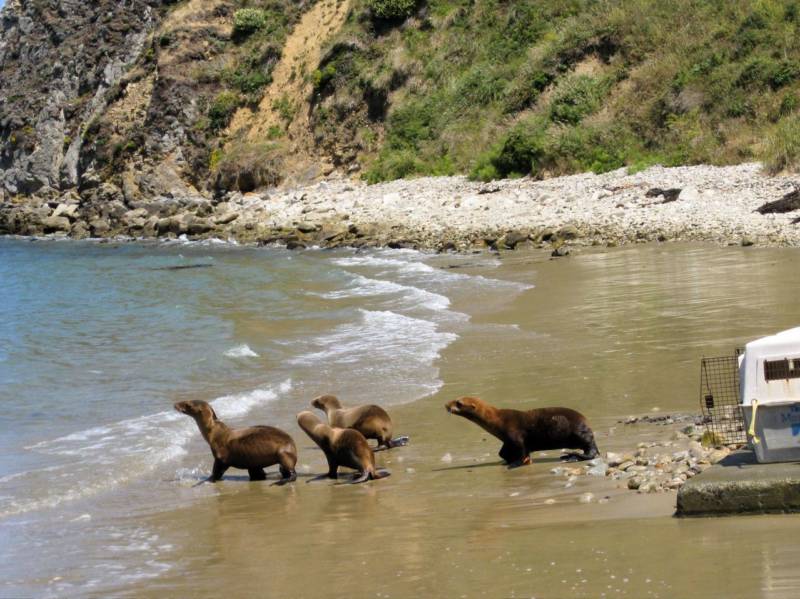
But then I noticed a white van marked “rescue” driving down to a dock near the Pt. Reyes lighthouse, and decided to follow it. Turns out, I stumbled upon an incredible scene: rescue workers releasing baby sea lions and elephant seal pups back into the waves.

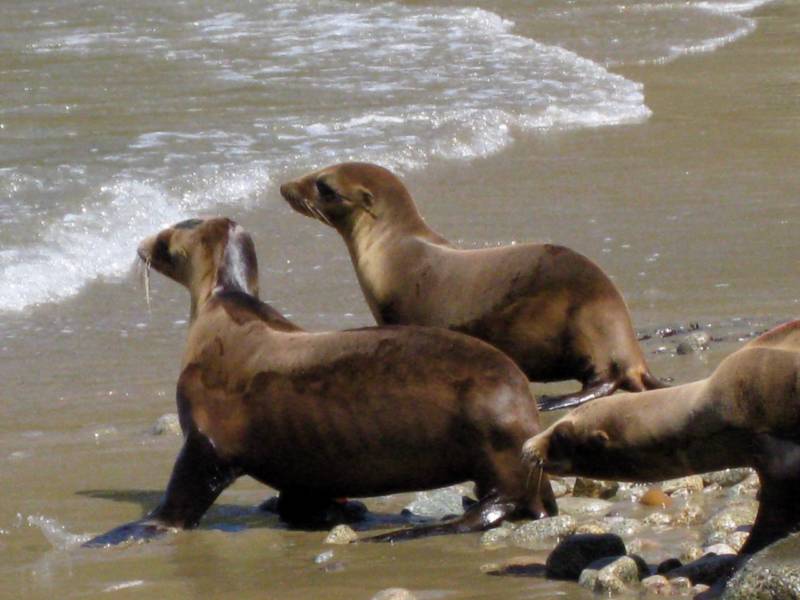
Volunteers lugged what looked like over-sized pet carriers out of the van and slid them onto a cement boat dock. Then a trio of sea lion pups poked their heads out, sniffed the salt air, and flippered their way across the cement and into the water, playfully nuzzling each other.

They seemed exhilarated–but thin. These pups had been rescued near Monterey, revived in the Marine Mammal Center’s Sausalito hospital, and were now healthy enough to return to the ocean, though you could still see their rib cages poking through their fur.

The sea lions swam out quickly but the elephant seals were a little more sluggish. One pup kept swimming back toward the humans, begging for fish. Then a giant female came out of the waves, perhaps offering herself as an adoptive mom, nudging the baby into the water.

Jim Oswald of the Marine Mammal Center (MMC) says the staff is seeing an unprecedented spike in rescue calls. In just the first two weeks of June, nearly 1,300 people phoned in, worried about stranded sea lions and other mammals. Most of them are malnourished sea lions who can’t seem to find enough anchovies, herring, or sardines to snack on.
Researchers aren’t quite sure why–but haven’t ruled out some kind of climate connection. The MMC is reporting its findings to the National Oceanic and Atmospheric Administration (NOAA) to try and figure out the cause. Possible El Nino Conditions? Warming oceans sending schools of smaller fish northwards? No one quite knows at this point.

“If it’s a climate change variable, that’s going to affect the fish the animals feed on,” says NOAA Wildlife Biologist  Joe Cordaro. “That could be a very long temporary shift in the bait fish distribution, or it could be long-term depending on how severely climate change affects the surface temperature of the ocean.”

But Cordaro says at this point, the sea lion strandings are “one big puzzle,” with climate change as just one possible factor. We could simply be witnessing a high-birth year for sea lions, with  a lot more pups than usual, or early signs of a returning El Nino weather pattern. Meteorologists won’t know until the fall whether California actually meets the criteria for a strong El Nino year. If so, Cordaro predicts “things are going to get a lot worse for the sea lions this fall and next spring.”

[Editor’s Note: The case for a return to El Nino was advanced on Wednesday, when the Australian Bureau of Meteorology reported that indications are almost certain at this point]

Regardless of the cause, the MMC’s Oswald says it’s cause for concern.

“These young sea lion pups get to the point where they’re so weak, they end up on the land and they’re too weak to go back,” Oswald explains. “It’s easier for them to waddle along, hoping they’ll find another waterway where they can find some food. They’re using up all their reserves if they stay out in the ocean.”

Stranded sea lion pups have even turned up on Bay Area freeways. Last week, rescuers found one on the 880 freeway in Oakland.

“His name is Fruitvale,” reports Oswald, “for the district in Oakland he was rescued from. He seems to be doing okay. He’s still being tube fed. I’m told from veterinarians that he’s feisty, moving around, and nippy, which is a good sign.”

The Marine Mammal Center’s Sausalito headquarters lets visitors watch volunteers in action. There’s an interactive exhibit with a sea lion on a gurney, where you can see its x-rays and test results. You can watch volunteers prepare fish meal, or even witness a post-mortem in the necropsy room.

Sounds grim, but until sea lion pups start finding more fish to eat–and humans start to figure out what’s causing the food chain to collapse, the Marine Mammal Rescue Squad plans on a very busy summer.
Sasha Khokha is chief of KQED’s Central Valley Bureau and a frequent contributor to Climate Watch.

And for more about the Marine Mammal Center’s sea lion rescue efforts, listen to Amy Standen’s recent radio report on KQED’s Quest. You can also view her slideshow and read her Reporter’s Notes on the Quest blog.

The Return of El Nino?

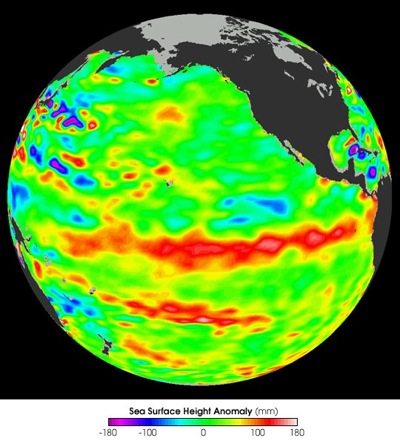
The federal Climate Prediction Center, operated by NOAA, reported this week that current conditions in the Pacific would seem to foreshadow a return to El Nino conditions, possibly within the next few weeks.

2006 El Nino conditions, as observed by the Jason satellite. Photo: NASA

The ocean conditions formally known as ENSO, or the El Nino/Southern Oscillation, arise when normal upwelling of deep, cold water abates, causing warmer surface temperatures (SST).

El Nino and its opposite, La Nina, have far-reaching implications on weather patterns. Here on the West Coast, it usually means wetter winters in southern California and drier ones in the Pacific Northwest.  Because northern and central California lie in between, things there can go either way.

El Nino can also have a significant impact on fisheries, as much of the food chain is interrupted when upwelling slows.

Here’s a good overview of El Nino “mechanics” from UC Berkeley.

Heat Relief for Coral Reefs?

This post is condensed from a Stanford News Service release. Cassandra Brooks is a science-writing intern at the Woods Institute for the Environment at Stanford.

Reed Galin
Photo: Reed Galin

Stanford scientists find heat-tolerant coral reefs that may resist climate change

By Cassandra Brooks

Some experts say that more than half of the world’s coral reefs could disappear in the next 50 years, in large part because of higher ocean temperatures caused by climate change. But now Stanford University scientists have found evidence that some coral reefs are adapting and may actually survive global warming.

“Corals are certainly threatened by environmental change, but this research has really sparked the notion that corals may be tougher than we thought,” said Stephen Palumbi, a professor of biology and a senior fellow at Stanford’s Woods Institute for the Environment.

Palumbi and his team began studying the resiliency of coral reefs in the Pacific Ocean in 2006. “The most exciting thing was discovering live, healthy corals on reefs already as hot as the ocean is likely to get 100 years from now,” said Palumbi, director of Stanford’s Hopkins Marine Station. “How do they do that?”

Coral reefs form the basis for thriving, healthy ecosystems throughout the tropics. They provide homes and nourishment for thousands of species, including schools of fish that feed millions of people across the globe.

Corals rely on partnerships with tiny, single-celled algae called zooxanthellae. The corals provide the algae a home, and, in turn, the algae provide nourishment, forming a symbiotic relationship. But when rising temperatures stress the algae, they stop producing food, and the corals spit them out. Without their algae symbionts, the reefs die and turn stark white, an event referred to as “coral bleaching.”

During particularly warm years, bleaching has accounted for the deaths of large numbers of corals. In the Caribbean in 2005, a heat surge caused more than 50 percent of corals to bleach, and many still have not recovered, according to the Global Coral Reef Monitoring Network, an international collaboration of government officials, policymakers and marine scientists, including Palumbi.

Havens of healthy reefs

In recent years, scientists discovered that some corals resist bleaching by hosting types of algae that can handle the heat, while others swap out the heat-stressed algae for tougher, heat-resistant strains. Palumbi’s team set out to investigate how widely dispersed these heat-tolerant coral reefs are across the globe and to learn more about the biological processes that allow them to adapt to higher temperatures.

In 2006, Palumbi and graduate student Tom Oliver, now a postdoctoral researcher at Stanford, traveled to Ofu Island in American Samoa. Ofu, a tropical coral reef marine reserve, has remained healthy despite gradually warming waters.

The island offered the perfect laboratory setting, Oliver said, with numerous corals hosting the most common heat-sensitive and heat-resistant algae symbionts. Ofu also has pools of varying temperatures that allowed the research team to test under what conditions the symbionts formed associations with corals.

In cooler lagoons, Oliver found only a handful of corals that host heat-resistant algae exclusively. But in hotter pools, he observed a direct increase in the proportion of heat-resistant symbionts, suggesting that some corals had swapped out the heat-sensitive algae for more robust types. These results, combined with regional data from other sites in the tropical Pacific, were published in the journal Marine Ecology Progress Series in March 2009.

Global pattern

To see if this pattern exists on a global scale, the researchers turned to Kevin Arrigo, an associate professor of environmental Earth system science at Stanford and an expert on remote satellite sensing of marine microalgae. Arrigo gathered worldwide oceanographic data on a variety of environmental variables, including ocean acidity, the frequency of weather events and sea-surface temperature.

Oliver then compiled dozens of coral reef studies from across the tropics and compared them to Arrigo’s environmental data. The results revealed the same pattern: In regions where annual maximum ocean temperatures were above 84 to 88 degrees Fahrenheit (29 to 31 degrees Celsius), corals were avoiding bleaching by hosting higher proportions of the heat-resistant symbionts.

Most corals bleach when temperatures rise 1.8 F (1 C) above the long-term normal highs. But heat-tolerant symbionts might allow a reef to handle temperatures up to 2.6 F (1.5 C) beyond the bleaching threshold. That might be enough to help get them through the end of the century, Oliver said, depending on the severity of global warming.

A 2007 report by the United Nations International Panel on Climate Change concluded that the average surface temperature of the Earth is likely to increase 3.6 to 8.1 F (2 to 4.5 C) by 2100. In this scenario, the symbiont switch alone may not be enough to help corals survive through the end of the century. But with the help of other adaptive mechanisms, including natural selection for heat-tolerant corals, there is still hope, Oliver said.

Heat-resistant corals also turn out to be more tolerant of increases in ocean acidity, which occurs when the ocean absorbs excess carbon dioxide from the atmosphere–another potential threat to coral reefs. This finding suggests that corals worldwide are adapting to increases in acidity as well as heat, Oliver said, and that across the tropics, corals with the ability to switch symbionts will do so to survive.

“Although we are doing things to the planet we have never done before, it’s hard to imagine that these corals, which have existed for a quarter of a billion years, only have 50 years left,” Palumbi said. “And part of our job might be to figure out where the tougher ones live and protect those places.”

For more on this story:

MICRODOCS: BRINGING THE LAB TO THE REEF

MICRODOCS: EXPERIMENTING WITH GLOBAL WARMING

California Not Catching the Wave…Yet

Tom Banse’s radio report on West Coast wave energy aired Thursday morning on The California Report. It’s also posted to the Climate Watch Radio section on this site.

A Crib Sheet for West Coast Ocean Energy

Every now and then when the government gets something right, it’s only fair to give credit.  So today we give props to the Federal Energy Regulatory Commission for making public records easily accessible.  Combined with our handy-dandy crib sheet, you can be the reporter and dig up all sorts of newsworthy nuggets.  We’ll get to some examples, but first the overview:

Wave energy buoys proposed for Reedsport, OR (artist's conception). Photo by Tom Banse.
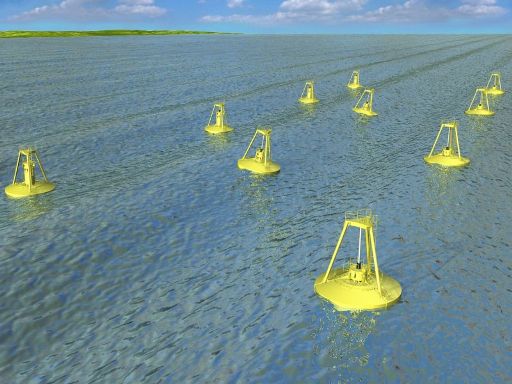
Wave energy buoys proposed for Reedsport, OR (artist's conception). Image provided by: Ocean Power Technologies

Starting in 2006, there was a “gold rush” on the ocean to stake claims for wave energy sites.  Now the spray is settling and an industry shakeout is occurring.  Energy developers have given up on about a third of the wave power projects they proposed along the West Coast.  Some tidal power proposals are ebbing away as well.  When things go sideways, we rarely get a press release about it.  Often the news pops up first in a filing to FERC.

FERC is the agency that oversees wave and tidal power projects in state waters (up to 3 miles offshore).  The agency’s webmasters set up an “eLibrary” to archive project applications and correspondence.

You can see on the crib sheet that FERC dismissed three ocean energy projects in California waters last month.  The simple explanation is that the three projects ended up on the wrong side of a bureaucratic turf battle.  The Department of Interior’s Minerals Management Service (MMS) won jurisdiction over all energy development on the outer continental shelf, defined in this case as more than three miles offshore.  Grays Harbor Ocean Energy Company president Burt Hamner explained in an e-mail:

FERC has cancelled its entire preliminary permit process for projects located on Federal ocean waters, and thus dismissed our seven pending applications for preliminary permits (as well as those of a few others).  The new MMS framework says that applicants for wave projects must first get a MMS lease for space, then apply to FERC for a commercial hydropower license.  But, MMS is prohibited from issuing leases in national marine sanctuaries.  Two of our projects, San Francisco and Hawaii, are in sanctuaries.  Therefore these are terminated because there is no way to get a lease or permits there.

At the City of San Francisco, utility specialist Randall Smith said the FERC dismissal of the city’s preliminary permit for the Oceanside project “doesn’t put us back to square one, but does force a step back.”  Smith elaborated, “The difference with MMS is getting a lease.  That’s a little more protracted.”

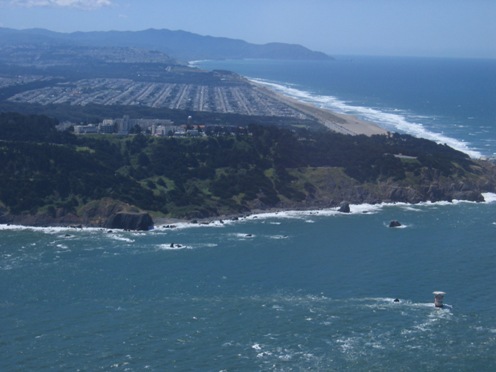
One wave power project was proposed for waters off San Francisco's Ocean Beach (upper right).
A wave power project proposed for waters off San Francisco's Ocean Beach (upper right) is in limbo.

The voluminous dockets for PG&E’s WaveConnect projects off Humboldt and Mendocino Counties, and the Green Wave Mendocino Wave Park suggest those are the ones moving ahead the fastest.  PG&E recently secured $6 million to pay for environmental studies, design work, and permitting.  The utility started its community outreach by scheduling two town meetings–in Eureka on May 19 and Ft. Bragg on May 21–both scheduled for 6 pm.

And now, the secret code: An easy way to keep tabs on a marine energy project is to make note of the applicant’s docket number (the one that starts with P-xxxxx) and then periodically plug that number into a “Docket search.”  (Click on “Submit” rather than the more prominent “Search Consolidated Dockets” button.)Here are all of the West Coast wave energy projects proposed to FERC, listed from north to south, as of this week:

P-12751 Makah Bay (Finavera)  license surrendered  4/09

P-13058 Grays Harbor Ocean Energy (Grays Harbor Ocean Energy Company)  11/2007

P-13047 Oregon Coastal Wave Energy (Tillamook Intergovernmental Dev. Entity) 10/2007

P-12750 Newport OPT Wave Park (Ocean Power Technologies)  permit surrendered 3/09

P-12793 Florence Oregon Ocean Wave Project (Oceanlinx)  4/2007, withdrawn 4/08

P-12713 Reedsport OPT Wave Park (Ocean Power Technologies)  3/2006

P-12743 Douglas County Wave Energy (Douglas County, OR)  9/2006  (oscillating column device on Umpqua River jetty)

P-12749 Coos Bay OPT Wave Park (Ocean Power Technologies)  3/2006

P-12752 Coos County Offshore (Bandon, Oregon) (Finavera) permit cancelled w/o objection 6/08

P-12779 Humboldt County WaveConnect (PG&E)  2/07

P-12753 Humboldt County Wave Energy (Finavera) permit surrendered 2/09

P-13075 Centerville OPT Wave Park (Ocean Power Technologies)  11/2007

P-12781 Mendocino County WaveConnect (PG&E)  2/07

P-13053 Green Wave Mendocino Wave Park (Green Wave Energy Solutions, LLC)  10/07

P-13377 and P-13378 Fort Ross Project- N & S (Sonoma County Water Agency)  2/09 pending

P-13376 Del Mar Landing Project (Sonoma County Water Agency)  2/09 pending

P-13308 San Francisco Ocean Energy Project (Grays Harbor Ocean Energy Company, LLC)  10/08 Dismissed 4/09

P-13379 San Francisco Oceanside Wave Energy Project (City and County of SF)  filed 02/09 Dismissed 4/09

P-13052 Green Wave San Luis Obispo Wave Park (Green Wave Energy Solutions, LLC) filed 10/07 pending

P-13309 Ventura Ocean Energy Project (Grays Harbor Ocean Energy Company)  10/08 Dismissed 4/09

Total proposed wave energy projects since 2006: 21

Total projects scrubbed by developer: 5

Total projects rejected by FERC: 3

For extra credit – Noteworthy tidal energy projects:

P-12585 San Francisco Bay Tidal Energy Project (Oceana Energy)  10/08

P-12672 Columbia River Tidal Energy Project (Oceana Energy) Permit surrendered 3/08


Robust Discussion of Rising Seas

KQED’s Forum program devoted a full hour this morning to recent projections for sea level rise and the threat it poses to California. Listen to the archived program here.

I joined host Michael Krasny and guests Peter Gleick and Will Travis, to discuss some of the recent findings. Travis heads the Bay Conservation & Development Commission and Gleick’s Pacific Institute issued a new report on the impacts last week.

Travis is just back from a trip to The Netherlands where he was studying some of the engineering techniques that the Dutch have deployed, to keep the North Sea at bay. Gleick has been tracking the issue here in California since 1990.

Gleick’s impact projections were underscored last week when scientists at a climate conference in Copenhagen projected a potential one-meter rise in the mean sea level by the end of this century, depending on how soon and how much we’re able to cut greenhouse gas emissions. That’s a pretty significant adjustment from the 2007 UN report, which had the rise pegged at a foot or two over the same time span. And two months ago, a USGS-led report postulated that a four-foot rise isn’t out of the question.

Some interesting questions and comments that came in from listeners:

– Sewage treatment plants in the Bay Area recently overwhelmed by storms are one glimpse into a future with higher sea levels.

– If pumps that convey water through the giant state and federal water projects in the Central Valley were solar-powered, it would reduce the carbon footprint of moving water around in California (often cited as 20% of our electricity use).

– A barrier at the Golden Gate could help “stem the tide” and potentially be part of a plant generating tidal power (Travis was skeptical).

– The Earth’s rotational bevavior also affects sea level and should be factored in.

In response to a listener who asked about a recent newspaper column that was dismissive of the prevailing climate science, I got the following note from Dave Johnson, a former Silicon Valley lawyer who teaches at Stanford:

“As to the climate-change contrarians, my short-form answer is this: I favor giving the scientifically-credible contrarian point of view some credit, and quite likely more than Al Gore or others would like. Why? Not because they necessarily have the science part right (or closer to right) than the IPCC.  Rather, it’s because the problem itself is a very complex system. Science is just now scoping the boundaries and behaviors of complex systems; to predict their behavior (especially of non-physical systems) will, to paraphrase Edward Witten, require ’22nd century’ knowledge.  As such, we all have to recognize the possibility, if not likelihood, that the global climate system might do things that we cannot fathom, much less predict. One possibility is self-correction to an equilibrium that can hold for another century or two. The other, sadly, is the converse – a spin-out into disequilibrium. Objectively, each has its percentage of possibility; so, objectively, each has to be seriously considered.  In short, whether I agree or disagree with the contrarians is, objectively, of no moment whatsoever.  In science, the strongest advocate of a particular conclusion must embrace the most aggressive testing of that conclusion. “

Hard to disagree with that. It’s always perilous to dismiss contrarian views out of hand. Galileo was a contrarian.

A Rising Tide Raises All Costs

Pacific Institute. Complete maps at link, below.
Photo: Pacific Institute. Complete maps at link, below.

This has been a week of dire predictions about the rising sea level and its eventual consequences.

On Tuesday, scientists preparing for the Copenhagen climate talks this year said that the current IPCC working model for sea level is out of date and overly cheerful.  German climate researcher Stefan Rahmstorf told the International Scientific Congress on Climate Change that even the most optimistic outlook for carbon emissions now portends at least a one-meter rise, or 3.28 feet by the end of this century. The U.N.’s 2007 report had anticipated a rise of up to two feet over the same time period.

Then today, analysts at Oakland’s Pacific Institute chimed in with a projection of California impacts from rising seas, based on a rise of 1.4 meters by 2100.

The report, which includes maps of projected inundation, projects nearly a half-million people at risk of a “100-year” flood event and loss of 41 square miles of coastal land, due to erosion.

“Critical infrastructure” in harm’s way includes highways, hospitals, schools, power and sewage treatment plants, as well as residential neighborhoods. It also includes several of the state’s busiest airports.

The report estimates that the tab for protecting that infrastructure could easily run to $14 billion. According to co-author Matt Heberger, “Communities really have to decide what it is that they value about the coast, whether that’s habitat, recreation, aesthetics, boating, shipping, all sort of things. We won’t necessarily be able to preserve all of those things at the same time. ”

The Governor has already issued an executive order requiring sea level rise to be factored into urban planning in all vulnerable regions of California. There remains an enormous planning task ahead.

Heberger sums it up thusly: “The evidence is in and we know what the impacts to the state are going to be. Now, what are we going to do about it?”

We’ll get some answers to that question on Monday’s Forum program on KQED and Sirius satellite. Listen to the archived program here.

Oceans Rising
Guests joining our discussion include Will Travis, executive director of the San Francisco Bay Conservation and Development Commission; Peter Gleick, president of the Pacific Institute, a non-partisan research institute on the environment and social equity; and Craig Miller, senior editor of KQED’s Climate Watch.

Was 2008 Relatively Warm or Cool?

Answer: Both. It depends on your historical time frame.

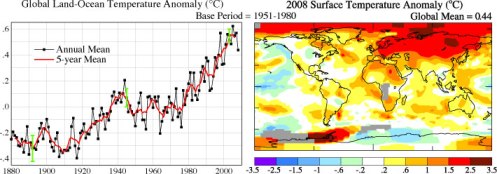
With a global average surface temperature of 79 degrees Fahrenheit, 2008 was the coolest year since 2000, according to climatologists at the NASA Goddard Institute for Space Studies (GISS). But it’s also the ninth-warmest year since 1880, so it’s probably not time to invest in a ski resort just yet.

Including the 2008 dip, the 10 warmest years on record (since 1880) have all occurred between 1997 and 2008, according to NASA.

The NASA scientists attribute 2008’s relatively lower temperature to a cooler Pacific Ocean, due to a strong La Nina pattern in the first half of 2008. La Nina and El Nino are opposite phases of a natural oscillation of  upwelling and subsequent temperatures in the equatorial Pacific Ocean.

2008 temperatures in the United States were cooler than any other year this decade, but, as illustrated on the map below, other parts of the world such as Eurasia and the Arctic were exceptionally warm.

Director of GISS James Hansen predicts that because a shift to El Nino is expected to start this year or next, it “still seems likely” that we’ll see a new record high for the average global surface air temperature in that time frame.

smallmain_graph_temp_lg1

Climate Coverage: From Drywall to Rubber Ducks

You just never know where the next climate story will come from.

This week on KQED’s Quest Radio, Marjorie Sun reports on how some of the most common building materials are among the biggest contributors to greenhouse gas emissions. Manufacturing your most basic buttcrack essentials like drywall, steel and cement requires vast amounts of energy. Now, several Silicon Valley start-ups are looking for cleaner solutions and some of their efforts are drawing major venture capital.

Then from the “concrete” to the…well, how would you describe this?  I’m not sure but it’s one of my favorite climate experiments of the year: NASA Deploys Rubber Ducks for Cryosphere Clues. Scientists from California’s Jet Propulsion Laboratory in Pasadena are behind this BBC story that probably should’ve been posted on April 1st.

We’re all pulling for these rubberized cryonauts, hoping they don’t end up in an endless swirl as part of the giant Pacific plastic trash vortex that David Gorn reported on in August.

“Is the Planet Just Doomed?”

3117211300_7c2dceccac_m.jpgThe world needs to completely phase out coal emissions over the next 20 years to avoid climate disaster, James Hansen, the head of NASA’s Goddard Institute of Space Studies (GISS) told a room packed with several hundred people at the AGU conference in San Francisco on Wednesday.

An immediate moratorium on new coal use that does not capture CO2 and phasing out of all other coal emissions by 2030 is the path to reach a target for CO2 emissions of 350 parts per million (ppm) identified in a new study led by Hansen. Previously, Hansen has said that the dangerous level for CO2 was likely to be 450 ppm or higher, but in light of new observations and analysis of ‘slow’ feedback processes like ice melt and greenhouse gas release from the ocean and soil, the study team revised that projection.

Unfortunately for the world, current atmospheric CO2 levels are already at 385 ppm.

(Hansen, a well-known climatologist, received a lot of publicity in 2005 and 2006 over his assertions that NASA administrators tried to censor his public statements about the causes of climate change.)

“We’ve got to get politicians to understand that it is more serious, and we’re at a more critical stage, than they seem to understand,” said the scientist. “No one is doing anything even close to what’s needed, even those countries who appear to be the most serious.”

Hansen’s colleague Pushker Kharecha acknowledged in an earlier lecture that phasing out coal over the next 20 years would be a “Herculean” task, but that it is possible, and necessary. Even if the world comes together to meet this goal, atmospheric CO2 would peak at 400-425ppm before gradually declining with the help of reforestation and other efforts.

Hansen warned that because of certain feedback loops, there will be no escape from “The Venus Syndrome” – runaway global warming – once the climate reaches certain tipping points. We may have already reached the tipping point with the Arctic sea ice which has decreased dramatically, he said. Other indicators he cited are a quadrupling of wildfires in American West over the last 30 years and the rapid retreat of glaciers, which he predicted will have disappeared within 50 years under a “business as usual” scenario.

All of this led one member of the audience to ask the question in everyone’s mind:

“Is the planet just doomed?”

To that Hansen replied that some human causes actually have slowed, such as CFCs and methane, and that there are technologies worth exploring like burning nuclear waste. Then he added, “I think we’ll solve the problem, but we need to tell the truth that it does require a carbon price. Politicians are not willing to do this.”

I can’t say I found his answer especially reassuring.

When Mitigation Falls Short, Adapt

3042486968_0a474edd83_m.jpgWhile California has plans in place to reduce greenhouse gases, to mitigate the effects of climate change, it is only recently that the local governments have begun thinking about adaptation strategies, according to two reports released today by the PPIC.Preparing California for a Changing Climate” and “Climate Policy at the Local Level: A Survey of California’s Cities and Counties.” Both focus on what is being done currently to confront climate change and where the state and municipalities need to focus adaptation efforts, in order to prepare for future environmental changes.

According to Ellen Hanak, who co-authored both studies, while three out of  four California’s communities are “doing something” related to climate change, only half of that group is looking into adaptation strategies and developing plans for protecting community assets.

“The focus has been on bringing greenhouse gases down,” said Hanak. “Only recently have folks been looking into climate impacts.”

Adaptation is a critical element because even if the world does reduce emissions significantly, Californians still may face problems like sea level rise, increased wildfires and flooding, public health issues related to air quality and increased temperatures because of change that has already been set in motion.  The extent of these problems, of course, will depend on how successful we are with mitigation strategies.  The less successful we are at reducing greenhouse gases, the better we need to be at adapting to change.

Hanak sees the executive order issued by the Governor on Friday requiring state agencies to assess and plan for sea level rise due to climate change, which we blogged last week, as one positive step in this direction.  Because the order mandates an assessment of projected sea level rise, local governments will soon have a benchmark to use for planning their adaptation strategies.