
Tag Archives: Agriculture

Delta Smelt Listed as Endangered

The California Fish and Game Commission today officially qualified two species of freshwater fish for special protection under the California Endangered Species Act.
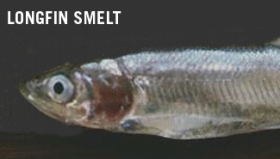
Longfin smelt. Photo: NOAA
Photo: NOAA

The Commission listed the delta smelt as “endangered” and the longfin smelt as “threatened,” a lesser classification. Both are denizens of the Sacramento-San Joaquin Delta and have long been at the center of controversy over water diversions from the Delta. According to the San Francisco-based Center for Biological Diversity:

“The San Francisco Bay-Delta Estuary is home to the largest and southernmost self-sustaining population of longfin smelt. Longfin smelt populations that inhabit the estuaries and lower reaches of Humboldt Bay and the Klamath River have also declined and may now be extinct. Since 2000, the Bay-Delta longfin smelt population has fallen to unprecedented low numbers. Since 2002, the delta smelt has plummeted to its lowest population levels ever recorded.”

CBD was among the environmental groups that petitioned the state for listing of the longfin in 2007. Delta smelt have been protected as a “threatened” species since last year but today that designation was escalated to “endangered.” The Center has also petitioned for–but has yet to attain–federal listing for both species by the U.S. Fish & Wildlife Service.

The listing could have major implications for water supplies this year. Court decisions in favor of the fishes have already forced reductions in water pumped out of the Delta for diversion to the San Joaquin Valley and Southern California. The rulings have prompted some to characterize subsequent reduced water deliveries as a “regulatory drought.”
Record-Low Water Allocations for Farms

Photo by Sasha Khokha
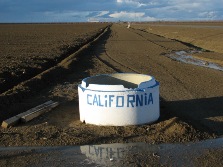
Deceptively soggy fields in Fresno County. Photo by Sasha Khokha

This morning’s news for Central Valley farmers was bad–but not unexpected: record low allocations of water from state and federal irrigation systems, just as growers make their spring planting decisions.

There are two major plumbing systems that supply water for Valley farms. This morning, the federal Bureau of Reclamation said the best-case scenario will be that ag customers of its Central Valley Project get 10% of their requested water this year. Zero is more likely for most, especially if the current season’s weather patterns persist. The previous low for CVP allocations was 25% in the early 1990s.

Also today, the California Department of Water Resources confirmed its earlier estimate of 15% allocations for farms served by the State Water Project.

The recent string of rainy days has left fields soggy but failed to make a dent in the current drought. Elissa Lynn, Senior Meteorologist for the state Department of Water Resources says we’d need four or five more big storms by April to bring the state’s precipitation levels up to normal.

It’s unlikely it will keep raining hard enough, for long enough, to bring California out of a drought.

And that means more fighting over the state’s water supply. Especially when it comes to the massive state and federal plumbing projects that pipe water from northern California to make arid Central Valley fields bloom.

Not only is there less water in the state’s reservoirs, but there are restrictions on pumping it because of legal decisions to protect the endangered delta smelt.

On The California Report this morning, we visited with a Fresno County tomato farmer, to find out how he’s coping. If you missed it, that radio story will be posted here sometime today.

For more on the drought, explore Climate Watch’s newest resource, California’s Water. Visit this page for access to KQED’s drought coverage, data and reports from the Department of Water Resources and the National Oceanic and Atmospheric Administration, and California water news from across the Web.

Cow Power Takes to the Highway

biogas1If the program for the World Ag Expo in Tulare had a centerfold, it might well be a gleaming red and silver tank truck, powered by pure Holstein hydrocarbons.

A Tulare County dairyman is using cow “emissions” to fuel two delivery trucks. Instead of a sleeper compartment, the cab of the truck holds six lightweight tanks for compressed bio-methane.

Western United Dairymen have produced a video about the project and its benefits to the environment. That’s an interesting twist because the dairy lobbying group and air quality regulators haven’t always seen eye to eye on the question of bovine gas.

Emissions from livestock have their own load of air quality issues, especially in Tulare County, where there are more cows than people. When cows burp or emit gas, it produces ozone, a key component of smog. Dairy owners have also wrangled with air regulators over emissions from some methane digesters that convert manure to electricity on dairies. For a refresher (poor word choice, perhaps), check out our recent radio/web series on methane.

But the California Air Resources Board stands behind the cow-power project (though perhaps not the manure spreaders–okay, old joke). In fact, CARB staked the dairy to a $600,000 grant, under legislation passed in June 2006 to encourage the introduction of alternative fuels into the California market. Hilarides Dairy and Cheese company used the money to help build a methane digester and figure out how to convert the diesel trucks.

How exactly does cow poop become something that can power a vehicle? It isn’t pretty, according to the group Sustainable Conservation, which put out a report on the subject. It goes something like this:

Manure is flushed from the cows’ stalls into a covered lagoon where bacteria convert the manure to biogas. The trapped gas is sent from the lagoon to a biogas upgrading system which removes impurities. Pressurized bio-methane is put into the truck’s fuel tank. The truck is then ready for the road.

The report estimates that cows could eventually power a million cars nationwide. But unless you live near a dairy farm or have your own personal cow to hook up to your fuel tank, don’t expect this will save you a trip to the gas station anytime soon.

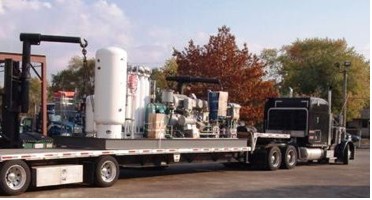
Photo courtesy of Hilarides Dairy: The biogas upgrading system arrives by truck from Michigan (but transported with conventional diesel).

The End of Ag? Chu Drops a Climate Bomb

arizona-drought-small.jpgHigher temperatures and drier conditions could destroy California’s vineyards by the end of the century if Americans do not act fast to slow global warming, Secretary of Energy Stephen Chu said Tuesday in his first interview since joining the Obama cabinet.  Chu, a California native, warned that increased water shortages in the West and a loss of up to 90 percent of the Sierra snowpack are likely to have a severe impact on the state’s agricultural industries as well as California’s cities.

“I don’t think the American public has gripped in its gut what could happen,” Chu told the Los Angeles Times.  “We’re looking at a scenario where there’s no more agriculture in California.”

Californians may appreciate this kind of attention in Washington to what is shaping up as potentially the worst drought in the state’s history.  The California Department of Water Resources reports $308.9 million in agricultural losses last year due to drought in the state, and if January was any indication of what’s to come, that number will be even higher for 2009.  The Santa Rosa Press Democrat reports that grape growers in the counties of Sonoma and Mendocino are facing a difficult choice this month as they decide whether to use some of their reduced water allotments for frost protection. With such a rapidly dwindling supply, water used now could mean none for irrigation later in the season.

This morning on KQED’s Forum, California water experts discussed the direness of the situation and the probability of water rationing and other measures to deal with it.

The California Department of Water Resources website has extensive information about drought conditions and mitigation efforts across the state, including this fact sheet updated for January 2009.

Photo by Reed Galin

Methane Epilogue: Power from Cows and Castoffs

dig_3944-web.jpgWe have updates from some of the places we visited in our methane series, heard on The California Report. For Part 1 of the series, click here. For Part 2 of the series, click here.

At Fiscalini Farms near Modesto, John Fiscalini says he finally worked out a deal with air regulators that allows him to convert his manure into methane for electric power. His permit from the San Joaquin Valley Air Pollution Control District allows him to run the engine while he makes adjustments to minimize particulate and nitrous oxide pollutants.

He hopes to be making power by the middle of this month–more than 13 months behind schedule. Capturing the methane, of course, will make a significant dent in the carbon footprint of the farm, which has 3,000 cows (1,500 producing and 1,500 “replacements”).

He also has a grant from the U.S. Dept. of Energy, under which university researchers will install equipment to monitor the methane operation. Fiscalini says they’ll “monitor everything we can possibly monitor” and gather data to make better judgments about the efficiency and economic feasibility of methane digesters. He’s having some doubts about the economic feasibility of his own. Now, he says, water quality regulators want him to do $40,000 worth of environmental assessments, including a hydro-geologic survey and a study of his waste stream (he uses leftovers from the methane digester for fertilizer).

You may recall that we started Part One at an unidentified landfill, to explain how methane is produced and captured, and why flaring it off is better than letting the methane escape into the atmosphere. I later heard from Jessica Jones, district manager for Waste Management, which runs the Redwood Landfill and Recycling Center in Marin County, the location where I did the recording. While the landfill currently flares off its collected methane, Jones wanted us to know about some of the company’s efforts to harness that gas–potentially enough to power 4,000-5,000 homes. In an email to KQED, she wrote:

“Redwood Landfill is currently working to permit a landfill gas to energy facility which will become Marin County’s largest source of green power.  Altamont Landfill in Alameda County currently has landfill gas to energy production through the use of internal combustion engines and turbines, and is beginning construction of a liquefied natural gas facility which will convert landfill gas into a clean burning fuel which can be used to power Waste Management’s refuse collection fleet.  This type of fuel is estimated to be potentially the closest to carbon neutral of any fuel being developed today.”

There’s more about Redwood’s landfill-gas-to-energy (LFGTE) project at the company’s website. In echoes from our conversations with John Fiscalini, Jones writes on the site that there are “regulatory hurdles” to be cleared before this can happen. Sound familiar?

Photo: Stinky silage; Methane digester tanks will soon power the Fiscalini dairy farm.

Megadose of Cli-Sci on Public Radio Friday

Just in case you can’t get enough climate science these days, public radio outlets doled out double-dose today.

Two recent climate studies were highlighted on KQED’s Forum program today. Host Dave Iverson invited me to join him, along with UC Berkeley researcher Inez Fung, author of a new study on seasons shifting from rising temperatures, and Phil Van Mantgem, who led a new USGS study on the alarming rise in tree mortality across the western U.S.

Van Mantgem then popped up on NPR’s Science Friday, followed by New York Times correspondent Andrew Revkin, author of the widely followed Dot Earth blog, who responded to recent polling on changing attitudes toward climate change.

Podcasts of both programs are available at their respective websites (linked above).

This coming week, we’ll begin our two-part series on methane’s contribution to global warming. Part One airs on The California Report on Monday morning, followed by Part Two a week later. Part One examines where methane comes from and why regulators are looking at it with new concern. In Part Two, we’ll visit a dairy farm near Modesto, where methane from cow manure is being captured and turned into electric power and steam–but not without considerable expense and frustration with regional air & water quality regulators.

Food Crisis a Likely Result of Global Warming

smallircefarm.jpgHere’s a new study for your “Boy, Are We In Trouble” file.   We’ve written a lot here about likely climate change effects like wildfires, rising seas, and water shortages, but one Pandora’s box we haven’t opened yet is the potential for a food crisis.  As it turns out, we may be in for a big one.

A Stanford study published in the January 9th issue of Science finds that rising temperatures are likely to have a major effect on crop yields in the the tropics and subtropics by 2100.  In some areas, the study predicts that primary food crops like maize and rice will be reduced by 20-to-40%.  Considering that half of the world’s population lives in these regions — three billion and rapidly growing — and that a large percentage are subsistence farmers, crop shortages could be devastating–and reverberate well beyond those regions, generating waves of “hunger refugees.”

Using 23 global climate models that contributed to the 2007 IPCC report, researchers from Stanford and the University of Washington determined that:

“There is a greater than 90% probability that by 2100 the lowest growing-season temperatures in the tropics and subtropics will be higher than any temperature recorded there to date.”

The researchers, Rosamond Naylor, director of Stanford University’s Program on Food Security and David Battisti, a University of Washington atmospheric sciences professor, looked at historic examples of food shortages caused by heat waves, such as France in 2003 and the Ukraine in 1972.

“I think that what startled me the most is that when we looked at our historic examples there were ways to address the problem within a given year,” said Naylor.  “People could always turn somewhere else to find food but in the future, there’s not going to be any place to turn unless we rethink our food supplies.”

The researchers say that the world must start planning adaptation strategies for what appears to be a likely scenario. And we might add that it’s not just the tropics at issue. If one of the nastier scenarios plays out for California’s snowpack and runoff, the resulting water crisis could also cripple food production right here, in one of the most productive and diverse agricultural regions in the world. In the grip of a three-year drought, the coming summer may give us a glimpse of things to come.

CA is “Extra Vulnerable” to Climate Change

3115732217_d7901f1545_m.jpgClimate change will most likely affect California more dramatically than it does many other places, according to researchers speaking Tuesday at the American Geophysical Union’s annual meeting in San Francisco. The panel featured new research into climate change impacts on sea level rise, agriculture, water evaluation and planning, air pollution, and extreme climate events.

Climate researcher Dan Cayan, from the Scripps Institution of Oceanography, described California as “extra vulnerable” to climate change and gave a broad (and somewhat scary) overview of the reasons why. The state’s temperature increases are expected to be similar to the global average temperature rise in the coming decades, making for hotter summers with longer heat waves. Given the expected increase in population in California’s interior, longer and harsher heat waves could have significant public health implications.

On top of the more intense summers and milder winters, precipitation across the state may well decrease, especially in Southern California. These drier conditions will be compounded by a significant withering of the Sierra snowpack. Even with a moderate increase in temperature (2 degrees C), Cayan says more than half of the historic California snowpack will disappear by 2100, as the mountains get more rain than snow at higher elevations. That can increase flooding and coupled with expected sea rise over the next century, the San Francisco Bay and the Sacramento/San Joaquin Delta may be in for some extreme events.

Fortunately, others are looking into sea level rise and what it’s going to mean for the San Francisco Bay Area and the coast of California. Peter Gleick, president and founder of the Pacific Institute, spoke about a new study currently under review focused on the projected impacts of sea level rise, including flooding and erosion, and the potential responses. The study will evaluate flood and erosion potential, create detailed maps of California’s vulnerable areas, estimate risks to populations and structures, anticipate costs of various adaptation strategies, and make policy recommendations. Gleick cited one immediate need as a catalog of the state’s existing levees and their conditions.

The report’s results should be out in February, which is also when we should see the draft version of the first California Adaptation Strategy, which aims to compile information on expected climate change impacts for the state and provide policymakers and resource managers with strategies for addressing them.

The Cost of Sloth

The changing climate could cost Californians “tens of billions of dollars a year.”

Money Man

Those are just the direct costs, toted up in a new report by economists at U-C Berkeley.
“California Climate: Risk and Response” is billed as the first comprehensive report on the costs that may be inflicted on California from the effects of climate change. The 127-page report was co-authored by Fredrich Kahl and David Roland-Holst of Berkeley’s Center for Energy, Resources and Economic Sustainability (part of the Dept. of Agricultural and Resource Economics).

Higher energy demand, heat waves, scarce water, wildfire and rising sea levels–even the “collapse” of the state’s half-billion-dollar ski industry–are just some of the potential cost drivers. The “good news,” according to the report, is that much of this cost could be avoided by immediate investment in strategies to prepare.

A key question is where the money will come from—especially in tough economic times—to invest in the energy and other infrastructure needed to stave off the worst damage. Skip Laitner of the American Council for an Energy-Efficient Economy, says we’re not necessarily talking about finding “new” money for these investments. “In the US economy,” says Laitner, “we’re looking at almost two trillion dollars of investment anyway, regardless of how tight the market is. The point I think is a smart re-deployment of investment to more productive uses.”

That includes rapid development of renewable energy and measures to use water more efficiently. The study was funded by the nonpartisan think tank known as Next 10 and is just the latest in a repeating chorus of studies making the point that a full-on confrontation with climate change will, in the long run, be good for the economy, and may even provide some near-term stimulus.

Just weeks ago, Roland-Holst unveiled a separate study on the potential for job creation from promoting conservation and a shift to renewable energy. Earlier this week, a Cal State Fullerton study put a $28 billion-dollar current price tag on air pollution in the south coast and San Joaquin Valley regions.

Roland-Holst will be one of the guests on KQED’s Forum program tomorrow (Friday). He’ll be joined by representatives from Next 10 and Environment California, in a robust discussion of the cost of climate change.

Methane Takes its Turn in the Spotlight

No sooner had I posted a piece about “The Other Greenhouse Gases,” than more new data bubbled up about one of them; methane.

Benicia Refinery

According to a study published by researchers at MIT, there was a global spike in atmospheric methane last year. The increase, on the order of millions of metric tons, was uniform around the world, not concentrated around major methane emitters, as one might expect. In other words, “background” methane levels are up all over, so that the atmospheric concentration is nearly 1800 parts per billion.

That’s a much lower concentration than carbon dioxide, which stands at about 385 parts per million. Methane also breaks down faster in the atmosphere. But it worries climatologists because it is far more potent than CO2 as a greenhouse gas; anywhere from 25 to 50 times more harmful, depending on how you measure it. Researchers Matthew Rigby and Ronald Prinn say atmospheric methane levels have more than tripled since the Industrial Revolution but has held steady in recent years. Recently something has thrown it out of balance but the MIT team could only speculate about possible reasons.

Methane escapes from a combination of both natural and human-induced sources. It leaks from oil & gas industry infrastructure and landfills, and is produced by livestock (and human) digestion. It’s also released by marshes and rice paddies. California is a major rice producer but the rice fields’ share of total U.S. methane emissions is relatively tiny.

Climate Watch is preparing an upcoming feature on  methane and climate change. Listen for it on The California Report in November.