Tag Archives: Agriculture

No Shockers in White House Climate Report

The Obama Administration released a much-vaunted update on climate change today. In its nearly 200 pages, the report contains no new data and few new conclusions on the pace and impact of climate change across the U.S. Rather it affirms the core findings of recent research and sounds the alarm for rapid, definitive action to reduce carbon emissions and prepare for changes already on the way.

In a statement from Lawrence Berkeley National Lab, Evan Mills, one of the report’s 28 co-authors, calls it “the most thorough and up-to-date review ever assembled of climate-change impacts observed to date as well as those anticipated in the future across the United States.” Mills is one of two northern California scientists listed in the report’s credits, along with Ben Santer of Lawrence Livermore National Lab.

One clear signal from the report is that it’s time to move adaptation strategies to the front burner; preparing for climate effects already in the pipeline.

Louis Blumberg directs the California climate change team for The Nature Conservancy, and told me in a telephone interview this morning, “I would say it’s a very clear signal that even if we dramatically reduce emissions immediately, which we need to do as soon as possible, we’ve already put enough CO2 into the atmosphere where we’re going to have have significant changes to our way of life. And we need to begin now and plan to adapt to these unavoidable impacts and I think this report underscores that urgency.”

But neither Blumberg nor Mills have given up on the mitigation side. Mills says “the good news is that the harshest impacts of future climate change can be avoided if the nation takes deliberate action soon.”

Here is a summary of  “key findings,” taken directly from the report:

1. Global warming is unequivocal and primarily human-induced.

Global temperature has increased over the past 50 years. This observed increase is due primarily to human-induced emissions of heat-trapping gases.

2. Climate changes are underway in the United States and are projected to grow.

Climate-related changes are already observed in the United States and its coastal waters. These include increases in heavy downpours, rising temperature and sea level, rapidly retreating glaciers, thawing permafrost, lengthening growing seasons, lengthening ice-free seasons in the ocean and on lakes and rivers, earlier snowmelt, and alterations in river flows. These changes are projected to grow.

3. Widespread climate-related impacts are occurring now and are expected to increase.

Climate changes are already affecting water, energy, transportation, agriculture, ecosystems, and health. These impacts are different from region to region and will grow under projected climate change.

4. Climate change will stress water resources.

Water is an issue in every region, but the nature of the potential impacts varies. Drought, related to reduced precipitation, increased evaporation, and increased water loss from plants, is an important issue in many regions, especially in the West. Floods and water quality problems are likely to be amplified by climate change in most regions. Declines in mountain snowpack are important in the West and Alaska where snowpack provides vital natural water storage.

5. Crop and livestock production will be increasingly challenged.

Agriculture is considered one of the sectors most adaptable to changes in climate. However, increased heat, pests, water stress, diseases, and weather extremes will pose adaptation challenges for crop and livestock production.

6. Coastal areas are at increasing risk from sea-level rise and storm surge.

Sea-level rise and storm surge place many U.S. coastal areas at increasing risk of erosion and flooding, especially along the Atlantic and Gulf Coasts, Pacific Islands, and parts of Alaska. Energy and transportation infrastructure and other property in coastal areas are very likely to be adversely affected.

7. Threats to human health will increase.

Health impacts of climate change are related to heat stress, waterborne diseases, poor air quality, extreme weather events, and diseases transmitted by insects and rodents. Robust public health infrastructure can reduce the potential for negative impacts.

8. Climate change will interact with many social and environmental stresses.

Climate change will combine with pollution, population growth, overuse of resources, urbanization, and other social, economic, and environmental stresses to create larger impacts than from any of these factors alone.

9. Thresholds will be crossed, leading to large changes in climate and ecosystems.

There are a variety of thresholds in the climate system and ecosystems. These thresholds determine, for example, the presence of sea ice and permafrost, and the survival of species, from fish to insect pests, with implications for society. With further climate change, the crossing of additional thresholds is expected.

10. Future climate change and its impacts depend on choices made today.

The amount and rate of future climate change depend primarily on current and future human-caused emissions of heat-trapping gases and airborne particles. Responses involve reducing emissions to limit future warming, and adapting to the changes that are unavoidable.

On KQED Public Radio’s Forum for Wednesday, 6/17

9am Forum with Michael Krasny
White House Climate Report
We discuss the report, as well as federal climate change legislation from Congressmen Henry Waxman and Ed Markey. Guests include Dan Kammen, professor of energy at UC Berkeley and co-director of the Berkeley Institute of the Environment; and Katharine Hayhoe, professor of geophysics at Texas Tech University and a lead author of the climate study.
Ag and Water: Making Do with Less

This story was produced in collaboration with NPR, with help from producer Cindy Carpien. Sasha’s radio story aired on The California Report on June 8, and will also air later this month as part of NPR’s series on water and the West.

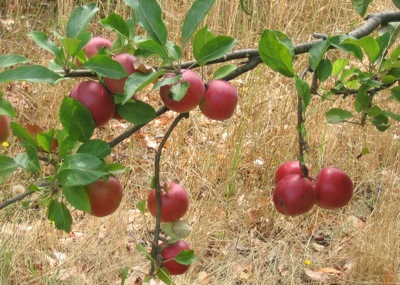
Juicy apples spring from the apparently dry landscape of Sonoma County. Photo: Cindy Carpien
Juicy apples spring from the apparently dry landscape of Sonoma County. Photo: Dan Lehrer, Flatland Flower Farm

Does climate change spell doomsday for California agriculture?

That’s what Nobel-prize winning physicist Steven Chu told the Los Angeles Times in an interview, soon after President Obama appointed him Secretary of Energy.

“I don’t think the American public has gripped in its gut what could happen,” he told the Times in February. “We’re looking at a scenario where there’s no more agriculture in California.”

For another perspective, I called UC Davis ag economist Richard Howitt, who focuses on water and California agriculture, to ask him what he thought.

“That’s a highly inaccurate statement,” Howitt said. “Steven got carried away. Brilliant man, but he doesn’t know anything about California water.”

Howitt’s models show climate change will likely lead to a 25% reduction in the state’s water supply over the next 50 years. He says that will likely mean some rough times ahead for farmers, but certainly not the end of California’s role as an agricultural powerhouse.

In fact, Howitt says if California farmers can continue to grow more drought-tolerant crops and cut back on flood irrigation, they’re likely to thrive in the marketplace over the long term:

“As income increases, people eat more California fruit, nuts, and vegetables,” he says. “They don’t care about cotton; they don’t care about corn. We are on the right side of the agricultural business in terms of future growth.”

Of course, that means if you were to fly over the Central Valley in 50 years, you’d probably see fewer emerald-green islands of crops like rice, alfalfa, and cotton–and more fields of wheat and flexible crops like canning tomatoes, which can be planted seasonally and according to demand.

“This will, of course mean that we have less slack in the system than we do now,”  says Howitt.  “We’re going to have to be much better at applying water, look a little more like Israel and a little less like Northern California.”

Engineers who specialize in irrigation technology have long looked to drought-stricken countries for models. The folks who developed the Pure Sense software I discuss in my radio story have collaborated extensively with farmers in Australia.

Howitt also says no matter how efficiently farmers apply water, they have to figure out how to more efficiently move it around the state. Rather than just fighting over smelt, salmon, and pumping in the Sacramento-San Joaquin Delta, Howitt thinks farmers could be more efficient if we plumb water east to west (currently the two major water systems in California are primarily north-south oriented). Howitt says that would create incentives for farmers in relatively water-rich areas, like the east side of the San Joaquin Valley, to sell water to farms with good soil but less water–like the west side of the San Joaquin Valley, home to the some of the largest and wealthiest farms in the world.

Tricking plants into yielding more with less

Meanwhile, the idea of “dry farming,” like what the folks at Sonoma County’s Flatland Farm are doing with their apples, is getting popular in coastal areas. Dry-farmed tomatoes, like these from Santa Cruz, are increasingly popular at farmer’s markets.

Some researchers are taking this concept to places where it doesn’t rain so much. The idea is to control irrigation to stress the plants to the point where they think they’re starting to die, which triggers the plant’s genetic imperative to produce more fruit. David Goldhamer, who advises Central Valley farmers through the UC Cooperative extension, has demonstrated that farmers who cut back on watering of navel oranges and pistachios, may actually produce higher-quality fruit and generate more income.

A sprinkling of history

I also visited David Zoldoske, at the Center for Irrigation Technology at Fresno State. They have an amazing collection of historical sprinkler systems and a virtual irrigation museum online. Zoldoske has been studying irrigation and water efficiency for decades. Here’s what he told me about how agriculture is going to have to adapt to warming temperatures:

“I think the thing to remember here is there is no silver bullet. There is no reservoir or canal or any other technology or engineering feat that’s going to solve this problem. We’re going to have to use every tool in the toolbox. It’s going  to take multiple feats of engineering elegance so we can solve this problem. And it’s still possible that we’ll fail. And I don’t want to be saying that we will fail. We need to be very focused on this. It’s going to be a long journey. We won’t solve it over night.”

Learn more:

Ag and Climate Change

The entire April-June issue of the University of California’s quarterly journal, California Agriculture, is devoted to research on climate change and how it may fundamentally alter California’s environment and landscape, agriculture and food quality.

Saving Every Drop:

The California Institute for Rural Studies has profiled some of the most efficient California farmers in their January report, California Water Stewards: Innovative On-Farm management Practices (.pdf link).

The institute is also tied into the California Agricultural Water Stewardship Initiative (CAWSI), which has just launched a new website that features farmers using less water.

“The Australian Reality”

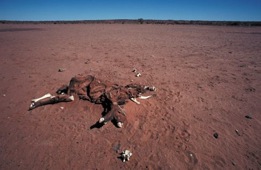
Australia's Simpson Desert. Photo: Mike Gillam

Referring to Australia’s seven-year drought, that’s how the state’s top water manager describes the new paradigm for water planning at the Dept. of Water Resources.

Speaking to a packed house at the annual forum of the Sacramento River Watershed Program yesterday, DWR Director Lester Snow said his staff is assuming that 2010 will be another dry year. Snow warned about “loss of resilience” in the state’s water system, calling it “completely unsustainable” in it’s present form, given predictions for population growth, coupled with anticipated effects of climate change.

All speakers at the forum seemed to agree that a paradigm shift is in order. Thomas Philps, a strategist at SoCal’s Metropolitan Water District, pointed out that in Victoria’s capital city of Melbourne (Australia), per capita water consumption runs about 40 gallons per day, while in California’s capital, it’s 280 gallons. As Sasha Khoka will report Monday morning on The California Report, Sacramento is just one of several cities in the Central Valley that still doesn’t meter its water use. Philps added that the Sacramento region is “on a trajectory” to use the same volume of water as Los Angeles, though he did not say by when.

UC Davis geologist Jeff Mount cautioned against relying on additional surface storage to secure California’s water future. Not only does storing water become “very expensive” year over year, but dams and reservoirs “don’t create any new water,” he said. (If some think Mount is taking a “jaundiced view” of the situation, it might be because he braved a bout of hepatitis to deliver his morning talk)

In a panel discussion on resource planning, moderator Greg Zlotnick of the Santa Clara Valley Water District asked panelists to respond with “true” or “false” to a quote from the Pacific Institute’s Peter Gleick in a story aired on NPR last week. The quote, as given by Zlotnick, was: “Government has built infrastructure and made promises that can’t be kept.” Here are the panelists’ responses:

Tina Swanson, The Bay Institute: “True.”

Philps: “True, but…” (Generally true but MWD doesn’t really expect to get its full contractual allocation of water anymore, anyway)

Don Glaser, US Bureau of Reclamation: “False, but…” (Water allotments from his agency’s Central Valley Project are intended to be “supplemental contracts,” to augment use of groundwater and other sources, but Glaser sees the statement becoming “more and more true in the future.”)

Snow: “Hell, no.”

NPR Spotlights California Water Issues

farm_0799_blog1

NPR’s Morning Edition launched an “occasional series” on California’s water woes this morning. Veteran correspondent John McChesney begins with the impact on agriculture in the Central Valley’s Westlands Water District, the nation’s “biggest irrigated region.”

KQED’s Central Valley Bureau Chief and Climate Watch contributor Sasha Khokha will have three stories in the series, two of which will debut on The California Report in the weeks ahead:

WATER METERS: Many California cities are preparing for or implementing mandatory water rationing this summer. But there are still cities and towns, particularly in California’s Central Valley, where water can’t be rationed because residents don’t even have water meters.  Residents are charged a flat rate for any amount of water they use. Khokha looks at the city of Fresno, where water meters will be phased in, but not until 2013.

MENDOTA PROFILE: The town of Mendota in California’s Central Valley is at the heart of the economic crisis spawned by drought and the loss of farm jobs.  Sam Rubio grew up here, the son of a Mexican farmworker.  He went off to college, and was planning to become a doctor, but instead has returned to this town to teach biology, mentor local kids, and run a café that’s become a haven for the farmworker youth.

AG ADAPTING TO DROUGHT: California farmers are facing an increasingly uncertain water supply, brought about by drought, environmental restrictions on pumping, and climate change. How will farmers adapt? Some of them are yanking out water-intensive crops and replacing them with more drought-tolerant ones. But others are trying to keep growing the same crops with improved technology. We’ll follow a new tech start-up that’s helping farmers use water more efficiently by tracking how much moisture reaches each plant in their fields–and sending a satellite message to their cell phones. We’ll also talk with a researcher who says there are ways California can grow some key crops, like oranges and nuts, using less water.


Change Your Diet, Change the Climate?

salinas-007_blog

Climate Watch contributor David Gorn has been looking at the link between climate and the food we eat. His latest report aired recently on NPR’s All Things Considered.

So I have to admit, when I first got this story assignment from National Public Radio, my reaction was mixed. You want to reduce global carbon emissions by changing your personal DIET? Oh, come on. I mean, how much of an impact could diet change have on climate change?

Quite a bit, apparently.

A United Nations report says livestock accounts for 18 percent of the world’s greenhouse gasses, much of it from the methane produced by cows, as well as goats and sheep.

Shipping beef and dairy products across the country and around the globe also contributes heavily to that carbon footprint, in the form of emissions from trains, planes and trucks.

So the idea is that by cutting out beef and cheese from your personal diet, you can significantly reduce your personal carbon footprint. Chris Jones, a staff researcher at UC Berkeley’s Institute of the Environment, says the production and distribution of beef, pork, lamb and cheese are particularly high offenders on the greenhouse gas emissions chart.

In my story for All Things Considered, I focused on an Earth Day event where the University of San Francisco cafeteria and about 400 other food service outlets across the country, managed by Palo Alto-based Bon Appetit, were cutting all beef and cheese out of the menu for one day. Yes, no cheeseburgers in a university cafeteria. Scary thought, eh? The students didn’t seem to flinch, though.

It looks like this approach to the low-carbon diet it may be catching on among Bay Area hospital cafeterias, as well.

It’s unclear what effect the current efforts might have on climate patterns but it’s a familiar pattern to Americans; using personal buying power to influence public policy decisions.

Congressman: Delta Fish a “Worthless Little Worm”

Peter Johnsen, U.S. Fish & Wildlife Service
Photo: Peter Johnsen, U.S. Fish & Wildlife Service

In hearings by the House Energy & Commerce Subcommitee today, Rep. George Radanovich (R-Fresno) called the Delta smelt “a worthless little worm that needs to go the way of the dinosaur.” He made the remark as part of a five-minute attack on “environmental alarmism,” in response to testimony from former vice-president Al Gore, founder of the Alliance for Climate Protection.

The tiny fish, recently listed by the state Fish & Game Commission as “endangered,” came up in remarks by Radanovich about the current drought conditions in the Central Valley. He blamed the lack of water on lawsuits that have restricted water supplies to farms, “for a Delta smelt–a worthless little worm that needs to go the way of the dinosaur. They’ve shut pumps down and restricted water deliveries to California over that thing, when what’s eating it is a striped bass, a non-native species in the Delta.”

Radanovich rejected the possibility that climate change might be a player in the current drought. Instead he took aim at what he described as “collaboration between environmentalists and sport fishermen,” blaming that for slashed water allocations to farms, as many as 60,000 job losses and “a $6 billion-dollar hit to our economy.”

“That is not global warming,” he said. ” “It’s the result of bad policy caused by environmental alarmism.”

Joining Gore among the 21 witnesses before the subcommittee on Day 4 of the climate bill hearings was UC Davis professor Dan Sperling (.pdf link), who had just come from a marathon hearing before the California Air Resources Board. Last evening the Air Board approved the first-ever Low-Carbon Fuel Standard, as part of it’s plan to reduce greenhouse gases.

Low-Carbon Fuels in Your Future

After years of study and a day of marathon testimony in Sacramento, state regulators have adopted the world’s first low-carbon standard (LCFS) for transportation fuels. Only one member of the California Air Resources Board, John Telles, voted against adoption.

During nearly six hours of testimony by almost 100 speakers, businesses lined up both for and against the new rules. As Marjorie Sun reported for us this week, some claimed that calculations for the carbon footprints of different fuels–especially ethanol–were not even-handed. Speaker after speaker assailed the LCFS as being the product of “incomplete analysis” or just bad math (public testimony begins about an hour into the webcast).

But Daniel Sperling, a UC Davis professor and member of the Air Board, calls it “government at its best.”

“There’s been a huge amount of effort,” he said, ” in working with the oil companies, working with the electricity companies, working with the environmental community, working with the biofuels companies, to try to get this really done right.”

Though numerous speakers challenged the view that it was done right, both Sperling and Air Board head Mary Nichols seemed to leave the door open to additional tweakage of the regulations. “In the end, it’s a science-based policy,” said Sterling. “There are a lot of pieces of this that we’re not certain exactly the best way to do it but we’ve got the framework of a really outstanding policy and an important policy. And we’ve made the commitment to work with all the different stakeholders in refining it, to make sure that it really works best.”

Small-business and environmental justice groups locked arms to decry the cost of the new rules. Some cited a report from Sacramento-based Sierra Research estimating $3.8 billion in increased fuel costs by 2020, if the LCFS takes effect.

An “expert working group” is due to report back on January 1, with possible suggestions for fine-tuning the plan.

Board member Ron Roberts summed up the proposed regulation by paraphrasing Winston Churchill: “It may not be the end or even the beginning of the end, but it’s the end of the start,” said Roberts (falling somewhat short of Churchillian eloquence but point taken).

The new rules are designed to cut greenhouse gas emissions from transportation 10 percent by 20-20.  Sperling is now headed to Capitol Hill, to testify before Congress on national legislation. California’s process is being closely watched in Washington, where pending federal carbon legislation is widely seen to be modeled after California’s plan.

The Battle Over Biomass

This week, the California Air Resources Board is expected to pass a controversial new standard that measures the carbon footprint of transportation fuels. Reporter Marjorie Sun filed a story for Climate Watch on the measure and why the ethanol industry is fighting it. She provides some additional insights here:

The proposed low carbon fuel standard is part of a broad effort by the California regulators to roll greenhouse gas emissions back to 1990 levels by 2020.

biofuel pumpSlashing carbon emissions from cars and trucks is a big part of the state’s game plan. That’s because transportation accounts for 40 percent of the state’s greenhouse gas emissions. A whopping 96 percent of the fuel sources that power our cars and trucks is petroleum-based. Right now, the bulk of ethanol sold in California–and the rest of the United States for that matter—is corn-based. (Brazil makes its ethanol fuel from sugar cane, which has a smaller carbon footprint.) U.S. producers argue that the proposed Low-Carbon Fuel Standard (LCFS) would make corn-based ethanol less competitive in the marketplace because of the way it calculates emissions. Pacific Ethanol was the biggest ethanol producer and marketer in California– until recently. With the drop in gasoline prices over the past year, demand for ethanol has plummeted. Over the past several months the company suspended operations at its two production plants in California and stopped construction of a third facility. In March, it filed for loan extensions with its creditors. So the new fuel standard could deliver yet another blow to the company. Hence, ethanol interests have been putting up a fight. But the Air Resources Board is counting on the proposed standard to spur innovation in the alternative fuels market, to reduce carbon emissions. The state says it’s hoping to “expand the size of the current renewable fuels market in California (already the largest in the nation) by three-to-five times. Instead of today’s corn, over half of the ethanol is likely to be made from extremely low-carbon, cellulosic feedstocks such as agricultural waste and switchgrass. There are numerous startups in California working on cellulosic ethanol. They’re experimenting with a wide range of plants, from switchgrass to algae, as potential sources of ethanol. Getting a new fuel to market, however, requires enormous capital costs. The state is projecting that by 2020, Californians will have bought more than 7 million alternative-fuel and hybrid vehicles. That’s about 20 times greater than today. But in these tight economic times, folks are hanging onto their old cars. So it’s not clear how fast Priuses and plug-ins will replace the carbon-spewing cars on the road today.
Sun’s radio story aired Wednesday on The California Report.

Water Allocations Tweaked Slightly Upward

A few drops of good news for farmers and cities this week: a heftier late-spring snowpack means there will be slightly more water headed their way this summer.

Earlier this week, the State Department of Water Resources said it will increase water from state reservoirs from 15% of what cities and farms had hoped for, to 20%.  Today the federal Bureau of Reclamation (Central Valley Project) followed suit and nudged some of its projected allocations up, too.

The five-percentage-point bump is mildly good news for some northern California farmers.  But farmers in the southern San Joaquin Valley are still slated to get zero gallons from federal reservoirs. For that to change would require an April of historically soggy proportions.

The previous nadir for State Water Project deliveries was set in 1991, when urban and industrial customers got 30% of their requested water and farms got zero.

Ag Rules: Heading Off the Heat

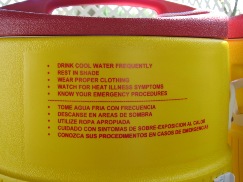
Water cooler imprinted with heat safety tips. Photo: Sasha Khokha

It was like a pageant of farmers in plaid shirts; nearly a dozen speakers  in a Fresno County meeting hall, surrounded by vineyards. Farm leaders offered glowing praise of Cal OSHA’s new guidelines and training seminars that will help them comply with the state’s first-in-the nation heat safety rules–passed three years ago.

The love-fest with Cal-OSHA sets a new tone for agriculture. Growers have traditionally been at odds with the agency tasked with protecting the state’s workers. Farmers have challenged fines and complained about inspections. But despite the regulations,  six workers died last summer, including a pregnant teenage farmworker (some of the victims worked in construction or other outdoor jobs).

Part of the problem was that neither Cal-OSHA inspectors nor farmers had a very clear understanding of how to implement the rules. Is it enough to have an umbrella folded up in the back of a pickup in case it got hot? How hot? How much shade and water is enough?

Today, Cal-OSHA chief Len Welsh made it clear: when it’s 85 degrees or hotter, shade tents or umbrellas have to go up. And that shade should be no more than a two-and-a-half-minute walk away, according to the rules, which also require enough shade so that one-in-four employees are protected from the sun at any given time.

That’s still worrisome for leaders of  the United Farmworkers Union, who were conspicuously absent from the press conference. There are times, they say, when the temperature soars well above 100 or spikes suddenly and everybody should get a break. The UFW says the new guidelines are too vague, and Cal-OSHA’s publicity campaign to educate farmers isn’t enough. Union leaders say the state should impose more fines and criminal penalties when workers die in the heat.