EPA Waiver Still Not “In the Can”

Now the waiting begins–or resumes. After nearly seven hours watching opposing sides duke it out in a Beltway hearing room this week, the EPA will settle down to deciding (again) if California should be allowed to set its own standards for auto emissions.

During the hearing, one group was using Twitter to pass around an online petition supporting the required EPA waiver. They weren’t too late. EPA will continue accepting public comment until April 6. EPA spokesman Cathy Milbourn says “We will review all of the comments, with a decision to follow.” No further timeline for that decision has been made public, however.

Meanwhile, the Detroit News is reporting today that California’s top air regulator may be ready to compromise on a new national standard that would obviate the need for a special waiver.

In case you need a quick review, the issue is whether the tailpipe emissions standards passed into law by California several years ago–the so-called Pavley regulations–can actually be enforced. The Pavley standards are more stringent than the current federal standard and the state is leaning heavily on them to attain its greenhouse gas targets under the Global Warming Solutions Act of 2006 (AB 32). But the waiver was denied under the Bush administration.

Thirteen other states are lined up to enact the California standard if they get a green light from EPA. The auto industry has long argued that this will create a “patchwork” of regulations across the nation, and the ensuing complications of compliance would place an onerous burden on the industry and push up prices for car buyers.

Supporters of the California standard, like Jim Kliesch of the Union of Concerned Scientists, say that automakers already have the technology and can easily comply. Kliesch conceded that consolidating the most efficient technology into one car would add–he figures–about $700 to the cost. But he says the same technology would recoup $1,800 in fuel savings over the life of the car.

Mark Cooper of the Consumer Federation of America pointed to an apparent disconnect in the car maket. He referred to a survey in which half the respondents said they wanted their next car to get at least 30 MPG–but Cooper said only 2% of models currently on the market deliver that.

And so, the argument goes, that if car makers would just follow the market toward cleaner, more fuel-efficient cars, it would actually help them recover from a financial abyss that threatens to topple them.

At the end of the day, the EPA has to make its decision based on three criteria, says David Doniger of the NRDC. To be valid, the California standard must be:

1. Equally strict or more stringent than the federal standard,

2. Needed to meet “compelling and extraordinary conditions,” and

3. Technologically and economically feasible.

Hmm. It seems like you could make a solid case for checking off numbers 1 and 2 but what’s “economically feasible” is a potential tripwire, especially with General Motors teetering on the brink of bankruptcy. Much of it will come down to whether the Obama administration buys into the “patchwork” argument. It’ll be at least another month before we know.

Stop and Count The Poppies

ca_poppy2Here’s a new reason to take time to stop and smell the roses. Or at least count them.
A consortium of scientists called the USA-National Phenology Network (USA-NPN) is recruiting volunteers from across the country to help track the effects of climate change on ecosystems.

Described by executive director Jake Weltzin as a project “for people interested in participating in climate change science, not just reading about it,” the network will collect data from government, academic, and “citizen” scientists to track the life-cycles of more than 200 plants, including California Poppies and Ponderosa Pines.  The project will begin tracking animals next year.

Phenology is the study of the seasonal cycles of plants and animals, such as plants sprouting, flowering and fruiting.   Abrupt changes in these patterns, due to climate change or other reasons, can be extremely disruptive to ecosystems.

USA-NPN hopes that the data collected will help scientists and resource managers “predict wildfires and pollen production, detect and control invasive species, monitor droughts, and assess the vulnerability of various plant and animal species to climate change. ”

Weltzin said that he hopes 100,000 citizen scientists will volunteer to help with the project.   Detailed information on how to participate is located at www.usanpn.org.

Listen here to an interview with Weltzin about the project on the U.S. Geological Survey’s website. Look for episode #85.

Delta Smelt Listed as Endangered

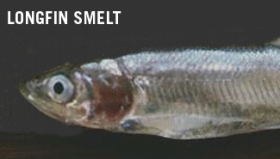
The California Fish and Game Commission today officially qualified two species of freshwater fish for special protection under the California Endangered Species Act.

Longfin smelt. Photo: NOAA
Photo: NOAA

The Commission listed the delta smelt as “endangered” and the longfin smelt as “threatened,” a lesser classification. Both are denizens of the Sacramento-San Joaquin Delta and have long been at the center of controversy over water diversions from the Delta. According to the San Francisco-based Center for Biological Diversity:

“The San Francisco Bay-Delta Estuary is home to the largest and southernmost self-sustaining population of longfin smelt. Longfin smelt populations that inhabit the estuaries and lower reaches of Humboldt Bay and the Klamath River have also declined and may now be extinct. Since 2000, the Bay-Delta longfin smelt population has fallen to unprecedented low numbers. Since 2002, the delta smelt has plummeted to its lowest population levels ever recorded.”

CBD was among the environmental groups that petitioned the state for listing of the longfin in 2007. Delta smelt have been protected as a “threatened” species since last year but today that designation was escalated to “endangered.” The Center has also petitioned for–but has yet to attain–federal listing for both species by the U.S. Fish & Wildlife Service.

The listing could have major implications for water supplies this year. Court decisions in favor of the fishes have already forced reductions in water pumped out of the Delta for diversion to the San Joaquin Valley and Southern California. The rulings have prompted some to characterize subsequent reduced water deliveries as a “regulatory drought.”

Snowpack Buildup “Too little, too late”

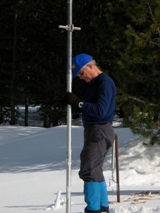
Frank Gehrke at Tamarck Flat last winter.
Frank Gehrke at Tamarack Flat last winter.

That’s how Frank Gehrke described the somewhat improved numbers in the latest Sierra snowpack survey. Gehrke has been trekking up to the snow courses for decades to do the seasonal surveys. Today, the statewide average for water content in the snowpack came in at 80% of normal for this date.

Northern Sierra locations clocked in a bit better at 84%, southern locations at 77%. These are an improvement over last month’s tally, when the state averaged only 61% of normal–but reservoirs are not filling fast enough to make up for the long, dry winter that preceded this recent string of storms.

Not that the recent rains haven’t helped. Oakland, Long Beach, Riverside and San Diego are among several spots that have now had at least 90% of their normal precipitation–and some local reservoirs have been catching up. But up in the Sierra, where it really counts for the Big Picture, they’re not catching up fast enough. The main holding “tanks” for the state’s two major water supply systems, Shasta Lake and Lake Oroville, are still at 60% and 55% of normal, respectively.

The recent storms have been relatively warm, too, with precipitation falling as rain all the way up to 7,500 or 8,000 feet. This is precisely the condition that climatologists have been warning about. Snow sticks to the mountain and makes its own reservoir, slowly releasing water well into the spring, as it melts off. But rain at those high elevations is double trouble. It runs off immediately into the rivers and also accelerates the snow melt. That means less water for later in the season, when we really need it.

That may be why the Governor didn’t wait around for today’s numbers. He went ahead and declared a statewide drought emergency on Friday, urging urban water users to cut consumption by 20%.

Can There Be This Much Climate News?

"Reports to the Contrary" by Chester Arnold

Some weeks it seems like KQED could fill up its entire “news hole” with climate-related stories (thank goodness we don’t). Last week was a prime example.

Monday: A keynote speaker at U.C. Berkeley’s annual Energy Symposium said that we need a “Fed” for energy policy. John Hofmeister, a former executive at Shell Oil and founder of Citizens for Affordable Energy, told the lunch crowd that the only way to overcome the current two-year “policy cycle” (the length of a congressional term) is with an autonomous policy group like the Federal Reserve Board, which can take a longer view.

Tuesday: PG&E announced a massive new solar power initiative (it was brought to my attention this week that no news story is complete these days without the word “massive”–at least when there’s no opportunity to use “deadly”). If approved by state regulators, the project will provide 500 megawatts of photovoltaic energy by 2015. Perhaps the most interesting aspect of the plan is that instead of, say, taking over huge tracts of the Mojave, the project will rely heavily on “solar infill;” making use of property already owned by the company, where they can conveniently access the grid.

Wednesday: Senator Barbara Boxer chaired a hearing of the Energy and Public Works Committee to update members on the latest climate science. They heard testimony from four experts, including Christopher Field of Stanford, who essentially said things are worse than you think. Ranking minority member James Inhofe of Oklahoma seized the moment to decry a $6.7 trillion “climate bailout,” a reference to upcoming federal climate legislation and costs associated with an aggressive plan to fight global warming. You can watch the entire two-and-a-half hour webcast for the gory details.

And of course also on Wednesday, the Coen Brothers rolled out their TV ad for The Reality Coalition, assailing the concept of “clean coal.”

Thursday: The California Air Resources Control Board rolled out new regulations to control some of the lesser known (but highly potent) greenhouse gases, including sulfur hexaflouride, used in the manufacture of computer chips. CARB says a pound of it has the same atmospheric warming potential as ten metric tons of CO2. The board also unveiled a new drought page on its website.

Friday: The Governor issued the latest in a series of drought declarations, this one proclaiming a state of emergency and called on cities to reduce their water use by 20%.

And this week wasn’t all that unusual.

Monday, another week begins with the winter’s third survey of the Sierra snowpack. While recent storms will no doubt have raised the water content from last month’s 61% of normal, it should be something of an anticlimax, especially given that the Governor didn’t wait for the numbers to make his drought declaration last week.

No Country for “Clean Coal?”

An activist group led by the Alliance for Climate Protection has crafted another national TV ad aimed at debunking “the clean coal myth,” this one directed by Hollywood legends Joel & Ethan Coen (directors of No Country for Old Men, in case you’re still puzzling over my obscure headline).

Produced by The Reality Coalition, the ad depicts a pitchman touting a fictional product called “Clean Coal” air freshener. He’s inter-cut with shots of a family spraying what looks like coal dust out of an aerosol can and coughing. The spot ends with the coalition’s stock text message: “In reality, there is no such thing as ‘clean coal.'” The best line in the mock ad, though, is when the pitchman explains that the product “harnesses the awesome power of the word ‘clean,'” the implication being that saying something is clean doesn’t make it so.

Former Vice President Al Gore has been on the stump for some time, carrying the same message; that clean-coal technology “doesn’t exist.” Reality Coalition spokesman Brian Hardwick goes farther than that. He claims that not only does it not exist but the industry isn’t doing much to make it reality. A separate analysis by the Center for American Progress pegged the research commitment by U.S. coal companies to carbon capture technology at about $3.5 billion “over several years,” compared to combined profits of $57 billion in just one year (2007).

The clean-coal debate is relevant to Californians. Mostly through imported power, coal provides more than 16% of the electricity we use. And as I mentioned in my radio segment for The California Report, China is counting on the U-S to develop technology to allow them to burn coal “cleanly.”

While clever, the ad does kind of miss the climate connection. It seems to be aimed at particulate pollution rather than the unseen emissions of carbon dioxide and other greenhouse gases blamed for global warming. Hardwick responded to that critique by saying that “Truly clean coal would have to mitigate all the (environmental) issues” involved in burning the fuel. Still, it’s a source of potential confusion for viewers unclear about the distinctions among greenhouse gases, ozone-depleting gases and local air quality issues.

PG&E Proposes New Solar Initiative

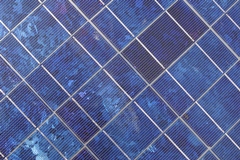
PG&E plans to produce up to 500 megawatts of new solar power over the next five years according to a plan announced by the California utility on Tuesday.  The project will focus on northern and central California and by 2015 is expected to deliver more than 1,000 gigawatt hours of power each year, equal to the annual consumption of about 150,000 average homes, according to the company. solar-panel

The proposal, which needs approval from the state Public Utilities Commission, calls for half of the new solar power to be generated by PG&E and the other half and to be built and owned by independent developers.

Rather than establishing a giant solar array in the desert and then having to transmit the energy huge distances before it can be used, this project takes a “solar infill” approach, which uses small or mid-sized installations located within PG&E’s service area to minimize the cost and delays of connecting them to the grid.

PG&E estimates that the project will meet 1.3 percent of the utility’s energy demand and will add $.32 to each PG&E customer’s monthly electricity bill.

For more, see this in-depth article from Greentech Media.

Was 2008 Relatively Warm or Cool?

Answer: Both. It depends on your historical time frame.

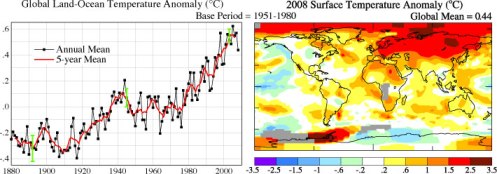
With a global average surface temperature of 79 degrees Fahrenheit, 2008 was the coolest year since 2000, according to climatologists at the NASA Goddard Institute for Space Studies (GISS). But it’s also the ninth-warmest year since 1880, so it’s probably not time to invest in a ski resort just yet.

Including the 2008 dip, the 10 warmest years on record (since 1880) have all occurred between 1997 and 2008, according to NASA.

The NASA scientists attribute 2008’s relatively lower temperature to a cooler Pacific Ocean, due to a strong La Nina pattern in the first half of 2008. La Nina and El Nino are opposite phases of a natural oscillation of  upwelling and subsequent temperatures in the equatorial Pacific Ocean.

2008 temperatures in the United States were cooler than any other year this decade, but, as illustrated on the map below, other parts of the world such as Eurasia and the Arctic were exceptionally warm.

Director of GISS James Hansen predicts that because a shift to El Nino is expected to start this year or next, it “still seems likely” that we’ll see a new record high for the average global surface air temperature in that time frame.

smallmain_graph_temp_lg1

Governor Gets His White House Climate Confab

Our Governor is a hard man to ignore. Less than a month ago, he and eleven other U.S. governors wrote a letter to the new President, reminding him of commitments he made to work in earnest with states on climate issues. Governor Schwarzenegger specifically recalled a line from President (then-elect) Obama’s remarks to the Governors’ Climate Summit last November: “Any governor willing to promote clean energy will have a partner in the White House.”

The January letter (this link is a .pdf download) requested a meeting with top-level members of the White House environmental team “as soon as possible…to discuss a state-federal partnership on clean energy and climate change issues.” This weekend the governors got their meeting.

The President didn’t show up but at least four high-level players did, including energy secretary Steven Chu, interior secretary Ken Salazar, EPA chief Lisa Jackson and the President’s energy and climate deputy, Carol Browner.

While no substantive announcements came out of it, Governor Schwarzenegger said afterward:

“Today’s meeting was the first step in creating a close and lasting partnership with President Obama and his administration on climate change. I look forward to working hand-in-hand with our federal partners to realize the ambitious clean energy and climate change goals I know we share, and that I know will provide a boost to our nation’s economy.”

Some remain skeptical that the path back to prosperity is paved with Green. California’s governor has been a vocal cheerleader for just such a strategy, to tackle both environmental and economic challenges.

The governors’ group’s stated goals include aggressive programs to reduce greenhouse gas emissions and harnessing “market mechanisms” (read that: “cap-and-trade”) to fund development of clean energy technology. They also want to “preserve and enhance state and local authority” in the regulation arena, and stave off “federal preemption” of what the states have already started.

Record-Low Water Allocations for Farms

Photo by Sasha Khokha
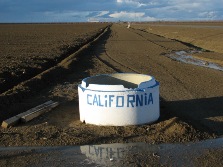
Deceptively soggy fields in Fresno County. Photo by Sasha Khokha

This morning’s news for Central Valley farmers was bad–but not unexpected: record low allocations of water from state and federal irrigation systems, just as growers make their spring planting decisions.

There are two major plumbing systems that supply water for Valley farms. This morning, the federal Bureau of Reclamation said the best-case scenario will be that ag customers of its Central Valley Project get 10% of their requested water this year. Zero is more likely for most, especially if the current season’s weather patterns persist. The previous low for CVP allocations was 25% in the early 1990s.

Also today, the California Department of Water Resources confirmed its earlier estimate of 15% allocations for farms served by the State Water Project.

The recent string of rainy days has left fields soggy but failed to make a dent in the current drought. Elissa Lynn, Senior Meteorologist for the state Department of Water Resources says we’d need four or five more big storms by April to bring the state’s precipitation levels up to normal.

It’s unlikely it will keep raining hard enough, for long enough, to bring California out of a drought.

And that means more fighting over the state’s water supply. Especially when it comes to the massive state and federal plumbing projects that pipe water from northern California to make arid Central Valley fields bloom.

Not only is there less water in the state’s reservoirs, but there are restrictions on pumping it because of legal decisions to protect the endangered delta smelt.

On The California Report this morning, we visited with a Fresno County tomato farmer, to find out how he’s coping. If you missed it, that radio story will be posted here sometime today.

For more on the drought, explore Climate Watch’s newest resource, California’s Water. Visit this page for access to KQED’s drought coverage, data and reports from the Department of Water Resources and the National Oceanic and Atmospheric Administration, and California water news from across the Web.