Warm water patterns in the Pacific during normal (upper) and El Nino (lower) years. The lower image is from 1995-96. Image from NASA
Scientists with the National Oceanic and Atmospheric Administration today confirmed what many had pretty much surmised: El Nino is back.
Officially the El Nino Southern Oscillation (ENSO), the cyclical pattern of ocean conditions has broad implications for weather and the Pacific food chain.
“NOAA expects this El Niño to continue developing during the next several months, with further strengthening possible. The event is expected to last through winter 2009-10.”
NOAA’s Climate Prediction Center suggested about a month ago that conditions were right for the return of El Nino.
More recently, the high incidence of underweight sea lion pups turning up along the California coast was taken by some as a harbinger of ENSO. During El Nino cycles, normal upwelling of deep, cold water slows down, essentially shutting down the “food elevator” for many species.
Of course, there can be an upside. According to NOAA:
“El Niño’s impacts depend on a variety of factors, such as intensity and extent of ocean warming, and the time of year. Contrary to popular belief, not all effects are negative. On the positive side, El Niño can help to suppress Atlantic hurricane activity. In the United States, it typically brings beneficial winter precipitation to the arid Southwest, less wintry weather across the North, and a reduced risk of Florida wildfires.”
Links to climate change are less clear. Some scientists have suggested that warming air and sea temperatures might bring about more and longer El Nino events.
Two developments this week would seem to validate concerns that things aren’t quite lining up for the vaunted new age of renewable energy.
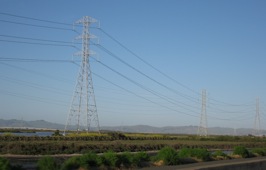
While the Secretaries of Energy and Interior were offering confident assurances to a Senate panel about the future of renewables, a consortium of environmental groups was suing them over a plan for major new transmission lines for the western electrical grid.
The groups, represented by lawyers at Oakland-based EarthJustice, produced their own maps to show that the proposed routes appear to miss many areas with the most potential for solar, wind and geothermal resources. Instead, environmentalists say the West-wide Energy Transmission Corridors approved under the Bush administration would seem to line up just about perfectly with major existing and proposed coal-fired power plants (note that the maps themselves are PDF downloads).
According to EarthJustice:
“The Bush corridors plan ignores the Renewable Portfolio Standards (RPS) adopted by nine of the eleven western states to increase use of the region’s vast wind, solar, and other forms of renewable energy. The approximately 6,000 miles and 3.2 million acres of federal land in eleven western states designated as energy corridors puts imperiled wildlife at risk and slices or brushes against the borders of iconic public lands. Among these are Utah’s Grand Staircase-Escalante National Monument, Arches National Park, and New Mexico’s Sevilleta National Wildlife Refuge.”
I asked Katie Renshaw, a Washington-based lawyer for EarthJustice, if Energy and Interior wouldn’t have updated their plans since the Bush-era maps were approved. “As far as we’ve seen, they haven’t,” said Renshaw. “An analysis was never really completed.”
The lawsuit comes just days after energy entrepreneur T. Boone Pickens revealed that he’s having to reconsider his plans for a major network of wind turbines through Texas. The reason: no transmission lines.
In California and elsewhere, proposed transmission lines have run afoul of environmental interests, as Rob Schmitz reported in his New Gridlock series for Climate Watch.
Update: Scott Streater has more on the controversy over siting renewables in a New York TimesGreenwire post.
As California’s Barbara Boxer opened Senate hearings on the Waxman-Markey climate bill today, her committee was urged by Republicans not to “rush through this thing.” At this point there seems to be little danger of that.
Boxer’s Environmental and Public Woks Committee heard testimony today, with Finance and Foreign Relations scheduled to have their whack at it tomorrow. During the latter, expect to hear gruesome details about Europe’s experiment with cap & trade, which has been fraught with problems. Peter Fairley recently provided an excellent overview of those pitfalls in MIT’s Technology Review. Fairley writes that in its current form, the Waxman bill is destined to hit many of the same potholes.
During today’s morning session, members of the Energy committee heard from several cabinet-level officials, including Department of Energy Secretary Steve Chu, who fielded numerous questions on the role of nuclear power in the nation’s energy future. While California still has in place a legislated moratorium on new nuclear plants, Chu assured committee members that restarting the nuclear industry is a “very important factor” in the low-carbon future and that faces “no reluctance” from him.
Chu said his department is “pushing as hard as we can” to provide loan guarantees for new plant construction (most of which is planned for the southeastern U.S.). The former head of Lawrence Berkeley National Lab said that the U.S. has lost the lead on nuclear technology and “should get it back.”
(We’ll look at the prospects for that in a Climate Watch radio feature, scheduled to air on the August 24th broadcast of KQED’s Quest radio series.)
Committee Republicans repeated concerns about potential job losses and the danger of “carbon leakage,” wonk-speak for when production moves overseas to countries where it creates more greenhouse gas emissions than it would here.
As in the House floor debate, Republicans recalled a comment made by then-candidate Barack Obama to the San Francisco Chronicle in January of last year, that electricity rates would “necessarily skyrocket” under cap-and-trade. David Hawkins of the Natural Resources Defense Council countered that the act would also offer some savings; that households could see “up to $14 per month” in savings from transportation efficiencies.
I thought the highlight of my trip to Point Reyes last week would be the cows grazing on spectacular cliffs covered with yellow lupine. I was visiting a historic dairy there for an upcoming story on crashing milk prices.
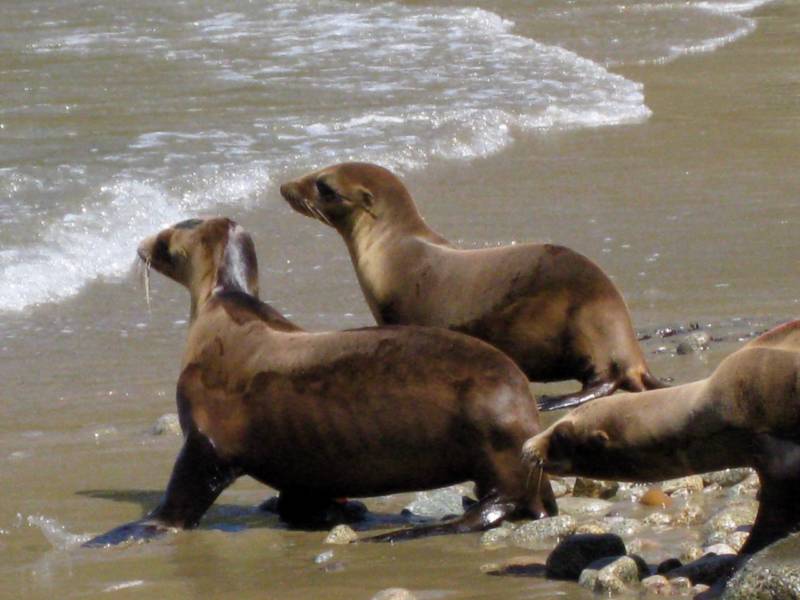
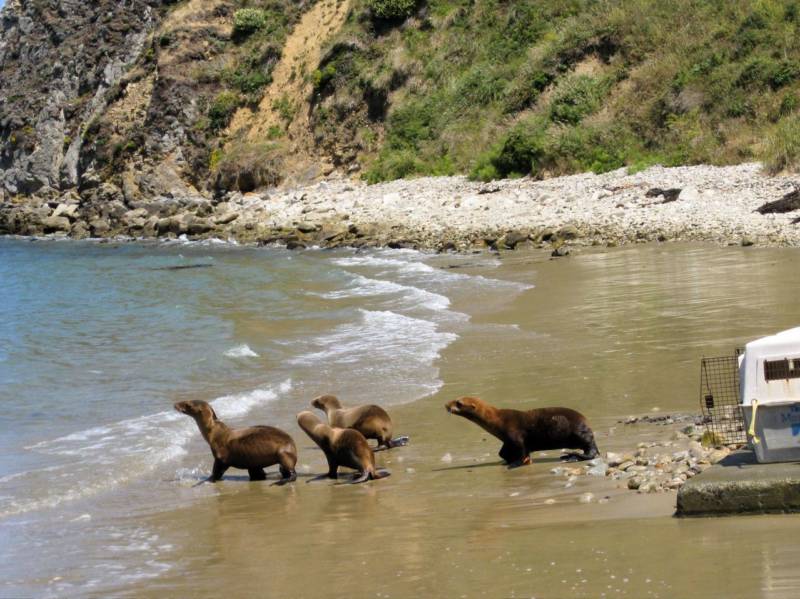
But then I noticed a white van marked “rescue” driving down to a dock near the Pt. Reyes lighthouse, and decided to follow it. Turns out, I stumbled upon an incredible scene: rescue workers releasing baby sea lions and elephant seal pups back into the waves.
Volunteers lugged what looked like over-sized pet carriers out of the van and slid them onto a cement boat dock. Then a trio of sea lion pups poked their heads out, sniffed the salt air, and flippered their way across the cement and into the water, playfully nuzzling each other.
They seemed exhilarated–but thin. These pups had been rescued near Monterey, revived in the Marine Mammal Center’s Sausalito hospital, and were now healthy enough to return to the ocean, though you could still see their rib cages poking through their fur.
The sea lions swam out quickly but the elephant seals were a little more sluggish. One pup kept swimming back toward the humans, begging for fish. Then a giant female came out of the waves, perhaps offering herself as an adoptive mom, nudging the baby into the water.
Jim Oswald of the Marine Mammal Center (MMC) says the staff is seeing an unprecedented spike in rescue calls. In just the first two weeks of June, nearly 1,300 people phoned in, worried about stranded sea lions and other mammals. Most of them are malnourished sea lions who can’t seem to find enough anchovies, herring, or sardines to snack on.
Researchers aren’t quite sure why–but haven’t ruled out some kind of climate connection. The MMC is reporting its findings to the National Oceanic and Atmospheric Administration (NOAA) to try and figure out the cause. Possible El Nino Conditions? Warming oceans sending schools of smaller fish northwards? No one quite knows at this point.
“If it’s a climate change variable, that’s going to affect the fish the animals feed on,” says NOAA Wildlife Biologist Joe Cordaro. “That could be a very long temporary shift in the bait fish distribution, or it could be long-term depending on how severely climate change affects the surface temperature of the ocean.”
But Cordaro says at this point, the sea lion strandings are “one big puzzle,” with climate change as just one possible factor. We could simply be witnessing a high-birth year for sea lions, with a lot more pups than usual, or early signs of a returning El Nino weather pattern. Meteorologists won’t know until the fall whether California actually meets the criteria for a strong El Nino year. If so, Cordaro predicts “things are going to get a lot worse for the sea lions this fall and next spring.”
Regardless of the cause, the MMC’s Oswald says it’s cause for concern.
“These young sea lion pups get to the point where they’re so weak, they end up on the land and they’re too weak to go back,” Oswald explains. “It’s easier for them to waddle along, hoping they’ll find another waterway where they can find some food. They’re using up all their reserves if they stay out in the ocean.”
Stranded sea lion pups have even turned up on Bay Area freeways. Last week, rescuers found one on the 880 freeway in Oakland.
“His name is Fruitvale,” reports Oswald, “for the district in Oakland he was rescued from. He seems to be doing okay. He’s still being tube fed. I’m told from veterinarians that he’s feisty, moving around, and nippy, which is a good sign.”
The Marine Mammal Center’s Sausalito headquarters lets visitors watch volunteers in action. There’s an interactive exhibit with a sea lion on a gurney, where you can see its x-rays and test results. You can watch volunteers prepare fish meal, or even witness a post-mortem in the necropsy room.
Sounds grim, but until sea lion pups start finding more fish to eat–and humans start to figure out what’s causing the food chain to collapse, the Marine Mammal Rescue Squad plans on a very busy summer. Sasha Khokha is chief of KQED’s Central Valley Bureau and a frequent contributor to Climate Watch.
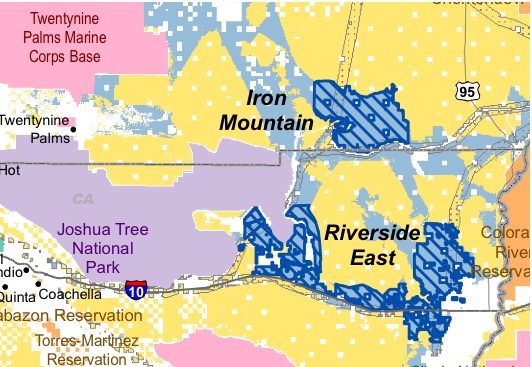
Somewhat overtaken by the other headlines of the week, dominated by celebrity obits and California’s financial meltdown, was the release by federal agencies of some new solar maps. They pinpoint federal lands in seven western states that present–in the government’s view–some of the best potential for building out utility-scale solar power production.
The four California locations (.pdf link) combine more than 350,000 acres in San Bernardino, Riverside and Imperial Counties. They supposedly represent the best combination of production potential, least conflict with other land uses and environmental concerns, and proximity to existing transmission lines or power plants. Areas were also mapped in neighboring Nevada and Arizona.
Update: Scott Streater has more on the controversy over planned renewable power sites, including California’s Iron Mountain site (see map, below), in a New York TimesGreenwire post.
All California locations are on BLM property in the state’s southeastern deserts. Image: DOE/BLM
The maps appeared just as California’s main regulator of power companies issued an update on solar projects in the state. The California Public Utilities Commission reported that the rate of new solar installations nearly doubled last year, from 2007 levels.
The CPUC tally shows California with over 500 MW of solar photovoltaic (PV) connected to the electric grid at almost 50,000 customer sites. The report notes that all those electrons combined are equivalent to one large power plant. About half of the current total went in under the California Solar Initiative, which has reached 13% of it’s 10-year goal, with another 8% in pending applications.
Also this week, more than $300 million fell from the federal money tree for a hydrogen power project in southern California. Cash from the American Recovery and Reinvestment Act (better known as the federal stimulus plan) will flow to the Hydrogen Energy California (HECA) project in Bakersfield. The project is designed to provide power for 150,000 homes in the area, by converting oil to hydrogen.
A statement from the California Recovery Task Force (CRTF), a conduit for federal stimulus funds, describes the HECA project as “an Integrated Gasification Combined Cycle power plant that will take petroleum coke, biomas, coal or blends of each, combined with non-potable water to convert them into hydrogen and carbon dioxide (CO2). The hydrogen gas will be used to fuel a net 250-megawatt power station.”
Perhaps more significant are the plans for the carbon dioxide generated in burning the oil. The CRTF statement says that “The CO2 will be transported by pipeline to nearby oil reservoirs and injected for permanent storage which will enhance U.S. energy security and enable additional production from existing California oilfields.”
CRTF says the project will “avoid” emissions of more than two million tons of greenhouse gases per year.
Today the federal Environmental Protection Agency formally granted the waiver that California has sought since 2002, allowing the state to set its own standards for greenhouse gas emissions from cars.
But wait–didn’t this already happen for practical purposes, last month? That’s when the Obama administration announced its intent to essentially put California’s proposed standards in place nationwide.
Well, yes–and no. Bernadette Del Chiaro, who represents the group Environment California, says that having the waiver is more than a legal technicality. She says it means that the state can get started sooner, cleaning up tailpipe emissions. Del Chiaro explains that: “California’s standards kick in now, through 2016. The federal program that President Obama has extended throughout the entire country, starts in 2013 (also through 2016).”
That gives the states, in effect, a three-year jump-start. In 2013, everybody should be on the same page.
California’s chief air regulator, Mary Nichols said, in a written statement:
“The waiver affirms California’s authority to set the standards for the cleanest cars in the nation and recognizes the ability of forward-thinking states to continue to adopt them. Now we can begin to work with the manufacturers to make a new generation of cars that deliver all the comfort and power we have come to expect but with improved efficiency and far fewer greenhouse gas emissions. ”
Thirteen other states had also pursued the waiver and can now proceed with their own programs.
While automakers have long argued that the tighter regs will make cars more expensive, Environment California calculates that they’ll “save consumers $36 billion at the pump by 2020.” That projection assumed that gasoline would would average about $2 per gallon over that period. Higher pump prices (which seem a lot more likely) would in turn, increase expected savings, as the underlying premise is that we’ll be driving cars that get better gas mileage.
But of course those cars will cost more than the clunkers we’re wheeling around in now. The state Air Resources Board estimates that the clean car regulations will tack an average of $1,000 onto the price of a new car by 2016. Obviously that would offset some of the pump savings.
The California Solar Initiative (CSI) provides rebates to cover about a fifth of the cost of installing solar systems.
Simplified Interconnection exempts solar customers from interconnection fees and the cost of the studies required to connect their equipment to the electricity grid.
Net Energy Metering allows solar power generators, who run the meter backwards as well as forwards, a credit on their power bills at “full retail electricity rates”–as opposed to the wholesale power price.
The policies were designed to encourage civilians to install solar for their own use; not necessarily to create an incentive for thousands of home power plants to serve the grid (depending on the size and location of your home, you may not be able to meet all your own electricity needs, let alone deliver surplus to the grid).
But if you can generate more solar power than you need, why not?
Adam Browning of the Vote Solar initiative, put it this way to the San Jose Mercury News: “Why are we talking about stamping on the brakes when we should be talking about pushing on the accelerator?”
Enter Assembly Bill 560. Net metering is currently capped at 2.5 % of the system’s peak energy demand or “load.” Once the stream of solar electrons coming onto the grid reaches that level, the utility is not obligated to sign more net-metering contracts. AB 560, courtesy of Assemblywoman Nancy Skinner (D-Oakland), would provide some more headroom for that program by raising the cap to 10%.
AB 560 has passed the Assembly. Tomorrow, it comes up before the state Senate Energy, Utilities, and Communications Committee. No doubt, a staff report due out the same day from the CPUC on the status of the California Solar Initiative will give the discussion some extra “juice.”
Meanwhile another bill, AB 920, from Assemblyman Jared Huffman (D-San Rafael), would change the way customers with solar installations are paid for surplus power. As I noted, they now get credited on their monthly bill at the full retail rate. Some of that credit is offset by “regular” power the solar customer uses at night or on cloudy days. Then, at the end of the year, leftover credits are zeroed out. AB 920 would require utilities to pay for credits left over at year-end, albeit at a lower rate–or allow the extra to be rolled over to the next year.
The state’s three investor owned utilities dislike both bills; especially Pacific Gas & Electric, which is closest to approaching that 2.5% cap. About 30,000 of PG&E’s 6 million customers have solar systems.
PG&E contends that expanding its home solar program would burden the rest of its customers, who bankroll the state rebates for solar installations. And because solar customers buy less electricity from the utility, PG&E argues they don’t contribute as much as others to cover the costs of transmission and generation.
PG&E has said it would support raising the net-metering cap to 3%–but wants to see a cost-benefit analysis from the CPUC before supporting any further home solar expansion. That report’s due out in January.
There are those outside the industry who share PG&E’s concerns. Framing it as a class issue, the non-profit Utility Reform Network opposes raising the cap unless changes are made to allow non-solar ratepayers to share in the benefits. Even with the current subsidies, going solar requires an often daunting up-front investment. As green becomes the color du jour for businesses and politicians, an increasing number of projects pair solar with low-income housing. But more often than not, your typical solar-powered household in California is likely to be well heeled.
As utilities enthusiastically pursue their own large scale solar projects, some solar advocates suspect that the companies are really worried that wide-scale residential solar would cut into their income. PG&E counters that state regulations eliminate the financial incentive for investor-owned utilities to simply sell more power to make more money.
All this raises a key question: Without lifting the cap on net metering, can California achieve its goal of 3,000 solar megawatts by 2016?
Rachael Myrow is host of The California Report, produced by KQED and heard on public radio stations throughout the state.
Editor’s Update: The CPUC’s latest report shows a near doubling in the rate of installed capacity, from 2007 to 2008, and so far, data would seem to indicate a continuing trend this year. Installed capacity to date puts the CSI at 13 percent of the total program goal, with another eight percent pending.
After a long day of debate, the U.S. House of Representatives approved the Waxman-Markey climate bill, by a narrow vote of 219-212. The bill now goes to the Senate.
President Obama reportedly changed the topic of his weekly address, in order to respond to the landmark bill’s passage.
Toward the end of the day-long floor debate, Ohio Republican John Boehner railed against a “manager’s amendment” that was “dropped at 3:09 a.m.,” as he reminded members numerous times. The 309-page amendment spelled out some of the regulatory architecture of the proposed law, and Boehner spent more than an hour going through it nearly page-by-page, detailing how the law would reach into local governments, private homes, homeowners’ associations and mortgage markets.
In urging her Democratic colleagues to vote in favor of the measure, House Speaker Nancy Pelosi promised that passage would mean “four things: jobs, jobs, jobs and jobs.” But Republicans repeatedly warned that the law would cost “2.5 million jobs” every year, for the next decade and highlighted conflicting estimates of the cost per household (Projections by the EPA and Congressional Budget Office put the number at between $140 and $175 per year, while House Republicans insisted that the real price would be many times that).
At times the House floor sounded more like the British Parliament in decorum. A Republican amendment known as the “New Manhattan Project” alternative to the bill was defeated 256-172. That proposal would have largely substituted the Waxman bill’s web of regulation with incentives for development of new energy sources.
One thing that both parties seemed to agree on was that the American Clean Energy and Security Act of 2009 is one of the most sweeping pieces of legislation ever to come before Congress. The Waxman bill ballooned to more than 1200 pages by the final vote.
Kristine Wong is a student at UC Berkeley’s Graduate School of Journalism. She is currently serving an internship at KQED Climate Watch.
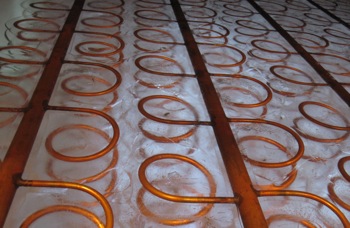
Copper meets ice in the Ice Bear rooftop cooler. Photo: Kristine Wong
Latest technology designed to improve grid performance, decrease peak energy demand
By Kristine Wong
When the hot weather hits town, everyone wants to cool off. Some down a cold drink, others take a dip in the pool. But most just turn on a switch–for the air conditioning or the fan. But when everybody jumps for the switch at the same time, the electrical grid is pushed to the max, which can lead to blackouts, as well as use of peak energy generators. Peak generators are used just a few times during the year but use more fossil fuels than other power plants.
Now, with the realization that climate change is upon us, along with advances in technology, there are new ways to stay cool while conserving energy and cutting carbon emissions at the same time. Several products showcased this week at the Edison Electric Institute conference in San Francisco seem to have the potential to do just that.
Take SmartMeter, for instance. The program from PG&E will monitor and control home energy use by satellite, and adjust energy consumption accordingly by supply and demand via a few palm-sized monitors. Right now, it’s still in demonstration mode. But PG&E will offer voluntary enrollment in 2010, and aims to outfit all households by 2012, according to Peter Chan, a PG&E supervisor in Demand Response Operations (“demand response” is industry-speak for systems that can adjust electrical use at the consumer end). Redistributing energy as needed avoids the need to bring peak generators online. Customers lower their energy bills and can also override the system if, say, that load of laundry really needs to go into the dryer now.
The Ice Bear aims to reduce the energy needed to cool low-rise buildings (under 3 stories), using rooftop energy storage that works in conjunction with the building’s air conditioning system. Developed by Windsor, CO-based Ice Energy, a rectangular unit about the size of a sub-compact car sits on the roof and stores energy at night. It releases the energy during peak daytime periods.
The company claims that using off-peak stored power during peak hours reduces carbon emissions by 40%. And the key technology is–well, ice. Major components include a block of ice threaded with a network of copper coils designed to keep the ice from melting, a condenser that makes the ice, and a controller that achieves the building’s thermostat level most efficiently in conjunction with the building’s air conditioning system. The unit uses R410, a refrigerant which the company says is more efficient than more commonly used refrigerants such as R-22. The system comes with a price tag topping $8000 but utilities are apparently bullish on Ice Bear and have bought thousands of units–13,000-15,000 units can conserve up to 50 megawatts, according to company spokeswoman Therese Wells.
The conference also featured previews of potential “game-changing” technologies. PG&E panelist and Director of Emerging Clean Technologies Hal La Flash told the audience about a solar “nantenna,” a flexible panel that may replace solar panels in the future. And Mike Howard, Senior Vice President of Research & Development at the Electric Power Research Institute, spoke of being 5-to-10 years away from the debut of LED lighting that has the potential to be even more energy efficient than compact fluorescent bulbs.
Suddenly, everywhere you look nowadays, prospects for clean, green energy are being muddied by NIMBY* syndrome.
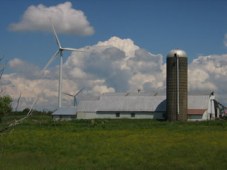
Wind farm: Windmills dwarf a dairy barn in upstate New York. Photo: Craig Miller
We saw it first-hand in Rob Schmitz’s series on “green gridlock” in California’s southeastern deserts. Trepidation there turns more on the transmission lines that would have to go up, to connect solar, wind and geothermal fields to population centers where the power is needed.
We’ve seen it at work in efforts to license wave power projects along the West Coast.
In Marin County, it took the McEvoy Ranch nine years from concept to completion, to get one 150-foot windmill up and running, to power the olive operation. Objections from the neighbors forced them to move the site more than a half-mile, and downsize the turbine to three quarters the proposed height and one third the power output (more about this in the next Quest/Climate Watch special, to premiere on August 25).
Now, as James Glanz reports in the New York Times, seismic fears are causing tremors in geothermal fields north of San Francisco.
Glanz writes that with venture funding from Kleiner Perkins Caufield & Byers and Google, Sausalito-based AltaRock Energy is deploying “enhanced” geothermal technology to wrest more steam from the earth. But fears over the potential for unleashing earthquakes in the process are not enhancing their prospects.


 Two developments this week would seem to validate concerns that things aren’t quite lining up for the vaunted new age of renewable energy.
 As California’s Barbara Boxer opened Senate hearings on the Waxman-Markey climate bill today, her committee was urged by Republicans not to “rush through this thing.” At this point there seems to be little danger of that.