Updated: Disaster Status Sought for Valley

Five days after filing it, Governor Arnold Schwarzenegger was still awaiting some response from the White House to his request for a federal disaster declaration, to address drought conditions in Fresno County.

Meanwhile, the Washington bureau of the McClatchy newspaper chain (which includes the Fresno Bee) reports that the request is something of a longshot.

The Governor made the request last Friday, one day after he faced a tense gathering in Fresno, where water issues upstaged even the precarious condition of state finances, and shortly after a meeting with farmers in Mendota.

The governor has had a standing statewide drought emergency in effect since February. Friday he signed an executive order freeing up state resources to help ease drought-related impacts. A federal declaration would allow affected businesses to apply for federal aid. President Obama has since signed several other disaster declarations last week, in response to storms in Missouri, wildfires in Oklahoma and other incidents.

Parsing the White House Climate Report

At least one researcher cited in the 196-page climate impacts report issued this week by the Obama administration is not impressed with the final product. Roger Pielke of the University of Colorado’s Center for Science & Technology Research has written a blog post critical of the report and in particular, the way in which his work was interpreted. If you’d rather not plow through the entire post, John Tierney has an overview of Pielke’s critique on his blog for the New York Times.

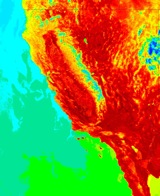
California heat wave, from the Aqua satellite. Image: NASA
2004 California heat wave, from the Aqua satellite. Image: NASA

The report was arguably the first to break down both observed and projected effects of climate change into coherent regional summaries. For the purposes of the report, California was considered part of the Southwest region, which included states as far east as Colorado and New Mexico.

Not surprisingly, many of the points raised in the Southwest section (beginning on p. 129) have to do with water supply. Most have been reported or discussed in our Climate Watch coverage, either here or in our radio reports. Selected “highlights” include:

– Past climate records based on changes in Colorado River flows indicate that drought is a frequent feature of the Southwest, with some of the longest documented “megadroughts” on Earth.

– The prospect of future droughts becoming more severe as a result of global warming is a significant concern, especially because the Southwest continues to lead the nation in population growth.

– Human-induced climate change appears to be well underway in the Southwest. Recent warming is among the most rapid in the nation, significantly more than the global average in some areas.

– Projections suggest continued strong warming, with much larger increases under higher emissions scenarios compared to lower emissions scenarios. Projected summertime temperature increases are greater than the annual average increases in some parts of the region, and are likely to be exacerbated locally by expanding urban
heat island effects.

– Water supplies in some areas of the Southwest are already becoming limited, and this trend toward scarcity is likely to be a harbinger of future water shortages. Groundwater pumping is lowering water tables, while rising temperatures reduce river flows in vital rivers including the Colorado.

– Projected temperature increases, combined with river-flow reductions, will increase the risk of water conflicts between sectors, states, and even nations.

– Increasing temperature, drought, wildfire, and invasive species will accelerate transformation of the landscape.

– Under higher emissions scenarios, high-elevation forests in California, for example, are projected to decline by 60 to 90 percent before the end of the century.

– In California, two-thirds of the more than 5,500 native plant species are projected to experience range reductions up to 80 percent before the end of this century under projected warming.

– Projected changes in the timing and amount of river flow, particularly in winter and spring, is estimated to more than double the risk of Delta flooding events by mid-century, and result in an eight-fold increase before the end of the century.

– A steady reduction in winter chilling could have serious economic impacts on fruit and nut production in the region. California’s losses due to future climate change are estimated between zero and 40 percent for wine and table grapes, almonds, oranges, walnuts, and avocados, varying significantly by location.

By the way, Pielke’s critique does not directly address anything in this list, though his work does involve weather-related disasters, which would include floods. Asked by a commentator on his blog if he thinks the entire report should be dismissed based on the flawed interpretation of his research, Pielke replied: “I wouldn’t think so and would certainly hope not. At the same time the section which covers my research does not give me a lot of confidence in the process that led to the report.”

No Shockers in White House Climate Report

The Obama Administration released a much-vaunted update on climate change today. In its nearly 200 pages, the report contains no new data and few new conclusions on the pace and impact of climate change across the U.S. Rather it affirms the core findings of recent research and sounds the alarm for rapid, definitive action to reduce carbon emissions and prepare for changes already on the way.

In a statement from Lawrence Berkeley National Lab, Evan Mills, one of the report’s 28 co-authors, calls it “the most thorough and up-to-date review ever assembled of climate-change impacts observed to date as well as those anticipated in the future across the United States.” Mills is one of two northern California scientists listed in the report’s credits, along with Ben Santer of Lawrence Livermore National Lab.

One clear signal from the report is that it’s time to move adaptation strategies to the front burner; preparing for climate effects already in the pipeline.

Louis Blumberg directs the California climate change team for The Nature Conservancy, and told me in a telephone interview this morning, “I would say it’s a very clear signal that even if we dramatically reduce emissions immediately, which we need to do as soon as possible, we’ve already put enough CO2 into the atmosphere where we’re going to have have significant changes to our way of life. And we need to begin now and plan to adapt to these unavoidable impacts and I think this report underscores that urgency.”

But neither Blumberg nor Mills have given up on the mitigation side. Mills says “the good news is that the harshest impacts of future climate change can be avoided if the nation takes deliberate action soon.”

Here is a summary of  “key findings,” taken directly from the report:

1. Global warming is unequivocal and primarily human-induced.

Global temperature has increased over the past 50 years. This observed increase is due primarily to human-induced emissions of heat-trapping gases.

2. Climate changes are underway in the United States and are projected to grow.

Climate-related changes are already observed in the United States and its coastal waters. These include increases in heavy downpours, rising temperature and sea level, rapidly retreating glaciers, thawing permafrost, lengthening growing seasons, lengthening ice-free seasons in the ocean and on lakes and rivers, earlier snowmelt, and alterations in river flows. These changes are projected to grow.

3. Widespread climate-related impacts are occurring now and are expected to increase.

Climate changes are already affecting water, energy, transportation, agriculture, ecosystems, and health. These impacts are different from region to region and will grow under projected climate change.

4. Climate change will stress water resources.

Water is an issue in every region, but the nature of the potential impacts varies. Drought, related to reduced precipitation, increased evaporation, and increased water loss from plants, is an important issue in many regions, especially in the West. Floods and water quality problems are likely to be amplified by climate change in most regions. Declines in mountain snowpack are important in the West and Alaska where snowpack provides vital natural water storage.

5. Crop and livestock production will be increasingly challenged.

Agriculture is considered one of the sectors most adaptable to changes in climate. However, increased heat, pests, water stress, diseases, and weather extremes will pose adaptation challenges for crop and livestock production.

6. Coastal areas are at increasing risk from sea-level rise and storm surge.

Sea-level rise and storm surge place many U.S. coastal areas at increasing risk of erosion and flooding, especially along the Atlantic and Gulf Coasts, Pacific Islands, and parts of Alaska. Energy and transportation infrastructure and other property in coastal areas are very likely to be adversely affected.

7. Threats to human health will increase.

Health impacts of climate change are related to heat stress, waterborne diseases, poor air quality, extreme weather events, and diseases transmitted by insects and rodents. Robust public health infrastructure can reduce the potential for negative impacts.

8. Climate change will interact with many social and environmental stresses.

Climate change will combine with pollution, population growth, overuse of resources, urbanization, and other social, economic, and environmental stresses to create larger impacts than from any of these factors alone.

9. Thresholds will be crossed, leading to large changes in climate and ecosystems.

There are a variety of thresholds in the climate system and ecosystems. These thresholds determine, for example, the presence of sea ice and permafrost, and the survival of species, from fish to insect pests, with implications for society. With further climate change, the crossing of additional thresholds is expected.

10. Future climate change and its impacts depend on choices made today.

The amount and rate of future climate change depend primarily on current and future human-caused emissions of heat-trapping gases and airborne particles. Responses involve reducing emissions to limit future warming, and adapting to the changes that are unavoidable.

On KQED Public Radio’s Forum for Wednesday, 6/17

9am Forum with Michael Krasny
White House Climate Report
We discuss the report, as well as federal climate change legislation from Congressmen Henry Waxman and Ed Markey. Guests include Dan Kammen, professor of energy at UC Berkeley and co-director of the Berkeley Institute of the Environment; and Katharine Hayhoe, professor of geophysics at Texas Tech University and a lead author of the climate study.

Speed Bumps on the “Hydrogen Highway”

Seems like the Governor is spending a lot of time looking at cars lately. If the rest of us spent as much time cruising Auto Row, the recession might already be fading in the rear-view mirror.

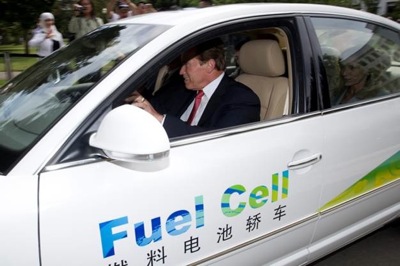
Governor Schwarzenegger tries out the Volkswagen Passat Lingyu. Photo: Governor's Office
Governor Schwarzenegger at the wheel of a Volkswagen Passat Lingyu. Photo: Governor's Office

But California’s chief executive isn’t interested in run-of-the-mill rolling stock (he will, of course, happily take credit for inventing the Hummer). He’s into exotics: the alternative-fuel cars of the future–and in some cases, present.

At least five times in the last three weeks, the Governor’s Office has created photo ops with alt-fuel autos, prototypes or refueling stations; from a fuel-cell Volkswagen (June 3) to the Mutt-&-Jeff of electrics, Hummer and Peapod (May 28 & June 10, respectively), he’s kicked the tires on a whole generation of not-widely-available wheels–not to mention the home ethanol refinery (June 4) or the hydrogen refueling station in Santa Monica (May 27).

All of which got us to wondering: “Dude, where’s our Hydrogen Highway?” You may recall the Governor’s promise five years ago, that California would by now be coming down the home stretch on a whole new infrastructure for the coming swarm of cars powered by hydrogen fuel cells.

Monday morning on KQED’s weekly Quest radio feature, David Gorn reports that we’ve apparently hit a few speed bumps:

“The technology clearly has promise, but it’s behind schedule. Schwarzenegger’s original plan called for 100 to 150 hydrogen fuel stations by next year, and so far there are only about two dozen. He also wanted 2,000 hydrogen-powered cars on the road, yet fewer than 200 are being road-tested today. The lack of progress has prompted California’s non-partisan state legislative analyst to recommend scrapping state funding for the hydrogen program. And on the federal level, Energy Secretary Steven Chu has asked Congress to cut about half of the national hydrogen-research budget. Chu said hydrogen technology is too far from fruition.”

None of these details stopped Governor  Schwarzenegger from hyping the 2009 Hydrogen Road Tour, a recently concluded San Diego-to-Vancouver rally, designed to highlight fuel-cell technology:

“We will keep pushing, and thanks to our public-private partnerships and the commitment of these automakers and energy companies, the era of pollution-free transportation is dawning.”

The Governor’s statement went on to say that “Auto manufacturers expect the number of hydrogen vehicles to increase to 4,300 by 2014 and more than 40,000 vehicles by 2017.” Of course, that was before Energy Secretary Steve Chu announced that R&D funding for hydrogen fuel cells on the road didn’t quite make the cut for the next DOE budget. Plug-in hydrid, anyone?

Transportation’s Tricky Carbon Footprint

Kristine Wong is our Climate Watch intern for the current term. She’s a student at UC Berkeley’s Graduate School of Journalism.

interchange_0145_blogStudy comparing environmental impact of transportation modes yields surprising results
By Kristine Wong

You may not believe that during peak commute hours, Boston’s light rail system generates more greenhouse gases (GHGs) per person than a gas-powered, fully occupied SUV–or a commercial airliner filled to capacity, traveling the same distance.

Yet this is what UC Berkeley researchers found in a study released this week. Mikhail Chester and Arpad Horvath compared the environmental impacts of cars, buses, planes, and rail after adding up all the energy costs and emissions (both GHGs and local air pollutants) over their entire life cycle–not just by what came out of the tailpipe. The authors say no such comprehensive study had been done before.

The researchers developed a method that evaluated each transportation mode based on the energy inputs needed for production and maintenance of the vehicle itself. They also looked at the infrastructure for each mode, such as construction of supporting components like rail station platforms and airport runways, bus and rail station lighting and parking, and the source of  power for each mode (e.g. gasoline, jet fuel, diesel or electric–and the costs of distributing and producing these inputs).

In total, Chester and Horvath compared 79 components across all transportation modes. Within each they also selected a few variations to represent differences, depending on factors such as vehicle make and mileage, passenger occupancy, and size.

The results were both logical and surprising. Most of the energy consumed and GHG emissions from auto, bus and air travel originated from the operational period, not from the materials needed to produce and maintain the vehicles. Rail produced the greatest amount of GHGs compared to all other modes over their life cycle. But Chester and Horvath point out that there is a big difference in GHG emissions from light rail systems in the Bay Area versus, say, Boston due to the portion of fossil fuel-based electricity used. Boston’s fuel mix is 82% fossil, while the Bay Area’s BART system clocks in at just 49% fossil fuel–a major factor in efficiency and GHG emission rates.

Finally, passenger occupancy was a key factor influencing efficiency. Not surprisingly, each mode was most efficient when used to capacity. But the researchers caution that boosting passenger occupancy is not a magic bullet. They say minimizing fossil fuel inputs and adding pollution filters and controls would have a greater effect on efficiency.

Chester and Horvath say that they hope their results will provide a framework for more comprehensive analysis of the environmental impacts of transportation, and to assess the impact of hybrid or electric vehicles and alternative energy sources such as biofuels, solar power, and wind power, none of which were included in the study.

There are more details of the study posted at the websites for Green Car Congress and Sustainable Transportation.

Head-to-Head: Chevron and The Sierra Club

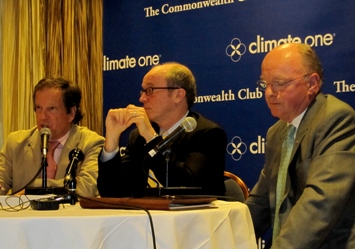
Two giants of California’s energy debate squared off at a Commonwealth Club forum in San Francisco last night.

Chevron CEO Dave O’Reilly and Sierra Club Executive Director Carl Pope fielded questions from moderator Alan Murray of The Wall Street Journal and a sometimes impassioned audience, about renewable energy opportunities, reducing greenhouse gas emissions, and predictions for the future of the United States’ energy economy. Several questions also concerned Chevron’s high profile court battle in Ecuador and the oil company’s presence in Richmond, the Bay Area city where a major Chevron refinery dominates the skyline–and some say, local governance

Carl Pope, ED of Sierra Club Alan Murray, Executive Editor of WSJ Online Dave O'Reilly, CEO of Chevron. Photo: Gretchen Weber
From left to right: Sierra Club chief Carl Pope; WSJ Online Executive Editor Alan Murray; Dave O'Reilly, CEO of Chevron. Photo: Gretchen Weber

In what was less of a debate than a discussion, Pope and O’Reilly agreed that the United States needs to make major changes towards greater energy efficiency and that the country must begin to rely more on renewable energy sources.

Their views diverged significantly, however, on the timeline for such changes. While Pope supports a 90% reduction of greenhouse gas emissions from today’s levels by 2050 and says he believes this goal possible, O’Reilly projected that by 2050, the United States will have reduced its GHG emissions by no more than 20-25% from today’s levels.

O’Reilly said that even if the U.S. replaced the entire transportation system with a zero-emissions system, the country would reduce GHG emissions by just 34%–and that doing likewise with the nation’s power generation would reduce GHGs by another 40%.

“So we have to ask ourselves, can we replace our entire energy system–transportation and power–in just a few short decades?” said O’Reilly. “I think the transition is going to take some time.”

According to O’Reilly, his company is already the largest provider of geothermal energy in the world and yet only 2% of Chevron’s income currently comes from renewable energy.

“The challenge of scale demands that we acknowledge that conventional energy sources will remain indispensable for decades,” said O’Reilly. “We must be realistic. For the foreseeable future we need to develop it all: conventional as well as non-conventional energy, as well as renewables and alternatives.”

When asked what his prediction was for how much of Chevron’s income would come from renewable energy sources by 2050, O’Reilly said he thought the number would be about 10-15%.

Pope responded, “The world will have room in 2050 for a very small company, 90% of whose energy comes from fossils [fuels]. The world will not have room, or tolerance, in 2050 for a big energy company [that does], so if Chevron wants to be successful, I think Chevron’s going to need to change those numbers.

Pope also called on Chevron to “come to the table” with local communities in which Chevron operates, such as Richmond, CA, and he proposed that all oil companies donate 10% of their profits to a global fund to clean up areas of the world damaged by the petroleum industry.

Not surprisingly, Pope and O’Reilly agreed that the highest priority for reducing GHG emissions is to replace coal with natural gas or another less carbon-intensive energy source, and while on stage, the men shook hands on an agreement to lobby the issue together in Washington.

KQED will broadcast the entire Commonwealth Club event at 8 p.m. on Friday, June 19, with a rebroadcast at 2 a.m. the following morning.

New Report Finds More Clean Energy Would Grow CA Economy

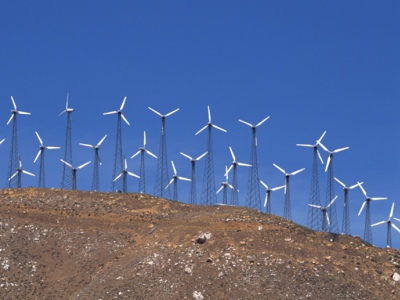
wind-powersmThe think tank known as Next 10 is the Voice of Eternal Optimism, when it comes to the economic potential of decarbonization. Its latest report poses the question: “Can California afford clean energy now?” You can probably guess the answer.

The study [PDF], which was funded by Next 10 and authored by UC Berkeley professor David Roland-Holst and a team of researchers from the Department of Agricultural and Resource Economics, concludes that California will face greater economic uncertainty if the state continues on a “business-as-usual” path in terms of energy. A greater investment in clean energy, the report finds, will spur sustained economic growth.

The study analyzes five new energy scenarios including  three different degrees of Renewable Portfolio Standards (RPS): 20 percent, 33 percent, and 50 percent as well as a 50 percent RPS plus energy efficiency increases of 1.0 and 1.5 percent per year.

According to the Executive Summary [PDF], the study’s most ambitious scenario, 50 percent renewable fuels and a 1.5 percent efficiency increase, could generate 420,000 additional jobs with more than $100 billion in cumulative payrolls over 40 years (2008-2050).   Without the energy efficiency  increases, however, the numbers are much lower. The report finds that a 50 percent RPS alone would create about 60,000 new jobs, whereas 33 percent would create just half that number.

California’s current RPS is intended to increase from 12 to 20 percent by 2010.  Last November, Governor Schwarzenegger set a target for California to have 33 percent of its electricity provided by renewable resources by 2020.

Ag and Water: Making Do with Less

This story was produced in collaboration with NPR, with help from producer Cindy Carpien. Sasha’s radio story aired on The California Report on June 8, and will also air later this month as part of NPR’s series on water and the West.

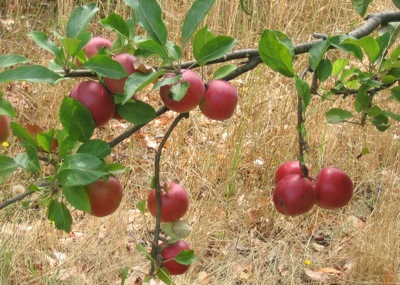
Juicy apples spring from the apparently dry landscape of Sonoma County. Photo: Cindy Carpien
Juicy apples spring from the apparently dry landscape of Sonoma County. Photo: Dan Lehrer, Flatland Flower Farm

Does climate change spell doomsday for California agriculture?

That’s what Nobel-prize winning physicist Steven Chu told the Los Angeles Times in an interview, soon after President Obama appointed him Secretary of Energy.

“I don’t think the American public has gripped in its gut what could happen,” he told the Times in February. “We’re looking at a scenario where there’s no more agriculture in California.”

For another perspective, I called UC Davis ag economist Richard Howitt, who focuses on water and California agriculture, to ask him what he thought.

“That’s a highly inaccurate statement,” Howitt said. “Steven got carried away. Brilliant man, but he doesn’t know anything about California water.”

Howitt’s models show climate change will likely lead to a 25% reduction in the state’s water supply over the next 50 years. He says that will likely mean some rough times ahead for farmers, but certainly not the end of California’s role as an agricultural powerhouse.

In fact, Howitt says if California farmers can continue to grow more drought-tolerant crops and cut back on flood irrigation, they’re likely to thrive in the marketplace over the long term:

“As income increases, people eat more California fruit, nuts, and vegetables,” he says. “They don’t care about cotton; they don’t care about corn. We are on the right side of the agricultural business in terms of future growth.”

Of course, that means if you were to fly over the Central Valley in 50 years, you’d probably see fewer emerald-green islands of crops like rice, alfalfa, and cotton–and more fields of wheat and flexible crops like canning tomatoes, which can be planted seasonally and according to demand.

“This will, of course mean that we have less slack in the system than we do now,”  says Howitt.  “We’re going to have to be much better at applying water, look a little more like Israel and a little less like Northern California.”

Engineers who specialize in irrigation technology have long looked to drought-stricken countries for models. The folks who developed the Pure Sense software I discuss in my radio story have collaborated extensively with farmers in Australia.

Howitt also says no matter how efficiently farmers apply water, they have to figure out how to more efficiently move it around the state. Rather than just fighting over smelt, salmon, and pumping in the Sacramento-San Joaquin Delta, Howitt thinks farmers could be more efficient if we plumb water east to west (currently the two major water systems in California are primarily north-south oriented). Howitt says that would create incentives for farmers in relatively water-rich areas, like the east side of the San Joaquin Valley, to sell water to farms with good soil but less water–like the west side of the San Joaquin Valley, home to the some of the largest and wealthiest farms in the world.

Tricking plants into yielding more with less

Meanwhile, the idea of “dry farming,” like what the folks at Sonoma County’s Flatland Farm are doing with their apples, is getting popular in coastal areas. Dry-farmed tomatoes, like these from Santa Cruz, are increasingly popular at farmer’s markets.

Some researchers are taking this concept to places where it doesn’t rain so much. The idea is to control irrigation to stress the plants to the point where they think they’re starting to die, which triggers the plant’s genetic imperative to produce more fruit. David Goldhamer, who advises Central Valley farmers through the UC Cooperative extension, has demonstrated that farmers who cut back on watering of navel oranges and pistachios, may actually produce higher-quality fruit and generate more income.

A sprinkling of history

I also visited David Zoldoske, at the Center for Irrigation Technology at Fresno State. They have an amazing collection of historical sprinkler systems and a virtual irrigation museum online. Zoldoske has been studying irrigation and water efficiency for decades. Here’s what he told me about how agriculture is going to have to adapt to warming temperatures:

“I think the thing to remember here is there is no silver bullet. There is no reservoir or canal or any other technology or engineering feat that’s going to solve this problem. We’re going to have to use every tool in the toolbox. It’s going  to take multiple feats of engineering elegance so we can solve this problem. And it’s still possible that we’ll fail. And I don’t want to be saying that we will fail. We need to be very focused on this. It’s going to be a long journey. We won’t solve it over night.”

Learn more:

Ag and Climate Change

The entire April-June issue of the University of California’s quarterly journal, California Agriculture, is devoted to research on climate change and how it may fundamentally alter California’s environment and landscape, agriculture and food quality.

Saving Every Drop:

The California Institute for Rural Studies has profiled some of the most efficient California farmers in their January report, California Water Stewards: Innovative On-Farm management Practices (.pdf link).

The institute is also tied into the California Agricultural Water Stewardship Initiative (CAWSI), which has just launched a new website that features farmers using less water.

River Diaries, Part 4: Homecoming

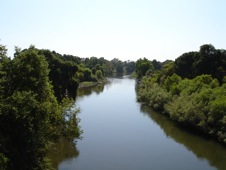
Tuolumne River, near Modesto. Photo: National Weather Service

The Tuolumne River Trust’s Paddle to the Sea project concludes today on the San Francisco waterfront. This is another journal entry from Emilio Martinez, one of two paddlers who traveled the entire route, from Yosemite to the Golden Gate.

Emilio Martinez: Return to the Valley

The surprise for the day was that my old stomps look completely different from the vantage point of a kayak on the River’s surface. Some visuals betokened our peculiar Central Valley “look:” the sudden appearance of palm trees behind the oaks and willows; the five bright yellow shopping carts submerged or waiting on the banks for their shiftless owners; and the three homeless sleeping bag spots.

All told, for the first time in my life, the exposed flanks of the Tuolumne were a genuine joy to behold.

A few more things of note, some nice, some just off-putting: the clarity of the water disappeared as we progressed from Fox Grove (Hughson) toward Modesto, going from a fairly deep green of decent transparency to the opaque silt-colored, pale oil-green that we Modestans are quite used to. Not only that, the counter breezes and slowing current acted like a turgid brake on our once swift progression on the water; and of course the air became redolent with–something–either fermenting processed vegetable matter (from where?) or the fertilizer smells wafting over the River from the nearby farm fields. I don’t know.

Besides, the obvious enjoyment of seeing your familiar haunts appear new, fresh, and full of the variety and appeal that Nature’s fecund imagination can contrive, was just sublime. And the River yielded some surreal grace notes, too, specifically in the form of an exquisitely colored horse, sporting every imaginable shade of black and white, lounging serenely underneath the Mitchell Bridge, a place I usually associate with graffiti, industrial consumer detritus, and shiftless “recreational” types: this image shall always remain in my conscious as almost mystical, an ancient ancestral avatar.

Modesto

If the Tuolumne may be considered an emerald queen in its Sierra manifestations, imprisoned and ghostly nobility during its Don Pedro phase, and a country beauty during its descent from La Grange to Waterford, then perhaps the best description of Her Majesty in Her Legion Park – to – Big Bend garb is that of Cinderella. What I mean is that after the Tuolumne’s creep through the homeless camps, fishing holes, arson-burned river banks, defunct Dennet Dam, past sunken fishing boats (five at least), felled floodplain almond trees, topped with a good dousing of cow muffin-perfumed swamp gases, even a queen emerges covered in the cinders and muck of real life as we know it in these troubled regions.

Nonetheless, the “Paddling to the Sea” company was fine and filled with story, song, and revelation; their faces fair and wise; their hearts still courageous enough to brave possible death by choosing life; and their eyes and ears eager to identify the symphony of wildlife that still calls the Tuolumne its home (today’s additions: dogs, crows, palm trees).

Our crew of Tuolumne River Trust personnel and their Grateful Rowers have been at it at least five-days-straight on the River (not counting at least three months of advance preparation on the part of TRT) and we are battered and bruised but still strong and excited by the new face that the River presents every day with each new bend.

So, perhaps fittingly, we began today’s ten-mile row on the nascent topology of the future “Gateway Park” beneath the 7th St. “Lions’ Bridge,” a place where ornate four-foot-high crucifixes memorialized the tragic death of 14-year-old Jeremy Wilson, a drowning victim of the ancient, defunct, and evil Dennett Dam, and ended it at the current “Big Bend” renovation site, where thousands of newly planted trees no higher than year-old-babies dotted the landscape in their blue and red ribbons–all a product of the indefatigable efforts of the TRT’s committed humanity.

I leave you with one image that marks the end of today’s trip in memory: the pale blue gauze of the Coastal Ranges slowly emerging from the horizon to steadfastly gaze back at us from beyond Westley, the small migrant town of my childhood days, the place where the River first entered my consciousness as something to be feared and revered: to many a theologian these are the two faces of the sacred.

Amen.

I want to end on the positive note here. I want to give credit where credit (and kudos) must be given: every one of the human representatives involved in this venture have displayed nothing but stellar professionalism, humanity, and good cheer: from the Hispanic Leadership Youth Council teens to the TRT (Tuolumne River Trust) people–especially the latter, who’ve had the huge task of dealing with boats, people, hunger, and rallies. I cannot imagine an undertaking of this scope being carried out in a better manner by better people, under more challenging conditions, or for a greater cause.

The Return of El Nino?

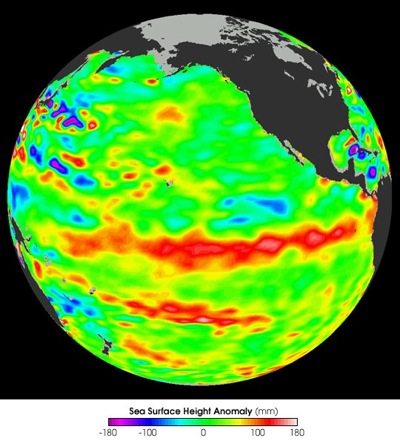
The federal Climate Prediction Center, operated by NOAA, reported this week that current conditions in the Pacific would seem to foreshadow a return to El Nino conditions, possibly within the next few weeks.

2006 El Nino conditions, as observed by the Jason satellite. Photo: NASA

The ocean conditions formally known as ENSO, or the El Nino/Southern Oscillation, arise when normal upwelling of deep, cold water abates, causing warmer surface temperatures (SST).

El Nino and its opposite, La Nina, have far-reaching implications on weather patterns. Here on the West Coast, it usually means wetter winters in southern California and drier ones in the Pacific Northwest.  Because northern and central California lie in between, things there can go either way.

El Nino can also have a significant impact on fisheries, as much of the food chain is interrupted when upwelling slows.

Here’s a good overview of El Nino “mechanics” from UC Berkeley.