National Panel Backs State Climate Efforts

A hefty stack of reports issued by a top national science board appears to affirm California’s response to the challenges of climate change.

The National Research Council, an arm of the National Academies of Science today released three reviews of the current climate science, each focusing on a different aspect of it. The first report, a 400-page assessment of the state of the science, affirms the prevailing view among scientists that global warming is proceeding apace, propelled largely by emissions of greenhouse gases, and that some of the early impacts are already upon us.

Stanford’s Pamela Matson, a specialist in biogeochemical ecology and lead author of the science assessment, said these conclusions are supported by “multiple lines of evidence” and have “stood firm” in the face of intense scientific scrutiny. Matson conceded, however, that much uncertainty remains in the science, and that the credible range of global warming projections runs from two, to eleven degrees, Fahrenheit, by the end of this century.

Two companion reports focused on mitigation and adaptation strategies, respectively (for a closer look at the latter, see Nicole Heller’s post at Climate Central).

Robert Fri, who led the NAS panel on “limiting the future magnitude of climate change,” said that federal policies should “enable flexibility and experimentation in policies at state & local level.” Fri cited California and Alaska as leaders in climate response policy at the state level. Mary Nichols, who chairs California’s Air Resources Board and effectively heads the implementation of the state’s climate strategy, also sits on the “Limiting Panel” of the NAS review. Nichols has been a vocal promoter of state and regional efforts, such as the Western Climate Initiative.

When queried about pending federal legislation that might nullify state programs to regulate carbon, Fri said that “the bar ought to be pretty high for federal preemption. States have already done a lot,” he said, and it’s important not to act in a way that reverses the progress.”

Likewise Fri’s colleague, Tom Wilbanks, head of the study’s adaptation panel, said that what’s needed is “not a federal response but a national response,” and that Washington’s role should be to “create a framework” of policies and resources that “reinforce each other rather than get in each others’ way.”

The recommendations come as California’s sweeping 2006 climate strategy, known widely as AB 32, is under attack from Republican gubernatorial candidates and a well-funded initiative campaign to suspend most regulations under the law. Likewise both the House and Senate bills pending in Washington would either preempt or temporarily freeze state programs to reduce carbon emissions.

Fri also provided the morning’s most eyebrow-raising moment when he said that current technology will not be up to the task of reducing warming.  “We can’t get there by just deploying what we know how to do,” he said, noting that brand new technologies will be required. “And we probably won’t be doing it at least cost,” he added.

The NAS reports released today do not recommend specific targets for GHG emissions. The three reports are the first in a series of five requested by Congress as part of the program called America’s Climate Choices.

A webcast of the one-hour public rollout of the reports is available at the NAS website.
What’s Soot Got to Do With It?

By Andrew Freedman, Climate Central

Most of the discussion regarding the highly anticipated Senate energy and climate change legislation, which Senators John Kerry (D-MA) and Joseph Lieberman (I-CT) introduced last week following months of negotiations, has focused on the bill’s provisions pertaining to offshore oil and gas drilling, incentives for renewable energy, and cap on carbon emissions for certain economic sectors.

Although the bill’s carbon dioxide (CO2) emissions reduction targets–an 80 percent emissions cut by 2050 compared to 2005 levels–would yield significant long-term climate benefits, the bill also addresses man-made climate change in the shorter term.

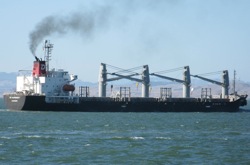
Stack emissions from a bulk freighter in San Francisco Bay. Photo: Craig Miller

A little-noticed portion of the bill concerns short-lived air pollutants such as black carbon (otherwise known as soot) and tropospheric ozone. These pollutants disrupt the climate on far shorter timescales than CO2, which scientists consider the most important greenhouse gas and the main villain in the climate change story.

Once emitted by the burning of fossil fuels, the use of solid-fuel cooking stoves or biomass burning, among other sources, black carbon only stays aloft for days to a few weeks before being washed out of the atmosphere by precipitation. This means that once black carbon emissions are reduced, there would be almost immediate climate benefits.

The Kerry-Lieberman bill would direct the US EPA to use its existing authority under the Clean Air Act to reduce black carbon emissions from diesel engines, using devices called diesel particulate filters which trap soot emissions before they escape from a vehicle’s tailpipe.

It would also call upon the EPA to publish a report on black carbon “sources, impacts, and reduction opportunities,” including an examination of how foreign assistance programs could help reduce emissions in other nations. In addition, the bill would establish an inter-agency process to facilitate “fast mitigation strategies” that focus on non-CO2 warming agents. This process would involve agencies such as the EPA and the Energy Department (DOE).

How big a climate player is black carbon?

Black carbon is thought to be a powerful warming agent in many regions, particularly snow and ice-covered areas such as the Himalayas and the Arctic. As its name suggests, black carbon particles are dark in color, and are therefore strong absorbers of incoming solar radiation. They warm the atmosphere and alter cloud characteristics, and when they land on brightly colored snow and ice, they darken the surface, causing a large uptick in the absorption of solar radiation, which hastens melting.

In the Arctic, black carbon contributes to a feedback loop that has helped cause a rapid melting of sea ice cover and drive temperatures upward at nearly twice the rate of the rest of the world. The decade from 1999-2008 was the warmest ten-year period in the Arctic of the past 2,000 years, according to a study published in the journal Science in 2009.

In addition to Arctic warming, black carbon has been shown to alter regional climate patterns such as the Indian monsoon, and human inhalation of soot particles is known to be a major health hazard worldwide.

In recent years numerous scientists, most prominently V. (Ram) Ramanathan of the Scripps Institution of Oceanography and James Hansen of NASA have called for significant cuts in short-lived air pollutants as a way to reduce climate change in the near term, while efforts continue to address CO2 emissions in the long run. Ramanathan’s studies have shown that black carbon may be the second largest contributor to global climate change.

In March testimony before the House Select Committee for Energy Independence and Global Warming, Ramanathan stated that the current global warming effect of black carbon “may be as much as 60 percent” of the CO2 warming effect. He noted, however, that there are significant uncertainties about black carbon’s role in the climate system.

Ramanathan told House lawmakers that reducing black carbon emissions “may provide a possible mechanism for buying time to develop and implement effective steps for reducing CO2 emissions.”

Bill is aligned with recent scientific advice

The Kerry-Lieberman bill’s inclusion of rapid mitigation strategies is consistent with advice contained in a new paper from an interdisciplinary panel of scholars, published on May 11 by the University of Oxford in the UK. The paper argues that non-CO2 drivers of climate change have been overlooked “for reasons of convenience in framing policy” rather than due to scientific concerns, and it presents a vision for an overhaul of climate policy that would include a much more prominent role for addressing emissions of short-lived air pollutants.

“Since action on these non-CO2 ‘forcers’ may have quicker impact and large, immediate primary benefits, we would give them priority, now. In contrast to long and arduous tasks, these can be ‘quick hits’,” the report states.

The bill’s provisions are also consistent with the findings of a scientific panel that examined options to address rapid Arctic climate change. In a 2008 report, the panel strongly endorsed pursuing emissions reductions of black carbon and other short-lived air pollutants. “…Curbing short-lived climate forcing agents, through rapid international action and Arctic nation leadership, may prove to be the best and perhaps only viable strategy for slowing Arctic warming in the time frame of years to a decade,” the report stated.

Considering that the Kerry-Lieberman bill itself faces a highly uncertain future, with significant resistance in both political parties, it may yet take even longer to address what many experts consider to be a ripe, low hanging fruit of the climate challenge. This does not bode well, given the much more difficult work that lies ahead to reduce CO2 and other longer-lasting greenhouse gases.

In April, Molly Samuel reported on the effects of black carbon and snow albedo on the California’s water forecasting efforts.

Rising Temps Taking a Toll on Lizards

The mesquite lizard is a member of the Sceloporus genus. Sinervo’s study included 48 species of Sceloporus.

A new study published this week in the journal Science finds that local lizard populations around the world are going extinct, likely due to climate change.  According to the research, conducted by a team of scientists including Barry Sinervo, a herpetologist at UC Santa Cruz, four percent of the world’s lizard populations have disappeared in the last 35 years, and another 20% of all lizard species could go extinct by 2080 if global temperatures continue to rise.

Using field observation and experiments, and computer modeling, Sinervo and his team determined that increased daytime temperatures in some areas have shortened the amount of time each day during which lizards can forage for food. The data–and that of collaborating scientists on five continents–indicates that higher temperatures and reduced feeding time correlates with the pattern of local extinctions among lizard species across the globe (the Science website has a slideshow explaining how the research was conducted).

Sinervo described his research today on the NPR program Science Friday as part of a panel discussing modern extinctions.  He was joined by UC Berkeley integrative biology professor Tony Barnosky and San Francisco State Biology professor Vance Vredenberg.  Christopher Joyce reported on the study’s findings yesterday on NPR’s All Things Considered.

Polls Underestimate Climate Change Concerns, Study Finds

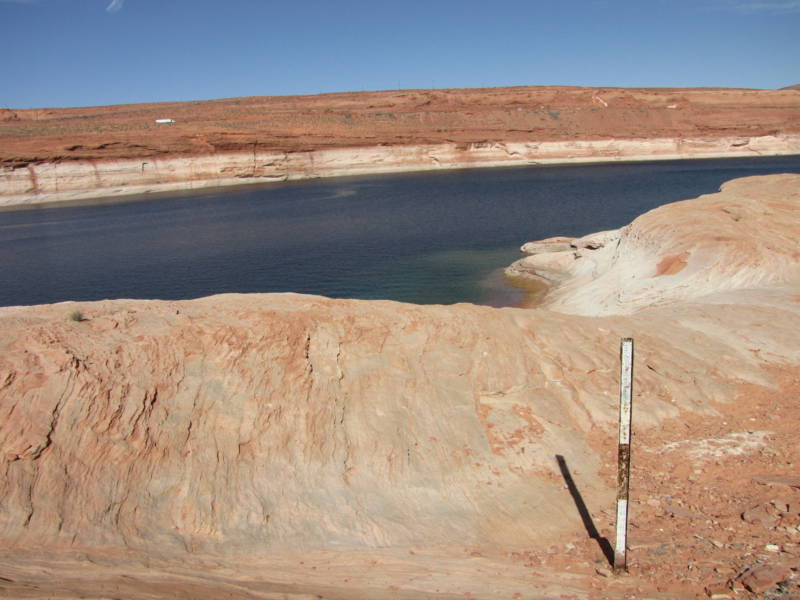
A historic water marker left high and dry at Lake Powell in April 2010. (Photo: Gretchen Weber)

If you’ve been paying attention at all over the last year, you’ve no doubt heard that Americans don’t care very much about climate change.  Pew polls, Yale polls, Gallup polls–all have found in the past year that climate change and the environment rank pretty much dead last when it comes to issues people care about in the United States.  But new research out of Stanford suggests that the truth might actually be a bit more complicated, and that Americans might be a lot more concerned about climate change than these polls indicate.

As it turns out, it’s all in the asking.

Jon Krosnick, a Senior Fellow at Stanford’s Woods Institute for the Environment, recently found that the standard “Most Important Problem” question, which has been a staple of polls and surveys for generations, might not capture the true nature of public sentiment toward environmental issues.

Krosnick has been studying the public’s perception of climate change since the 1990s. He said that during that time his findings have continually indicated that “huge majorities” agreed that the planet is heating up and that the government should take action, but that global warming was repeatedly left off the list when people were asked what was the country’s most important problem.

It was a Stanford undergraduate, Samuel Larson, who suggested that perhaps how the question was being asked was influencing the answers, said Krosnick.  Maybe, Larson postulated, if the question were opened up to consider the world, rather than just the United States, and if it asked about the future, rather than today, people’s answers might reflect something different.

In fact, their answers changed dramatically, researchers found.  In the May 2010 study, the team analyzed the results of two polls from the fall of 2009 that addressed the issue in two distinct ways.   When asked, “What do you think is the most important issue facing the world today?” about half (49%) of respondents in the first poll answered “the economy” or “unemployment,” while only one percent mentioned global warming or the environment.  In the second poll, the responses were 54% economy and two percent environment.

But when the question was re-framed as “What do you think is the most serious problem facing the world in the future if nothing is done to stop it?” the results swung dramatically.  In the first poll, 25% said the environment or global warming, and 10% said the economy.  In the second poll the results were 21% and 16%, respectively.

For specific data on Californians and their views on environmental issues and climate policy, see last summer’s PPIC report: Californians and the Environment.

Geoengineering Field Tests on the Horizon?

Bill Gates may investing in geoengineering projects, but a widely-quoted news story reporting that he contributed $300,000 to a San Francisco company to launch climate-intervention field tests is full of inaccuracies, according to one scientist involved.  The article, which appeared Monday on the Times Online website, asserts that Gates gave the company, Silver Lining Project, the funds to develop machines to spray seawater up to 1,000 meters into the sky in efforts to whiten clouds and increase their reflectivity, thus blocking the sun and ultimately slowing the rate of atmospheric warming.  The article then describes a planned field trial, which would involve 10 ships and 10,000 square km of ocean, leading some readers to assume that Gates is funding the largest-scale geoengineering field test to date.

According to Ken Caldeira of the Carnegie Institute of Global Ecology at Stanford, Silver Lining has received no funds from Gates personally.  Instead, he said, the $300,000 was allotted by Caldeira and David Keith, who have been directing geoengineering project funding for Gates.  Caldeira explained in an email that the scientists dispensed funds not to Silver Lining for field tests, but to engineer Armand Neukermans and his team, “to test the feasibility of fine seawater sprays in the laboratory.”

“There was no funding given for the planning, preparation, or execution of any field tests,” Caldeira wrote.   “I have expressly said that private efforts to conduct field tests should await the development of appropriate governance structures. I am opposed to private entities conducting field tests without appropriate governance and would oppose funding such activities.”

It’s possible, as critics assert, that the technology developed by Neukermans could eventually be used in Silver Lining Project field tests. However, the $300,000 from Caldeira and Keith would most likely be a drop in that bucket.  The Vancouver Sun reports that a scientist collaborating with Silver Lining, Robert Wood, said that it will likely take $25 to $30 million to fund the proposed field experiments.

The Times Online article touched on a particularly hot issue with the statement, “The British and American scientists involved do not intend to wait for international rules on technology that deliberately alters the climate.”

In March, scientists and policymakers gathered in Monterey for a week to discuss this very issue.  The general sentiment at the close of the talks was that more research is needed, as well as more input from governing bodies and the public, before potentially damaging field experiments are undertaken.

“This is a first step down a dangerous road,” said Rutgers scientist Alan Robock about the reported Silver Lining Project field test plans.  “Because, where do you stop?  There is no governance or agreed-upon restrictions determining what’s safe.”

Another Whack at a Federal Climate Bill

87767226The latest version of a federal climate bill sets a series of national targets for greenhouse gas emissions and would halt California’s plans for state and regional carbon trading.


Unveiled by Senators John Kerry and Joe Lieberman today, the American Power Act aims to push GHG emissions down to slightly below 2005 levels by 2013, then sets a longer-term reduction timetable of 83% (of 2005 levels) by 2020, 58% by 2030, 17% by 2050 (or to flip it around, an 83% reduction from 2005 levels by 2050), in line with the promise that President Obama made following the “Copenhagen Accord.”

The 987-page bill regulates seven greenhouse gases, with room for the Environmental Protection Agency to add others under the Clean Air Act. The cap-and-trade provisions focus on “7,500 factories and power plants,” which is to say those that put out more than 25,000 metric tons of carbon per year. That’s the same benchmark used by the federal EPA in its proposed regulations.

Like previous drafts, this one nullifies state and regional carbon regulation, setting up “one clear set of rules” for industry and providing “compensation for the revenues lost as a result of the termination of their cap-and-trade programs,” such as California’s AB 32, and regional efforts, such as the Western Climate Initiative. California’s Legislative Analyst has estimated that the state has committed about $120 million so far, to the implementation of its 2006 climate law. California regulators have already weighed in on the concept of “federal preemption,” warning against leaving the job of carbon reduction to the federal government alone. The Kerry-Lieberman bill requires “consultation” with states that currently have their own emissions plans.

Significantly, the first several sections of the Senate bill address development of energy sources. The reduction goals for greenhouse gas emissions aren’t even spelled out completely until page 265. Energy provisions that may come to bear on California policy include:

Agribusiness:

– All farms appear to be exempt from cap & trade but benefit from offset programs

Oil Industry:

– According to a summary of the bill from Kerry’s office: “Producers and importers of refined products” will get a fixed price for their carbon allowances.

– Offshore drilling is included as part of the energy strategy but states can prohibit leasing within 75 miles of the coast

Nuclear Power:

– Provides several incentives, including an “expedited procedure for issuing combined construction & operating licenses for qualified new nuclear reactors.”

– Increases loan guarantees to $54 billion

Missing from the bill is a comprehensive national strategy for storage of spent nuclear fuel, an unresolved issue that prevents California utilities from any expansion of nuclear power.

Governor Schwarzenegger issued a statement that barely acknowledged federal preemption, saying only that “California has been an unparalleled leader in clean energy, pioneering policies that have benefited the entire nation, and we must be able to continue our important, groundbreaking work that will both improve the environment and help our economy.”

Some environmentalists have already responded with raspberries. In a statement based on draft summaries of the bill, the group Friends of the Earth called it “dangerous,” claiming that the bill would “scrap crucial tools for solving the climate crisis” and provide “billions in giveaways to corporate polluters.” In a statement from the Environmental Defense Fund, on the other hand, its western regional vice president said that the bill’s announcement “marks real progress in the fight against climate change.”

Andrea Seabrook reported on the bill’s rollout and prospects for NPR’s All Things Considered.

Campus as Climate Microcosm

Felt Reservoir, Stanford University (photo: Gretchen Weber)

On a recent weekend, a couple of dozen hearty souls hiked more than 20 miles across the sprawling lands of Stanford University, to learn about global warming and see first-hand how the changing climate is affecting the campus.  It was the fourth annual “Walk the Farm” outing, a trek organized by the Bill Lane Center for the American West and led by its Executive Director, Jon Christensen.  Each year, the hike takes a different route through Stanford’s more than 8,000 acres, and is designed to use the university as a microcosm for a different global theme.  This year’s was climate change.

Throughout the 12-hour day, Stanford researchers joined the hikers to talk about the effects of climate change on the campus and region, as well as the related research taking place at the university.   Biology professor Carol Boggs spoke about her research on the Bay checkerspot butterfly, its extirpation in the region, and plans for a possible future reintroduction of the species on campus.  Other presenters included climate scientists Chris Field and Steven Schneider, and biologist Scott Loarie.

Watch this six-minute video for an overview of this year’s Walk the Farm hike and highlights from some of the talks along the way:

Hear more from Carol Boggs about the Bay checkerspot butterfly:

Scott Loarie explains how a rapidly changing climate is posing challenges for species migration in the video below:

California Scientists Join Climate Appeal

More than 50 California-based scientists are among those who signed a letter protesting “McCarthy-like” attacks on climate scientists in the United States.

The letter was published in this week's issue of the journal Science.

The letter, circulated as a kind of petition to selected members of the National Academy of Sciences (NAS), is both a defense of established climate science and a counter-offensive against an increasingly vocal community that rejects that science and some of the proposed policy responses. The letter asserts that the signatories are “deeply disturbed by the recent escalation of political assaults on scientists in general and on climate scientists in particular.”

Steering the core group of scientists behind the letter (full text and list of signatories available as a PDF download) was Peter Gleick, who heads the Pacific Institute in Oakland. Gleick, whose primary focus is on water policy issues, has been an outspoken defender of the prevailing climate science and has, on occasion, answered critics on this blog. Gleick declines credit as the sole author, saying it was written by a group of a half-dozen co-authors.

Other excerpts:

“Many recent assaults on climate science and, more disturbingly, on climate scientists by climate change deniers, are typically driven by special interests or dogma, not by an honest effort to provide an alternative theory that credibly satisfies the evidence.”

“The Intergovernmental Panel on Climate Change (IPCC) and other scientific assessments of climate change, which involve thousands of scientists producing massive and comprehensive reports, have, quite expectedly and normally, made some mistakes. When errors are pointed out, they are corrected. But there is nothing remotely identified in the recent events that changes the fundamental conclusions about climate change…”

The letter concludes by calling for “an end to McCarthy- like threats of criminal prosecution against our colleagues based on innuendo and guilt by association, the harassment of scientists by politicians seeking distractions to avoid taking action, and the outright lies being spread about them.”

A total of 255 scientists signed the letter, which was published this week in the journal Science (available by subscription only). High-profile signers include Paul Ehrlich and Stephen Schneider, both based at Stanford.

Perhaps just as interesting as who signed the letter is who did not. Missing are several luminaries in California climate science circles, such as Dan Cayan and Richard Somerville of the Scripps Institution, and Ben Santer at Lawrence Livermore National Lab. Santer has participated in media calls organized to defend findings of the IPCC. Santer has served as an IPCC lead author.

Gleick explained to me that the letter was circulated only to NAS members listed in climate-related disciplines. From a check of the proprietary NAS member database, it appears that Cayan and Santer are not members. Also missing from the signatories is Stanford’s Chris Field, who is engaged in preparing the next IPCC report. Field has been an NAS member since 2001.

According to Gleick, a few declined to sign as they were “involved in ongoing assessments” for NAS when the letter was circulated and wished to avoid any apparent conflicts of interest. Gleick admits that scientists walk a precarious line when they cross over from research into activism, but says sometimes it’s justified. “It’s important that scientists speak out when an issue is as important as climate is,” he said.

CA Power Plants Must Find New Cooling Methods

California’s electrical power generators will be scrambling for new ways to cool their turbines, now that state regulators have ordered a phase-out of  “once-through cooling.” The practice, which has been under study by regulators since at least 2005, requires sucking in billions of gallons of cold ocean or river water and then returning it at higher temperatures. Nineteen major power plants across the state, including California’s only two commercial nuclear plants, are currently using once-through cooling.

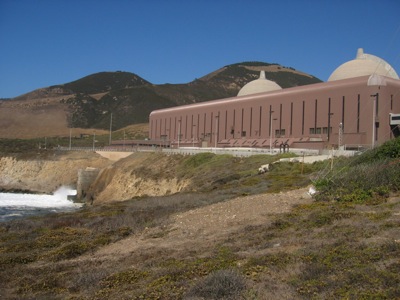
Sea water used for cooling at Diablo Canyon nuclear power plant. Photo: Craig Miller
Sea water spews from an outlet after being used for cooling at PG&E's Diablo Canyon nuclear power plant. Photo: Craig Miller

Prior to Tuesday’s vote by the Water Resources Control Board, the head of that body’s ocean unit testified that once-through cooling systems kill 2.6 million fish, 19 billion fish larvae and 57 seals, sea lions and sea turtles each year, Dow Jones reported.

According to the Board’s summary:

“The proposed policy establishes technology-based standards to implement federal Clean Water Act section 316(b) and reduce the harmful effects associated with cooling water intake structures on marine and estuarine life.”

The rules require that companies phase out the practice and install equipment that reduces impact on marine ecosystems within the next several years.  Some generators have warned that the high cost of complying with the regulations could force them to shut some plants down.

For more on the practice of “once through cooling” and its effects on marine life, listen to Amy Standen’s Quest radio report from Monday.

AB 32 Stopper Headed for Ballot

It looks like there will be a measure on November’s statewide ballot to block full implementation of California’s greenhouse gas regulations.

Groups supporting the measure they call the “California Jobs Initiative” claim they gathered more than 800,000 signatures, nearly twice what they needed to qualify the proposal as a statewide referendum.

The existing climate law, known widely as AB 32, allows for the Governor to declare an emergency suspension of up to one year. But John Kabateck, who heads the California branch of the National Federation of Independent Businesses, says small businesses in particular can’t wait to see what the next governor might do; that the measure is needed to “stop the madness.” Kabateck said it’s time to “just push the pause button and please stop loading small businesses with new costs, new mandates and new regulations at a time when we need to crawl out of the hole.”

Studies have reached varying conclusions about what effect the state’s current regulatory path for carbon emissions would have on the California economy. Opponents of the measure have already formed their own campaign, trying to keep momentum behind the three-year-old climate law known as AB-32.

Steve Maviglio, who works for the the pro-AB 32 Californians for Clean Energy and Jobs, formed to oppose the ballot initiative, says he doesn’t think all those signatures necessarily signify broad support. “I think what that represents is the travesty of the initiative system and how out-of-state oil companies can buy their way onto the ballot,” he told me, in a telephone interview. The push to get the measure on the ballot has been financed largely by Texas-based oil companies and a somewhat obscure organization called the Adam Smith Foundation, based in Missouri.

“It took them $2 million to round up these signatures” said Maviglio. “And if you look at every single poll, you can see that Californians know we can have both clean air and a strong economy, and that we’re not going to be fooled by Texas oil companies,” he added.

The proposed ballot measure would freeze AB-32 until the state’s unemployment level dropped to five-and-a-half percent—or lower–for one full year. That’s something that’s happened only three times since the mid-1970’s: once in the late 1980s (for about ten quarters), a similar stretch in the late ‘90s, and once in 2005-06. After the deep recession of the early ‘80s, it took the state’s unemployment rate about four-and-a-half years to move from its 11% peak back to the 5.5 percent threshold.

Governor Arnold Schwarzenegger today called the effort to halt AB-32 “the work of greedy oil companies.”