Positive Feedbacks in a Warming Arctic

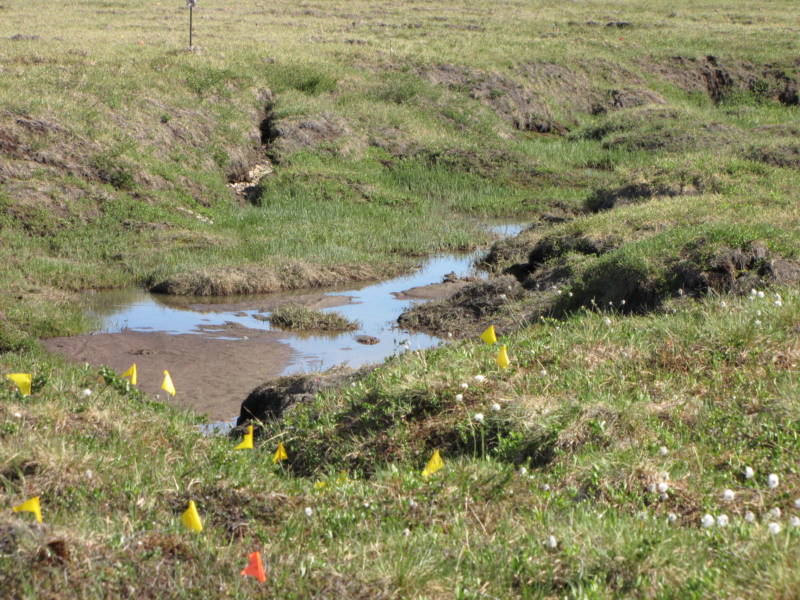
A thermokarst study site near Toolik Field Station (Photo: Gretchen Weber)

The Arctic is warming, almost twice as fast as the global average, according to a recent study.  Much of the accelerated warming here is due to positive feedbacks, including one related to the loss of summer sea ice in recent decades.  White surfaces, like snow and ice, reflect most of the sun’s energy and have a high albedo, while the unfrozen ocean absorbs it.  This creates a feedback loop: the warmer the temperatures, the less sea ice.  The less sea ice, the more heat absorbed, the higher the temperatures.  (As Molly Samuel reported recently, scientists are studying albedo as it relates to California’s snowpack and water supply.)

Another concern in a warming Arctic is thawing permafrost.  Earlier this week, I was out with my polar fellow colleagues measuring the depth of the permafrost here around Toolik Lake with a metal probe and a plastic ruler.  In some places we measured it to be just centimeters below a thin surface layer of plant-supporting soil called the “active layer.”

According to Breck Bowden, a scientist from the University of Vermont who studies permafrost here at Toolik, the latest modeling shows that approximately half of the permafrost in the Arctic will thaw in the next 50 years.  That’s significant not just for the Arctic ecosystems, but potentially for the entire planet.  Scientists estimate that there’s one to two times as much carbon frozen in the Arctic soils as there is currently circulating in the atmosphere, said Bowden.   The problem is that as the permafrost thaws, that carbon (mostly in the form of frozen organic matter), some of which has been frozen for thousands of years, will be processed by microbes in the soil and ultimately released into the atmosphere as greenhouse gases: CO2 and methane.

“So why should someone who is living in Alabama, or Nigeria, or the Phillippines worry about what’s going on the Arctic?” said Bowden. “Well, they should worry a lot if there’s going to be a massive amount of CO2 that gets into the atmosphere and your sea level rises or your crops fail because of changes that are related to CO2 changes globally. What happens here in the Arctic is going to affect everything on the globe.”

One indicator that the permafrost in the Arctic is already thawing is the increase in thermokarsts, which are places where the permafrost has thawed and the ground has collapsed, causing a disturbance in the landscape, and often releasing large amounts of sediment into nearby streams. Several scientists, including Bowden, study thermokarsts around Toolik Lake, and they’ve observed that the number of them is increasing.

A group of us were in the field with Bowden yesterday as he paid a visit to one of his research sites about 20 minutes up the Dalton Highway from Toolik Field Station, and a 30-minute hike across the uneven ground that defines the tundra landscape.
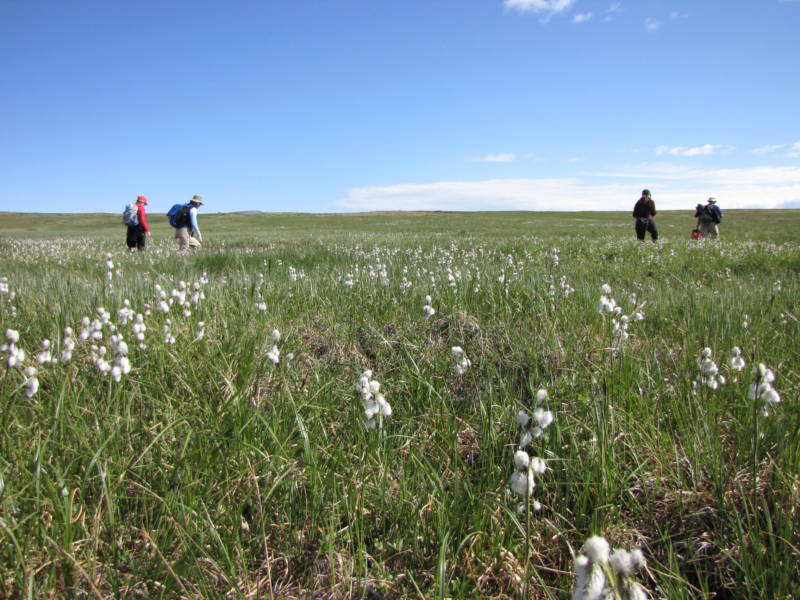
Picking our way through the tundra (Photo: Gretchen Weber)

“The Arctic explorers uniformly and universally cursed walking on the tundra, and you can see why,” Bowden explained as we hiked.  “You step on it, you break your ankle. You step between it, you break your ankle.  It’s very lumpy.”

The thermokarst we hiked to was not particularly catastrophic-looking to my untrained eye.  It’s a gully that’s about 300 meters long, 20 meters wide, and about five meters deep.  The collapse happened in 2003, and in the subsequent years it has widened, and vegetation has grown back along its sides, giving them a gentle, convex shape.  Someone like me might have hiked down one side of this thermokarst and up the other without giving it much thought.

Bowden was careful to point out that thermokarsts are a natural phenomenon.  (They also have been known to occur when roads and houses are built in the Arctic without proper insulation.)  But he also believes that the increase in thermokarsts observed in remote areas around Toolik is not natural.

“Thermokarsts have been going on as long as there’s been an arctic landscape, and there have been more of them when it’s warmer and fewer of them when it’s colder,” he said.  “But I do firmly believe that there are more of them now than there were 20 years ago, as a consequence of warming we can document in a variety of places.  The question is, why is the warming occurring?”
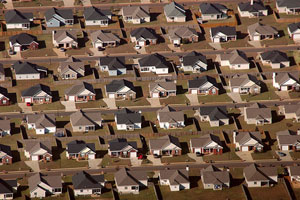
Linking Sprawl and Climate Change

Credit: Mark Strozier

Transportation is the top source of greenhouse gas emissions in California. So in a state where car culture rules, what will it take to get us out of our cars?

That’s the goal behind SB 375, a bill passed in 2008 that links greenhouse gases to urban sprawl. Under this first-in-the-nation policy, the state’s 18 regional planning organizations must reduce the emissions coming from vehicles through land use and transportation planning. This week, the Air Resources Board is expected to release the draft emission reduction targets that the agencies must meet by 2020 and 2035.

While the chances of getting Californians out of their cars completely are slim, the idea is to reduce the number of miles traveled through more public transit, more “walkable” communities and denser development. (Learn more about that in this Quest story about transit villages).

According to a report released today, that development approach can have some dramatic benefits, considering how California is expected to grow. By 2050, some projections put the population at 60 million, adding seven million new households.

The planning firm Calthorpe Associates looked at those housing needs and ran a number of growth scenarios, in a study funded by the California Strategic Growth Council and California High Speed Rail Authority. They compared a business-as-usual approach of low-density suburbs (30% urban and compact growth) to a “growing smart” scenario with more urban in-fill and transit-oriented development (90% urban and compact growth). While that last scenario may sound like the land of endless condos, according to Peter Calthorpe, it would still be 53% single family homes. Calthorpe calls it “a shift back to what California used to build–bungalows.”

Here are some of the benefits they found for the scenario by 2050:

  • Reduces the number of vehicle miles traveled  by nearly 3.7 trillion
  • Saves more than $194 billion in capital infrastructure costs
  • Saves 19 million acre-feet of water
  • Prevents the release of 70 million metric tons of carbon dioxide equivalent, or 25% less than business-as-usual
  • Saves California households $6,400 per year in auto-related costs and utility bills.

In-fill development can often cost more than low-density development and this report doesn’t take housing prices into account. Indeed, costs may be one of the biggest challenges for SB 375, since both the state and cities are facing budget crises  and a lull in the housing market.

Under the bill, state transportation funding will be prioritized for projects that meet the SB 375 goals. But according to Hasan Ikhrata, Executive Director of the Southern California Association of Governments (one of the regional organizations doing the planning), financial incentives will be key to reaching the goals. “I think the biggest challenge is to find incentives to help cities, because cities want to do this, but they don’t have the resources to do it without help,” he said.

A Sauna…for Science

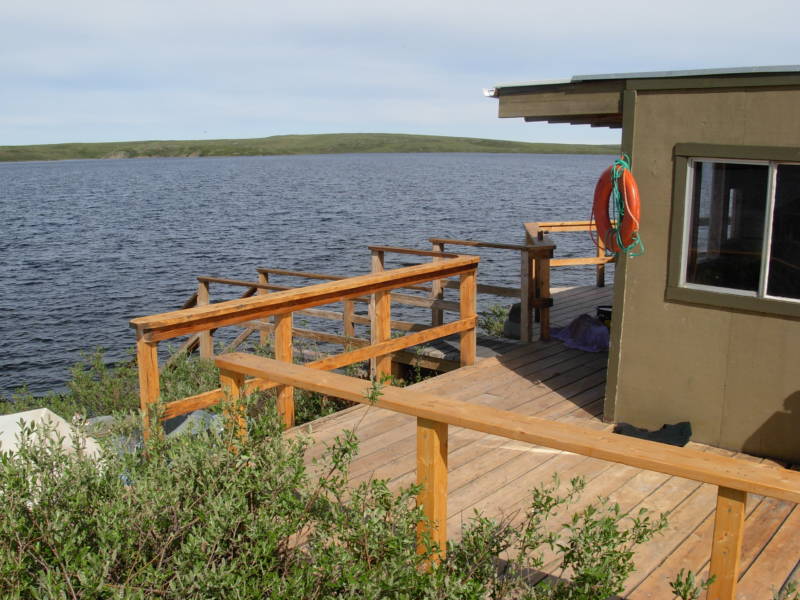
The sauna at Toolik Field Station

Last night I celebrated my first summer solstice in the Arctic by participating in one of the most beloved activities here at Toolik Field Station.  I took a sauna. Then I jumped in the lake, which still had ice on it one week ago, according to the Toolik Naturalist’s Journal.  The sauna at Toolik is spoken about in almost reverential tones, and with good reason.  It’s a small wooden cabin a few dozen yards from the main camp, perched at the water’s edge, and there’s a window that lets you soak up the stunning expanse of lake, tundra, and mountains, while you warm your bones after a plunge in the frigid waters.  “Sauna Nirvana” was how one of the scientists described the experience.

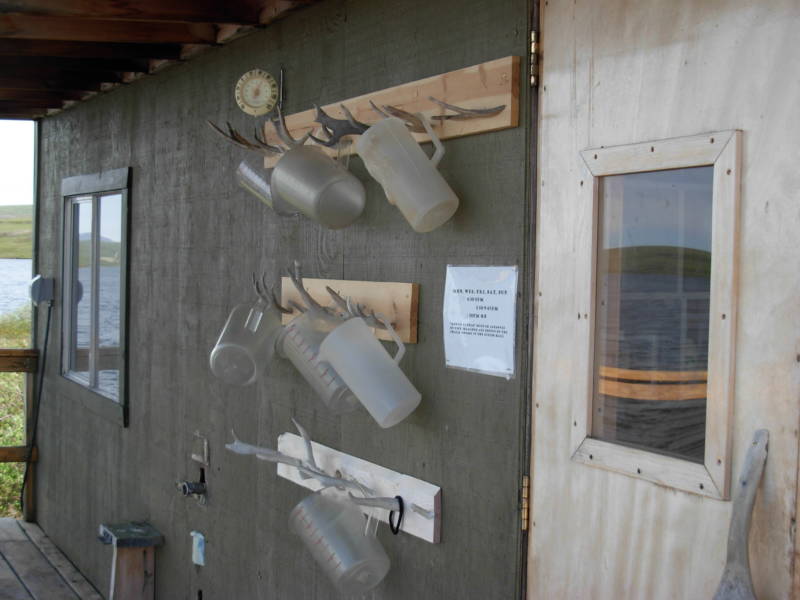
But people don’t just love the sauna for the view and the warmth.  They also love it because here at Toolik, it’s the main way to get clean.  The process entails warming up in the sauna, running outside and dumping lake water over yourself, soaping up with some biodegradeable cleanser, dumping more lake water over yourself, and then running back into the sauna so you don’t freeze to death.  Or, if you are hard-core, you can skip the water-dumping part and just jump in the lake.

Pitchers for bathing, on hooks outside the sauna (photo: Gretchen Weber)

The station didn’t have any showers at all until 2001 (researchers have been coming here since 1975), and even now, residents are limited to two two-minute showers per week.  Water conservation here is taken very seriously, not because there isn’t enough supply, but because all of the waste water from the showers, kitchen, and outhouses, has to be trucked 140 miles north to Prudhoe Bay for disposal at a cost of $1.24 per gallon.  Because this is such an active research site, scientists aren’t too keen on the idea of a leach field right next to the spots where they are sampling nitrogen and phosphorus.  So, in the name of science, we sauna.

Last summer, 85,680 gallons of waste water were trucked out of Toolik, which translates to 9.77 gallons of water per day, per person, according to Michael Abels, the Toolik Operations Supervisor.   Compare that with the 99 gallons per day that San Franciscans use, per capita, or the 287 gallons in Sacramento.  True, the conditions here are pretty extreme, but it’s an interesting experiment to see what it’s like to get along on 10 gallons of water each day. Of course, no one here is watering any lawns or trying to keep a swimming pool full.  And since we’re only allowed one load of laundry every two weeks, maybe everyone smells a little differently than they do in the rest of the US–but I think most people here would agree that living on 10 gallons of water a day isn’t half bad.

Clock Ticking for Solar Developers

The “33 x 20” series continues Monday on Quest Radio, with the first of two parts on the proposed Solargen project in San Benito County. The reports will be repeated on The California Report weekly magazine.

Well hidden among the coast ranges of San Benito County, there’s a valley where, as one ecologist put it, “the hammer is hitting the anvil.” Mike Westphal of the Bureau of Land Management’s Hollister field office was describing the current tension playing out in Panoche Valley between two environmental goals: the mandate to combat global warming with a transition to renewable energy, and the desire to conserve the habitat of endangered animals, as well as California’s remaining ag land.

Solargen argues that Panoche Valley is a rare combination of great sun, proximity to population centers, and existing transmission lines to get the power there. (Photo: Craig Miller)

As part of our collaborative series: “33 x 20: California’s Clean Power Countdown,” Quest Senior Editor Andrea Kissack and I have been exploring the effort by Solargen Energy to develop Panoche Valley as a utility-scale solar power array (the state defines “utility-scale” as any facility that produces 200 megawatts of electricity or more).

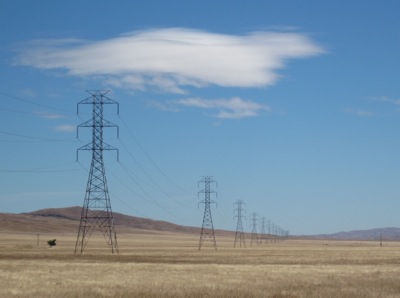
Like many developers, Solargen CEO Mike Peterson is racing to break ground by the end of this year, in order to cash in on up-front stimulus money from the federal government. He says Panoche Valley presents a rare alignment of attributes for solar power: high solar potential (he says 90% of the Mojave), relative proximity to population centers, and existing transmission lines to get the power there. Peterson told me that the lines already in place have enough available capacity to handle his 420 megawatts of solar power, though a spokeswoman for PG&E says that question is still under study.

Meanwhile, some farmers and wildlife advocates have opposed the plan, saying big solar “farms” are better placed on “degraded” land. Ron Garthwaite, who runs Claravale organic dairy, says “This is just not the place to put it. There’s other places which have no ag value and which have less of a natural value where they could put it.”

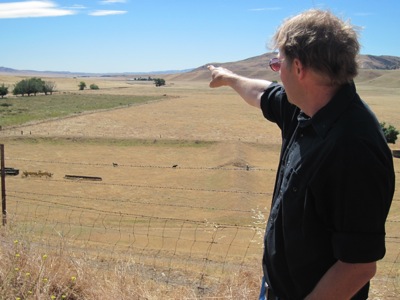
Standing at the valley's north end, BLM ecologist Mike Westphal points to where 2,000 acres might be covered in PV solar panels. (Photo: Craig Miller)

Westphal, whose agency is not directly involved in assessing the project, sees the valley as a rare microcosm for the once unspoiled habitat of the San Joaquin Valley, just over the hill. “What we really need to think hard about is do we want to risk ecosystems to get energy,” he told me, scanning the valley from Shotgun Pass at the north end.  “That’s what’s going on here in Panoche Valley is we’re making this equation: how much do we want to risk the continued endangerment or extinction of this ecosystem in order to get more energy? That’s the crux of this conflict here.”

In this video clip, BLM ecologist Michael Westphal gives Craig Miller an overview of the valley, looking south from Shotgun Pass.

Solargen is shelling out for a $1.3 million-dollar environmental impact report, which Peterson says does not include measures such as the two dozen biologists and a detachment of scat-sniffing dogs, trained to track down the droppings of other critters for DNA analysis. The results help determine what species are there. Peterson says the total tab in “preparing and preparing for the EIR” now tops $7 million.

In Part 2 of our Panoche Valley “case study,” Andrea Kissack will have a closer look at the wildlife issues. That report runs next Monday, June 28, on Quest Radio.

As for the Governor’s ambitious goal to have renewable energy sources account for one third of the state’s electrical generation by 2020, Peterson describes the process as “surprisingly harder than you would expect.” He says he ponders how to “get this done in a way that is able to meet the mandates, but also be a good steward to the environment, and try to make people happy. And we won’t be able to please everybody.”

He’s right about that. Dairyman Garthwaite says of the state’s quest for renewables: “Just because somebody in Sacramento says something, doesn’t mean that it can happen–or should happen. I mean there’s all kinds of political things involved in that, there’s lobbyists involved in that. People want to make money.”

Climate Watch intern Chris Penalosa mapped some of California’s larger solar projects in development, below.


View Utility Scale Solar Projects in California in a larger map

Field Notes from the Arctic: The Journey North

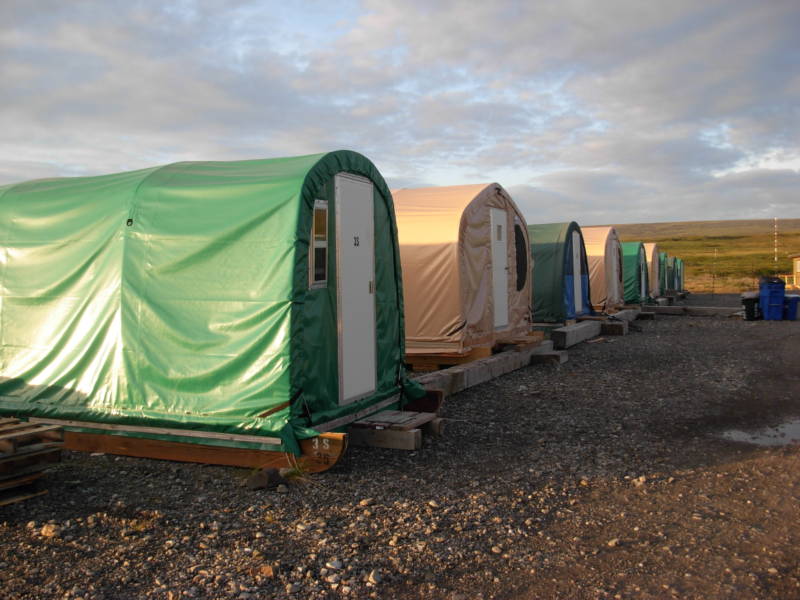
Sleeping quarters at Toolik Field Station, at midnight (photo: Gretchen Weber)

Naively, I thought Alaska’s “Haul Road” would be smooth.  For some reason, I’d pictured the 414-mile route that runs north, from near Fairbanks, to Deadhorse, near Prudhoe Bay, to be a picture of modern asphalt-laying engineering, and that, during our 350-mile drive to Toolik Field Station, I would be able to catch up on some of the sleep I’d been missing after two nights in a University of Fairbanks dorm room (think college students on summer break in a place where the sun barely sets).  After all, this is the road that tracks the Trans-Alaska Pipeline, connecting the largest oil field in North America (which happens to be operated by BP) to the rest of the continent.

As it turns out, I was heartbreakingly wrong.  Roughly a quarter of the road, which is officially called the Dalton Highway, is paved.  And the paved parts are actually the worst. Between the frost heaves caused by the alternate freezing and thawing of the ground, and those Ice Road Trucker tires chewing up the road, driving the Haul Road is more like an amusement park ride, at least from the back seat of a 15-person van.  Suffice it to say that I did not catch up on any sleep during the ride, which turned out to be a good thing, because the second half of this ride was through some of the most beautiful country I have ever seen.

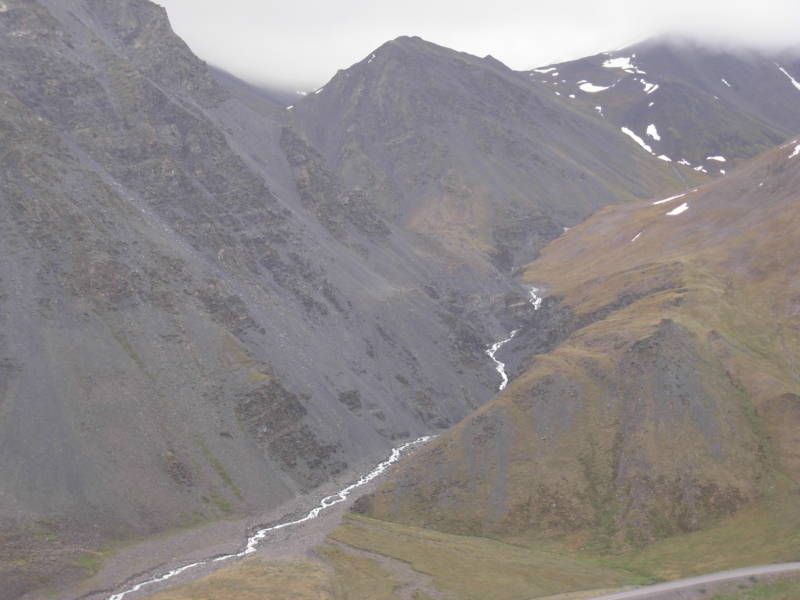
View from just below Atigun Pass (4643 ft) in the Brooks Range (photo: Gretchen Weber)

About 70 miles north of Coldfoot, one of the three “towns” along the road, and 120 miles north of the Arctic Circle, we passed a sign marking the “Farthest North Spruce Tree.”  It actually wasn’t the farthest north spruce tree we saw, and also, it was dead, but right around there was where we crossed the treeline, leaving behind the white and black spruces stunted from extreme temperatures, and crossed into the tundra.

Back in Fairbanks, over breakfast (reindeer sausage), a biologist named Andi Lloyd had talked about her research on the treeline in Alaska.  There’s a lot of evidence showing that climate in the Arctic is changing faster than any place on Earth.  Here, mean winter temperatures have climbed between six and eight degrees F since 1960, and in summer, between two and three, said Lloyd.  This change is affecting how the boreal forest is expanding, she said, and causing the treeline to move north. In some places, such as the Seward Peninsula, Lloyd says it has moved ten kilometers (six miles) in the last century. “The Arctic is changing faster than we can study it,” said Lloyd.

But the relationship between climate change and the forest is not as simple as warmer temperatures equal northern expansion.  Rising temperatures also mean a drier environment, said Lloyd, as precipitation in the region has not increased as much as temperatures, and more warmth means more evaporation.  Lloyd and others have found that trees in the boreal forest are increasingly drought-stressed, which means they are growing much slower than they did in the mid 1900s, and that they are more vulnerable to insect infestation.

“I had a naive idea that the temperature controlled everything, but then I had a dawning awareness that the boreal forest is a moisture-limited forest,” she said.

There are no trees here at Toolik Station, where I will be for the next two weeks talking to scientists about the changing Arctic. The camp is nestled on the shore of Toolik Lake, in the northern foothills of Alaska’s Brooks Range. During the time I am here, the population of the camp will be about 140 people.  We arrived at 10 p.m., after 13 hours of driving, and the sun was still high in the sky.  It was still up there casting shadows when I awoke at 2:30 a.m.  At breakfast time, however, camp is encased in fog, and the temperature is about 45 degrees–kind of feels like I never left San Francisco.

Climate Watch associate producer Gretchen Weber is spending two weeks at Toolik Station, as a Logan Polar Science Fellow.

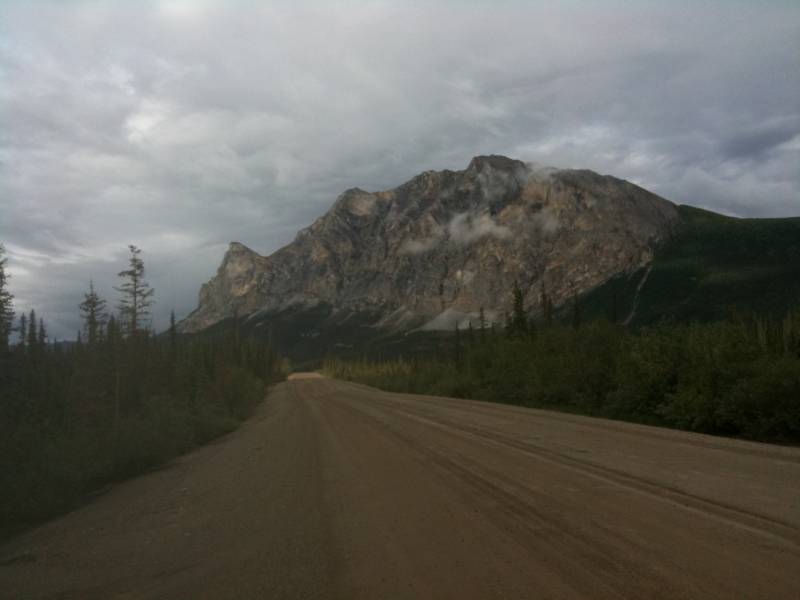
The Dalton Highway (photo: Gretchen Weber)

California’s Future Energy Mix

The Quest/Climate Watch series “33×20: California’s Clean Power Countdown” continues on Monday, with the first of two parts on one company’s attempt to build one of the nation’s largest PV solar arrays in San Benito County.

(Image: Solargen Energy)

With its ambitious 33%-by-2020 renewable energy goal, California will be looking for renewable megawatts from all corners of the state. While the state may hit 18-19% by the end of this year, reaching 33% will require approximately a doubling of renewable power, since the state’s energy appetite will continue to grow in the meantime.

So, where will the energy come from? According to the California Public Utilities Commission, wind and solar will have to carry much of the “load.” Check out the CPUC projections in the charts below.

When Planes Punch “Holes” in the Sky

This post also appears at Climate Central, a content partner of Climate Watch.

By Michael D. Lemonick

How did this happen? The crazy-looking cloud formation in the photo above isn’t a still from a sci-fi movie. It’s not “Photoshopped.” It’s quite real.

It’s also totally artificial, which requires a bit of an explanation.

Since at least as early as the 1940s, meteorologists have been noticing formations like this, and it wasn’t long before they figured out that aircraft were probably involved somehow–perhaps by creating a pressure wave as they passed through, or by heating the clouds and evaporating them.

By the 1980s, says Andrew Heymsfield, a scientist with the National Center for Atmospheric Research (NCAR) in Boulder, Colorado, the holes had become more common and the explanation clearer: as planes punch through cloud decks that have particular characteristics, the air is compressed, then expands and cools, just like the coolant in an air conditioner. The cooling forces water droplets to freeze into tiny ice particles; these in turn act as seeds around which raindrops or snowflakes can form. The clouds then “rain out” or “snow out,” leaving a hole in their wake.

That’s the theory, anyway, though the phenomenon also makes great fodder for tabloids. But now Heymsfield has the smoking gun (outlined in a press release from NCAR), so to speak. Back in 2007, he and some colleagues flew their research aircraft through a snow squall west of Denver. They checked later with ground radar and learned that the band of precipitation was oddly shaped–about 20 miles long–but only about 2½ miles wide. It had appeared and disappeared quite abruptly, leaving a couple of inches of snow in its wake. Then they checked the cameras on their plane and discovered a hole in the clouds. Sandwiched between solid cloud decks, it wasn’t visible from the ground.

You might not have seen it from a satellite either; such holes are often hidden entirely. But that’s not the case in this image (below) from space, centered over the Texas-Louisiana border. Nearly all of the spots, big or small, are holes punched by ascending or descending aircraft. Some of the lines are also caused by planes traveling through the clouds at a constant altitude. “You can probably see around 50 of these artifacts in the image,” Heymsfield said.

The holes don’t just close up right away, either. “We’ve tracked some of them (by satellite) for up to five hours,” said Heymsfield.

If this phenomenon were just an example of gee-whiz science, the paper Heymsfield and four co-authors published about it in the Bulletin of the American Meteorological Society would be fascinating enough. But it turns out that it has military implications as well. Heymsfield has consulted with Boeing on how to fly jets so as not to leave their calling cards in the sky. “Military aircraft,” he notes, “really don’t want to be visible. (On the day the satellite image was taken) we saw a fantastic trail from a B-52.”

The study also underscores how one of our most natural instincts is simply wrong; that the Earth is so enormous, it seems impossible that human activity could alter the planet in any significant way. Unfortunately, there’s no lack of evidence showing how wrong our instincts can be. Oil spewing into the Gulf, another set of record warm temperatures, and endangered species wherever we look are just a few examples. Holes punched in clouds can now be added to the list of human modifications of the environment around us, even if the results do look like science fiction.

NCAR researcher Andrew Heymsfield discusses his aircraft-induced cloud modification study. (Video: NCAR)

“Merchants of Doubt” Traces Roots of Denial

A new book asserts that the very same group of Cold War ideologues who banded together to spread doubt about the link between tobacco and cancer also spearheaded the first efforts to discredit climate scientists as they began warning about the effects of anthropogenic global warming.
In “Merchants of Doubt,”  science historians Naomi Oreskes of UC San Diego and Erik Conway of the NASA Jet Propulsion Laboratory at CalTech, argue that the seeds of the current groundswell of climate change “denial,” and an assault on science in general, were planted decades ago.

The authors say it started with a handful of respected scientists, who, motivated by free-market political ideology and funded by the tobacco industry, worked to cast doubt on well-established scientific knowledge.

Conway discussed the book last Friday with Greg Dalton of Climate One at the Commonwealth Club of San Francisco.

“One of the strategies the tobacco companies decided to pursue in the early 1990’s is the undermining of science, broadly,” said Conway. “They began to use their PR apparatus not just to undermine the science of tobacco and cancer and health effects, but…to attack all regulatory sciences in general.”

That strategy was one of the motivations for the book, said Conway.  “We wondered, ‘What effect will this have on science when it’s being under continuous corporate assault, especially in a society that is very dependent on science and engineering?”

According to Conway, one of the scientists central to the tobacco industry’s efforts was Fred Seitz, a physicist and former president of the U.S. National Academy of Sciences.   Others were the prominent physicists Fred Singer, Robert Jastrow, and William Nierenberg, who was once the director of the Scripps Institution of Oceanography in San Diego.  All were associated with a conservative think tank, the George C. Marshall Institute.  In the 1990’s, said Conway, “the Marshall Institute decided to make its main issue the effort to cast doubt on global warming.”

Conway said that the scientists were motivated by their experiences during the Cold War and the political beliefs they developed during that time.

“Really, this is about opposition to government regulation,” he said. “We don’t think the scientists were in this for the money. They were working for the tobacco industry, to defend Star Wars (the Reagan administration’s space defense plan), to prevent acid rain and global warming regulation.” Conway says these “merchants of doubt” were pursuing “a political ideology to defend market fundamentalism and their political beliefs, not because they were in the pay for big money.”

The authors argue that the legacy of this Cold War ideology lives on in today’s climate change “denial” discourse.  The seeds planted then continue to sprout, they contend, despite the fact that today’s “merchants” are far less influential within the scientific community.

“There is a second generation, but one that is not nearly as respected,” said Conway. “The think tank network  now exists and has been institutionalized and is self-perpetuating. They simply hire their own people who have some credentials, rarely actually climate scientists, who continue to do that kind of thing.  But they don’t have nearly the kind of stature that Nierenberg did or that Fred Seitz had.”

A 2008 study also makes a link between conservative think tanks an climate skepticism.  The report, published in the journal Environmental Politics, found that of 141 English-language, “environmentally sceptical” books published between 1972 and 2005, 92% have links to conservative think tanks, 90% of which, the report found, “espouse environmental scepticism.”

Dumbfounded by “SmartMeters”

UPDATE: In late January, 2011, The New York Times published a good overview of how the controversy over smart meters has evolved since this post.

When utilities and the California Public Utilities Commission hatched plans to bolt a “smart meter” onto every household, the premise–and the promise–was that by digitally tracking just how much they were using and spending, customers would be able to make smarter choices about their energy use, ultimately saving money and cutting carbon emissions.

Smart meters are also a critical component of the nascent but much vaunted “smart grid,” in which household appliances and electric cars communicate with the vast power transmission network, and optimize things like when to recharge.

But as I report in my radio story for The California Report, many PG&E customers consider them more bane than boon (PG&E uses the trademark “SmartMeter,” whereas I may refer to them generically as “smart meters”).

Part of what’s riled up customers in Bakersfield and elsewhere in California is that PG&E hasn’t provided the devices to help watch the watts. Customers can go online to track their energy use over the last 24 hours, but that’s about it. And in the meantime, consumers are paying the cost of the new meters, and in some cases, higher bills that they blame on those meters.

Liz Keogh shows me the "SmartMeter" outside her Bakersfield home. Photo: Sasha Khokha
Liz Keogh shows me the "SmartMeter" outside her Bakersfield home. Her summer 2009 bills went up by half after it was installed. (Photo: Kristin Torres)

Julie Fitch, who heads the energy division of the California Public Utilities Commission, told me she thinks those real-time tracking gadgets won’t actually change consumer habits that much. “There’s a certain percentage of us who are interested in seeing what our energy use is at all times, and are fascinated by it, but I think it’s probably a small percentage in the grand scheme of things,” Fitch said.

Fitch says consumers will see more of an advantage from smart meters when home appliances can communicate with the devices.

“The reality is the grid right now is that it’s actually fairly dumb,” Fitch said. There’s a lot of manual decisions that need to be made in order to get the electricity from a generator to your house. I think what we’re looking at is a much more automatically controlled situation where appliances are automatically linked in with smart devices.”

For example, a fully integrated system could “decide” to run your clothes dryer at off-peak times, to relieve strain on the grid and possibly save money. But the whole idea of charging more for power at different times of day, known as peak pricing, troubles consumer advocates like Mark Toney. He heads The Utility Reform Network (TURN), a consumer advocacy group based in Oakland.

“We want to make sure this doesn’t unduly harm seniors, for instance, who are home bound,” Toney told me, pointing out that folks don’t have a choice sometimes about whether to run their air conditioner in the sweltering Central Valley heat.  “We don’t want them to be faced with the choice of being safe in their home or being subject to heat stroke because they shut off their AC because they can’t afford it,” he said.

Toney is also concerned that struggling customers are more likely to see their power shut off,  if they can’t keep up with the bills.  Smart meters allow utilities to turn off power remotely, without having to send a crew out to someone’s home–and that, he says, gives the company less incentive to negotiate payment plans.

The CPUC’s response? Utilities will still have to follow standard procedures, including advance notice of shut-offs.

Meanwhile an independent lab appointed by the CPUC continues to test PG&E SmartMeters to try to determine why some of them are malfunctioning. Some customers now have “side-by-side” test installations, with both analog and digital meters tracking electricity use in tandem. Strangely enough, the deployment of smart meters by Southern California’s two major utilities has gone relatively smoothly, with just a fraction of the complaints that PG&E has logged.

In my radio story, I interviewed Bakersfield Resident Liz Keogh, who saw her electric bill spike after her SmartMeter was installed.  Keogh is very energy-conscious; her home is a veritable showcase of energy-saving gadgetry. There could be any number of technical reasons why the new meters led to larger bills. Keogh developed her own personal theory (since disproved by independent tests), which she demonstrates in the video below, using some unlikely props. It’s a good example of the broad spectrum of consumer objections to the technology.

What Will it Take?

An interesting confluence of events this week: A Senate committee votes down a contentious amendment to the “climate” bill, a new Stanford survey shows rising concern about global warming, and pundits gather in Pasadena to sort through it all.

87496035The survey, conducted by Jon Krosnick’s Political Psychology Research Group with funding from the National Science Foundation, suggests that some climate pollsters have been getting it wrong. About three in four respondents to the Stanford poll (74%) acknowledge that the “world’s temperature” is rising, and though they appear to be divided on the cause (with a slight edge to human causation), roughly the same majority (76%) favor federal limits on “the amount of greenhouse  gasses thought to cause global warming.” Krosnick summarized some of his findings in an editorial for the New York Times.
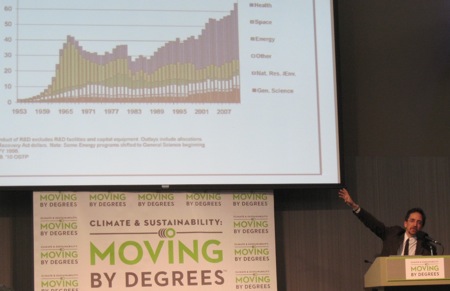
Meanwhile eminent climate scientists, social scientists and journalists assembled in SoCal this week, in part to ask the question: “What will it take to precipitate meaningful policy responses to climate change?” The answer from author Stewart Brand was succinct: “It takes warfare.” Brand was part of a panel at “Moving By Degrees,” a day-long forum hosted by American Public Media’s Marketplace program. Brand, who describes himself as an “ecopragmatist,” has concluded that when the planet’s “carrying capacity” is strained to the point where nations and peoples are fighting over dwindling resources, only then will coordinated international action begin in earnest.

Brand’s dim view was shared by physicist-turned-blogger Joe Romm, who said that while current US policy is driven by “denial,” he sees a coming shift in which people move “from denial to desperation.” That, says Romm, will be the catalyst. “Denial makes easy things hard and desperation makes hard things easy,” he said. Romm says he expects the desperation phase to set in about a decade from now, when extreme weather events and other likely manifestations of climate change intensify and become more frequent. Romm challenged the notion that technology will provide an easy solution to climate change and defied the gathering to come up with one “game-changing” technological breakthrough in energy, over the past three decades.

New York Times blogger Andrew Revkin points to a graph that shows the relatively low level of US R&D funding devoted to energy.
New York Times blogger Andrew Revkin points to a graph that shows the relatively low level of US R&D funding devoted to energy (it's the little green squiggle in the middle). Photo: Craig Miller

Romm and Brand were joined by two high-profile climate scientists, Ben Santer of Lawrence Livermore National Lab and Michael Mann, who directs the Earth System Science Center at Penn State; social scientists Naomi Oreskes of UC San Diego and Eileen Claussen, President of the Pew Center on Global Climate Change and Strategies for the Global Environment; as well as commentators from business and investment groups.

Most agreed that “putting a price on carbon,” through cap-and-trade or some other means, is an essential, if overdue policy step. Analyst Bruce Kahn of Deutsche Bank issued a plea for a coherent policy on carbon pricing. “You can’t put a policy in place today and change it tomorrow,” said Kahn. “A carbon price needs longevity and certainty so companies will add it to their business models.” Once that happens, Kahn said there’s “a massive amount of capital out there looking for a place to go,” and that investment capital will flow to where stable policies exist. Mindy Lubber, president of the CERES investor group, went a step further: “We are losing the jobs and opportunities right now in the clean tech sector,” said Lubber, “because we don’t have the right market signals in place.”

Brand also had some advice for environmentalists, which he says have become “the cohort of the Left:” Brand said “We need to de-tribalize,” and he offered that “The best thing Al Gore could do is shed the Democratic party.”

All of the day’s sessions are archived at the Marketplace conference website.