The Easy Fix That Isn’t

Touted as a simple way to combat climate change, white roofs may actually increase global warming, according to a new Stanford study. 
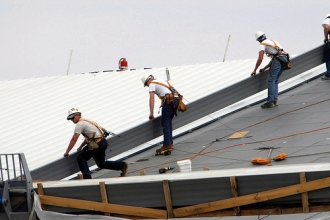
Installing white roofs (or painting them white) has been promoted as a way to help slow global warming. New research shows that white roofs may actually add to global warming.

By Alyson Kenward

If you’re interested in staving off climate change without trying too hard, painting your roof white seems like a complete no-brainer. It’s far cheaper than trading in your SUV for a Prius, and it turns the laws of physics to best advantage. Dark roofs absorb sunlight that heats up your house, office tower, or apartment building. That means you’re bound to crank up the energy-intensive air conditioner to keep pace in the summer months — and since electricity in the U.S. comes largely from fossil fuels, the net result is more heat-trapping greenhouse gas emissions, and more global warming.
Continue reading The Easy Fix That Isn’t

Still Worried After All These Years: Paul Ehrlich on a Planet with 7 Billion People

Stanford biologist Paul Ehrlich still sees runaway population growth as a threat to the planet, but is hopeful that humans can avoid the first catastrophic collapse of a global civilization.

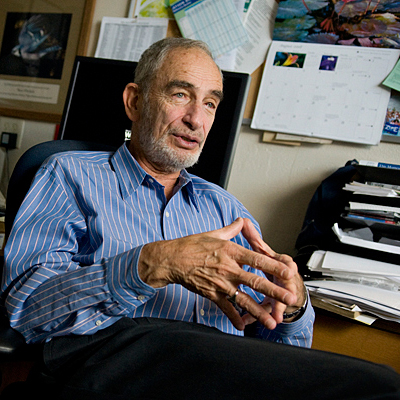
Stanford biologist Paul Ehrlich points to population and consumption as equally responsible for producing environmental damage.

By Sarah Jane Keller
Stanford News Service

Today’s the day that, according to a United Nations tally, world population reaches seven billion — and could top ten billion by the end of the century.

In his 1968 book, The Population Bomb, Stanford biologist Paul Ehrlich warned of the threat of unchecked human population growth. Over the past four decades, the book has brought attention to the question of how many individuals our planet can sustain. Today, Ehrlich reflects on what the four decades since have taught him. Continue reading Still Worried After All These Years: Paul Ehrlich on a Planet with 7 Billion People

Another Run for Flush-to-Faucet Water Recycling

L.A. tries some new technology to get past the “yuck factor”

Hear the companion radio feature to this post on The California Report.

Ten million dogs can't be wrong.

For the record: the route isn’t nearly as direct as the popular canine version. I tasted this water in Orange County and it’s fine — actually, a little “tasteless” since all the minerals had been removed from it as well. The engineering folks in both Orange County and LA’s Department of Water and Power will tell you that this recycled water has a “distilled” quality to it.

With the future of Southern California’s water supply in some doubt, municipal water managers are moving again toward the ultimate recycling strategy, which lingers in the public’s mind with such appetizing monikers as “toilet to tap.” The region went through a political tempest a decade ago as it tried to bring the East Valley Water Recycling Project on line, a system that did not use the final “advanced” stage of water treatment (being used today in the OC and proposed for the new effort by LADWP). Mired in engineering concerns and a public relations mess, the project was scuttled by newly-elected LA mayor James Hahn. Today, the technology has improved and now, the process has a successful SoCal track record for “potable re-use.” Continue reading Another Run for Flush-to-Faucet Water Recycling

New Satellite Launched to Watch Climate, Weather

Agencies hope the next-generation satellite will serve as a bridge between the nation’s aging satellite fleet and the new ones yet to come.

Launch of the NPP satellite from Vandenberg Air Force Base on Friday.

In a joint effort to improve observations of the Earth from space, NASA and NOAA launched a new satellite on Friday from Vandenberg Air Force base near Lompoc, CA. The satellite carries with it a suite of next-generation technologies and tools that the agencies say will enable scientists to continue monitoring climate change and weather patterns as many existing Earth-observing satellites are reaching the outer edge of their life expectancies.

The new satellite is part of the NPOESS Preparatory Project (NPP), which aims to monitor the entire planet, collecting and processing data on the Earth’s weather, atmosphere, oceans, land, and near-space environment.  The agencies say this data will not only help with monitoring climate change, but also with natural disaster prediction and planning, and military strategies.  NASA describes the NPP as a bridge between the aging Earth Observation System (EOS) satellites and the “forthcoming” Joint Polar Satellite System (JPSS) satellites, which are scheduled to begin launching in 2016. Continue reading New Satellite Launched to Watch Climate, Weather

California Governor Plans Year-End Climate Conference

Brown administration urges local preparations for climate impacts

Coastal communities need to ponder the future of homes like these in Redondo Beach.

California Governor Jerry Brown is picking up the climate baton from his predecessor, planning his first climate conference. According to officials, Brown will host  the Governor’s Conference on Confronting Climate Change, currently pegged for December 15th at the California Academy of Sciences in San Francisco.

The conference is still taking shape but recent remarks from the administration seem to imply that the focus will be on planning for climate change impacts. “We have to move from planning to action…and we are behind,” says Julia Levin, Brown’s deputy secretary for climate change and energy at the California Natural Resources Agency. Continue reading California Governor Plans Year-End Climate Conference

A Source of CO2 That Might Surprise You

That babbling brook out back has been holding out on you

A satellite view of the Mississippi River shows a mosaic of riverbank land-use patterns.

Rivers and streams in the United States are releasing a lot more CO2 into the atmosphere than scientists previously thought, according to a new study by scientists at Yale. In fact, American waterways are discharging the gas into the atmosphere at a rate of 100 million metric tons per year, an amount equal to a car burning 40 billion gallons of gas, researchers say.

The study, conducted by David Butman and Peter Raymond of the Yale School of Forestry and Environmental Studies, looked at water chemistry data from more than 4,000 rivers and streams. The authors say identifying this significant source of CO2 could change the way scientists model the movement of carbon through ecosystems and the atmosphere.

“These rivers breathe a lot of carbon,” said Butman in a press release from the National Science Foundation, one of the study’s funders. “They are a source of carbon dioxide, just like we breathe out carbon dioxide and like smokestacks emit carbon dioxide.”

The study is published in the current issue of Nature Geoscience.

Clearing the Air on Climate and Smog

By Lisa Aliferis

Why climate change and public health policy make good chemistry

A major study released today in Fresno details the direct link between higher levels of air pollution and asthma-related ER and hospital admissions. So, what’s that got to do with climate change? Plenty.

Tourists snap photos of a murky sunset in San Diego” credit=”Sandy Huffaker / Getty Images

“There’s a division in the public’s mind between global warming and health effects of pollution,” says Dimitri Stanich of the California Air Resources Board.

In reality, there’s significant overlap. Some components of air pollution shown to have harmful warming effects on the planet are also harming people, especially children, right now.

Let’s start with ground-level ozone. Ground-level ozone is different from the ozone layer, which lies about 15 miles above the earth (not exactly ground level). The ozone layer shields us from most of the sun’s harmful rays. Ozone is good in the atmosphere but bad, in many ways, at or near ground level. Continue reading Clearing the Air on Climate and Smog

NOAA Chief: The Climate Crisis the Media is Missing

Carbon Emissions and Osteoporosis of the Sea

Ocean Acidification topped the list of concerns for a panel of marine scientists opening the annual Society of Environmental Journalists conference in Miami this week.

The topic was oceans, and when moderator Nancy Baron of the science education group, COMPASS asked the scientists to “Tell us how it is, really,” panelist and top NOAA administrator Jane Lubchenco said that rapidly rising acidity in the ocean is a “huge challenge.”

“It’s the most important under-reported global environmental story today,” she said. “The ocean has become 30% more acidic over the last century, and this massive change is likely to have serious impacts, and it’s likely to get worse.” Continue reading NOAA Chief: The Climate Crisis the Media is Missing

California Adopts Nation’s Most Sweeping Cap & Trade Plan

But it’s just another milestone in a long journey that’s far from finished

It’s official (no, really, this time). California has cap & trade — or will once the program starts ramping up next year. Today’s approval by the state’s Air Resources Board was described by chair Mary Nichols as like “moving a large army a few feet in one direction.”

Ready to roll: A license plate in Sacramento bears the legislative shorthand for California's landmark climate policy.

The objective that “army” is marching — or shuffling — toward is, of course, the fulfillment of California’s goal to roll back greenhouse gas emissions to 1990 levels by the end of this decade. With at least a semi-intentional pun, Nichols calls cap & trade the “capstone” of that effort, although the program is expected to produce at most, 20% of the hoped-for reductions in carbon emissions. The rest will come from other measures either lumped under or related to the state’s Global Warming Solutions Act, more widely known as AB 32.

Those other measures include stricter standards for tailpipe emissions, a “low-carbon fuels standard” (still being worked on), and the ambitious-but-attainable goal to get a third of the state’s electricity from renewable energy sources, also by 2020. Continue reading California Adopts Nation’s Most Sweeping Cap & Trade Plan

Yep, It’s Warmer Out There…But Not Everywhere

Berkeley study affirms temperature trends cited in major climate reports

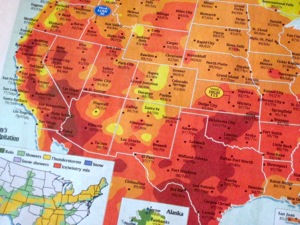
Hot enough for you? Temperature map from the July 31 edition of USA Today

Just in case you’ve been wondering, the world is getting warmer. Not everywhere but overall, things are heating up pretty much as advertised. A comprehensive study of temperature records — some of which had been under attack by climate change skeptics — concludes that the average global land temperature has risen one degree (Celsius) since the mid-1950s.

The project, known as the Berkeley Earth Surface Temperature Study, was launched by a team of scientists from various institutions, to address charges that climatologists had been relying on shaky data from temperature-logging stations around the world. Continue reading Yep, It’s Warmer Out There…But Not Everywhere