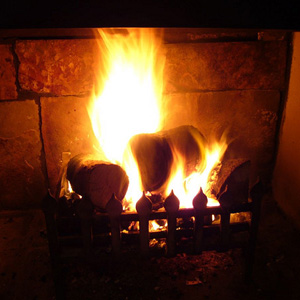
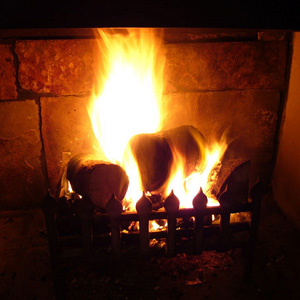
30% of the particulate matter found in the air during the winter comes from wood smoke.
If it seems like we’ve had a lot of Spare-the-Air days recently in the Bay Area, you’re right. Wednesday will bring the total to eight air quality alerts since November 1st, when the season began.
Blame the weather. Last year there were only four all season, November-February, mostly because it was so rainy. The Bay Area Air Quality Management District, the agency responsible for issuing the alerts, has recorded up to 20 in a single winter. So eight in a month and a half is pretty significant, though it’s hard to know if the trend will continue since weather patterns change constantly.
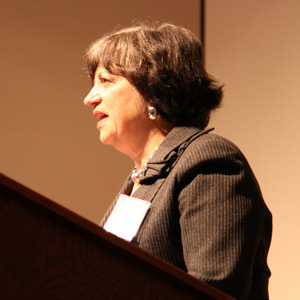
Mary Nichols chairs the California Air Resources Board.” credit=”The National Academy of Sciences/Flickr
ARB’s response to inquiry wasn’t what Orange County Republican had in mind
Orange County Republican Darrell Issa says he remains “deeply troubled” by what he calls a “lack of candor” & “internal inconsistencies” in the California Air Resource Board’s (ARB) response to his November 9th letter probing negotiations toward a new national fuel economy standard. (You can read my original post on Rep. Issa’s and Nichols first round of correspondence here.)
Independent California voters are feeling the heat from climate change, according to a new poll.
The nearly unanimous rejection of climate science by Republican presidential candidates has not swayed most independent voters in California, according to a new poll.
The survey, commissioned by the California League of Conservation Voters Education Fund, finds that nearly two-in-three (63%) voters who decline to state a party affiliation, agree that “climate change is occurring and is a major problem that needs to be addressed.” Thirty-one percent said that climate change is not an issue worth addressing, as the science is still unclear. Continue reading Poll: Indy Californians Still Support Climate Action→
The one-day conference reinforced the need to prepare for coming climate impacts
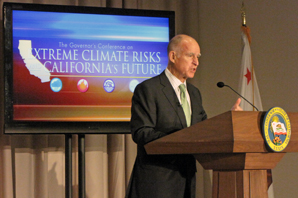
Governor Jerry Brown.
Governor Jerry Brown says he wants to “intensify California’s leadership” on the climate front, but his climate conference at the California Academy of Sciences on Thursday offered no new initiatives toward that end.
The one-day event was a series of panel discussions emphasizing the importance of science and how it can reinforce policy decisions on climate change.
Droughts kill trees — but until now scientists didn’t know the root of the problem
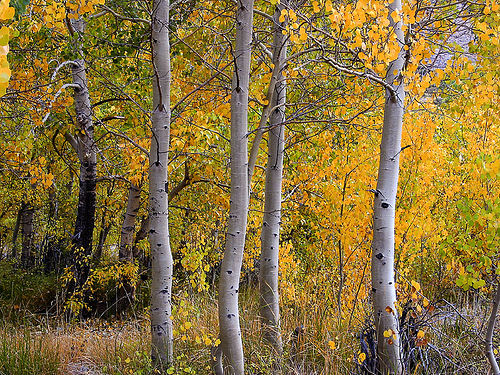
Aspens live at high elevations in the Western United States, including in California’s White Mountains and Sierra Nevada.
Throughout the West, aspens are quaking for good reason.
About 17% of the aspen in the Colorado Rockies have died in the last decade. That’s about one in every six trees. The widespread die-off, called sudden aspen decline, began after a severe drought and heat wave. So people studying the trees knew that’s what triggered the deaths, but they didn’t know what exactly killed the trees.
William Anderegg, a grad student at Stanford, with help from a team of scientists there and at the University of Utah, has zeroed in on the culprit, and describes the work in a paper published this week. There were two working theories: failures in photosynthesis, which would mean less food for the tree; or damage to the roots, which would mean less water. Anderegg found it was the roots.
New science forecasts include everything except moderation
Scientists say there’s a little bit of everything on the horizon for California — except maybe funds to study it.” credit=”Craig Miller
Two days before Governor Jerry Brown hosts his own conference on “Extreme Climate Risks and California’s Future,” scientists and a smattering of state and local officials spent a rainy Tuesday at Scripps Institution of Oceanography in La Jolla, talking about just that.
It began with calls to keep the funding for statewide climate research. Sacramento legislators may be looking at cutting money to the Public Interest Energy Research (PIER) program in particular, and California Energy Commission vice chair James Boyd told the crowd “all is not well.” He said that research funding is “under assault again” with the weak economy used to question the focus on climate at a time when predictions are becoming more severe. Continue reading Take Your Pick: Wetter, Drier, and Hotter for California→
The tsunami that crossed the Pacific Ocean from Japan was actually two huge waves that combined
Researchers have long suspected that tsunamis sometimes merge to create a single more powerful wave, but the tsunami caused by the earthquake that rocked Japan earlier this year was the first time they actually saw it happen.
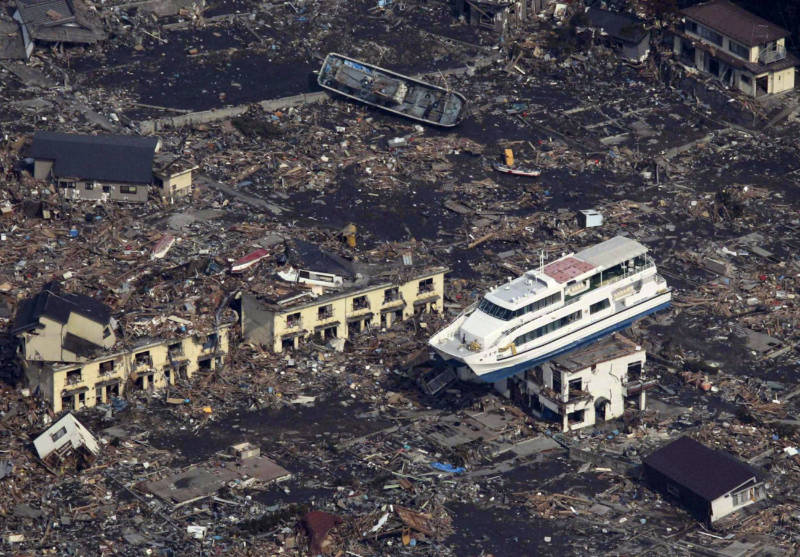
The tsunami traveled miles inland on the Japanese coast.
The biggest earthquake ever recorded was in 1960, in Chile. The 9.5 quake killed and injured thousands there, and triggered a deadly tsunami that hit Hawaii, the Philippines, and Japan.
“It was a mystery for a long time,” said Tony Song, a research scientist at NASA’s Jet Propulsion Laboratory, of the resulting tsunami that crossed the Pacific. “How it happened so far away,” and caused so much damage.
The explanation, it turned out, was that it was a merging tsunami. When the quake hit, a wave radiated out from the epicenter. But it didn’t form a neat circle, like when you drop a stone into a pond. Instead, underwater mountains and ridges broke the wave into segments that headed in different directions. Then that mountainous underwater topography guided some of those sections back together. They merged into a single double-size wave that could cross the ocean without losing much steam.
The explanation made sense, but Song and other researchers had never seen it actually happen until the tsunami in March.
“We knew waves could merge, but had never seen evidence before,” said Song. This animation from NASA shows it happening. The wave radiates out from the earthquake’s epicenter. Then the animation zooms in to show the waves, which have been broken up, merging.
Scientists at NASA and Ohio State University lucked into the find. Three satellites capable of measuring sea level changes down to a matter of centimeters happened to be in the area. When they passed over the tsunami, two of them measured one height for the wave. A third, the NASA-Centre National d’Etudes Spaciales Jason-1 satellite, measured a different height, twice what the other satellites saw. It was a merging tsunami. The wave front the satellites measured was the one heading east from the earthquake’s epicenter, not the one that ravaged the Japanese coast. But the discovery at least raises the question of whether or not the wave going in the other direction, the one that did hit Japan, was also a merging tsunami. Song says, unfortunately, he doesn’t have the data to say one way or the other.
“Specifically, our study is about the double power away from Japan, instead of toward Japan, though the same mechanism might work in both directions.”
Merging tsunamis occasionally hit Crescent City, California. According to Song, the topography of the ocean floor has the same effect when earthquakes near Alaska trigger tsunamis headed for California.
Now that he’s observed one of these waves in action, Song says scientists will be able to make better forecasts, predicting where tsunami waves are likely to merge, and where they’re likely to hit land.
A couple of other items you may have missed over the last few months about the tsunami:
Song and his colleagues presented their analysis at the San Francisco meeting of the American Geophysical Union this week (#AGU11).
UPDATED and CORRECTED: An earlier version of this post may have misled some readers by implying that actual satellite data confirmed the merger of two tsunami waves into the front that hit Japan. The data was observed for waves moving in the opposite direction.
High-tech imaging helps Colorado researchers catch the wind
Wind power has come a long way but maximizing the output of even modern wind farms is still a challenge.
It isn’t enough to buy a slew of multi-megawatt turbines and stake them on a windy hillside. You have to know how the wind behaves, not only going into the turbine but the “wake” coming out the backside. Otherwise, you can get more windstorm than wattage. It’s a new area of research and it got help this week from scientists who literally “look” at the wind.
Speaking at the American Geophysical Union (#AGU11) here in San Francisco, Julie Lundquist from the University of Colorado, Boulder, offered up her team’s images of a wind turbine’s wake. Using Doppler Lidar — think police radar gun — she showed us the color-coded flow: a slower, cool-colored wake at the center just behind the turbine, surrounded by the warmer-colored fast flow swirling around it. Continue reading Build a Better Wind Farm and the Watts Will Beat a Path to Your Door→
Sea level rise will irrevocably change life near the San Francisco Bay. That’s the premise of RISE: Climate Change and Coastal Communities, a documentary that starts airing this week on KQED Public Radio. Producer Claire Schoen sets the stage on a personal note.
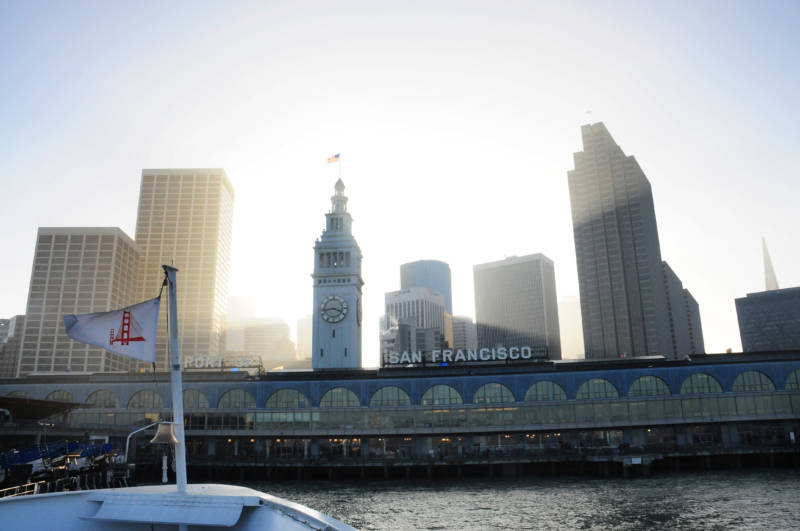
Climate scientists predict that sea level rise and extreme weather will cause severe, repeated flooding of San Francisco’s Financial District by 2050.
By Claire Schoen
“Mom, can you please can it with the climate change lecture – just for once,” my children complained. At ages 22 and 26, my politically correct, Berkeley-raised kids are well educated in all things scientific and political. But… “Enough already,” they cry.
And I confess that their complaint has some validity: I can bring up the topic of climate change in pretty much any conversation.