Tesla’s Model X: Sleek, Climate-Friendly and Made in California

Tesla is blazing a trail for electric vehicles, but its sky-high prices are still a barrier

Production on Tesla's Model X begins in 2013.

On February 8th, Tesla Motors CEO, Elon Musk, unveiled the company’s latest electric car: The Model X. Probably the sleekest and sexiest SUV you’ve ever seen, and also the priciest. But what’s most remarkable — beyond the falcon wings — is that the car will be manufactured here in the Golden State, at the former NUMMI plant in Fremont.

Why did Tesla choose to locate its headquarters and manufacturing in the high-priced San Francisco Bay Area? Was it linked to the state’s ambitious clean energy targets and policies? The new rules approved last month by the California Air Resources Board require automakers to produce 1.4 million zero-emission cars for the California market by 2025, and are part of the aggressive goal of reducing the state’s emissions 80% by 2050.

Tesla spokesperson Khobi Brooklyn eschewed policy explanations and told me, “We wanted to build our cars in California, not only creating jobs in the U.S., but also California specifically.” She cited Silicon Valley as “an incredibly rich pool of talent” and said that purchasing an existing car manufacturing facility saved money and time in preparing for car production. I’ve no doubt the California sales tax rebates on capital equipment purchasing (estimated at $20 Million) helped too.

Continue reading Tesla’s Model X: Sleek, Climate-Friendly and Made in California
Golden Gate National Recreation Area Gets Wind Turbines Spinning

The National Park Service is expanding its renewable energy efforts

By Thibault Worth

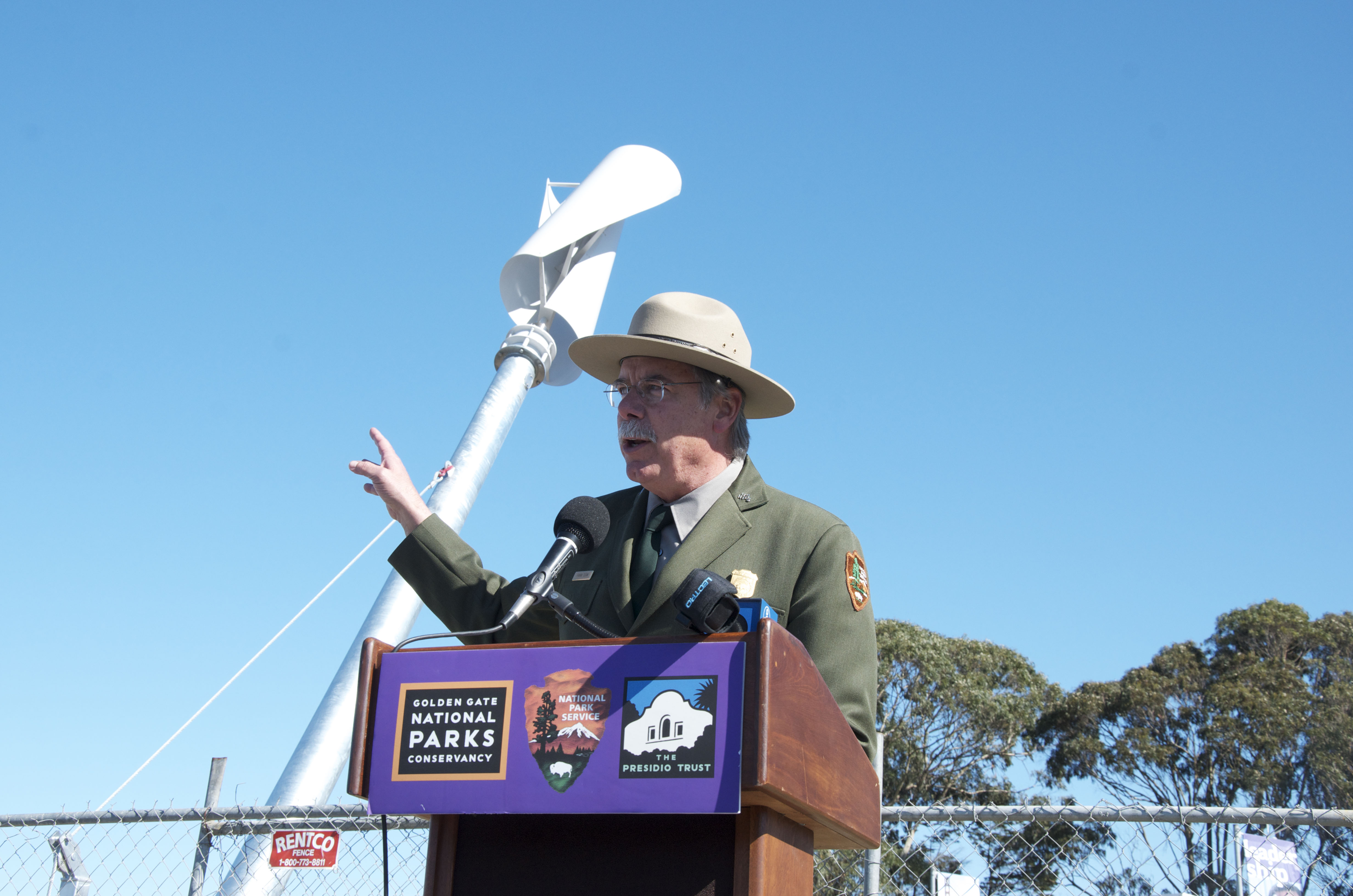
Frank Dean, General Superintendent of Golden Gate National Recreation Area, speaks in front of one of the new wind turbines at Crissy Field.” credit=”Alison Taggart-Barone/National Park Service

The Crissy Field Center, an environmental education center operated by the Golden Gate National Parks Conservancy, the Park Service and the Presidio Trust, erected three out of an eventual five wind turbines Wednesday. The event highlighted the expanding mission of the National Park Service to use more renewable energy in powering park facilities.

While the Center’s turbines will be used for mostly educational purposes, the ceremony took place on the same day that the National Park Service reached an interconnection agreement with Southern California Edison to bring 20 dormant renewable energy projects in California online.

Continue reading Golden Gate National Recreation Area Gets Wind Turbines Spinning

The Case of the Disappearing Sierra Snowfall

A new report says snowfall in the Sierra hasn’t shrunk, but not everyone’s buying it

Snow has been sparse in the Sierra Nevada this winter.

There are good years and there are bad years, but overall, snowfall in the Sierra hasn’t declined in the past century. That’s according to a new study by University of Alabama climatologist John Christy (who, it’s worth noting, has come under fire as a climate change denier).

The San Francisco Chronicle had a story about the report, “Searching for information in 133 years of California snowfall observations,” (link is to the abstract; full article is behind a pay wall) in today’s paper:

Continue reading The Case of the Disappearing Sierra Snowfall

Leaked Documents Describe Corporate Agenda to Discredit Climate Science

Bay Area climate scientist named in disputed document

The climate corner of the Blogosphere exploded this week with the alleged leak of numerous documents from one of the nation’s most ardent opponents of action to slow global warming.

It started when DeSmogBlog published a series of documents that its editors said were leaked to them, revealing much of the playbook for the Heartland Institute. If authentic, the documents would validate longstanding complaints that corporate interests have been bankrolling a deliberate campaign of disinformation, aimed at casting doubt on legitimate climate science, and that Heartland has been an important channel for this campaign. Continue reading Leaked Documents Describe Corporate Agenda to Discredit Climate Science

Take Me to the River (Without Leaving My Desk)

A new project to visually map American waterways will start with California’s Sacramento

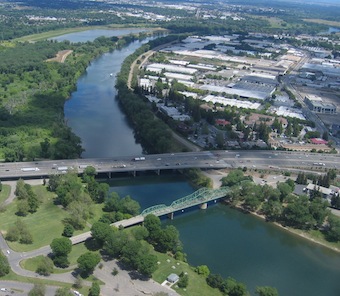
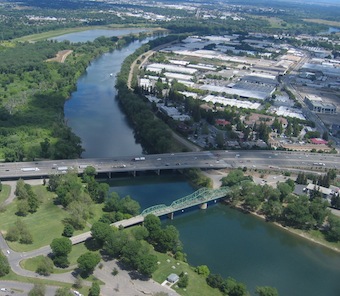
The Sacramento River is a lifeline for California.

By the end of the summer, you may be able to float down the Sacramento River from your computer, thanks to the Riverview Project. It’s an initiative to document and map rivers, using similar tools to the ones Google used to create Street View, and with similar results: the ability to drop into a place on a map, click to move down the street (or float down the river), and take a look around.

“There’s reams of data (about rivers),” Jared Criscuolo, one of the founders of the Riverview Project told me. “But the thing we’ve noticed we’re missing is a visual piece.”

Continue reading Take Me to the River (Without Leaving My Desk)

Next-Gen Snow Surveys: “Activate the Laser”

New technology could provide a much clearer picture for water forecasts

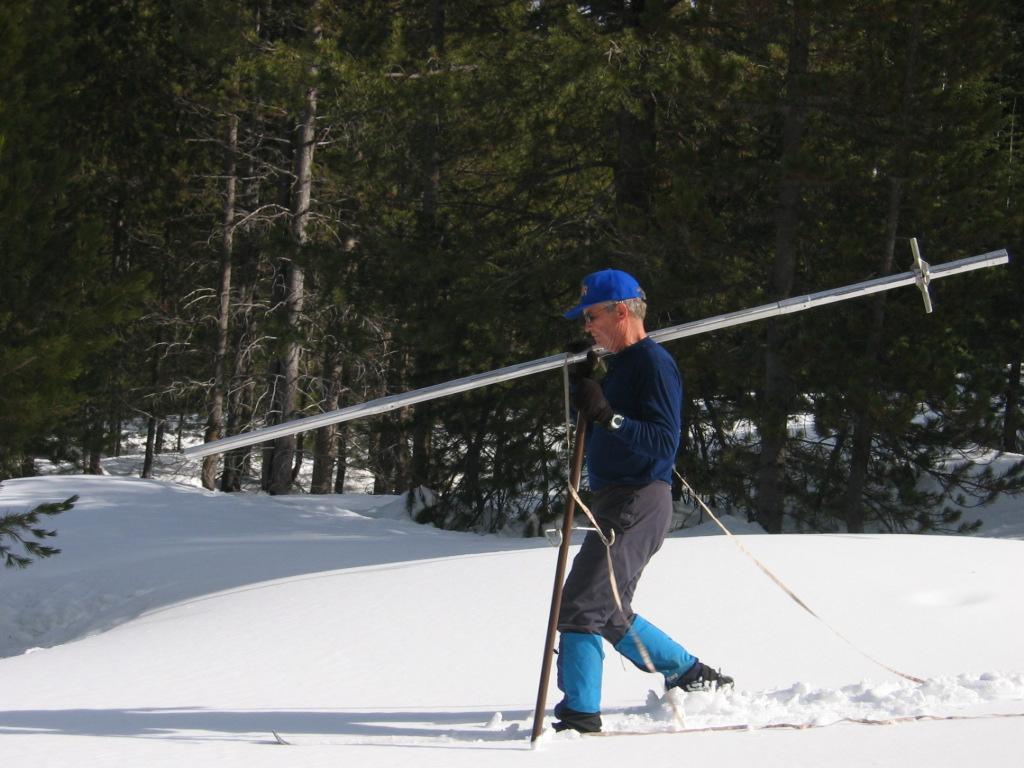
Frank Gehrke conducts a manual snow survey using a "Mt. Rose gauge," essentially a hollow aluminum tube shoved into the snow at predetermined locations.

In California, where most of our water comes from the mountains, being able to accurately measure the snow pack is vital. And it is in outlier years like this — very dry years, though the same goes for very wet ones — when water managers have the hardest time making accurate predictions.

“Knowing the water content of the snow in an entire watershed is the holy grail for snow scientists,” survey guru Frank Gehrke told me.

During the winter, Gehrke trudges into the woods on a monthly basis to do manual snow surveys for the state Department of Water Resources. DWR uses remote snow sensors, too. But even with all that data we don’t get an exact picture of the snow pack. So scientists from National Center for Atmospheric Research (NCAR) and NASA Jet Propulsion Laboratory (JPL) are developing tools to measure snow with lasers. This new technology has the potential to be that holy grail that Gehrke’s looking for.

Continue reading Next-Gen Snow Surveys: “Activate the Laser”

Climate Adaptation and Unintended Consequences

Radio documentary explores the social and economic impacts of adapting to climate change

Rising seas will irrevocably change life near the San Francisco Bay. That’s the premise of RISE: Climate Change and Coastal Communities, a three-part documentary by independent producer Claire Schoen. The final part, “Chuey’s Story,” airs this evening at 8 pm on KQED 88.5 FM.

By Claire Schoen

Chuey Cazares works as a fisherman out of the South Bay town of Alviso. Adapting to climate change may save his town, but it's having unintended consequences for his livelihood.

There’s an old adage that goes something like this: “The human capacity to create technology exceeds our capacity to understand its impact.”

Lots of people have referred to this idea, Einstein perhaps most famously when he said, “The unleashed power of the atom has changed everything save our modes of thinking and we thus drift toward unparalleled catastrophe.” Splitting the atom certainly brought us the promise of unlimited energy to run industry and military might to protect the world from Hitler. It also brought us a nuclear North Korea and Fukushima.

Continue reading Climate Adaptation and Unintended Consequences

Job and Climate Concerns Driving Support for Large-Scale Solar

For the five desert counties polled, the economy is the top concern, “solar” leads energy choices

When it

Here’s the fine print up front: this survey, conducted during December and January, was underwritten by BrightSource Energy, the company that’s building one of California’s largest solar projects at Ivanpah, northwest of Needles in the Mojave Desert. Private capital for Ivanpah came from Google and from CalSTRS, the state’s teachers’ retirement system. It’s an enterprise that’s been lauded by Governors Schwarzenegger and Brown, by U.S. Interior Secretary Ken Salazar and President Obama.

But just this week, Ivanpah came under fire in a Los Angeles Times story boldly titled “Sacrificing the Desert to Save the Earth.” BrightSource took to its own website to refute the charge that their utility-scale solar effort is responsible for “razing the desert” and pointed to their “low impact design,” a native plant nursery on site and a “Head Start” program for juvenile desert tortoises.

All that said, the phone survey conducted by Probolsky Research, LLC and released today by Vote Solar, a non-profit advocacy group, shows jobs and the economy leading the list of concerns among 52.3 percent of those polled, horse lengths ahead of a host of other woes which only garnered single-digit responses, including “environmental issues.” Only 5.5 percent put that at the top of the list. Continue reading Job and Climate Concerns Driving Support for Large-Scale Solar

State Analyst: Cap & Trade Plan Good as Far as it Goes

But what happens after 2020?

A non-partisan analysis of California’s recently approved cap-and-trade program says state regulators at the Air Resources Board (CARB) did a decent job of balancing competing directives, but warns that legislators need to start thinking about what happens after the program runs its course, less than a decade from now.

Craig Miller

“The legislature and the Air Board need to provide some certainty of what the regulatory landscape will look like after 2020, so that the regulated community can start planning and making appropriate investments,” Mark Newton of the Legislative Analyst’s Office (LAO) told me in a telephone interview. The state’s greenhouse gas emissions reduction law, AB 32, sets a goal of reducing California’s emissions to 1990 levels by 2020. “AB 32 leaves open the door to changes being made,” said Newton, “but it doesn’t provide any specificity about a new goal that you’ll be reaching after the 2020 goals are met.”

In other words, industries regulated under the program have no idea what will happen after 2020, although the legislative intent — and California environmental history — points to further regulation. It took regulators a solid four years to get their carbon trading plan off the ground, so planning ahead seems prudent.

Continue reading State Analyst: Cap & Trade Plan Good as Far as it Goes

California, Clean Energy, and the Obama Promise

What does the President’s vow not to “walk away from the promise of clean energy” mean for California?

By Alison van Diggelen

President Obama made a strong State of the Union commitment not to walk away from the promise of clean energy. Was it a shrewd long-term strategy or a political liability that will result in even more “Solyndras” here in California?

On the one hand, Obama’s clean energy focus has helped expand the clean energy job market, into a sector with more than 2.7 million jobs, with investments in smart power grid, energy efficiency, electric cars and renewable power. In 2011, the federal clean energy push led to a remarkable $56 billion investment in the sector, surpassing even China’s. Continue reading California, Clean Energy, and the Obama Promise