Category Archives: Government & Business

What’s brewing in Sacramento, Silicon Valley, and beyond

Planning for the Other “Big One”

Imagine 45 days of rain brought by a series of winter storms so strong and wet that they turned the Sacramento Valley into an inland sea, making the state capital virtually inaccessible.

Well, that happened in California in the winter of 1861-1862, and scientists say it will happen again, bringing massive flooding, landslides and property damage across the state.

To help emergency agencies plan for such an event, the US Geological Survey released the “ARkStorm Scenario” in Sacramento this week, detailing the repercussions of a storm that produces up to ten feet of rain and forces the evacuations of more than a million people.

“Vast floods would basically take out all the farm land,” said Marcia McNutt, director of the USGS. “They would destroy homes, animals would die, roads would be impassable, infrastructure would be rendered unusable, dikes would fail, levees, would fail.”

Scientists created this hypothetical storm by combining two actual storms, one from 1969 and one from 1986, and putting them back to back.  Together, they rival the 1860’s storm in magnitude, which was the last time California saw a storm this size.
Continue reading Planning for the Other “Big One”

Its First Renewables Goal Unmet, Can CA Meet The Next One?

California may not have met its goal of 20% renewable energy by 2010, but outgoing California Energy commissioner Jeffrey Byron says the state is close, and that California is on track to meet its its goal of 33% renewable energy by 2020.

“We didn’t get to the point where we’re generating 20% of our electricity by renewables, but I believe we do have, or we’re very close to having, all the contracts in place,” he said Thursday.

Byron was at Stanford University on Thursday, speaking at a workshop titled, “Grid Integration of Renewables.”
Continue reading Its First Renewables Goal Unmet, Can CA Meet The Next One?

Scripps Launching Carbon-Tracking Net

Major partnership is said to be the most ambitious of its kind

Up to now, tracking greenhouse gas emissions around the world has been a patchwork affair for scientists. But if it lives up to its hype, a new partnership with roots in California will mean a much more accurate picture of the heat-trapping gases that cause global warming.

Climate scientist Ralph Keeling tracking real-time carbon dioxide readings from his lab at UC San Diego. (Photo: Ed Joyce)

Currently, scientists rely on a few dozen sampling stations to continuously monitor greenhouse gases around the globe.
But now, the Scripps Institution of Oceanography is teaming with a private-sector initiative to build the world’s most comprehensive network yet, for tracking carbon around the globe. Continue reading Scripps Launching Carbon-Tracking Net

Another One Bites the Dust?

California’s cap-and-trade partners are dropping like flies.

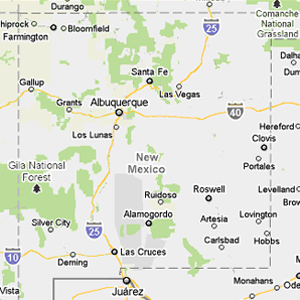
It’s not official yet, but it’s looking like what was once envisioned as a regional carbon trading program involving seven US states and four Canadian provinces, will now involve just one US state – California – and just three provinces: Quebec, British Columbia, and Ontario.

One by one, members of the Western Climate Initiative have postponed their involvement or dropped out altogether, as Arizona did last February when Gov. Jan Brewer issued an executive order backing out of the carbon trading program.

And today, an online publisher quotes a key official in California’s carbon trading program, that the state stands to lose its last remaining US partner, New Mexico. As Colin Sullivan of E&E reported:

Kevin Kennedy, assistant executive officer in charge of the Office of Climate Change at the California Air Resources Board, told lawyers during a forum sponsored by Law Seminars International that the election results likely mean New Mexico will not participate in the fledgling WCI, at least at the outset of the market starting Jan. 1, 2012.

“The change in administration probably takes New Mexico out of the situation,” Kennedy said.

(Subscription required for full article)

Last week New Mexico’s new governor, Susana Martinez, announced that she was removing all members of the state’s Environmental Improvement Board, “because of what she said was its ‘anti-business’ policies.”  Last year, the EIB approved measures for the state to limit emissions and join the WCI’s cap-and-trade program.

Hidden Treasure: An “Eco-City” in SF Bay?

Thousands roar by Treasure Island every day without a passing glance. That could soon change…radically.

Listen to Alison Hawkes’ companion radio feature on The California Report, Monday morning, and see a slide show of the island’s transformation, below.

Architect's rendering of a proposed "eco-city" on Treasure Island, in San Francisco Bay.

San Francisco’s twin islands in the Bay – Treasure Island and Yerba Buena – are not exactly jewels of nature. Although they have stunning views, a half-century of use by the U.S. Navy and years in redevelopment limbo have taken a toll.

Some sites on Treasure Island are severely contaminated, and much of the island is cracked asphalt and derelict buildings. Yerba Buena is solid rock but Treasure Island is entirely artificial, conjured from bay mud as an engineering showcase for the 1939 World’s Fair. As time passes, a corner of Treasure Island is gradually sinking into the sea. Rising sea levels as a result of climate change could subsume the island entirely, returning it back to its natural state, which is to say underwater.

In short, the place needs some serious help and this is where a massive multi-billion dollar redevelopment takes stage. Private developers want to transform the islands into a high-density “eco-city” with as many as 20,000 residents, making use of the best that technology and city planning have to offer in sustainable development. Continue reading Hidden Treasure: An “Eco-City” in SF Bay?

Mapping California’s Worldbeating Cleantech Boom

The Golden State shines in a new global listing from the UK’s Guardian newspaper

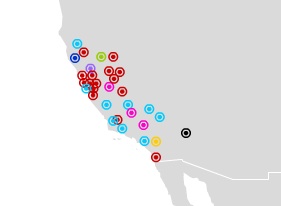
Detail of an interactive map of the world's innovative "cleantech" companies (Image: Guardian UK)

Of all the companies around the world that the UK’s Guardian called out for its second annual Global Cleantech 100, roughly a third are based in California. The list spans technologies including energy generation, storage and efficiency; water and waste water; transportation and others.

The special report includes an interactive map of where the firms are located. It makes an interesting study by itself, showing a dense cluster of 31 firms over California, with a smattering of others around the US. About a dozen are concentrated in a few northeastern states. Four are located in China, two in India. Continue reading Mapping California’s Worldbeating Cleantech Boom

CA Says “So Long, Energy-Sucking Light Bulbs”


(Photo: Craig Miller)

This post originally appeared on California Watch, a KQED content partner and a project of the Center for Investigative Reporting.

By Susanna Rust

Say goodbye to your 100-watt incandescent light bulbs. On Jan. 1, it’ll become increasingly challenging to find one on a store shelf in California.

That’s because the state has ordered a phaseout of the high energy-consuming light bulb.

The state is pressing to have the old incandescents replaced with newer, more efficient bulbs, such as compact fluorescents, halogens and light-emitting diode light bulbs, or LEDs.

And beginning in 2012, 100-watt incandescents will be off the shelves completely.

As is typical, California is getting a jump-start on a trend that will begin nationwide in a few years. Three years ago, the federal government enacted legislation to phase out the old bulbs. National phaseout will begin in 2014. Other countries, such as Australia, Ireland and Cuba have already banned them.

There are drawbacks to the new bulbs, however.

Fluorescent bulbs, or CFLs, contain mercury, which can be harmful to the environment and to human health. Therefore, the bulbs must be handled differently than other household waste.

Local hazardous waste centers, and some hardware stores, will take spent fluorescent bulbs for recycling. The other bulbs contain chemicals such as bromine and iodine. These do not require special recycling.

Consumers looking to find a replacement for the old 100-watt bulb will likely choose the energy-efficient 72-watt bulb, which will provide an equal amount of light but uses less power.

“The consumer will still be able to use the product and have the same results to light an office, a desk lamp, a hallway. A 72-watt light bulb will still provide the same service as the old 100-watt bulb,” Adam Gottlieb, a spokesman for the California Energy Commission, told the Scripps Howard news service. “Consumers really need to know they won’t see any difference. The difference they’ll see is a more energy-efficient bulb.”

The California Energy Commission website has a user-friendly FAQ page about the new light bulb standards and how the rules affect consumers.

EPA’s CO2 Rules Old-Hat for California

A much-hyped EPA ruling to regulate greenhouse gases in 2011 doesn’t really change much for California.

A lot’s being made of the move by the federal Environmental Protection Agency’s move to start regulating greenhouse gases in the new year, but policy analysts are greeting it as a relative non-event in states like California (and Massachusetts), which are already moving ahead with their own carbon regulation strategies.

“It’s really a complement to what we’re doing with AB 32,” said California Air Resources Board spokeswoman Gennet Paauwe.

The EPA is acting in response to a 2007 US Supreme Court finding that greenhouse gases fall under the jurisdiction of the Clean Air Act, and therefore are subject to regulation by the federal agency.

Critics of the EPA’s move, such as incoming House Energy Chair Fred Upton (R-Mich), say it’s a job-killer that will hurt domestic energy production. Other members of Congress, like California’s Barbara Boxer, support the EPA’s action.

The new regulations will affect power plants and refineries, which together produce about 40% of all carbon dioxide emissions in the United States.  Starting January 2, industry will be required to consider new technologies and implement measures to mitigate greenhouse gas pollution for approval of new facilities and “major modifications” to existing ones.

“This is about taking a look at what technologies are available that can cost-effectively achieve reductions in greenhouse gases,” EPA assistant administrator Gina McCarthy told reporters in a recent conference call. “We set the standards, and the industry themselves figure out the most cost-effective ways to achieve those standards,” she said.

Vickie Patton, a lawyer for the Environmental Defense Fund, says a similar process is already in place for monitoring many other pollutants, and the new ruling simply adds greenhouse gases to the list.

Existing power plants and refineries will have to address greenhouse gas emissions, too, but not for at least a year.  Draft standards (providing details of the new rules) aren’t expected for power plants until July 2011, and December for refineries.  The agency says those standards wont be finalized until mid-to-late 2012 after a long period of public comment. By that time California’s cap & trade plan under AB 32 will be up and running, barring any legal delays.

The EPA says it will be up to each state to devise it’s own plans for implementing the standards.  And that’s where much of the uncertainly lies.  Texas has already refused to cooperate and sued unsuccessfully to stay the EPA ruling, long before the draft standards have been released or any formal process has been established for implementation.

“We’re really early stage,” said McCarthy. “I can’t tell you what types of reductions we hope to achieve. That’s all going to be driven by the technologies that come to our attention through the public comment period.”

Patton says that despite that state’s high profile objections, most states are on board with the federal process.

“Virtually every state in our country has rolled up its sleeves, prepared for this transition, and is ready to begin carrying out these protections to address global warming pollution, except for Texas,” she said.

Patton said that states like California, which has been a pioneer in both new technologies and in emissions regulation, will have “an important voice” as the standards are being developed.

“In the absence of an effective price on carbon or other incentives for industrial plants to choose clean technology, this is very important and useful tool to help the transition to clean energy and industry in California,” said CARB’s Paauwe. But once the AB 32 program is in motion, she said, this regulation could be redundant, as CARB hopes that the state cap and trade program as well as other market incentives will motivate firms to install the cleanest technologies on their own.

At that time, she said, “We can look at whether a separate clean technology process is necessary.”


The Other Effect of CA’s Clean Air Laws

(Photo: David McNew/Getty Images)

By Andrew Freedman

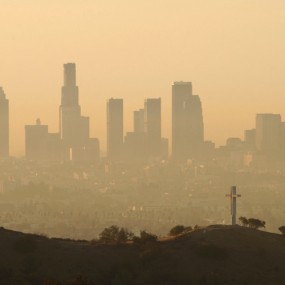
Pollution reduction measures that were aimed primarily at reducing California’s notorious smog problem and improving public health, also helped cut emissions of black carbon — a key global warming agent — according to a new study published Tuesday.

Black carbon, more commonly referred to as soot, is an atmospheric particulate that scientists have shown to be a significant contributor to global warming. It is an attractive target for emissions reductions because relatively cost effective technologies to reduce it already exist, such as diesel particulate filters for trucks, and because unlike carbon dioxide (CO2), which stays in the air for decades to millennia, black carbon only remains airborne for days to weeks. Continue reading The Other Effect of CA’s Clean Air Laws

It’s (Sort of) Official: Cap & Trade Is (Almost) Here

After a ten-hour hearing in which board members endured more than 170 speakers, the California Air Resources Board (CARB) voted to “endorse” a 200-page set of rules for what will be the world’s second largest cap & trade program (after Europe).

CARB is charged with implementing the 2006 Global Warming Solutions Act, or AB 32, which mandates that California reduce its greenhouse gas emissions to 1990 levels by 2020.  The cap & trade program is a key piece of the Air Board’s plans.

“It’s an exciting program,” said Board chair Mary Nichols. “It’s a very big step forward.”

Not that the job is done. Several facets of the regulation will now undergo a fine-tuning process, with another report back to the board in July of next year. Eventually it will find its way to the state’s Office of Administrative Law for review, and finally to the governor’s office, to be signed as an executive order. Continue reading It’s (Sort of) Official: Cap & Trade Is (Almost) Here